TLE 10
Explore the definition, ingredients, and vital role of stock (fond) as a foundational element in soups, sauces, gravies, and various dishes to enhance flavor and texture.
(called fond in
French)is a flavorful
liquid base made by
slowly simmering
bones, meat,
seafood, and/or
vegetables in water.
It is used as a
foundation for soups,
sauces, stews, and
Stock
(fond)
9.
Stock (fond) isone of
the most important
basic preparations
in cooking because
it provides the
foundation of flavor
in many dishes. Its
role goes beyond just
being a liquid—it
enhances taste,
texture, and overall
Importance of Stock in
Cooking
10.
Stock is themain liquid
used in soups.
It gives soups a rich, deep
flavor that plain water
cannot provide.
Example:
Chicken stock chicken
→
soup
Vegetable stock →
vegetable soup
✅ 1. Base for Soups
11.
Many classic saucesare built on
stock.
It adds body, aroma, and
savory depth.
Example:
Brown stock brown sauces
→
(like demi-glace)
White stock cream or
→
velouté sauces
👉 Stock helps sauces taste more
professional and balanced.
12.
Gravies rely onstock for
flavor and consistency. It
blends with drippings
and thickening agents
(like flour) to create a
smooth, tasty sauce for
meat. Example: Turkey
gravy Beef gravy 👉
Stock makes gravies rich
instead of watery or flat.
13.
Stock acts asa natural
flavor booster.
It contains gelatin,
minerals, and extracted
flavors from bones and
vegetables.
Used in:
Rice dishes (like risotto)
Stews and braised dishes
👉 It improves both taste
and mouthfeel.
14.
-When bones aresimmered,
they release gelatin, which:
Gives a slightly thick,
silky texture
Improves the consistency
of soups and sauces
#4 Appreciate the role of stock as a foundation in cooking.
#5 “Where are these prepared? Here are three dishes:
1. A Comforting Stew
This deep, dark beef stew is thick with slow-cooked meat and root vegetables. Where do you start preparing a dish with this kind of profound depth?
#6 “Where are these pr 2. Seafood Soup
This elegant, golden-orange soup is smooth and refined. Instead of using the heavy mahogany reduction from the stew, this light and delicate soup must be derived from something much clearer and more subtle. What foundational liquid allows you to create this specific color and velvety texture?
epared?
#7 “Where are these prepared 3. A Rich Glaze
This image shows a viscous, intensely reflective, mahogany-colored liquid being drizzled. It is an essence of flavor. It’s not a soup or a stew; it's a powerful reduction of a foundational liquid that has been cooked down until it is syrupy and concentrated.
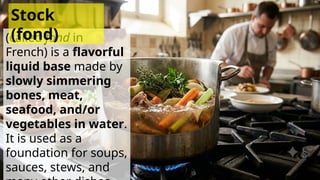
#8 stock (fond) (called fond in French) is a flavorful liquid base made by slowly simmering bones, meat, seafood, and/or vegetables in water. It is used as a foundation for soups, sauces, stews, and many other dishes.
#9 Importance of Stock in Cooking
Stock (fond) is one of the most important basic preparations in cooking because it provides the foundation of flavor in many dishes. Its role goes beyond just being a liquid—it enhances taste, texture, and overall quality.
#10 ✅ 1. Base for Soups
Stock is the main liquid used in soups.
It gives soups a rich, deep flavor that plain water cannot provide.
Example:
Chicken stock → chicken soup
Vegetable stock → vegetable soup
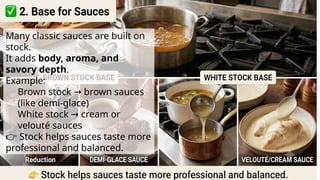
#11 ✅ 2. Base for Sauces
Many classic sauces are built on stock.
It adds body, aroma, and savory depth.
Example:
Brown stock → brown sauces (like demi-glace)
White stock → cream or velouté sauces
👉 Stock helps sauces taste more professional and balanced.
#12 ✅ 3. Essential for Gravies
Gravies rely on stock for flavor and consistency.
It blends with drippings and thickening agents (like flour) to create a smooth, tasty sauce for meat.
Example:
Turkey gravy
Beef gravy
👉 Stock makes gravies rich instead of watery or flat.
#13 ✅ 4. Enhances Flavor of Dishes
Stock acts as a natural flavor booster.
It contains gelatin, minerals, and extracted flavors from bones and vegetables.
Used in:
Rice dishes (like risotto)
Stews and braised dishes
👉 It improves both taste and mouthfeel.
#14 ✅ 5. Provides Body and Texture
When bones are simmered, they release gelatin, which:
Gives a slightly thick, silky texture
Improves the consistency of soups and sauces
#15 ✅ 6. Versatile Cooking Ingredient
Stock can be used in many ways:
Cooking grains (rice, pasta)
Braising meats
Deglazing pans
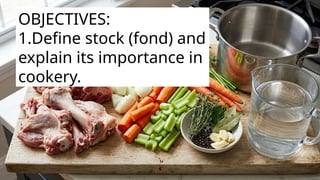
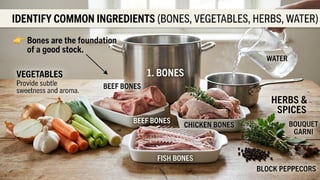
#16 Identify common ingredients (bones, vegetables, herbs, water)
1. Bones
The primary ingredient in most stocks
Provide flavor, nutrients, and gelatin, which gives thickness and body
Examples:
Beef bones
Chicken bones
Fish bones
👉 Bones are the foundation of a good stock.
#17 ✅ 2. Vegetables
Add flavor, aroma, and natural sweetness
Common vegetables (called mirepoix):
Onion
Carrot
Celery
👉 Vegetables help balance and enhance the taste.
#18 ✅ 3. Herbs and Spices
Provide additional aroma and seasoning
Common herbs and spices:
Bay leaves
Peppercorns
Thyme
Parsley stems
👉 Used lightly to complement, not overpower, the stock.
#19 ✅ 4. Water
The liquid base of stock
Extracts flavors from bones, vegetables, and herbs during simmering
👉 Water acts as the carrier of all flavors.
#20 Activity
Group activity: List ingredients used in stock preparation
#21 Closing
Generalization: Students explain why stock is important