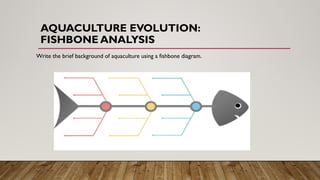
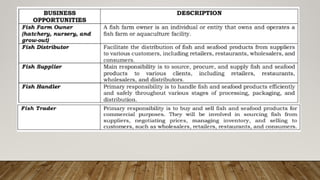
• Fish culturewas believed to have started in China.
• Historical records reveal that net making and methods were developed
in 2953 B. C. under the regime of Fu Hi.
• The Roman considered fish as among the most highly priced delicacies
during the first century A.D.
• Fish farming was well attended during this period but it did not
contribute much to the scientific progress of aquaculture because the
people were more interested in food rather than in the progress of the
industry.
• The first real inventor of practical fecundation by artificial means was
Jacob of Westphalia. In England, Leonard Mascall who published "Book
of Fishing" in 1590 is said to be the pioneer of fish culture.
10.
• In theUnited States, early interest in fishponds was recorded in the
diary of Squire Caroll on August 27, 1792. The gold fish is the first
species of fish reared in the United States.
• In Indonesia, the origin of fishponds is not known. Some authors say it
might be of Chinese origin, while others say it is of Malay origin.
Records of fishponds in government archives date back to 1821.
• The most original form of fish farming practices in Japan is in seaweeds
and pearl culture. Mikimota is the pioneer in the culture of pearl
oysters, thus he is known as the king of pearl oyster culture.
• In thePhilippines, there is no record as to when the cultivation of fish
in pond started.
• The first fishponds must have been introduced by the Malay emigrants
long before the Chinese traders came to the Philippines.
• Navotas and Malabon are the two principal towns that may be
considered as pioneers in the fishpond industry in the Philippines.
• Dr. PioValencia is the pioneer of fish culture in theVisayas, while Talava,
pioneered oyster culture in our country.
• Scientific fish farming in our country may be said to have started with
the experiments on milkfish culture in 1940.
13.
• In thesixties, improved milkfish culture was applied.To further support
the industry, national and international research institutions were
established in the early seventies.
• Among the leading aquaculture research centers today are the
Southeast Asian Fisheries Development Center's Aquaculture
Department in Tigbuan, Iloilo; the International Center for Living
Aquatic Resources Management in Makati; the Central Luzon State
University's Freshwater Aquaculture Center in Nueva Ecija; and the
Brackishwater Aquaculture Center of the University of the Philippines.
14.
• Our governmenthas established model fish farms throughout the
country to extend technical assistance to fish culturists.
• Some operate as fish hatcheries and nurseries and distribute
fingerlings to fish farmers.
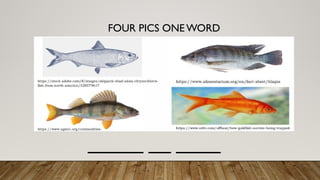
• Fishes cultured in freshwaters are tilapia, carp, catfish, mudfish, and
gourami. Milkfish and prawns are the most important species cultured
in brackish water ponds. The culture of marine species is still in the
experimental stage. Only a few species have far been reared in ponds
and pens.
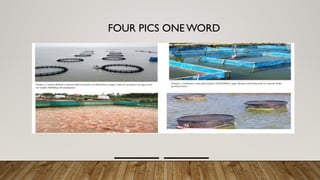
Pond Culture- commonmethod of fish culture.Water is maintained in
an enclosed area by artificial construction of dike/bund.
Cage Culture- rearing of fish from juvenile stage to commercial size in a
volume of water enclosed on all sides.
Pen Culture- raising of fish in a volume of water enclosed on all sides
except bottom. This system can be considered a hybrid between pond
culture and cage culture.
Raceway Culture- raising of fish in running water. Raceways are
designed to provide a flow-through system to enable the rearing of much
denser population of fishes.
Recirculating Aquaculture System- an aquaculture system that
incorporates the treatment and reuse of water with less than 10% of
total water volume replaced per day.
Answer the questions.
1.Whointroduced the first fish ponds in the Philippines?
2. What are the two principal towns that may be
considered as pioneers in the fishpond industry in the
Philippines?
3.Who is the pioneer of fish culture in theVisayas?
4.Who is the pioneer of oyster culture in our country?
5. How does scientific fish farming in our country start?
19.
6. In whatyear was improved milkfish culture applied?
7. When were the national and international research institutions
established?
8. What are the leading aquaculture research centers here in the
Philippines?
9. What are the examples of fish cultured in freshwaters?
10.What are the two most important species cultured in brackish water
ponds?
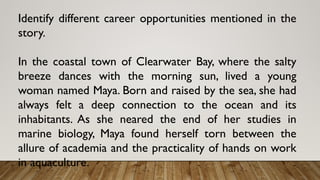
Identify different careeropportunities mentioned in the
story.
In the coastal town of Clearwater Bay, where the salty
breeze dances with the morning sun, lived a young
woman named Maya. Born and raised by the sea, she had
always felt a deep connection to the ocean and its
inhabitants. As she neared the end of her studies in
marine biology, Maya found herself torn between the
allure of academia and the practicality of hands on work
in aquaculture.
25.
One sunny afternoon,Maya stumbled upon a flyer
advertising various job opportunities at the newly
established Clearwater Aquaculture Center. Intrigued,
she decided to pay them a visit. Stepping into the bustling
facility, Maya was greeted by the sight of tanks filled with
vibrant fish species, and the sound of water gently lapping
against the edges.
26.
"I'm looking fora career that lets me work closely with
marine life,"
Maya explained to the receptionist. "Ah, you've come to
the right place," the receptionist replied with a warm
smile. "We have a range of positions available, each
offering unique experiences in aquaculture."
Maya's eyes widened with excitement as the receptionist
outlined the different roles:
27.
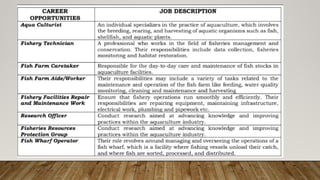
1. You areresponsible for the day-to-day care and
maintenance of fish stocks in aquaculture facilities.
2. You have specialized in the practice of aquaculture,
which involves the breeding, rearing, and harvesting of
aquatic organisms such as fish, shellfish, and aquatic
plants.
3. You will conduct research aimed at advancing
knowledge and improving practices within the
aquaculture industry.
28.
4.You will workin the field of fisheries management and
conservation.Your responsibilities include data collection,
fisheries monitoring and habitat restoration.
5.Your role revolve around managing and overseeing the
operations of a fish wharf, which is a facility where fishing
vessels unload their catch, and where fish are sorted,
processed, and distributed.
29.
As Maya listenedintently to the descriptions, she felt a
sense of clarity wash over her. Each role offered its own
unique opportunities to immerse herself in the world of
aquaculture. After much consideration, Maya decided to
apply for the position of Fish Farm Caretaker, eager to
dive headfirst into this new adventure.
30.
Months passed, andMaya thrived in her role at the
Clearwater Aquaculture Center. Whether she was
feeding the fish, conducting water tests, or simply basking
in the tranquil beauty of the ocean, Maya knew she had
found her calling. With each passing day, she grew more
passionate about her work, knowing that she was playing
a vital role in protecting and preserving the marine
environment she loved so dearly.
31.
In the end,Maya realized that her journey in aquaculture
was not just a career choice but a lifelong commitment
to the ocean and all its wonders.And as she looked out
over the glistening waters of Clearwater Bay, she knew
that the tides of opportunity would continue to guide
her on her journey, wherever it may lead.
32.
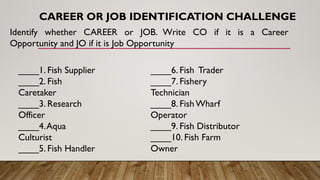
Identify whether CAREERor JOB. Write CO if it is a Career
Opportunity and JO if it is Job Opportunity
CAREER OR JOB IDENTIFICATION CHALLENGE
____1. Fish Supplier
____2. Fish
Caretaker
____3. Research
Officer
____4.Aqua
Culturist
____5. Fish Handler
____6. Fish Trader
____7. Fishery
Technician
____8. FishWharf
Operator
____9. Fish Distributor
____10. Fish Farm
Owner
33.
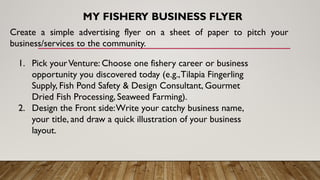
Create a simpleadvertising flyer on a sheet of paper to pitch your
business/services to the community.
MY FISHERY BUSINESS FLYER
1. Pick yourVenture: Choose one fishery career or business
opportunity you discovered today (e.g.,Tilapia Fingerling
Supply, Fish Pond Safety & Design Consultant, Gourmet
Dried Fish Processing, Seaweed Farming).
2. Design the Front side:Write your catchy business name,
your title, and draw a quick illustration of your business
layout.
34.
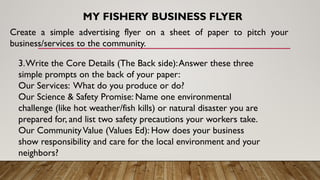
Create a simpleadvertising flyer on a sheet of paper to pitch your
business/services to the community.
MY FISHERY BUSINESS FLYER
3.Write the Core Details (The Back side):Answer these three
simple prompts on the back of your paper:
Our Services: What do you produce or do?
Our Science & Safety Promise: Name one environmental
challenge (like hot weather/fish kills) or natural disaster you are
prepared for, and list two safety precautions your workers take.
Our CommunityValue (Values Ed): How does your business
show responsibility and care for the local environment and your
neighbors?
35.
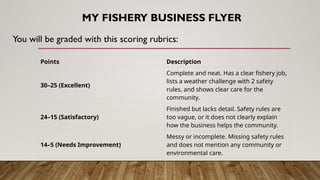
You will begraded with this scoring rubrics:
MY FISHERY BUSINESS FLYER
Points Description
30–25 (Excellent)
Complete and neat. Has a clear fishery job,
lists a weather challenge with 2 safety
rules, and shows clear care for the
community.
24–15 (Satisfactory)
Finished but lacks detail. Safety rules are
too vague, or it does not clearly explain
how the business helps the community.
14–5 (Needs Improvement)
Messy or incomplete. Missing safety rules
and does not mention any community or
environmental care.