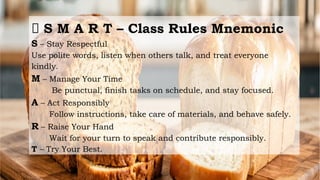
🌟 S MA R T – Class Rules Mnemonic
S – Stay Respectful
Use polite words, listen when others talk, and treat everyone
kindly.
M – Manage Your Time
Be punctual, finish tasks on schedule, and stay focused.
A – Act Responsibly
Follow instructions, take care of materials, and behave safely.
R – Raise Your Hand
Wait for your turn to speak and contribute responsibly.
T – Try Your Best.
13.
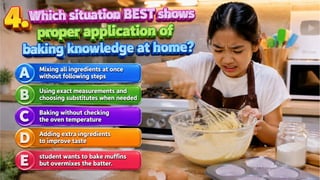
4. Which situationBEST shows proper application of baking knowledge at home?
A. Mixing all ingredients at once without following steps
B. Using exact measurements and choosing substitutes when needed
C. Baking without checking the oven temperature
D. Adding extra ingredients to improve taste
Editor's Notes
#1 🌟 S M A R T – Class Rules Mnemonic
S – Stay Respectful
Use polite words, listen when others talk, and treat everyone kindly.
M – Manage Your Time
Be punctual, finish tasks on schedule, and stay focused.
A – Act Responsibly
Follow instructions, take care of materials, and behave safely.
R – Raise Your Hand
Wait for your turn to speak and contribute responsibly.
T – Try Your Best.
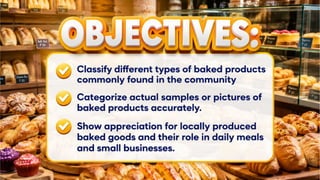
#3 OBJECTIVES:
Classify different types of baked products commonly found in the community
Categorize actual samples or pictures of baked products accurately.
Show appreciation for locally produced baked goods and their role in daily meals and small businesses.
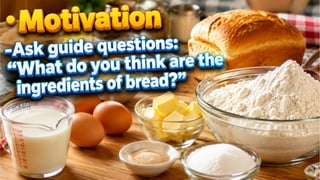
#5 •Motivation
-Ask guide questions: “What do you think are the ingredients of bread?”
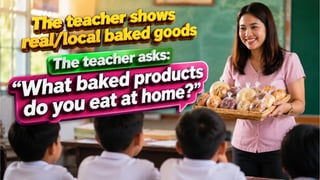
#6 The teacher shows real/local baked goods
The teacher asks:
What baked products do you eat at home?
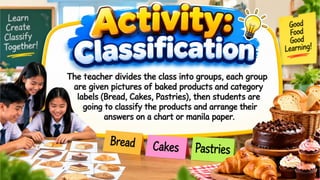
#7 Activity: Classification
The teacher divides the class into groups, each group are given pictures of baked products and category labels (Bread, Cakes, Pastries), then students are going to classify the products and arrange their answers on a chart or manila paper.
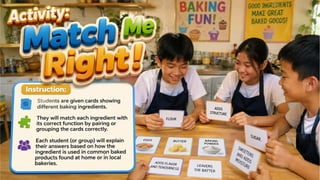
#8 Activity: Match Me Right!
Instruction:
Students are given cards showing different baking ingredients.
They will match each ingredient with its correct function by pairing or grouping the cards correctly.
Each student (or group) will explain their answers based on how the ingredient is used in common baked products found at home or in local bakeries.
#9 Discussion:
The teacher discusses substitutes using local examples.
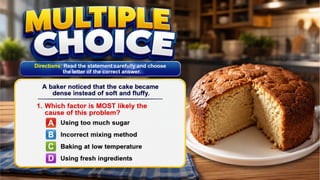
#10 Multiple choice
Directions: Read the statement carefully and choose the letter of the correct answer.
A baker noticed that the cake became dense instead of soft and fluffy.
1. Which factor is MOST likely the cause of this problem?
A. Using too much sugar
B. Incorrect mixing method
C. Baking at low temperature
D. Using fresh ingredients
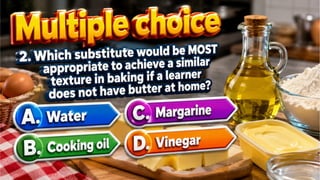
#11 2. Which substitute would be MOST appropriate to achieve a similar texture in baking if a learner does not have butter at home?
A. Water
B. Cooking oil
C. Margarine
D. Vinegar
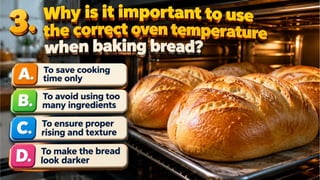
#12 3. Why is it important to use the correct oven temperature when baking bread?
A. To save cooking time only
B. To avoid using too many ingredients
C. To ensure proper rising and texture
D. To make the bread look darker
#13 4. Which situation BEST shows proper application of baking knowledge at home?
Mixing all ingredients at once without following steps
Using exact measurements and choosing substitutes when needed
Baking without checking the oven temperature
Adding extra ingredients to improve taste
student wants to bake muffins but overmixes the batter.
#14 5. What will MOST LIKELY happen to the final product?
A. It becomes lighter
B. It becomes chewy and tough
C. It becomes sweeter
D. It becomes more colorful

 Most read