AT 6604 VD UNIT II NOTES 4/28/2016
P M SUBRAMANIAN, ASST PROF,REC 1
RAJALAKSHMI ENGINEERING COLLEGE
DEPARTMENT OF AUTOMOBILE ENGINEERING
AT 6604 VD UNIT II - P.M SUBRAMANIAN, ASST PROF, DEPT OF AUE, REC,CHENNAI 1
RAJALAKSHMI ENGINEERING COLLEGE
DEPARTMENT OF AUTOMOBILE ENGINEERING
AT 6604 VD UNIT II - P.M SUBRAMANIAN, ASST PROF, DEPT OF AUE, REC,CHENNAI
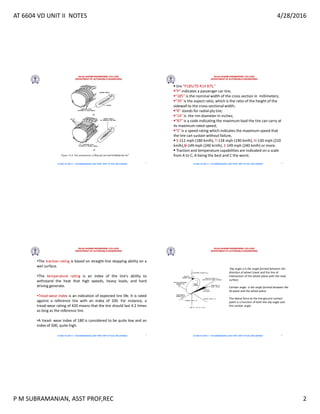
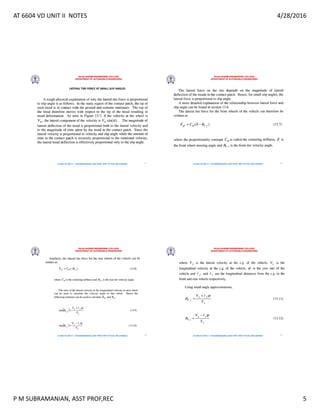
The origin of the reference axes is at the
center of the contact patch.
The X axis is defined by the intersection of the
ground plane with the mean plane of the
wheel.
Axis Z is perpendicular to the ground and
points upwards.
To ensure a right handed axes, the Y axes
points rightwards.
2
RAJALAKSHMI ENGINEERING COLLEGE
DEPARTMENT OF AUTOMOBILE ENGINEERING
AT 6604 VD UNIT II - P.M SUBRAMANIAN, ASST PROF, DEPT OF AUE, REC,CHENNAI
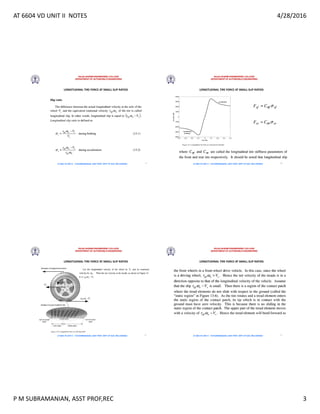
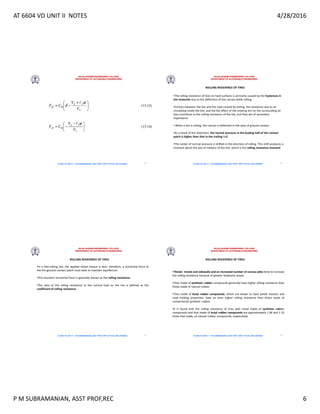
The force the tire receives from the road is
assumed to be at the center of the contact patch
The lateral force Fy is the force along the Y axis,
the longitudinal force Fx is the force along the
X axis and the normal or vertical force Fz is the
force along the Z axis.
The moment along the Z axes Mz is called the
aligning moment.
The moment along the X axes Mx is called
the overturning moment and
the moment along the Y axis My is called the
rolling resistance moment.
3
RAJALAKSHMI ENGINEERING COLLEGE
DEPARTMENT OF AUTOMOBILE ENGINEERING
AT 6604 VD UNIT II - P.M SUBRAMANIAN, ASST PROF, DEPT OF AUE, REC,CHENNAI 4
AT 6604 VD UNIT II NOTES 4/28/2016
P M SUBRAMANIAN, ASST PROF,REC 2
RAJALAKSHMI ENGINEERING COLLEGE
DEPARTMENT OF AUTOMOBILE ENGINEERING
AT 6604 VD UNIT II - P.M SUBRAMANIAN, ASST PROF, DEPT OF AUE, REC,CHENNAI 5
RAJALAKSHMI ENGINEERING COLLEGE
DEPARTMENT OF AUTOMOBILE ENGINEERING
AT 6604 VD UNIT II - P.M SUBRAMANIAN, ASST PROF, DEPT OF AUE, REC,CHENNAI
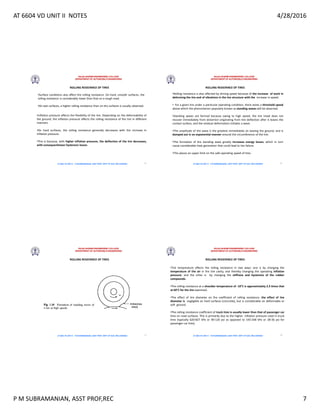
 tire P185/70 R14 87S,
P indicates a passenger car tire;
185 is the nominal width of the cross section in millimeters;
70 is the aspect ratio, which is the ratio of the height of the
sidewall to the cross-sectional width;
R stands for radial-ply tire;
14 is the rim diameter in inches;
87 is a code indicating the maximum load the tire can carry at
its maximum rated speed;
S is a speed rating which indicates the maximum speed that
the tire can sustain without failure,
 S-112 mph (180 kmlh), T-118 mph (190 kmlh), H-130 mph (210
kmlh),V-149 mph (240 krnlh), Z-149 mph (240 kmlh) or more.
 Traction and temperature capabilities are indicated on a scale
from A to C, A being the best and C the worst.
6
RAJALAKSHMI ENGINEERING COLLEGE
DEPARTMENT OF AUTOMOBILE ENGINEERING
AT 6604 VD UNIT II - P.M SUBRAMANIAN, ASST PROF, DEPT OF AUE, REC,CHENNAI
•The traction rating is based on straight-line stopping ability on a
wet surface.
•The temperature rating is an index of the tire's ability to
withstand the heat that high speeds, heavy loads, and hard
driving generate.
•Tread-wear index is an indication of expected tire life. It is rated
against a reference tire with an index of 100. For instance, a
tread-wear rating of 420 means that the tire should last 4.2 times
as long as the reference tire.
•A tread- wear index of 180 is considered to be quite low and an
index of 500, quite high.
7
RAJALAKSHMI ENGINEERING COLLEGE
DEPARTMENT OF AUTOMOBILE ENGINEERING
AT 6604 VD UNIT II - P.M SUBRAMANIAN, ASST PROF, DEPT OF AUE, REC,CHENNAI
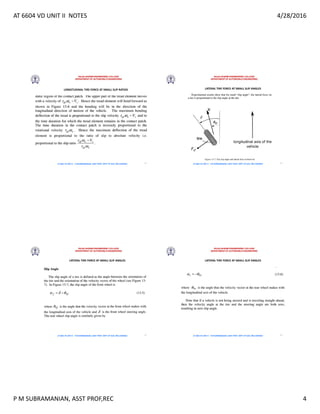
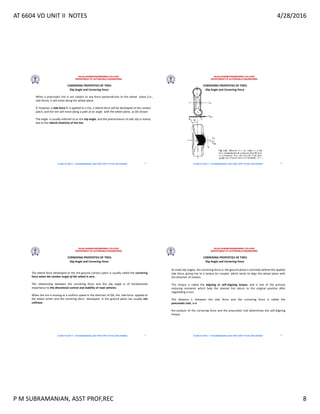
Slip angle a is the angle formed between the
direction of wheel travel and the line of
intersection of the wheel plane with the road
surface.
Camber angle is the angle formed between the
XZ plane and the wheel plane.
The lateral force at the tire-ground contact
patch is a function of both the slip angle and
the camber angle
8
AT 6604 VD UNIT II NOTES 4/28/2016
P M SUBRAMANIAN, ASST PROF,REC 3
RAJALAKSHMI ENGINEERING COLLEGE
DEPARTMENT OF AUTOMOBILE ENGINEERING
AT 6604 VD UNIT II - P.M SUBRAMANIAN, ASST PROF, DEPT OF AUE, REC,CHENNAI
LONGITUDINAL TIRE FORCE AT SMALL SLIP RATIOS
9
RAJALAKSHMI ENGINEERING COLLEGE
DEPARTMENT OF AUTOMOBILE ENGINEERING
AT 6604 VD UNIT II - P.M SUBRAMANIAN, ASST PROF, DEPT OF AUE, REC,CHENNAI
LONGITUDINAL TIRE FORCE AT SMALL SLIP RATIOS
10
RAJALAKSHMI ENGINEERING COLLEGE
DEPARTMENT OF AUTOMOBILE ENGINEERING
AT 6604 VD UNIT II - P.M SUBRAMANIAN, ASST PROF, DEPT OF AUE, REC,CHENNAI
LONGITUDINAL TIRE FORCE AT SMALL SLIP RATIOS
11
RAJALAKSHMI ENGINEERING COLLEGE
DEPARTMENT OF AUTOMOBILE ENGINEERING
AT 6604 VD UNIT II - P.M SUBRAMANIAN, ASST PROF, DEPT OF AUE, REC,CHENNAI
LONGITUDINAL TIRE FORCE AT SMALL SLIP RATIOS
12
AT 6604 VD UNIT II NOTES 4/28/2016
P M SUBRAMANIAN, ASST PROF,REC 4
RAJALAKSHMI ENGINEERING COLLEGE
DEPARTMENT OF AUTOMOBILE ENGINEERING
AT 6604 VD UNIT II - P.M SUBRAMANIAN, ASST PROF, DEPT OF AUE, REC,CHENNAI
LONGITUDINAL TIRE FORCE AT SMALL SLIP RATIOS
13
RAJALAKSHMI ENGINEERING COLLEGE
DEPARTMENT OF AUTOMOBILE ENGINEERING
AT 6604 VD UNIT II - P.M SUBRAMANIAN, ASST PROF, DEPT OF AUE, REC,CHENNAI
LATERAL TIRE FORCE AT SMALL SLIP ANGLES
14
RAJALAKSHMI ENGINEERING COLLEGE
DEPARTMENT OF AUTOMOBILE ENGINEERING
AT 6604 VD UNIT II - P.M SUBRAMANIAN, ASST PROF, DEPT OF AUE, REC,CHENNAI
LATERAL TIRE FORCE AT SMALL SLIP ANGLES
15
RAJALAKSHMI ENGINEERING COLLEGE
DEPARTMENT OF AUTOMOBILE ENGINEERING
AT 6604 VD UNIT II - P.M SUBRAMANIAN, ASST PROF, DEPT OF AUE, REC,CHENNAI
LATERAL TIRE FORCE AT SMALL SLIP ANGLES
16
AT 6604 VD UNIT II NOTES 4/28/2016
P M SUBRAMANIAN, ASST PROF,REC 5
RAJALAKSHMI ENGINEERING COLLEGE
DEPARTMENT OF AUTOMOBILE ENGINEERING
AT 6604 VD UNIT II - P.M SUBRAMANIAN, ASST PROF, DEPT OF AUE, REC,CHENNAI
LATERAL TIRE FORCE AT SMALL SLIP ANGLES
17
RAJALAKSHMI ENGINEERING COLLEGE
DEPARTMENT OF AUTOMOBILE ENGINEERING
AT 6604 VD UNIT II - P.M SUBRAMANIAN, ASST PROF, DEPT OF AUE, REC,CHENNAI 18
RAJALAKSHMI ENGINEERING COLLEGE
DEPARTMENT OF AUTOMOBILE ENGINEERING
AT 6604 VD UNIT II - P.M SUBRAMANIAN, ASST PROF, DEPT OF AUE, REC,CHENNAI 19
RAJALAKSHMI ENGINEERING COLLEGE
DEPARTMENT OF AUTOMOBILE ENGINEERING
AT 6604 VD UNIT II - P.M SUBRAMANIAN, ASST PROF, DEPT OF AUE, REC,CHENNAI 20
AT 6604 VD UNIT II NOTES 4/28/2016
P M SUBRAMANIAN, ASST PROF,REC 6
RAJALAKSHMI ENGINEERING COLLEGE
DEPARTMENT OF AUTOMOBILE ENGINEERING
AT 6604 VD UNIT II - P.M SUBRAMANIAN, ASST PROF, DEPT OF AUE, REC,CHENNAI 21
RAJALAKSHMI ENGINEERING COLLEGE
DEPARTMENT OF AUTOMOBILE ENGINEERING
AT 6604 VD UNIT II - P.M SUBRAMANIAN, ASST PROF, DEPT OF AUE, REC,CHENNAI
ROLLING RESISTANCE OF TIRES
•The rolling resistance of tires on hard surfaces is primarily caused by the hysteresis in
tire materials due to the deflection of the carcass while rolling.
•Friction between the tire and the road caused by sliding, the resistance due to air
circulating inside the tire, and the fan effect of the rotating tire on the surrounding air
also contribute to the rolling resistance of the tire, but they are of secondary
importance.
• When a tire is rolling, the carcass is deflected in the area of ground contact.
•As a result of tire distortion, the normal pressure in the leading half of the contact
patch is higher than that in the trailing half.
•The center of normal pressure is shifted in the direction of rolling. This shift produces a
moment about the axis of rotation of the tire, which is the rolling resistance moment.
22
RAJALAKSHMI ENGINEERING COLLEGE
DEPARTMENT OF AUTOMOBILE ENGINEERING
AT 6604 VD UNIT II - P.M SUBRAMANIAN, ASST PROF, DEPT OF AUE, REC,CHENNAI
ROLLING RESISTANCE OF TIRES
•In a free-rolling tire, the applied wheel torque is zero; therefore, a horizontal force at
the tire-ground contact patch must exist to maintain equilibrium.
•This resultant horizontal force is generally known as the rolling resistance.
•The ratio of the rolling resistance to the normal load on the tire is defined as the
coefficient of rolling resistance.
23
RAJALAKSHMI ENGINEERING COLLEGE
DEPARTMENT OF AUTOMOBILE ENGINEERING
AT 6604 VD UNIT II - P.M SUBRAMANIAN, ASST PROF, DEPT OF AUE, REC,CHENNAI
ROLLING RESISTANCE OF TIRES
•Thicker treads and sidewalls and an increased number of carcass plies tend to increase
the rolling resistance because of greater hysteresis losses.
•Tires made of synthetic rubber compounds generally have higher rolling resistance than
those made of natural rubber.
•Tires made of butyl rubber compounds, which are shown to have better traction and
road holding properties, have an even higher rolling resistance than those made of
conventional synthetic rubber.
•It is found that the rolling resistance of tires with tread made of synthetic rubber
compounds and that made of butyl rubber compounds are approximately 1.06 and 1.35
times that made of natural rubber compounds, respectively
24
AT 6604 VD UNIT II NOTES 4/28/2016
P M SUBRAMANIAN, ASST PROF,REC 7
RAJALAKSHMI ENGINEERING COLLEGE
DEPARTMENT OF AUTOMOBILE ENGINEERING
AT 6604 VD UNIT II - P.M SUBRAMANIAN, ASST PROF, DEPT OF AUE, REC,CHENNAI
ROLLING RESISTANCE OF TIRES
•Surface conditions also affect the rolling resistance. On hard, smooth surfaces, the
rolling resistance is considerably lower than that on a rough road.
•On wet surfaces, a higher rolling resistance than on dry surfaces is usually observed.
•Inflation pressure affects the flexibility of the tire. Depending on the deformability of
the ground, the inflation pressure affects the rolling resistance of the tire in different
manners.
•On hard surfaces, the rolling resistance generally decreases with the increase in
inflation pressure.
•This is because, with higher inflation pressure, the deflection of the tire decreases,
with consequentlower hysteresis losses
25
RAJALAKSHMI ENGINEERING COLLEGE
DEPARTMENT OF AUTOMOBILE ENGINEERING
AT 6604 VD UNIT II - P.M SUBRAMANIAN, ASST PROF, DEPT OF AUE, REC,CHENNAI
ROLLING RESISTANCE OF TIRES
•Rolling resistance is also affected by driving speed because of the increase of work in
deforming the tire and of vibrations in the tire structure with the increase in speed.
• For a given tire under a particular operating condition, there exists a threshold speed
above which the phenomenon popularly known as standing waves will be observed.
•Standing waves are formed because owing to high speed, the tire tread does not
recover immediately from distortion originating from tire deflection after it leaves the
contact surface, and the residual deformation initiates a wave.
•The amplitude of the wave is the greatest immediately on leaving the ground, and is
damped out in an exponential manner around the circumference of the tire.
•The formation of the standing wave greatly increases energy losses, which in turn
cause considerable heat generation that could lead to tire failure.
•This places an upper limit on the safe operating speed of tires.
26
RAJALAKSHMI ENGINEERING COLLEGE
DEPARTMENT OF AUTOMOBILE ENGINEERING
AT 6604 VD UNIT II - P.M SUBRAMANIAN, ASST PROF, DEPT OF AUE, REC,CHENNAI
ROLLING RESISTANCE OF TIRES
27
RAJALAKSHMI ENGINEERING COLLEGE
DEPARTMENT OF AUTOMOBILE ENGINEERING
AT 6604 VD UNIT II - P.M SUBRAMANIAN, ASST PROF, DEPT OF AUE, REC,CHENNAI
•Tire temperature affects the rolling resistance in two ways: one is by changing the
temperature of the air in the tire cavity, and thereby changing the operating inflation
pressure; and the other is by changing the stiffness and hysteresis of the rubber
compounds.
•The rolling resistance at a shoulder temperature of -10°C is approximately 2.3 times that
at 60°C for the tire examined.
•The effect of tire diameter on the coefficient of rolling resistance- the effect of tire
diameter is negligible on hard surfaces (concrete), but is considerable on deformable or
soft ground.
•The rolling resistance coefficient of truck tires is usually lower than that of passenger car
tires on road surfaces. This is primarily due to the higher inflation pressure used in truck
tires (typically 620-827 kPa or 90-120 psi as opposed to 193-248 kPa or 28-36 psi for
passenger car tires)
ROLLING RESISTANCE OF TIRES
28
AT 6604 VD UNIT II NOTES 4/28/2016
P M SUBRAMANIAN, ASST PROF,REC 8
RAJALAKSHMI ENGINEERING COLLEGE
DEPARTMENT OF AUTOMOBILE ENGINEERING
AT 6604 VD UNIT II - P.M SUBRAMANIAN, ASST PROF, DEPT OF AUE, REC,CHENNAI
CORNERING PROPERTIES OF TIRES
Slip Angle and Cornering Force
When a pneumatic tire is not subject to any force perpendicular to the wheel plane (i.e.,
side force), it will move along the wheel plane.
If, however, a side force F, is applied to a tire, a lateral force will be developed at the contact
patch, and the tire will move along a path at an angle with the wheel plane, as OA shown
The angle is usually referred to as the slip angle, and the phenomenon of side slip is mainly
due to the lateral elasticity of the tire.
29
RAJALAKSHMI ENGINEERING COLLEGE
DEPARTMENT OF AUTOMOBILE ENGINEERING
AT 6604 VD UNIT II - P.M SUBRAMANIAN, ASST PROF, DEPT OF AUE, REC,CHENNAI
CORNERING PROPERTIES OF TIRES
Slip Angle and Cornering Force
30
RAJALAKSHMI ENGINEERING COLLEGE
DEPARTMENT OF AUTOMOBILE ENGINEERING
AT 6604 VD UNIT II - P.M SUBRAMANIAN, ASST PROF, DEPT OF AUE, REC,CHENNAI
Slip Angle and Cornering Force
CORNERING PROPERTIES OF TIRES
The lateral force developed at the tire-ground contact patch is usually called the cornering
force when the camber angle of the wheel is zero.
The relationship between the cornering force and the slip angle is of fundamental
importance to the directional control and stability of road vehicles.
When the tire is moving at a uniform speed in the direction of OA, the side force applied at
the wheel center and the cornering force developed in the ground plane are usually not
collinear
31
RAJALAKSHMI ENGINEERING COLLEGE
DEPARTMENT OF AUTOMOBILE ENGINEERING
AT 6604 VD UNIT II - P.M SUBRAMANIAN, ASST PROF, DEPT OF AUE, REC,CHENNAI
Slip Angle and Cornering Force
CORNERING PROPERTIES OF TIRES
At small slip angles, the cornering force in the ground plane is normally behind the applied
side force, giving rise to a torque (or couple). which tends to align the wheel plane with
the direction of motion.
This torque is called the aligning or self-aligning torque, and is one of the primary
restoring moments which help the steered tire return to the original position after
negotiating a turn.
The distance t, between the side force and the cornering force is called the
pneumatic trail, and
the product of the cornering force and the pneumatic trail determines the self-aligning
torque.
32
AT 6604 VD UNIT II NOTES 4/28/2016
P M SUBRAMANIAN, ASST PROF,REC 9
RAJALAKSHMI ENGINEERING COLLEGE
DEPARTMENT OF AUTOMOBILE ENGINEERING
AT 6604 VD UNIT II - P.M SUBRAMANIAN, ASST PROF, DEPT OF AUE, REC,CHENNAI
Slip Angle and Cornering Force
CORNERING PROPERTIES OF TIRES
33
RAJALAKSHMI ENGINEERING COLLEGE
DEPARTMENT OF AUTOMOBILE ENGINEERING
AT 6604 VD UNIT II - P.M SUBRAMANIAN, ASST PROF, DEPT OF AUE, REC,CHENNAI
Slip Angle and Cornering Force
CORNERING PROPERTIES OF TIRES
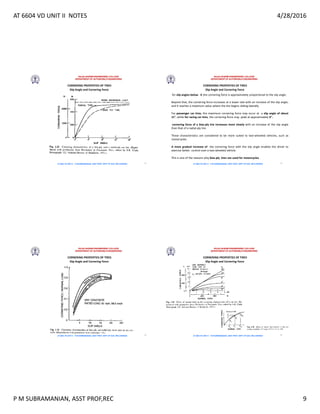
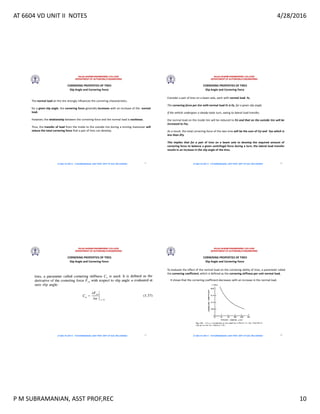
for slip angles below 4 ,the cornering force is approximately proportional to the slip angle.
Beyond that, the cornering force increases at a lower rate with an increase of the slip angle,
and it reaches a maximum value where the tire begins sliding laterally.
For passenger car tires, the maximum cornering force may occur at a slip angle of about
18, while for racing car tires, the cornering force may peak at approximately 6.
cornering force of a bias-ply tire increases more slowly with an increase of the slip angle
than that of a radial-ply tire.
These characteristics are considered to be more suited to two-wheeled vehicles, such as
motorcycles.
A more gradual increase of the cornering force with the slip angle enables the driver to
exercise better control over a two-wheeled vehicle.
This is one of the reasons why bias-ply tires are used for motorcycles
34
RAJALAKSHMI ENGINEERING COLLEGE
DEPARTMENT OF AUTOMOBILE ENGINEERING
AT 6604 VD UNIT II - P.M SUBRAMANIAN, ASST PROF, DEPT OF AUE, REC,CHENNAI
Slip Angle and Cornering Force
CORNERING PROPERTIES OF TIRES
35
RAJALAKSHMI ENGINEERING COLLEGE
DEPARTMENT OF AUTOMOBILE ENGINEERING
AT 6604 VD UNIT II - P.M SUBRAMANIAN, ASST PROF, DEPT OF AUE, REC,CHENNAI
Slip Angle and Cornering Force
CORNERING PROPERTIES OF TIRES
36
AT 6604 VD UNIT II NOTES 4/28/2016
P M SUBRAMANIAN, ASST PROF,REC 10
RAJALAKSHMI ENGINEERING COLLEGE
DEPARTMENT OF AUTOMOBILE ENGINEERING
AT 6604 VD UNIT II - P.M SUBRAMANIAN, ASST PROF, DEPT OF AUE, REC,CHENNAI
Slip Angle and Cornering Force
CORNERING PROPERTIES OF TIRES
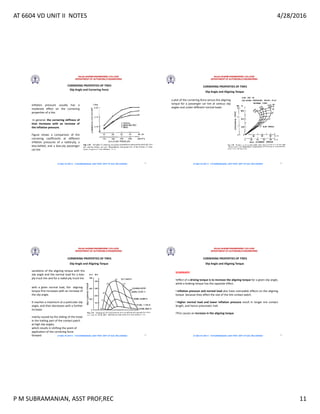
The normal load on the tire strongly influences the cornering characteristics.
for a given slip angle, the cornering force generally increases with an increase of the normal
load.
However, the relationship between the cornering force and the normal load is nonlinear.
Thus, the transfer of load from the inside to the outside tire during a turning maneuver will
reduce the total cornering force that a pair of tires can develop.
37
RAJALAKSHMI ENGINEERING COLLEGE
DEPARTMENT OF AUTOMOBILE ENGINEERING
AT 6604 VD UNIT II - P.M SUBRAMANIAN, ASST PROF, DEPT OF AUE, REC,CHENNAI
Slip Angle and Cornering Force
CORNERING PROPERTIES OF TIRES
Consider a pair of tires on a beam axle, each with normal load Fz,
The cornering force per tire with normal load Fz is Fy, for a given slip angle.
If the vehicle undergoes a steady-state turn, owing to lateral load transfer,
the normal load on the inside tire will be reduced to Fzi and that on the outside tire will be
increased to Fzo.
As a result, the total cornering force of the two tires will be the sum of Fyi and Fyo which is
less than 2Fy.
This implies that for a pair of tires on a beam axle to develop the required amount of
cornering force to balance a given centrifugal force during a turn, the lateral load transfer
results in an increase in the slip angle of the tires.
38
RAJALAKSHMI ENGINEERING COLLEGE
DEPARTMENT OF AUTOMOBILE ENGINEERING
AT 6604 VD UNIT II - P.M SUBRAMANIAN, ASST PROF, DEPT OF AUE, REC,CHENNAI
Slip Angle and Cornering Force
CORNERING PROPERTIES OF TIRES
39
RAJALAKSHMI ENGINEERING COLLEGE
DEPARTMENT OF AUTOMOBILE ENGINEERING
AT 6604 VD UNIT II - P.M SUBRAMANIAN, ASST PROF, DEPT OF AUE, REC,CHENNAI
Slip Angle and Cornering Force
CORNERING PROPERTIES OF TIRES
To evaluate the effect of the normal load on the cornering ability of tires, a parameter called
the cornering coefficient, which is defined as the cornering stiffness per unit normal load,
It shows that the cornering coefficient decreases with an increase in the normal load.
40
AT 6604 VD UNIT II NOTES 4/28/2016
P M SUBRAMANIAN, ASST PROF,REC 11
RAJALAKSHMI ENGINEERING COLLEGE
DEPARTMENT OF AUTOMOBILE ENGINEERING
AT 6604 VD UNIT II - P.M SUBRAMANIAN, ASST PROF, DEPT OF AUE, REC,CHENNAI
Slip Angle and Cornering Force
CORNERING PROPERTIES OF TIRES
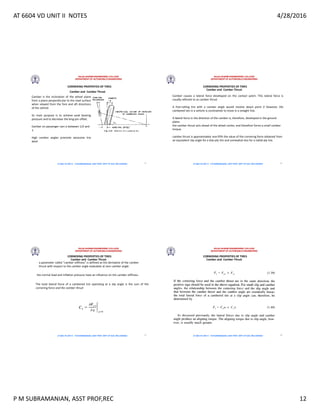
Inflation pressure usually has a
moderate effect on the cornering
properties of a tire.
In general, the cornering stiffness of
tires increases with an increase of
the inflation pressure.
Figure shows a comparison of the
cornering coefficients at different
inflation pressures of a radial-ply, a
bias-belted, and a bias-ply passenger
car tire
41
RAJALAKSHMI ENGINEERING COLLEGE
DEPARTMENT OF AUTOMOBILE ENGINEERING
AT 6604 VD UNIT II - P.M SUBRAMANIAN, ASST PROF, DEPT OF AUE, REC,CHENNAI
Slip Angle and Aligning Torque
CORNERING PROPERTIES OF TIRES
a plot of the cornering force versus the aligning
torque for a passenger car tire at various slip
angles and under different normal loads
42
RAJALAKSHMI ENGINEERING COLLEGE
DEPARTMENT OF AUTOMOBILE ENGINEERING
AT 6604 VD UNIT II - P.M SUBRAMANIAN, ASST PROF, DEPT OF AUE, REC,CHENNAI
Slip Angle and Aligning Torque
CORNERING PROPERTIES OF TIRES
variations of the aligning torque with the
slip angle and the normal load for a bias-
ply truck tire and for a radial-ply truck tire
with a given normal load, the aligning
torque first increases with an increase of
the slip angle.
It reaches a maximum at a particular slip
angle, and then decreases with a further
increase .
mainly caused by the sliding of the tread
in the trailing part of the contact patch
at high slip angles,
which results in shifting the point of
application of the cornering force
forward 43
RAJALAKSHMI ENGINEERING COLLEGE
DEPARTMENT OF AUTOMOBILE ENGINEERING
AT 6604 VD UNIT II - P.M SUBRAMANIAN, ASST PROF, DEPT OF AUE, REC,CHENNAI
Slip Angle and Aligning Torque
CORNERING PROPERTIES OF TIRES
SUMMARY:
•effect of a driving torque is to increase the aligning torque for a given slip angle,
while a braking torque has the opposite effect.
• Inflation pressure and normal load also have noticeable effects on the aligning
torque because they affect the size of the tire contact patch.
• Higher normal load and lower inflation pressure result in longer tire contact
length, and hence pneumatic trail.
•This causes an increase in the aligning torque
44
AT 6604 VD UNIT II NOTES 4/28/2016
P M SUBRAMANIAN, ASST PROF,REC 12
RAJALAKSHMI ENGINEERING COLLEGE
DEPARTMENT OF AUTOMOBILE ENGINEERING
AT 6604 VD UNIT II - P.M SUBRAMANIAN, ASST PROF, DEPT OF AUE, REC,CHENNAI
Camber and Camber Thrust
CORNERING PROPERTIES OF TIRES
Camber is the inclination of the wheel plane
from a plane perpendicular to the road surface
when viewed from the fore and aft directions
of the vehicle
Its main purpose is to achieve axial bearing
pressure and to decrease the king-pin offset.
Camber on passenger cars is between 1/2 and
1.
High camber angles promote excessive tire
wear
45
RAJALAKSHMI ENGINEERING COLLEGE
DEPARTMENT OF AUTOMOBILE ENGINEERING
AT 6604 VD UNIT II - P.M SUBRAMANIAN, ASST PROF, DEPT OF AUE, REC,CHENNAI
Camber causes a lateral force developed on the contact patch. This lateral force is
usually referred to as camber thrust
A free-rolling tire with a camber angle would revolve about point 0 However, the
cambered tire in a vehicle is constrained to move in a straight line.
A lateral force in the direction of the camber is, therefore, developed in the ground
plane.
the camber thrust acts ahead of the wheel center, and therefore forms a small camber
torque.
camber thrust is approximately one-fifth the value of the cornering force obtained from
an equivalent slip angle for a bias-ply tire and somewhat less for a radial-ply tire.
Camber and Camber Thrust
CORNERING PROPERTIES OF TIRES
46
RAJALAKSHMI ENGINEERING COLLEGE
DEPARTMENT OF AUTOMOBILE ENGINEERING
AT 6604 VD UNIT II - P.M SUBRAMANIAN, ASST PROF, DEPT OF AUE, REC,CHENNAI
a parameter called camber stiffness is defined as the derivative of the camber
thrust with respect to the camber angle evaluated at zero camber angle.
the normal load and inflation pressure have an influence on the camber stiffness.
The total lateral force of a cambered tire operating at a slip angle is the sum of the
cornering force and the camber thrust
Camber and Camber Thrust
CORNERING PROPERTIES OF TIRES
47
RAJALAKSHMI ENGINEERING COLLEGE
DEPARTMENT OF AUTOMOBILE ENGINEERING
AT 6604 VD UNIT II - P.M SUBRAMANIAN, ASST PROF, DEPT OF AUE, REC,CHENNAI
CORNERING PROPERTIES OF TIRES
Camber and Camber Thrust
48
AT 6604 VD UNIT II NOTES 4/28/2016
P M SUBRAMANIAN, ASST PROF,REC 13
RAJALAKSHMI ENGINEERING COLLEGE
DEPARTMENT OF AUTOMOBILE ENGINEERING
AT 6604 VD UNIT II - P.M SUBRAMANIAN, ASST PROF, DEPT OF AUE, REC,CHENNAI
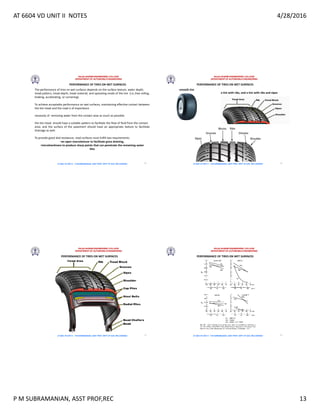
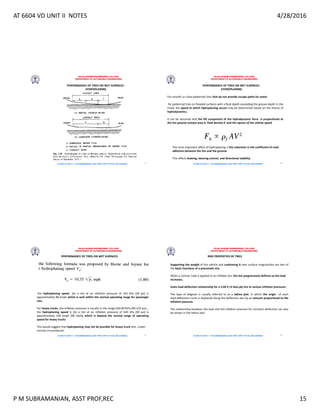
PERFORMANCE OF TIRES ON WET SURFACES
The performance of tires on wet surfaces depends on the surface texture, water depth,
tread pattern, tread depth, tread material, and operating mode of the tire (i.e.,free rolling,
braking, accelerating, or cornering).
To achieve acceptable performance on wet surfaces, maintaining effective contact between
the tire tread and the road is of importance
necessity of removing water from the contact area as much as possible.
the tire tread should have a suitable pattern to facilitate the flow of fluid from the contact
area, and the surface of the pavement should have an appropriate texture to facilitate
drainage as well.
To provide good skid resistance, road surfaces must fulfill two requirements:
•an open macrotexture to facilitate gross draining,
•microharshness to produce sharp points that can penetrate the remaining water
film
49
RAJALAKSHMI ENGINEERING COLLEGE
DEPARTMENT OF AUTOMOBILE ENGINEERING
AT 6604 VD UNIT II - P.M SUBRAMANIAN, ASST PROF, DEPT OF AUE, REC,CHENNAI
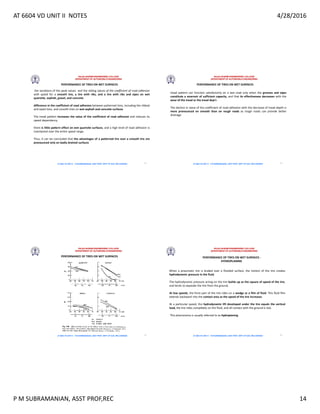
PERFORMANCE OF TIRES ON WET SURFACES
smooth tire
a tire with ribs, and a tire with ribs and sipes
50
RAJALAKSHMI ENGINEERING COLLEGE
DEPARTMENT OF AUTOMOBILE ENGINEERING
AT 6604 VD UNIT II - P.M SUBRAMANIAN, ASST PROF, DEPT OF AUE, REC,CHENNAI
PERFORMANCE OF TIRES ON WET SURFACES
51
RAJALAKSHMI ENGINEERING COLLEGE
DEPARTMENT OF AUTOMOBILE ENGINEERING
AT 6604 VD UNIT II - P.M SUBRAMANIAN, ASST PROF, DEPT OF AUE, REC,CHENNAI
PERFORMANCE OF TIRES ON WET SURFACES
52
AT 6604 VD UNIT II NOTES 4/28/2016
P M SUBRAMANIAN, ASST PROF,REC 14
RAJALAKSHMI ENGINEERING COLLEGE
DEPARTMENT OF AUTOMOBILE ENGINEERING
AT 6604 VD UNIT II - P.M SUBRAMANIAN, ASST PROF, DEPT OF AUE, REC,CHENNAI
PERFORMANCE OF TIRES ON WET SURFACES
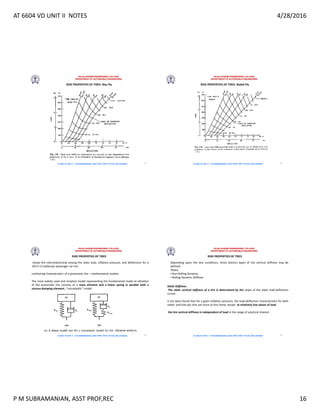
the variations of the peak values and the sliding values of the coefficient of road adhesion
with speed for a smooth tire, a tire with ribs, and a tire with ribs and sipes on wet
quartzite, asphalt, gravel, and concrete
difference in the coefficient of road adhesion between patterned tires, including the ribbed
and siped tires, and smooth tires on wet asphalt and concrete surfaces
The tread pattern increases the value of the coefficient of road adhesion and reduces its
speed dependency.
there is little pattern effect on wet quartzite surfaces, and a high level of road adhesion is
maintained over the entire speed range.
Thus, it can be concluded that the advantages of a patterned tire over a smooth tire are
pronounced only on badly drained surfaces
53
RAJALAKSHMI ENGINEERING COLLEGE
DEPARTMENT OF AUTOMOBILE ENGINEERING
AT 6604 VD UNIT II - P.M SUBRAMANIAN, ASST PROF, DEPT OF AUE, REC,CHENNAI
PERFORMANCE OF TIRES ON WET SURFACES
tread pattern can function satisfactorily on a wet road only when the grooves and sipes
constitute a reservoir of sufficient capacity, and that its effectiveness decreases with the
wear of the tread or the tread depth.
The decline in value of the coefficient of road adhesion with the decrease of tread depth is
more pronounced on smooth than on rough roads as rough roads can provide better
drainage
54
RAJALAKSHMI ENGINEERING COLLEGE
DEPARTMENT OF AUTOMOBILE ENGINEERING
AT 6604 VD UNIT II - P.M SUBRAMANIAN, ASST PROF, DEPT OF AUE, REC,CHENNAI
PERFORMANCE OF TIRES ON WET SURFACES
55
RAJALAKSHMI ENGINEERING COLLEGE
DEPARTMENT OF AUTOMOBILE ENGINEERING
AT 6604 VD UNIT II - P.M SUBRAMANIAN, ASST PROF, DEPT OF AUE, REC,CHENNAI
PERFORMANCE OF TIRES ON WET SURFACES -
HYDROPLANING
When a pneumatic tire is braked over a flooded surface, the motion of the tire creates
hydrodynamic pressure in the fluid.
The hydrodynamic pressure acting on the tire builds up as the square of speed of the tire,
and tends to separate the tire from the ground.
At low speeds, the front part of the tire rides on a wedge or a film of fluid. This fluid film
extends backward into the contact area as the speed of the tire increases.
At a particular speed, the hydrodynamic lift developed under the tire equals the vertical
load, the tire rides completely on the fluid, and all contact with the ground is lost.
This phenomena is usually referred to as hydroplaning
56
AT 6604 VD UNIT II NOTES 4/28/2016
P M SUBRAMANIAN, ASST PROF,REC 15
RAJALAKSHMI ENGINEERING COLLEGE
DEPARTMENT OF AUTOMOBILE ENGINEERING
AT 6604 VD UNIT II - P.M SUBRAMANIAN, ASST PROF, DEPT OF AUE, REC,CHENNAI
PERFORMANCE OF TIRES ON WET SURFACES -
HYDROPLANING
57
RAJALAKSHMI ENGINEERING COLLEGE
DEPARTMENT OF AUTOMOBILE ENGINEERING
AT 6604 VD UNIT II - P.M SUBRAMANIAN, ASST PROF, DEPT OF AUE, REC,CHENNAI
PERFORMANCE OF TIRES ON WET SURFACES -
HYDROPLANING
For smooth or close-patterned tires that do not provide escape paths for water
for patterned tires on flooded surfaces with a fluid depth exceeding the groove depth in the
tread, the speed at which hydroplaning occurs may be determined based on the theory of
hydrodynamics.
It can be assumed that the lift component of the hydrodynamic force is proportional to
the tire ground contact area A, fluid density P, and the square of the vehicle speed
The most important effect of hydroplaning is the reduction in the coefficient of road
adhesion between the tire and the ground.
This affects braking, steering control, and directional stability.
58
RAJALAKSHMI ENGINEERING COLLEGE
DEPARTMENT OF AUTOMOBILE ENGINEERING
AT 6604 VD UNIT II - P.M SUBRAMANIAN, ASST PROF, DEPT OF AUE, REC,CHENNAI
PERFORMANCE OF TIRES ON WET SURFACES
the hydroplaning speed for a tire at an inflation pressure of 193 kPa (28 psi) is
approximately 88 kmph which is well within the normal operating range for passenger
cars.
For heavy trucks, the inflation pressure is usually in the range 620-827kPa (90-120 psi). ,
the hydroplaning speed V, for a tire at an inflation pressure of 620 kPa (90 psi) is
approximately 158 kmph (98 mph), which is beyond the normal range of operating
speed for heavy trucks
This would suggest that hydroplaning may not be possible for heavy truck tires under
normal circumstances.
59
RAJALAKSHMI ENGINEERING COLLEGE
DEPARTMENT OF AUTOMOBILE ENGINEERING
AT 6604 VD UNIT II - P.M SUBRAMANIAN, ASST PROF, DEPT OF AUE, REC,CHENNAI
RIDE PROPERTIES OF TIRES
Supporting the weight of the vehicle and cushioning it over surface irregularities are two of
the basic functions of a pneumatic tire.
When a normal load is applied to an inflated tire, the tire progressively deflects as the load
increases.
static load-deflection relationship for a 5.60 X 13 bias-ply tire at various inflation pressures
The type of diagram is usually referred to as a lattice plot, in which the origin of each
load-deflection curve is displaced along the deflection axis by an amount proportional to the
inflation pressure.
The relationship between the load and the inflation pressure for constant deflection can also
be shown in the lattice plot
60
AT 6604 VD UNIT II NOTES 4/28/2016
P M SUBRAMANIAN, ASST PROF,REC 16
RAJALAKSHMI ENGINEERING COLLEGE
DEPARTMENT OF AUTOMOBILE ENGINEERING
AT 6604 VD UNIT II - P.M SUBRAMANIAN, ASST PROF, DEPT OF AUE, REC,CHENNAI
RIDE PROPERTIES OF TIRES- Bias Ply
61
RAJALAKSHMI ENGINEERING COLLEGE
DEPARTMENT OF AUTOMOBILE ENGINEERING
AT 6604 VD UNIT II - P.M SUBRAMANIAN, ASST PROF, DEPT OF AUE, REC,CHENNAI
RIDE PROPERTIES OF TIRES- Radial Ply
62
RAJALAKSHMI ENGINEERING COLLEGE
DEPARTMENT OF AUTOMOBILE ENGINEERING
AT 6604 VD UNIT II - P.M SUBRAMANIAN, ASST PROF, DEPT OF AUE, REC,CHENNAI
RIDE PROPERTIES OF TIRES
shows the interrelationship among the static load, inflation pressure, and deflections for a
165 X 13 radial-ply passenger car tire.
cushioning characteristics of a pneumatic tire – mathematical models.
The most widely used and simplest model representing the fundamental mode of vibration
of the pneumatic tire consists of a mass element and a linear spring in parallel with a
viscous damping element, -viscoelastic model
63
RAJALAKSHMI ENGINEERING COLLEGE
DEPARTMENT OF AUTOMOBILE ENGINEERING
AT 6604 VD UNIT II - P.M SUBRAMANIAN, ASST PROF, DEPT OF AUE, REC,CHENNAI
RIDE PROPERTIES OF TIRES
Depending upon the test conditions, three distinct types of tire vertical stiffness may be
defined:
•Static,
• Non Rolling Dynamic,
• Rolling Dynamic Stiffness
Static Stiffness:
The static vertical stiffness of a tire is determined by the slope of the static load-deflection
curves .
It has been found that for a given inflation pressure, the load-deflection characteristics for both
radial- and bias-ply tires are more or less linear, except at relatively low values of load.
the tire vertical stiffness is independent of load in the range of practical interest.
64
AT 6604 VD UNIT II NOTES 4/28/2016
P M SUBRAMANIAN, ASST PROF,REC 17
RAJALAKSHMI ENGINEERING COLLEGE
DEPARTMENT OF AUTOMOBILE ENGINEERING
AT 6604 VD UNIT II - P.M SUBRAMANIAN, ASST PROF, DEPT OF AUE, REC,CHENNAI
RIDE PROPERTIES OF TIRES
Nonrolling Dynamic Stiffness:
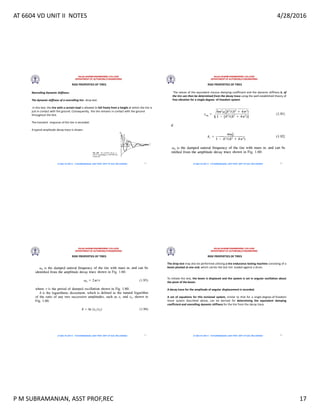
The dynamic stiffness of a nonrolling tire -drop test.
In this test, the tire with a certain load is allowed to fall freely from a height at which the tire is
just in contact with the ground. Consequently, the tire remains in contact with the ground
throughout the test.
The transient response of the tire is recorded.
A typical amplitude decay trace is shown .
65
RAJALAKSHMI ENGINEERING COLLEGE
DEPARTMENT OF AUTOMOBILE ENGINEERING
AT 6604 VD UNIT II - P.M SUBRAMANIAN, ASST PROF, DEPT OF AUE, REC,CHENNAI
RIDE PROPERTIES OF TIRES
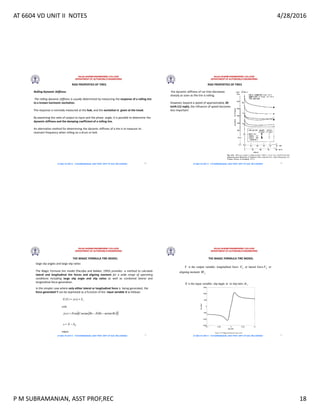
The values of the equivalent viscous damping coefficient and the dynamic stiffness k, of
the tire can then be determined from the decay trace using the well-established theory of
free vibration for a single-degree- of-freedom system
66
RAJALAKSHMI ENGINEERING COLLEGE
DEPARTMENT OF AUTOMOBILE ENGINEERING
AT 6604 VD UNIT II - P.M SUBRAMANIAN, ASST PROF, DEPT OF AUE, REC,CHENNAI
RIDE PROPERTIES OF TIRES
67
RAJALAKSHMI ENGINEERING COLLEGE
DEPARTMENT OF AUTOMOBILE ENGINEERING
AT 6604 VD UNIT II - P.M SUBRAMANIAN, ASST PROF, DEPT OF AUE, REC,CHENNAI
RIDE PROPERTIES OF TIRES
The drop test may also be performed utilizing a tire endurance testing machine consisting of a
beam pivoted at one end, which carries the test tire loaded against a drum.
To initiate the test, the beam is displaced and the system is set in angular oscillation about
the pivot of the beam.
A decay trace for the amplitude of angular displacement is recorded.
A set of equations for this torsional system, similar to that for a single-degree-of-freedom
linear system described above, can be derived for determining the equivalent damping
coefficient and nonrolling dynamic stiffness for the tire from the decay trace.
68
AT 6604 VD UNIT II NOTES 4/28/2016
P M SUBRAMANIAN, ASST PROF,REC 18
RAJALAKSHMI ENGINEERING COLLEGE
DEPARTMENT OF AUTOMOBILE ENGINEERING
AT 6604 VD UNIT II - P.M SUBRAMANIAN, ASST PROF, DEPT OF AUE, REC,CHENNAI
RIDE PROPERTIES OF TIRES
Rolling Dynamic Stiffness
The rolling dynamic stiffness is usually determined by measuring the response of a rolling tire
to a known harmonic excitation.
The response is normally measured at the hub, and the excitation is given at the tread.
By examining the ratio of output to input and the phase angle, it is possible to determine the
dynamic stiffness and the damping coefficient of a rolling tire.
An alternative method for determining the dynamic stiffness of a tire is to measure its
resonant frequency when rolling on a drum or belt.
69
RAJALAKSHMI ENGINEERING COLLEGE
DEPARTMENT OF AUTOMOBILE ENGINEERING
AT 6604 VD UNIT II - P.M SUBRAMANIAN, ASST PROF, DEPT OF AUE, REC,CHENNAI
RIDE PROPERTIES OF TIRES
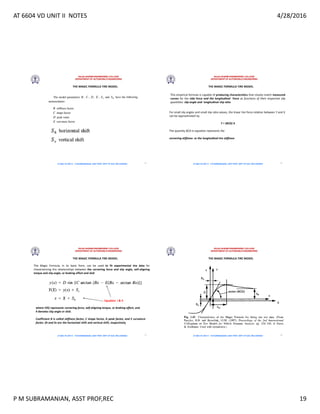
the dynamic stiffness of car tires decreases
sharply as soon as the tire is rolling.
However, beyond a speed of approximately 20
kmlh (12 mph), the influence of speed becomes
less important.
70
RAJALAKSHMI ENGINEERING COLLEGE
DEPARTMENT OF AUTOMOBILE ENGINEERING
AT 6604 VD UNIT II - P.M SUBRAMANIAN, ASST PROF, DEPT OF AUE, REC,CHENNAI
THE MAGIC FORMULA TIRE MODEL
large slip angles and large slip ratios
The Magic Formula tire model (Pacejka and Bakker, 1993) provides a method to calculate
lateral and longitudinal tire forces and aligning moment for a wide range of operating
conditions including large slip angle and slip ratios as well as combined lateral and
longitudinal force generation.
In the simpler case where only either lateral or longitudinal force is being generated, the
force generated Y can be expressed as a function of the input variable X as follows:
71
RAJALAKSHMI ENGINEERING COLLEGE
DEPARTMENT OF AUTOMOBILE ENGINEERING
AT 6604 VD UNIT II - P.M SUBRAMANIAN, ASST PROF, DEPT OF AUE, REC,CHENNAI
THE MAGIC FORMULA TIRE MODEL
72
AT 6604 VD UNIT II NOTES 4/28/2016
P M SUBRAMANIAN, ASST PROF,REC 19
RAJALAKSHMI ENGINEERING COLLEGE
DEPARTMENT OF AUTOMOBILE ENGINEERING
AT 6604 VD UNIT II - P.M SUBRAMANIAN, ASST PROF, DEPT OF AUE, REC,CHENNAI
THE MAGIC FORMULA TIRE MODEL
73
RAJALAKSHMI ENGINEERING COLLEGE
DEPARTMENT OF AUTOMOBILE ENGINEERING
AT 6604 VD UNIT II - P.M SUBRAMANIAN, ASST PROF, DEPT OF AUE, REC,CHENNAI
THE MAGIC FORMULA TIRE MODEL
This empirical formula is capable of producing characteristics that closely match measured
curves for the side force and the longitudinal force as functions of their respective slip
quantities: slip angle and longitudinal slip ratio
For small slip angles and small slip ratio values, the linear tire force relation between Y and X
can be approximated by
Y = (BCD) X
The quantity BCD in equation represents the
cornering stiffness or the longitudinal tire stiffness
74
RAJALAKSHMI ENGINEERING COLLEGE
DEPARTMENT OF AUTOMOBILE ENGINEERING
AT 6604 VD UNIT II - P.M SUBRAMANIAN, ASST PROF, DEPT OF AUE, REC,CHENNAI
THE MAGIC FORMULA TIRE MODEL
The Magic Formula, in its basic form, can be used to fit experimental tire data for
characterizing the relationships between the cornering force and slip angle, self-aligning
torque and slip angle, or braking effort and skid
where Y(X) represents cornering force, self-aligning torque, or braking effort, and
X denotes slip angle or skid.
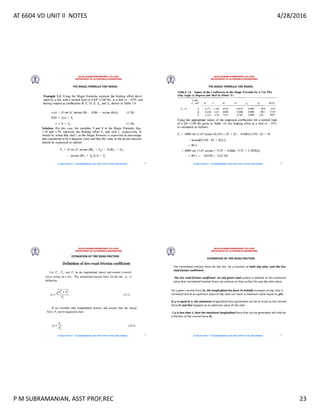
Coefficient B is called stiffness factor, C shape factor, D peak factor, and E curvature
factor. Sh and Sv are the horizontal shift and vertical shift, respectively
Equation I  II
75
RAJALAKSHMI ENGINEERING COLLEGE
DEPARTMENT OF AUTOMOBILE ENGINEERING
AT 6604 VD UNIT II - P.M SUBRAMANIAN, ASST PROF, DEPT OF AUE, REC,CHENNAI
THE MAGIC FORMULA TIRE MODEL
76
AT 6604 VD UNIT II NOTES 4/28/2016
P M SUBRAMANIAN, ASST PROF,REC 20
RAJALAKSHMI ENGINEERING COLLEGE
DEPARTMENT OF AUTOMOBILE ENGINEERING
AT 6604 VD UNIT II - P.M SUBRAMANIAN, ASST PROF, DEPT OF AUE, REC,CHENNAI
THE MAGIC FORMULA TIRE MODEL
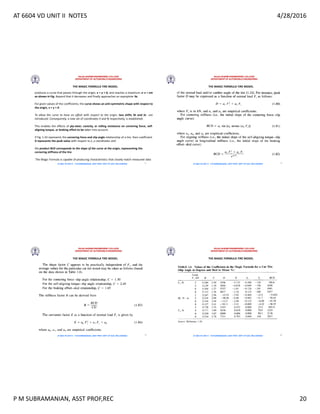
produces a curve that passes through the origin, x = y = 0, and reaches a maximum at x = xm
as shown in Fig. Beyond that it decreases and finally approaches an asymptote Ya.
For given values of the coefficients, the curve shows an anti-symmetric shape with respect to
the origin, x = y = 0.
To allow the curve to have an offset with respect to the origin, two shifts Sh and Sv are
introduced. Consequently, a new set of coordinates X and Y, respectively, is established.
This enables the effects of ply-steer, conicity, or rolling resistance on cornering force, self-
aligning torque, or braking effort to be taken into account.
if Fig. 1.43 represents the cornering force and slip angle relationship of a tire, then coefficient
D represents the peak value with respect to x, y coordinates and
the product BCD corresponds to the slope of the curve at the origin, representing the
cornering stiffness of the tire
The Magic Formula is capable of producing characteristics that closely match measured data
77
RAJALAKSHMI ENGINEERING COLLEGE
DEPARTMENT OF AUTOMOBILE ENGINEERING
AT 6604 VD UNIT II - P.M SUBRAMANIAN, ASST PROF, DEPT OF AUE, REC,CHENNAI
THE MAGIC FORMULA TIRE MODEL
78
RAJALAKSHMI ENGINEERING COLLEGE
DEPARTMENT OF AUTOMOBILE ENGINEERING
AT 6604 VD UNIT II - P.M SUBRAMANIAN, ASST PROF, DEPT OF AUE, REC,CHENNAI
THE MAGIC FORMULA TIRE MODEL
79
RAJALAKSHMI ENGINEERING COLLEGE
DEPARTMENT OF AUTOMOBILE ENGINEERING
AT 6604 VD UNIT II - P.M SUBRAMANIAN, ASST PROF, DEPT OF AUE, REC,CHENNAI
THE MAGIC FORMULA TIRE MODEL
80
AT 6604 VD UNIT II NOTES 4/28/2016
P M SUBRAMANIAN, ASST PROF,REC 21
RAJALAKSHMI ENGINEERING COLLEGE
DEPARTMENT OF AUTOMOBILE ENGINEERING
AT 6604 VD UNIT II - P.M SUBRAMANIAN, ASST PROF, DEPT OF AUE, REC,CHENNAI
THE MAGIC FORMULA TIRE MODEL
81
RAJALAKSHMI ENGINEERING COLLEGE
DEPARTMENT OF AUTOMOBILE ENGINEERING
AT 6604 VD UNIT II - P.M SUBRAMANIAN, ASST PROF, DEPT OF AUE, REC,CHENNAI
THE MAGIC FORMULA TIRE MODEL
82
RAJALAKSHMI ENGINEERING COLLEGE
DEPARTMENT OF AUTOMOBILE ENGINEERING
AT 6604 VD UNIT II - P.M SUBRAMANIAN, ASST PROF, DEPT OF AUE, REC,CHENNAI
THE MAGIC FORMULA TIRE MODEL
83
RAJALAKSHMI ENGINEERING COLLEGE
DEPARTMENT OF AUTOMOBILE ENGINEERING
AT 6604 VD UNIT II - P.M SUBRAMANIAN, ASST PROF, DEPT OF AUE, REC,CHENNAI
THE MAGIC FORMULA TIRE MODEL
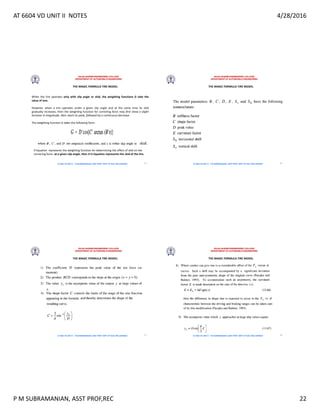
When brakes are applied during a turning maneuver, the tires on a vehicle develop both
slip angles and skids.
Under these circumstances, Eqs. I and II are inadequate for characterizing tire behavior.
To characterize the combined effects of slip angle and skid on the cornering force, self-
aligning torque, or braking effort, empirical weighting functions G are introduced.
which when multiplied by the original functions given in Eqs. I and II produce the
interactive effects of skid on cornering force and self-aligning torque, or of slip angle on
braking effort .
84
AT 6604 VD UNIT II NOTES 4/28/2016
P M SUBRAMANIAN, ASST PROF,REC 22
RAJALAKSHMI ENGINEERING COLLEGE
DEPARTMENT OF AUTOMOBILE ENGINEERING
AT 6604 VD UNIT II - P.M SUBRAMANIAN, ASST PROF, DEPT OF AUE, REC,CHENNAI
THE MAGIC FORMULA TIRE MODEL
When the tire operates only with slip angle or skid, the weighting functions G take the
value of one.
However, when a tire operates under a given slip angle and at the same time its skid
gradually increases, then the weighting function for cornering force may first show a slight
increase in magnitude, then reach its peak, followed by a continuous decrease.
The weighting function G takes the following form:
if Equation represents the weighting function for determining the effect of skid on the
cornering force at a given slip angle, then X in Equation represents the skid of the tire.
85
RAJALAKSHMI ENGINEERING COLLEGE
DEPARTMENT OF AUTOMOBILE ENGINEERING
AT 6604 VD UNIT II - P.M SUBRAMANIAN, ASST PROF, DEPT OF AUE, REC,CHENNAI
THE MAGIC FORMULA TIRE MODEL
86
RAJALAKSHMI ENGINEERING COLLEGE
DEPARTMENT OF AUTOMOBILE ENGINEERING
AT 6604 VD UNIT II - P.M SUBRAMANIAN, ASST PROF, DEPT OF AUE, REC,CHENNAI
THE MAGIC FORMULA TIRE MODEL
87
RAJALAKSHMI ENGINEERING COLLEGE
DEPARTMENT OF AUTOMOBILE ENGINEERING
AT 6604 VD UNIT II - P.M SUBRAMANIAN, ASST PROF, DEPT OF AUE, REC,CHENNAI
THE MAGIC FORMULA TIRE MODEL
88
AT 6604 VD UNIT II NOTES 4/28/2016
P M SUBRAMANIAN, ASST PROF,REC 23
RAJALAKSHMI ENGINEERING COLLEGE
DEPARTMENT OF AUTOMOBILE ENGINEERING
AT 6604 VD UNIT II - P.M SUBRAMANIAN, ASST PROF, DEPT OF AUE, REC,CHENNAI
THE MAGIC FORMULA TIRE MODEL
89
RAJALAKSHMI ENGINEERING COLLEGE
DEPARTMENT OF AUTOMOBILE ENGINEERING
AT 6604 VD UNIT II - P.M SUBRAMANIAN, ASST PROF, DEPT OF AUE, REC,CHENNAI
THE MAGIC FORMULA TIRE MODEL
90
RAJALAKSHMI ENGINEERING COLLEGE
DEPARTMENT OF AUTOMOBILE ENGINEERING
AT 6604 VD UNIT II - P.M SUBRAMANIAN, ASST PROF, DEPT OF AUE, REC,CHENNAI
ESTIMATION OF TIRE ROAD FRICTION
91
RAJALAKSHMI ENGINEERING COLLEGE
DEPARTMENT OF AUTOMOBILE ENGINEERING
AT 6604 VD UNIT II - P.M SUBRAMANIAN, ASST PROF, DEPT OF AUE, REC,CHENNAI
ESTIMATION OF TIRE ROAD FRICTION
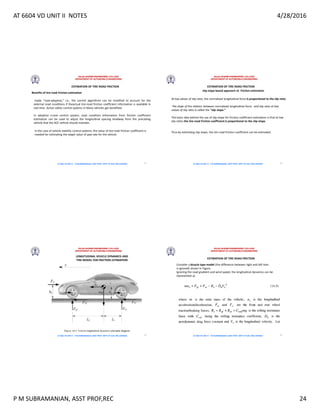
The normalized traction force for the tire be a function of both slip ratio and the tire-
road friction coefficient .
The tire road-friction coefficient on any given road surface is defined as the maximum
value that normalized traction force can achieve on that surface for any slip ratio value.
For a given normal force Fz, the longitudinal tire force Fx initially increases as slip ratio is
increased and at an optimum value of slip ratio can reach a maximum value equal to ,μFz .
If μ is equal to 1, the maximum longitudinal force generated can be as much as the normal
force Fz and this happens at an optimum value of slip ratio .
If μ is less than 1, then the maximum longitudinal force that can be generated will only be
a fraction of the normal force Fz.
92
AT 6604 VD UNIT II NOTES 4/28/2016
P M SUBRAMANIAN, ASST PROF,REC 24
RAJALAKSHMI ENGINEERING COLLEGE
DEPARTMENT OF AUTOMOBILE ENGINEERING
AT 6604 VD UNIT II - P.M SUBRAMANIAN, ASST PROF, DEPT OF AUE, REC,CHENNAI
ESTIMATION OF TIRE ROAD FRICTION
Benefits of tire-road friction estimation
made road-adaptive, i.e., the control algorithms can be modified to account for the
external road conditions if theactual tire-road friction coefficient information is available in
real time. Active safety control systems in Many vehicles get benefited.
In adaptive cruise control system, road condition information from friction coefficient
estimation can be used to adjust the longitudinal spacing headway from the preceding
vehicle that the ACC vehicle should maintain.
In the case of vehicle stability control systems, the value of tire-road friction coefficient is
needed for estimating the target value of yaw rate for the vehicle.
93
RAJALAKSHMI ENGINEERING COLLEGE
DEPARTMENT OF AUTOMOBILE ENGINEERING
AT 6604 VD UNIT II - P.M SUBRAMANIAN, ASST PROF, DEPT OF AUE, REC,CHENNAI
ESTIMATION OF TIRE ROAD FRICTION
slip-slope based approach to friction estimation
At low values of slip ratio, the normalized longitudinal force is proportional to the slip ratio
The slope of the relation between normalized longitudinal force and slip ratio at low
values of slip ratio is called the slip slope.
The basic idea behind the use of slip-slope for friction coefficient estimation is that at low
slip ratios the tire-road friction coefficient is proportional to the slip-slope.
Thus by estimating slip-slope, the tire road friction coefficient can be estimated.
94
RAJALAKSHMI ENGINEERING COLLEGE
DEPARTMENT OF AUTOMOBILE ENGINEERING
AT 6604 VD UNIT II - P.M SUBRAMANIAN, ASST PROF, DEPT OF AUE, REC,CHENNAI
LONGITUDINAL VEHICLE DYNAMICS AND
TIRE MODEL FOR FRICTION ESTIMATION
95
RAJALAKSHMI ENGINEERING COLLEGE
DEPARTMENT OF AUTOMOBILE ENGINEERING
AT 6604 VD UNIT II - P.M SUBRAMANIAN, ASST PROF, DEPT OF AUE, REC,CHENNAI
ESTIMATION OF TIRE ROAD FRICTION
Consider a bicycle type model (the difference between right and left tires
is ignored) shown in Figure.
Ignoring the road gradient and wind speed, the longitudinal dynamics can be
represented as
96
AT 6604 VD UNIT II NOTES 4/28/2016
P M SUBRAMANIAN, ASST PROF,REC 25
RAJALAKSHMI ENGINEERING COLLEGE
DEPARTMENT OF AUTOMOBILE ENGINEERING
AT 6604 VD UNIT II - P.M SUBRAMANIAN, ASST PROF, DEPT OF AUE, REC,CHENNAI
ESTIMATION OF TIRE ROAD FRICTION
the vehicle longitudinal acceleration/deceleration is measured by using an
accelerometer and the total vehicle longitudinal force can be obtained based on above
equations- Determination of the Longitudinal force
97
RAJALAKSHMI ENGINEERING COLLEGE
DEPARTMENT OF AUTOMOBILE ENGINEERING
AT 6604 VD UNIT II - P.M SUBRAMANIAN, ASST PROF, DEPT OF AUE, REC,CHENNAI
ESTIMATION OF TIRE ROAD FRICTION
Determination of the normal force
It is important to calculate the value of the normal force for each tire as accurately as
possible for the friction estimation algorithm.
The weight of the vehicle contributes the major part of the normal forces on the tires.
Longitudinal acceleration and deceleration forces acting on the vehicle redistribute the
normal forces between the tires.
If the vehicle is traveling in a straight line on level road, the normal forces at the front
and rear tires can be calculated using a static force model of the vehicle
98
RAJALAKSHMI ENGINEERING COLLEGE
DEPARTMENT OF AUTOMOBILE ENGINEERING
AT 6604 VD UNIT II - P.M SUBRAMANIAN, ASST PROF, DEPT OF AUE, REC,CHENNAI
ESTIMATION OF TIRE ROAD FRICTION
Thus an acceleration of the vehicle causes the normal forces on the front tires to decrease
and the normal forces on the rear tires to increase.
The above normal force calculation method is based on a static force model and ignores
the influence of the vibrations of the suspension. - reasonable estimate of the normal
force, especially when the road surface is fairly paved and not bumpy.
However, if the road surface is very bumpy, a dynamic normal force estimation method
incorporating the suspension dynamics will provide a more accurate calculation of the
normal force
Note also that during cornering, the normal forces of the right and left tires on both front
and rear axle are different due to vehicle roll moment.
However, since we are using a bicycle model, the differences in the left and right tires
cannot be considered in this formulation.
99
RAJALAKSHMI ENGINEERING COLLEGE
DEPARTMENT OF AUTOMOBILE ENGINEERING
AT 6604 VD UNIT II - P.M SUBRAMANIAN, ASST PROF, DEPT OF AUE, REC,CHENNAI
ESTIMATION OF TIRE ROAD FRICTION
Tire model
The longitudinal force generated at
each tire is known to depend on the
longitudinal slip ratio, the tire-road
friction coefficient, and the normal
force applied at the tire.
Figure shows the traction and braking
force vs. slip ratio relationship for a
variety of road surfaces computed
using the Magic Tire Road Friction
Measurement Formula model
100
AT 6604 VD UNIT II NOTES 4/28/2016
P M SUBRAMANIAN, ASST PROF,REC 26
RAJALAKSHMI ENGINEERING COLLEGE
DEPARTMENT OF AUTOMOBILE ENGINEERING
AT 6604 VD UNIT II - P.M SUBRAMANIAN, ASST PROF, DEPT OF AUE, REC,CHENNAI
ESTIMATION OF TIRE ROAD FRICTION
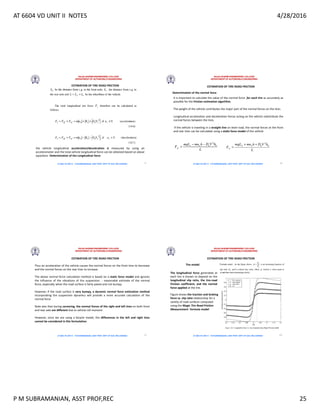
In the slip-slope model used for tire road friction coefficient identification, we merely
assume that the slip-slope is proportional to the tire road friction coefficient at small slip
ratios.
Longitudinal force ratio p is modeled as being proportional to the slip ratio, with the
proportionality constant being a function of the tire road friction coefficient.
At high values of slip ratio, the force ratio is constant and independent of the slip ratio.
The constant value of the force ratio is a function of the friction coefficient.
Hence the tire is modeled at high slip ratios with a constant Longitudinal force ratio P ,
with the value of the constant being dependent on the tire-road friction coefficient
101
RAJALAKSHMI ENGINEERING COLLEGE
DEPARTMENT OF AUTOMOBILE ENGINEERING
AT 6604 VD UNIT II - P.M SUBRAMANIAN, ASST PROF, DEPT OF AUE, REC,CHENNAI
ESTIMATION OF TIRE ROAD FRICTION
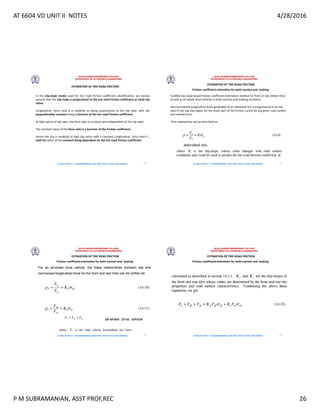
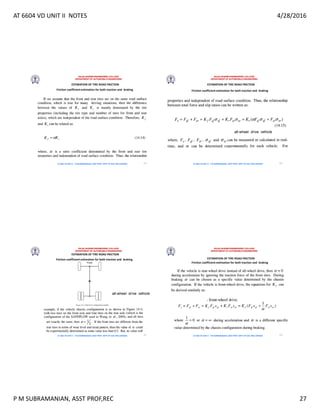
Friction coefficient estimation for both traction and braking
•unified slip-slope based friction coefficient estimation method for front or rear-wheel drive
as well as all-wheel drive vehicles in both traction and braking situations.
•the normalized longitudinal force generated at an individual tire is proportional to its slip
ratio in the low-slip region (or the linear part of the friction curve) for any given road surface
and normal force.
•This relationship can be described as:
102
RAJALAKSHMI ENGINEERING COLLEGE
DEPARTMENT OF AUTOMOBILE ENGINEERING
AT 6604 VD UNIT II - P.M SUBRAMANIAN, ASST PROF, DEPT OF AUE, REC,CHENNAI
ESTIMATION OF TIRE ROAD FRICTION
Friction coefficient estimation for both traction and braking
103
RAJALAKSHMI ENGINEERING COLLEGE
DEPARTMENT OF AUTOMOBILE ENGINEERING
AT 6604 VD UNIT II - P.M SUBRAMANIAN, ASST PROF, DEPT OF AUE, REC,CHENNAI
ESTIMATION OF TIRE ROAD FRICTION
Friction coefficient estimation for both traction and braking
104
AT 6604 VD UNIT II NOTES 4/28/2016
P M SUBRAMANIAN, ASST PROF,REC 27
RAJALAKSHMI ENGINEERING COLLEGE
DEPARTMENT OF AUTOMOBILE ENGINEERING
AT 6604 VD UNIT II - P.M SUBRAMANIAN, ASST PROF, DEPT OF AUE, REC,CHENNAI
ESTIMATION OF TIRE ROAD FRICTION
Friction coefficient estimation for both traction and braking
105
RAJALAKSHMI ENGINEERING COLLEGE
DEPARTMENT OF AUTOMOBILE ENGINEERING
AT 6604 VD UNIT II - P.M SUBRAMANIAN, ASST PROF, DEPT OF AUE, REC,CHENNAI
ESTIMATION OF TIRE ROAD FRICTION
Friction coefficient estimation for both traction and braking
106
RAJALAKSHMI ENGINEERING COLLEGE
DEPARTMENT OF AUTOMOBILE ENGINEERING
AT 6604 VD UNIT II - P.M SUBRAMANIAN, ASST PROF, DEPT OF AUE, REC,CHENNAI
ESTIMATION OF TIRE ROAD FRICTION
Friction coefficient estimation for both traction and braking
107
RAJALAKSHMI ENGINEERING COLLEGE
DEPARTMENT OF AUTOMOBILE ENGINEERING
AT 6604 VD UNIT II - P.M SUBRAMANIAN, ASST PROF, DEPT OF AUE, REC,CHENNAI
ESTIMATION OF TIRE ROAD FRICTION
Friction coefficient estimation for both traction and braking
108
AT 6604 VD UNIT II NOTES 4/28/2016
P M SUBRAMANIAN, ASST PROF,REC 28
RAJALAKSHMI ENGINEERING COLLEGE
DEPARTMENT OF AUTOMOBILE ENGINEERING
AT 6604 VD UNIT II - P.M SUBRAMANIAN, ASST PROF, DEPT OF AUE, REC,CHENNAI
ESTIMATION OF TIRE ROAD FRICTION
Friction coefficient estimation for both traction and braking
109
RAJALAKSHMI ENGINEERING COLLEGE
DEPARTMENT OF AUTOMOBILE ENGINEERING
AT 6604 VD UNIT II - P.M SUBRAMANIAN, ASST PROF, DEPT OF AUE, REC,CHENNAI
ESTIMATION OF TIRE ROAD FRICTION
Friction coefficient estimation for both traction and braking
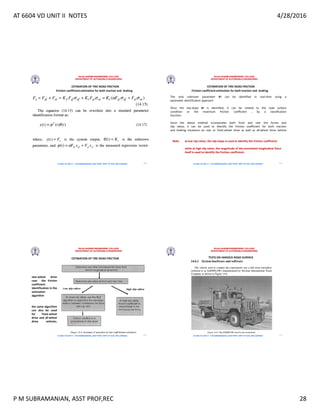
The only unknown parameter Kr can be identified in real-time using a
parameter identification approach
Once the slip-slope Kr is identified, it can be related to the road surface
condition or the maximum friction coefficient , by a classification
function.
Since the above method incorporates both front and rear tire forces and
slip ratios, it can be used to identify the friction coefficient for both traction
and braking situations on rear or front-wheel drive as well as all-wheel drive vehicle
Note: at low slip ratios, the slip-slope is used to identify the friction coefficient
while at high slip ratios, the magnitude of the normalized longitudinal force
itself is used to identify the friction coefficient.
110
RAJALAKSHMI ENGINEERING COLLEGE
DEPARTMENT OF AUTOMOBILE ENGINEERING
AT 6604 VD UNIT II - P.M SUBRAMANIAN, ASST PROF, DEPT OF AUE, REC,CHENNAI
ESTIMATION OF TIRE ROAD FRICTION
rear-wheel drive
case the friction
coefficient
identification in the
estimation
algorithm
the same algorithm
can also be used
for front-wheel
drive and all-wheel
drive vehicles.
111
RAJALAKSHMI ENGINEERING COLLEGE
DEPARTMENT OF AUTOMOBILE ENGINEERING
AT 6604 VD UNIT II - P.M SUBRAMANIAN, ASST PROF, DEPT OF AUE, REC,CHENNAI
TESTS ON VARIOUS ROAD SURFACE
112
AT 6604 VD UNIT II NOTES 4/28/2016
P M SUBRAMANIAN, ASST PROF,REC 29
RAJALAKSHMI ENGINEERING COLLEGE
DEPARTMENT OF AUTOMOBILE ENGINEERING
AT 6604 VD UNIT II - P.M SUBRAMANIAN, ASST PROF, DEPT OF AUE, REC,CHENNAI
TESTS ON VARIOUS ROAD SURFACE
113
RAJALAKSHMI ENGINEERING COLLEGE
DEPARTMENT OF AUTOMOBILE ENGINEERING
AT 6604 VD UNIT II - P.M SUBRAMANIAN, ASST PROF, DEPT OF AUE, REC,CHENNAI
TESTS ON VARIOUS ROAD SURFACE
114
RAJALAKSHMI ENGINEERING COLLEGE
DEPARTMENT OF AUTOMOBILE ENGINEERING
AT 6604 VD UNIT II - P.M SUBRAMANIAN, ASST PROF, DEPT OF AUE, REC,CHENNAI
TESTS ON VARIOUS ROAD SURFACE
Tests on dry concrete road surface
The experiments for this part were carried out on the dry concrete testing track. The track was
a well paved concrete surface and completely dry. So, the friction level of the surface was very
good.
Acceleration(Traction)Test
The slip-slope based friction coefficient estimation method was evaluated
for acceleration with different starting speeds.
At the beginning of the test,
the speed of the vehicle was kept constant for about 6 seconds to allow the
low-pass filters to initialize and the Kalman filter to estimate the
accelerometer bias.
After that, the vehicle starts accelerating. Figure
shows the slip-slope estimation results for acceleration with the starting
speed at 20 mph
As the results indicate, the slip-slope for the
acceleration on dry concrete converges to a value of about 9.8.
115
RAJALAKSHMI ENGINEERING COLLEGE
DEPARTMENT OF AUTOMOBILE ENGINEERING
AT 6604 VD UNIT II - P.M SUBRAMANIAN, ASST PROF, DEPT OF AUE, REC,CHENNAI
TESTS ON VARIOUS ROAD SURFACE
116
AT 6604 VD UNIT II NOTES 4/28/2016
P M SUBRAMANIAN, ASST PROF,REC 30
RAJALAKSHMI ENGINEERING COLLEGE
DEPARTMENT OF AUTOMOBILE ENGINEERING
AT 6604 VD UNIT II - P.M SUBRAMANIAN, ASST PROF, DEPT OF AUE, REC,CHENNAI
TESTS ON VARIOUS ROAD SURFACE
Combination of Acceleration and Braking Test
Experiments for a situation of sequential acceleration and braking were
also studied on the same dry concrete surface.
Figure 14-8 shows one of the test results.
The SAFEPLOW first stays at a constant speed for a while to let
the filters initialize and estimate the accelerometer bias, then it starts
accelerating for about 20 seconds and then gently brakes for about 10
seconds.
As the result indicates, the slip-slope consistently converges to about the same value
around 9.8.
From the experimental results, it was observed that for acceleration and braking in the
small slip region, the slip-slope consistently converges to some value around 9.8 on this
surface.
Therefore, we can use this slip-slope value to classify the road surface as dry concrete, dry
concrete like surface orto classify the friction coefficient as being close to 1.
117
RAJALAKSHMI ENGINEERING COLLEGE
DEPARTMENT OF AUTOMOBILE ENGINEERING
AT 6604 VD UNIT II - P.M SUBRAMANIAN, ASST PROF, DEPT OF AUE, REC,CHENNAI
TESTS ON VARIOUS ROAD SURFACE
118
RAJALAKSHMI ENGINEERING COLLEGE
DEPARTMENT OF AUTOMOBILE ENGINEERING
AT 6604 VD UNIT II - P.M SUBRAMANIAN, ASST PROF, DEPT OF AUE, REC,CHENNAI
TESTS ON VARIOUS ROAD SURFACE
Tests on concrete surface with loose snow covering
119
RAJALAKSHMI ENGINEERING COLLEGE
DEPARTMENT OF AUTOMOBILE ENGINEERING
AT 6604 VD UNIT II - P.M SUBRAMANIAN, ASST PROF, DEPT OF AUE, REC,CHENNAI
TESTS ON VARIOUS ROAD SURFACE
The experiments for this part were carried out also on the concrete test track after a heavy
snow day.
The right side lane in the figure was used for the testing.
Since the road surface is slightly slippery, the friction coefficient is expected to be
noticeably less than 1.
Tests on concrete surface with loose snow covering
120
AT 6604 VD UNIT II NOTES 4/28/2016
P M SUBRAMANIAN, ASST PROF,REC 31
RAJALAKSHMI ENGINEERING COLLEGE
DEPARTMENT OF AUTOMOBILE ENGINEERING
AT 6604 VD UNIT II - P.M SUBRAMANIAN, ASST PROF, DEPT OF AUE, REC,CHENNAI
TESTS ON VARIOUS ROAD SURFACE
Combination of Acceleration and Braking Test
Figure 14-10 shows one of the test results.
The SAFEPLOW first stays at a constant speed for a while to let the filters initialize and
estimate the accelerometer bias, then it starts accelerating for about 16 seconds and then
gently brakes for about 16 seconds.
As the result indicates, the slip-slope consistently converges to about the same value
around 7.0.
.
From the experimental results, we can see that for acceleration and
braking in the small slip region, the slip-slope consistently converges to
some value around 7.0, which is quite different from the slip-slope value
(9.8) obtained on dry concrete surface.
Therefore, we can use this slip-slope value to classify the road surface as a slightly slippery
surface or to classify the friction coefficient as being about 0.7.
Tests on concrete surface with loose snow covering
121
RAJALAKSHMI ENGINEERING COLLEGE
DEPARTMENT OF AUTOMOBILE ENGINEERING
AT 6604 VD UNIT II - P.M SUBRAMANIAN, ASST PROF, DEPT OF AUE, REC,CHENNAI
TESTS ON VARIOUS ROAD SURFACE
Tests on concrete surface with loose snow covering
122
RAJALAKSHMI ENGINEERING COLLEGE
DEPARTMENT OF AUTOMOBILE ENGINEERING
AT 6604 VD UNIT II - P.M SUBRAMANIAN, ASST PROF, DEPT OF AUE, REC,CHENNAI
TESTS ON VARIOUS ROAD SURFACE
Tests on surface consisting of two different friction levels
123
RAJALAKSHMI ENGINEERING COLLEGE
DEPARTMENT OF AUTOMOBILE ENGINEERING
AT 6604 VD UNIT II - P.M SUBRAMANIAN, ASST PROF, DEPT OF AUE, REC,CHENNAI
TESTS ON VARIOUS ROAD SURFACE
Tests on surface consisting of two different friction levels
The purpose of the experiments in this section is to test the system's transient response
performance and its ability to detect a sudden change of the road friction level.
The test track consists of two surfaces with different friction levels-dry asphalt surface
and icy surface.
Figure 14-11 shows a photograph of the transitional part of the track.
124
AT 6604 VD UNIT II NOTES 4/28/2016
P M SUBRAMANIAN, ASST PROF,REC 32
RAJALAKSHMI ENGINEERING COLLEGE
DEPARTMENT OF AUTOMOBILE ENGINEERING
AT 6604 VD UNIT II - P.M SUBRAMANIAN, ASST PROF, DEPT OF AUE, REC,CHENNAI
TESTS ON VARIOUS ROAD SURFACE
Tests on surface consisting of two different friction levels
Combination of Acceleration and Braking Test
Figure 14-12 shows experimental results from a test in which the SAFEPLOW accelerates on
the dry asphalt surface and brakes through the transitional part of the track.
As before, on the dry asphalt surface, tires work in the low-slip linear region and the slip-slope
is used to classify the surface friction level for both acceleration and braking.
However, the wheels lock up once the vehicle reaches the icy surface when performing
braking.
Thus, the slip ratio will be almost as high as 100% and the tires are working in the nonlinear
region of the tire force characteristics.
Therefore, the normalized force is used to classify the surface friction level.
As the result indicates, the friction coefficient estimate promptly converges to a value of
about 0.22 once the vehicle reaches the icy surface.
125
RAJALAKSHMI ENGINEERING COLLEGE
DEPARTMENT OF AUTOMOBILE ENGINEERING
AT 6604 VD UNIT II - P.M SUBRAMANIAN, ASST PROF, DEPT OF AUE, REC,CHENNAI
TESTS ON VARIOUS ROAD SURFACE
Tests on surface consisting of two different friction levels
126
RAJALAKSHMI ENGINEERING COLLEGE
DEPARTMENT OF AUTOMOBILE ENGINEERING
AT 6604 VD UNIT II - P.M SUBRAMANIAN, ASST PROF, DEPT OF AUE, REC,CHENNAI
TESTS ON VARIOUS ROAD SURFACE
Hard braking test
It is used to further verify the system performance in high-slip
region (nonlinear part of the force-slip curves).
The SAFEPLOW performs hard braking on a dry concrete surface
Figure 14-13 shows a test result.
Since the tires are working outside the
linear region, the normalized force is directly used to classify the surface
friction level.
As the result indicates, the system behaves well even in the
nonlinear region.
The estimated friction coefficient converges to about 0.96 once the vehicle starts hard
braking.
127
RAJALAKSHMI ENGINEERING COLLEGE
DEPARTMENT OF AUTOMOBILE ENGINEERING
AT 6604 VD UNIT II - P.M SUBRAMANIAN, ASST PROF, DEPT OF AUE, REC,CHENNAI
TESTS ON VARIOUS ROAD SURFACE
Hard braking test
128