METAMORPHISM
PRESENTATION OF GROUP4 (11-DIAMOND)
metamorphisM
Metamorphism is the transformation of existing
rock to rock with a different mineral composition
or texture. Metamorphism takes place at
temperatures in excess of 150 °C, and often also
at elevated pressure or in the presence of
chemically active fluids, but the rock remains
mostly solid during the transformation.
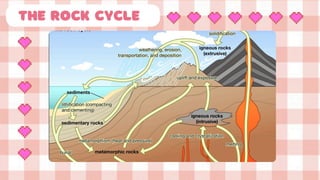
THE ROCK CYCLE
ESSENCE OF METAMORPHISM
Metamorphism is essentially a process of re-
equilibration, where rocks adjust their mineral
makeup and physical properties to adapt to
new environmental conditions. These
conditions can arise from various geological
events, such as tectonic plate collisions,
volcanic activity, or the deep burial of rocks.
TYPES OF METAMORPHISM
Metamorphism occurs in various forms, each
characterized by specific conditions and resulting rock
types:
1. Regional Metamorphism (major type)
2. Contact Metamorphism (major type)
3. Hydrothermal Metamorphism
4. Shock Metamorphism
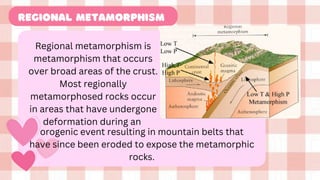
REGIONAL METAMORPHISM
Regional metamorphism is
metamorphism that occurs
over broad areas of the crust.
Most regionally
metamorphosed rocks occur
in areas that have undergone
deformation during an
orogenic event resulting in mountain belts that
have since been eroded to expose the metamorphic
rocks.
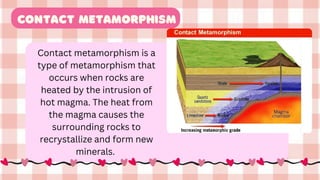
Contact metamorphism is a
type of metamorphism that
occurs when rocks are
heated by the intrusion of
hot magma. The heat from
the magma causes the
surrounding rocks to
recrystallize and form new
minerals.
CONTACT METAMORPHISM
Hydrothermal metamorphism occurs when hot,
chemically active, mineral laden waters interact with
a surrounding preexisting rock (called the country
rock). Most hydrothermal metamorphism takes place
at low pressures and relatively low temperature, as
the phase diagram shows. It is one of the most
pervasive and widespread types of metamorphism,
although most of it cannot be seen easily.
HYDROTHERMAL METAMORPHISM
several distinctly differnt types of
hydrothermal metamorphism
The most spectacular hydrothermal metamorphism
takes place as an after effect of igneous activity.
Magmas have lots of water with dissolved minerals,
but as the magma crystallizes the mineral laden water
is driven off into the surrounding country rock where
it seeps into cracks and pores precipitating the
minerals.
1. IGNEOUS FLUIDS AND PEGMATITES:
The most spectacular result of this is a
Pegmatite, a very coarse grained Felsic igneous
rock. Pegmatites commonly have single crystals
measured in feet in size, as well as a host of
exotic minerals, including some of the most
important gem minerals.
Hydrothermal deposits of this type also
produce many important mineral deposits, from
silver and gold to copper.
A second type of hydrothermal metamorphism takes
place at oceanic rift centers (Divergent Plate
Boundaries). Here magma ozzes out onto the ocean floor
to form pillow basalts. While the rock is still hot sea
water carrying all its salts percolates into the rocks
where a lot of chemical reactions take place. Minerals
are leached out of the rock and carried to the surface
where they often form Smokers, gysers on the ocean
floor
2. ocEANIC HYDROTHERMAL METAMORPHISM:
SHOCK METAMORPHISM
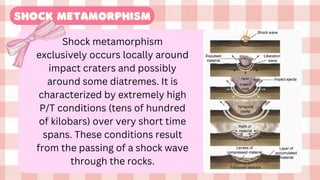
Shock metamorphism
exclusively occurs locally around
impact craters and possibly
around some diatremes. It is
characterized by extremely high
P/T conditions (tens of hundred
of kilobars) over very short time
spans. These conditions result
from the passing of a shock wave
through the rocks.
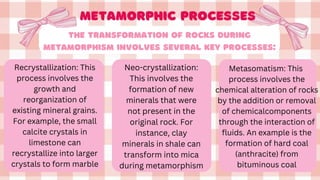
The transformation of rocks during
metamorphism involves several key processes:
Recrystallization: This
process involves the
growth and
reorganization of
existing mineral grains.
For example, the small
calcite crystals in
limestone can
recrystallize into larger
crystals to form marble
Neo-crystallization:
This involves the
formation of new
minerals that were
not present in the
original rock. For
instance, clay
minerals in shale can
transform into mica
during metamorphism
Metasomatism: This
process involves the
chemical alteration of rocks
by the addition or removal
of chemicalcomponents
through the interaction of
fluids. An example is the
formation of hard coal
(anthracite) from
bituminous coal
METAMORPHIC PROCESSES
Impact and
Significance of
Metamorphism
Metamorphism plays a crucial role in the Earth's
rock cycle, transforming rocks and creating a wide
variety of new rock types. Metamorphic rocks
provide valuable insights into the Earth's
geological history, tectonic processes, and the
conditions that existed deep within the Earth's
crust. Moreover, metamorphic rocks can be
economically important, containing valuable
minerals like gemstones and ores.
THANK
YOUGroup4 Members:
Jay Lou Libuna
Casse Marie Leyble
Julianne Mharie Magbanua
Jairus Andrei Magno
Jhosua Loreno
Vincent Libuna