THERAPEUTIC DIET
Therapeutic diet- slight alteration in the
normal dietary intake of an individual with
a view to treat or improve his existing
physical condition or ailment.
 Nutrition Includes study of process by which
food is ingested, digested, absorbed and
utilized in the body.
 Dietetics “Science and art of feeding
individuals based on the principles of nutrition”.
 “Science and art of human nutritional care”
 “Application of diet therapy principles in patient
related settings”
ADAPTION OF NORMAL TO THERAPEUTIC DIET
 To provide consistency-fluid or soft.
 2. Increase Or Decrease energy values
 3. Increase Or Decrease one more Nutrients.
 4. Increase Or Decrease bulk in diet
 5.Provide bland flavored diet
 6.Include or exclude specific foods which are
allergic
 7.To modify the feeding intervals
CONSTRUCTION OF THERAPEUTIC DIET
1.Qualitative Balanced diet-
60-65% CHO
10-20% Protein
20-30% Fat
2. Quantitative
Food groups
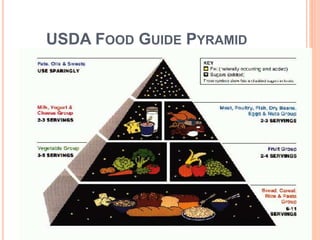
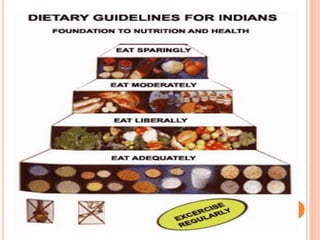
Food guide pyramid
Food Exchange System
USDA FOOD GUIDE PYRAMID
FOOD EXCHANGE LIST
An exchange list is a grouping of foods
in which specified amounts of all foods
listed are of approximately equal
carbohydrate, protein, and fat value.
Specific foods within the lists may
differ slightly in their nutritive value
from the averages stated for the group.
 Any food from the given exchange list can be
substituted or exchanged for any other food in that
list.
 In the fruits list, e.g. one small mango can be
substituted for one medium sweet lime or four small
tomatoes.
 In all, there are eight exchange lists:
 1. Milk exchange
 2. Legume and pulse exchange
 3. Flesh food exchange
 4. Vegetable A exchange
 5. Vegetable B exchange
 6.Fruit exchange
 7. Cereal exchange
 8. Fat exchange
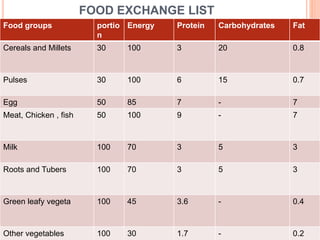
FOOD EXCHANGE LIST
Food groups portio
n
Energy Protein Carbohydrates Fat
Cereals and Millets 30 100 3 20 0.8
Pulses 30 100 6 15 0.7
Egg 50 85 7 - 7
Meat, Chicken , fish 50 100 9 - 7
Milk 100 70 3 5 3
Roots and Tubers 100 70 3 5 3
Green leafy vegeta 100 45 3.6 - 0.4
Other vegetables 100 30 1.7 - 0.2
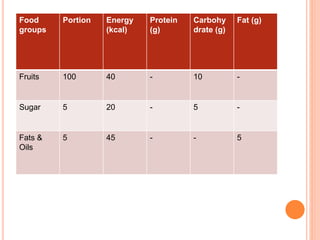
Food
groups
Portion Energy
(kcal)
Protein
(g)
Carbohy
drate (g)
Fat (g)
Fruits 100 40 - 10 -
Sugar 5 20 - 5 -
Fats &
Oils
5 45 - - 5
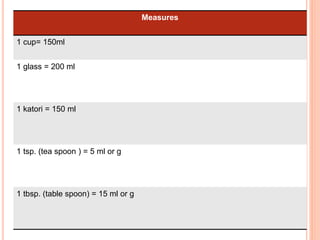
Measures
1 cup= 150ml
1 glass = 200 ml
1 katori = 150 ml
1 tsp. (tea spoon ) = 5 ml or g
1 tbsp. (table spoon) = 15 ml or g
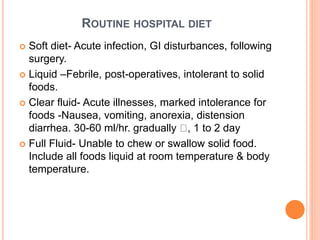
ROUTINE HOSPITAL DIET
 Soft diet- Acute infection, GI disturbances, following
surgery.
 Liquid –Febrile, post-operatives, intolerant to solid
foods.
 Clear fluid- Acute illnesses, marked intolerance for
foods -Nausea, vomiting, anorexia, distension
diarrhea. 30-60 ml/hr. gradually , 1 to 2 day
 Full Fluid- Unable to chew or swallow solid food.
Include all foods liquid at room temperature & body
temperature.
LIQUID DIET
 Clear liquid:
 Foods with low residue content – help minimize
load of digestion in intestine
 Foods are clear and liquid at room temperature
 Purpose – to provide fluid and electrolyte to prevent
dehydration
 Inadequate in calories and essential nutrients
 Should not be provided for more than 1-3 days as a
sole source of nourishment
 Initial feeding progression between IV and full fluid
or solid food following surgery.
 May be used as a dietary preparation for bowel
examination or surgery
 Acute GI disturbances, any illness associated with
high fever.
 50-100ml/hr or two at frequent intervals
 Do not use solid foods
RECOMMENDED FOODS
 Clear, fat-free broth
 Light coffee/tea (without milk/cream)
 Strained fruit juices
 Tender coconut water, whey, barley water
 Gelatin
 Sugar & salt added to liquids
 High protein supplements
 honey
 Full fluid – liquid or semi-liquid at room
temperature. Do not use solid foods
 Intermediate between clear liquid and regular diet
 Provides oral source of fluids to people-
 Incapable of chewing, swallowing or digesting solid
foods
 Post-surgery after IV/ clearfluid
 Chewing or swallowing disorders
 Jaw-wiring
 Oesophageal or GI strictures
 Moderate GI inflammation
 Acute illness
 Nutrient composition depends on type and amount
of liquid the patient can consume
 Diet is low in iron, vit B12, vit A & thiamine
 By careful planning, it can be made adequate for
maintenance requirements except fibre
 Liquid nutritional supplements or blenderized foods
could be added - nutritional adequacy
 2-4 hours interval
 Inadequate in fibre – leads to constipation
 In case of prolonged use, vitamins, iron or liquid
nutritional supplements must be added.
RECOMMENDED FOODS- FULL FLUID
 Soups and broth
 Cereal porridge (refined cereals)
 Milk and milk beverages, yoghurt
 Coffee, tea, fruit juices
 Butter, cream, oil added to foods
 Plain puddings, custard, ice-cream, jelly
 Sugar, honey, salt and mild flavourings
SOFT DIET
 Provides soft whole foods, lightly seasoned and
moderately low in fibre
 Soft texture, easy to digest
 Small volumes of meals are offered until patient
tolerates solid foods
 Transition between liquid and normal
 Post-operative cases,
 Acute infection
 GI disturbance
 Chewing problem
 Individualized according to clinical diagnosis,
surgery, appetite, food tolerance, pre-nutritional
status, chewing and swallowing ability
 Nutritionally adequate
 Mechanical soft diet – normal diet that is modified
only in texture for ease of mastication.
 Used when patient cannot chew or use facial
muscles, dental, medical or surgical conditions
 Foods may be liquid, chopped, pureed or regular
with soft consistency.
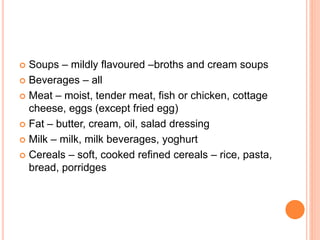
 Soups – mildly flavoured –broths and cream soups
 Beverages – all
 Meat – moist, tender meat, fish or chicken, cottage
cheese, eggs (except fried egg)
 Fat – butter, cream, oil, salad dressing
 Milk – milk, milk beverages, yoghurt
 Cereals – soft, cooked refined cereals – rice, pasta,
bread, porridges
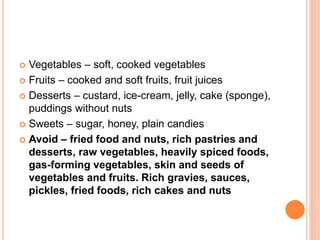
 Vegetables – soft, cooked vegetables
 Fruits – cooked and soft fruits, fruit juices
 Desserts – custard, ice-cream, jelly, cake (sponge),
puddings without nuts
 Sweets – sugar, honey, plain candies
 Avoid – fried food and nuts, rich pastries and
desserts, raw vegetables, heavily spiced foods,
gas-forming vegetables, skin and seeds of
vegetables and fruits. Rich gravies, sauces,
pickles, fried foods, rich cakes and nuts
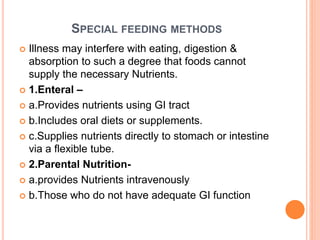
SPECIAL FEEDING METHODS
 Illness may interfere with eating, digestion &
absorption to such a degree that foods cannot
supply the necessary Nutrients.
 1.Enteral –
 a.Provides nutrients using GI tract
 b.Includes oral diets or supplements.
 c.Supplies nutrients directly to stomach or intestine
via a flexible tube.
 2.Parental Nutrition-
 a.provides Nutrients intravenously
 b.Those who do not have adequate GI function
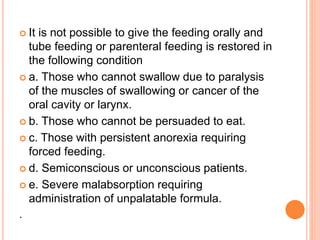
 It is not possible to give the feeding orally and
tube feeding or parenteral feeding is restored in
the following condition
 a. Those who cannot swallow due to paralysis
of the muscles of swallowing or cancer of the
oral cavity or larynx.
 b. Those who cannot be persuaded to eat.
 c. Those with persistent anorexia requiring
forced feeding.
 d. Semiconscious or unconscious patients.
 e. Severe malabsorption requiring
administration of unpalatable formula.
.
 g. Those who are undernourished or at risk of
becoming so.
 h. Those who cannot digest and absorb
 i. After surgery
 j. Patients with neurological and renal disorders or
have continued fevers or diabetes.
 k. Babies of very low birth weight.
ENTERAL FEEDING
 Indications -the preferred route - "If the gut
works, use it"
 Mechanical GI tract dysfunction/disorders - may
have normal digestive & absorptive function with an
oral/mechanical/physiological obstruction
 Facial/jaw injuries, head & neck , swallowing
disorders, obstruction of the upper GI tract, GI tract
fistulas, short bowel syndrome (feed beyond the
obstruction/fistula)
 Metabolic GI tract dysfunction - may have impaired
ability to digest & absorb nutrients
 Pancreatitis, inflammatory bowel disease,
chemotherapy
 Hypermetabolic conditions - may have increased
energy & protein requirements that cannot be met
with regular oral intake
 Major burns, trauma, sepsis, post-operative
recovery following surgery
CONTRAINDICATION FOR ENTERAL THERAPY: GI
TRACT NOT WORKING
 Intractable vomiting
 Intestinal obstruction
 Upper GI tract hemorrhage
 Severe, intractable diarrhea
 Severe, acute pancreatitis
 Expected need less than 5-10 days
 A satisfactory tube feeding must be
 Nutritionally adequate
 Well tolerated by patient so that vomiting is not induced.
 Easily digested with no unfavourable reaction such as
distension, diarrhoea or constipation
 Easily prepared and
 Inexpensive
 FORMULAS
 Many new commercial modular formulas are available.
 From the standpoint of accuracy in measuring,
sanitation, and convenience, most hospitals prefer
commercial mixtures.
 A 24-hour intake of three litres would furnish 3,000
calories.
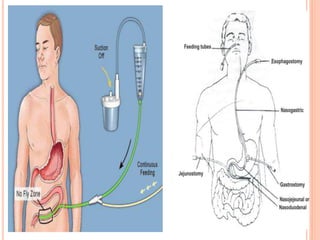
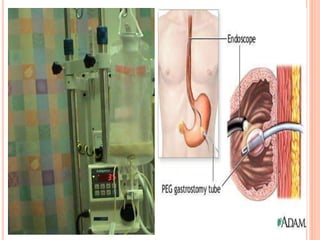
FEEDING ROUTES
 Nasogastric (NG) : tube is placed into the
stomach via the nose.
 Nasoenteric: tube is placed into the GI tract via
the nose. (Nasoenteric feedings usually refer to
nasoduodenal and Nasojejunal feedings.)
 Nasoduodenal (ND): tube is placed into the
duodenum via the nose.
 Nasojejunal (NJ): tube is placed into the mouth.
This method is often used to feed infants
because a nasogastric tube can hinder the
infant’s breathing.
 Orogastric : tube is placed into the GI tract via the
mouth. This method is often used to feed infants
because a nasogastric tube can hinder the infant’s
breathing.
 Enterostomy (EN-ter-OSS-toe-mee): an opening
into the GI tract through which a feeding tube can
be passed.
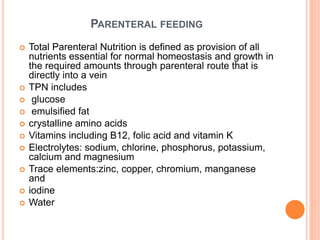
 Gastrostomy (gas –TROSS-toe-mee): an opening
into the stomach through which a feeding tube can
be passed. A nonsurgical technique for creating a
gastrostomy under local anesthesia is called
Percutaneous endoscopic gastrostomy (PEG).
 Jejunostomy (JE-ju-NOSS-toe-mee): an opening in
the jejunum through which a feeding tube can be
passed. A nonsurgical technique for creating a
jejunostomy is called Percutaneous endoscopic
jejunostomy (PEJ).The tube can either be guided
into the jejunum via a gastrostomy or passed
directly into the jejunum (direct PEJ)
 ROUTES:
 Short-term:
 Nasogastric, Nasoduodenal, Nasojejunal
 Long-term: Gastrostomy & Jejunostomy (surgically
placed) and PEG - percutaneous-esophago-
gastrostomy & PEJ - percutaneous-esophago-
jejunostomy (endoscopically placed)
PARENTERAL FEEDING
 Total Parenteral Nutrition is defined as provision of all
nutrients essential for normal homeostasis and growth in
the required amounts through parenteral route that is
directly into a vein
 TPN includes
 glucose
 emulsified fat
 crystalline amino acids
 Vitamins including B12, folic acid and vitamin K
 Electrolytes: sodium, chlorine, phosphorus, potassium,
calcium and magnesium
 Trace elements:zinc, copper, chromium, manganese
and
 iodine
 Water
INDICATIONS
 Patients who do not have functioning GI tracts and
who are either malnourished or likely to become so.
The following conditions may require use of
parenteral nutrition: 1.Severe pancreatitis.
2.Malabsorption disorders. 3.Intestinal obstructions
or fistulas. 4.Major trauma or burns. 5.Critical
illnesses or wasting disorders. 6.Bone marrow
transplants. 7.Being malnourished and having a
high risk of aspiration.
 8. Short-bowel syndrome (a portion of the intestine
has been removed).
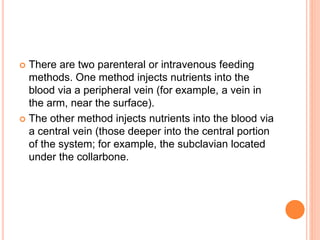
 There are two parenteral or intravenous feeding
methods. One method injects nutrients into the
blood via a peripheral vein (for example, a vein in
the arm, near the surface).
 The other method injects nutrients into the blood via
a central vein (those deeper into the central portion
of the system; for example, the subclavian located
under the collarbone.
 Peripheral Parenteral Nutrition (PPN): A type of
nutrition support in which intravenous feedings
are delivered into peripheral veins.
 PPN can supply only limited amounts of energy and
protein.
 PPN is most often used in patients who need short-
term nutrition support (about 7 to 10 days and who
do not have high nutrient needs or fluid restrictions.
 Total Parenteral Nutrition (TPN): A type of
nutrition support in which intravenous feedings
are delivered into a central vein; also called
nutrition.
 Central veins lie close to the heart where the large
volume of flood rapidly dilutes TPN solutions.
Therefore, patients with very high nutrient needs or
fluid restrictions are able receive the nutrient-dense
solutions they require. TPN is also preferred for
patients who require long-term intravenous
feedings.
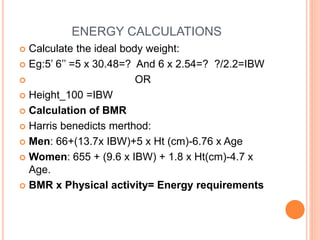
ENERGY CALCULATIONS
 Calculate the ideal body weight:
 Eg:5’ 6’’ =5 x 30.48=? And 6 x 2.54=? ?/2.2=IBW
 OR
 Height_100 =IBW
 Calculation of BMR
 Harris benedicts merthod:
 Men: 66+(13.7x IBW)+5 x Ht (cm)-6.76 x Age
 Women: 655 + (9.6 x IBW) + 1.8 x Ht(cm)-4.7 x
Age.
 BMR x Physical activity= Energy requirements
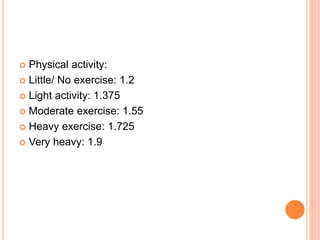
 Physical activity:
 Little/ No exercise: 1.2
 Light activity: 1.375
 Moderate exercise: 1.55
 Heavy exercise: 1.725
 Very heavy: 1.9
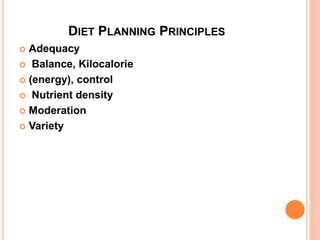
DIET PLANNING PRINCIPLES
 Adequacy
 Balance, Kilocalorie
 (energy), control
 Nutrient density
 Moderation
 Variety
Therapeutic diet introduction              .pptx