The Craft of Research
Digital Paper
Andrew Abbott
Tricks of the Trade
Howard S. Becker
Writing for Social Scientists
Howard S. Becker
What Editors Want
Philippa J. Benson and Susan C. Silver
The Craft of Translation
John Biguenet and Rainer Schulte, editors
The Chicago Guide to Grammar, Usage, and Punctuation
Bryan A. Garner
Legal Writing in Plain English
Bryan A. Garner
From Dissertation to Book
William Germano
Getting It Published
William Germano
From Notes to Narrative
Kristen Ghodsee
Writing Science in Plain English
Anne E. Greene
Cite Right
Charles Lipson
How to Write a BA Thesis
Charles Lipson
The Chicago Guide to Writing about Multivariate Analysis
Jane E. Miller
The Chicago Guide to Writing about Numbers
Jane E. Miller
The Subversive Copy Editor
Carol Fisher Saller
The Writer’s Diet
Helen Sword
A Manual for Writers of Research Papers, Theses, and Dissertations
Kate L. Turabian
Student’s Guide to Writing College Papers
Kate L. Turabian
The Craft of
Research
Fo urt h Ed i t i o n
Wayne C. Booth
Gregory G. Colomb
Joseph M. Williams
Joseph Bizup
William T. FitzGerald
T h e U n i v e r s i t y o f C h i c a g o P r e s s
Chicago & London
Wayne C. Booth (1921–2005) was the George M. Pullman Distinguished Service Professor
Emeritus in English Language and Literature at the University of Chicago. His books included
The Rhetoric of Fiction and For the Love of It: Amateuring and Its Rivals, both published by the
University of Chicago Press.
Gregory G. Colomb (1951–2011) was professor of English at the University of Virginia and the
author of Designs on Truth: The Poetics of the Augustan Mock-Epic.
Joseph M. Williams (1933–2008) was professor in the Department of English Language and
Literature at the University of Chicago and the author of Style: Toward Clarity and Grace.
Joseph Bizup is associate professor in the Department of English at Boston University as well
as assistant dean and director of the College of Arts and Sciences Writing Program. He is the
author of Manufacturing Culture: Vindications of Early Victorian Industry.
William T. FitzGerald is associate professor in the Department of English at Rutgers University.
He is the author of Spiritual Modalities: Prayer as Rhetoric and Performance.
The University of Chicago Press, Chicago 60637
The University of Chicago Press, Ltd., London
© 1995, 2003, 2008, 2016 by The University of Chicago
All rights reserved. Published 2016.
Printed in the United States of America
25 24 23 22 21 20 19 18 17 16 1 2 3 4 5
ISBN-13: 978-0-226-23956-9 (cloth)
ISBN-13: 978-0-226-23973-6 (paper)
ISBN-13: 978-0-226-23987-3 (e-book)
DOI: 10.7208/chicago/9780226239873.001.0001
Library of Congress Cataloging-in-Publication Data
Names: Booth, Wayne C., author. | Colomb, Gregory G., author. | Williams, Joseph M., author. |
Bizup, Joseph, 1966– author. | FitzGerald, William T., author.
Title: The craft of research / Wayne C. Booth, Gregory G. Colomb, Joseph M. Williams, Joseph
Bizup, William T. FitzGerald.
Other titles: Chicago guides to writing, editing, and publishing.
Description: Fourth edition. | Chicago: The University of Chicago Press, 2016. | Series: Chicago
guides to writing, editing, and publishing | Includes bibliographical references and index.
Identifiers: LCCN 2016000143 | ISBN 9780226239569 (cloth: alk. paper) | ISBN
9780226239736 (pbk.: alk. paper) | ISBN 9780226239873 (e-book)
Subjects: LCSH: Research—Methodology. | Technical writing.
Classification: LCC Q180.55.M4 B66 2016 | DDC 001.4/2—dc23 LC record available at http://
lccn.loc.gov/2016000143
♾ This paper meets the requirements of ANSI/NISO Z39.48-1992 (Permanence of Paper).
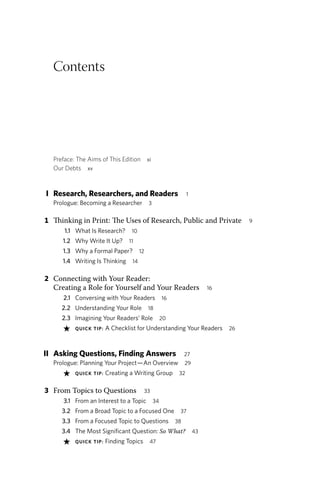
Contents
Preface: The Aims of This Edition xi
Our Debts xv
I Research, Researchers, and Readers 1
Prologue: Becoming a Researcher 3
1 Thinking in Print: The Uses of Research, Public and Private 9
1.1 What Is Research? 10
1.2 Why Write It Up? 11
1.3 Why a Formal Paper? 12
1.4 Writing Is Thinking 14
2 Connecting with Your Reader:
Creating a Role for Yourself and Your Readers 16
2.1 Conversing with Your Readers 16
2.2 Understanding Your Role 18
2.3 Imagining Your Readers’ Role 20
★ QUICK TIP: A Checklist for Understanding Your Readers 26
II Asking Questions, Finding Answers 27
Prologue: Planning Your Project—An Overview 29
★ QUICK TIP: Creating a Writing Group 32
3 From Topics to Questions 33
3.1 From an Interest to a Topic 34
3.2 From a Broad Topic to a Focused One 37
3.3 From a Focused Topic to Questions 38
3.4 The Most Significant Question: So What? 43
★ QUICK TIP: Finding Topics 47
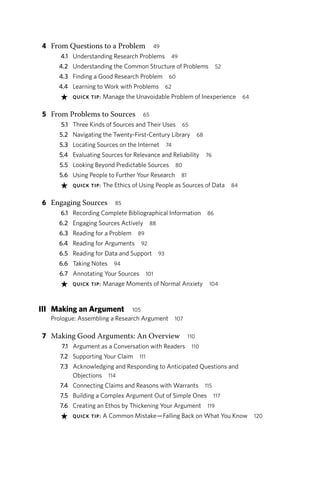
4 From Questions to a Problem 49
4.1 Understanding Research Problems 49
4.2 Understanding the Common Structure of Problems 52
4.3 Finding a Good Research Problem 60
4.4 Learning to Work with Problems 62
★ QUICK TIP: Manage the Unavoidable Problem of Inexperience 64
5 From Problems to Sources 65
5.1 Three Kinds of Sources and Their Uses 65
5.2 Navigating the Twenty-First-Century Library 68
5.3 Locating Sources on the Internet 74
5.4 Evaluating Sources for Relevance and Reliability 76
5.5 Looking Beyond Predictable Sources 80
5.6 Using People to Further Your Research 81
★ QUICK TIP: The Ethics of Using People as Sources of Data 84
6 Engaging Sources 85
6.1 Recording Complete Bibliographical Information 86
6.2 Engaging Sources Actively 88
6.3 Reading for a Problem 89
6.4 Reading for Arguments 92
6.5 Reading for Data and Support 93
6.6 Taking Notes 94
6.7 Annotating Your Sources 101
★ QUICK TIP: Manage Moments of Normal Anxiety 104
III Making an Argument 105
Prologue: Assembling a Research Argument 107
7 Making Good Arguments: An Overview 110
7.1 Argument as a Conversation with Readers 110
7.2 Supporting Your Claim 111
7.3 Acknowledging and Responding to Anticipated Questions and
Objections 114
7.4 Connecting Claims and Reasons with Warrants 115
7.5 Building a Complex Argument Out of Simple Ones 117
7.6 Creating an Ethos by Thickening Your Argument 119
★ QUICK TIP: A Common Mistake—Falling Back on What You Know 120
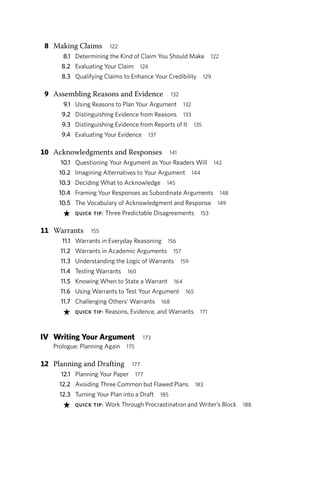
8 Making Claims 122
8.1 Determining the Kind of Claim You Should Make 122
8.2 Evaluating Your Claim 124
8.3 Qualifying Claims to Enhance Your Credibility 129
9 Assembling Reasons and Evidence 132
9.1 Using Reasons to Plan Your Argument 132
9.2 Distinguishing Evidence from Reasons 133
9.3 Distinguishing Evidence from Reports of It 135
9.4 Evaluating Your Evidence 137
10 Acknowledgments and Responses 141
10.1 Questioning Your Argument as Your Readers Will 142
10.2 Imagining Alternatives to Your Argument 144
10.3 Deciding What to Acknowledge 145
10.4 Framing Your Responses as Subordinate Arguments 148
10.5 The Vocabulary of Acknowledgment and Response 149
★ QUICK TIP: Three Predictable Disagreements 153
11 Warrants 155
11.1 Warrants in Everyday Reasoning 156
11.2 Warrants in Academic Arguments 157
11.3 Understanding the Logic of Warrants 159
11.4 Testing Warrants 160
11.5 Knowing When to State a Warrant 164
11.6 Using Warrants to Test Your Argument 165
11.7 Challenging Others’ Warrants 168
★ QUICK TIP: Reasons, Evidence, and Warrants 171
IV Writing Your Argument 173
Prologue: Planning Again 175
12 Planning and Drafting 177
12.1 Planning Your Paper 177
12.2 Avoiding Three Common but Flawed Plans 183
12.3 Turning Your Plan into a Draft 185
★ QUICK TIP: Work Through Procrastination and Writer’s Block 188
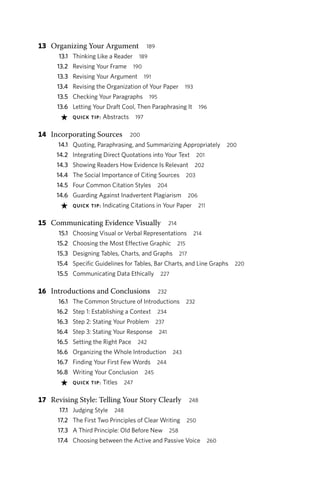
13 Organizing Your Argument 189
13.1 Thinking Like a Reader 189
13.2 Revising Your Frame 190
13.3 Revising Your Argument 191
13.4 Revising the Organization of Your Paper 193
13.5 Checking Your Paragraphs 195
13.6 Letting Your Draft Cool, Then Paraphrasing It 196
★ QUICK TIP: Abstracts 197
14 Incorporating Sources 200
14.1 Quoting, Paraphrasing, and Summarizing Appropriately 200
14.2 Integrating Direct Quotations into Your Text 201
14.3 Showing Readers How Evidence Is Relevant 202
14.4 The Social Importance of Citing Sources 203
14.5 Four Common Citation Styles 204
14.6 Guarding Against Inadvertent Plagiarism 206
★ QUICK TIP: Indicating Citations in Your Paper 211
15 Communicating Evidence Visually 214
15.1 Choosing Visual or Verbal Representations 214
15.2 Choosing the Most Effective Graphic 215
15.3 Designing Tables, Charts, and Graphs 217
15.4 Specific Guidelines for Tables, Bar Charts, and Line Graphs 220
15.5 Communicating Data Ethically 227
16 Introductions and Conclusions 232
16.1 The Common Structure of Introductions 232
16.2 Step 1: Establishing a Context 234
16.3 Step 2: Stating Your Problem 237
16.4 Step 3: Stating Your Response 241
16.5 Setting the Right Pace 242
16.6 Organizing the Whole Introduction 243
16.7 Finding Your First Few Words 244
16.8 Writing Your Conclusion 245
★ QUICK TIP: Titles 247
17 Revising Style: Telling Your Story Clearly 248
17.1 Judging Style 248
17.2 The First Two Principles of Clear Writing 250
17.3 A Third Principle: Old Before New 258
17.4 Choosing between the Active and Passive Voice 260
17.5 A Final Principle: Complexity Last 262
17.6 Spit and Polish 265
★ QUICK TIP: The Quickest Revision Strategy 266
V Some Last Considerations 269
The Ethics of Research 271
A Postscript for Teachers 275
Appendix: Bibliographical Resources 281
Index 313
Preface
THE AIMS OF THIS EDITION
This fourth edition of The Craft of Research is the first to appear
since the deaths of the book’s three original authors, Wayne C.
Booth, Gregory G. Colomb, and Joseph M. Williams. In undertak-
ing this revision, we—Joseph Bizup and William T. FitzGerald—
faced the pleasurable and challenging task of reworking a book we
have both long admired. Our goal has been to update and refine it
without appropriating it from its original authors.
The fourth edition has the same main aim as the first three: to
meet the needs of all researchers, not just first-year undergradu-
ates and advanced graduate students, but even those in business
and government who do and report research on any topic, aca-
demic, political, or commercial. The book was written to
• guide you through the complexities of turning a topic or ques-
tion into a research problem whose significance matches the
effort that you put into solving it;
• help you organize and draft a report that justifies the effort;
• show you how to read your report as your readers will so that
you can revise it into one that they will read with the under-
standing and respect it deserves.
Other handbooks touch on these matters, but this one is dif-
ferent. Most current guides acknowledge that researchers rarely
move in a straight line from finding a topic to stating a thesis to
filling in note cards to drafting and revision. Experienced research-
ers loop back and forth, move forward a step or two before going
xii Preface
back in order to move ahead again, change directions, all the while
anticipating stages not yet begun. But so far as we know, no other
guide tries to explain how each part of the process influences all
the others—how developing a project prepares the researcher for
drafting, how drafting can reveal problems in an argument, how
writing an introduction can prompt you to do more research.
In particular, the book tries to be explicit about matters that
other guides treat as a mysterious creative process beyond analysis
and explanation, including
• how to turn a vague interest into a problem readers think is
worth posing and solving;
• how to build an argument that motivates readers to take your
claim seriously;
• how to anticipate the reservations of thoughtful but critical
readers and then respond appropriately;
• how to create an introduction and conclusion answering that
toughest of questions from readers, So what?;
• how to read your own writing as readers will, and thereby
know when and how to revise it.
Central in every chapter is the advice to side with your readers, to
imagine how they will judge what you have written.
The book addresses the formal elements common to most
genres of research-based writing not just because writers need
to understand their superficial shape but also because they help
writers think. These genres—the research paper, the research re-
port, the white paper, and many others—are not empty patterns or
forms: they also embody and enable specific ways of working and
arguing; they help us all to develop and refine our projects, test our
work, and even discover new lines of thought. How we write thus
affects how we argue and research, and vice versa. In this sense, to
learn the genres of one’s field is to learn the field itself.
The book is informed by another conviction as well: that the
skills of research and research-based writing are not just for the
elite but can be learned by everyone. Some aspects of advanced re-
The Aims of This Edition xiii
search can be learned only in the context of a specific community
of researchers, but even if you don’t yet belong to one, you can still
create something like it on your own. Our “Postscript for Teachers”
suggests ways you (and your teachers) can do that.
WHAT THIS EDITION DOES NOT ADDRESS
Like the previous editions of The Craft of Research, this fourth
edition treats research generally. It does not discuss how to in-
corporate narratives, “thick descriptions,” or audiovisual forms of
evidence into your arguments. They are important topics, but too
large for us to do justice to them here. Nor does this edition cover
research techniques that are specific to particular fields. Likewise,
while it discusses the principles that should guide online research,
it does not attempt to describe the vast array of specialized search
tools and databases now available online and through the library.
Our bibliography suggests a number of sources for guidance in
those areas.
WHAT’S NEW IN THIS EDITION
In preparing this fourth edition, we have kept in mind the positive
reception of earlier editions and the wide audience they attracted,
an audience that ranges from first-year students in composition
classes, to graduate students and other advanced researchers, and
even to professionals working in fields such as business, medicine,
and law. Indeed, this audience is an international one: the book has
been translated into Russian, Spanish, Portuguese, Korean, Japa-
nese, and Chinese.
What we have been most mindful of is that The Craft of Re-
search is the result of an extraordinary collaboration among three
gifted teachers and scholars in whose footsteps we are proud to
follow. While seeking to help the book speak to new generations
of researchers, we have also striven to honor and retain the per-
spective, content, and voice that have made The Craft of Research a
recognized classic. Those who are familiar with earlier editions will
discover that this edition is faithful to the book’s vision and overall
xiv Preface
structure. At the same time, each chapter has been thoroughly up-
dated to reflect the contemporary landscape of research.
Here, concretely, is what we’ve done:
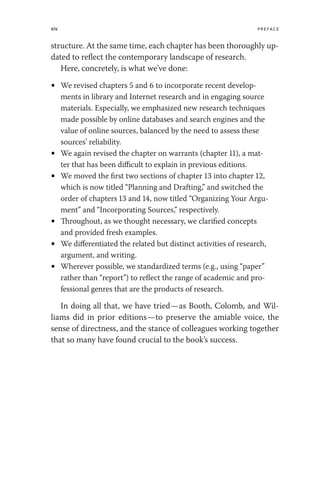
• We revised chapters 5 and 6 to incorporate recent develop-
ments in library and Internet research and in engaging source
materials. Especially, we emphasized new research techniques
made possible by online databases and search engines and the
value of online sources, balanced by the need to assess these
sources’ reliability.
• We again revised the chapter on warrants (chapter 11), a mat-
ter that has been difficult to explain in previous editions.
• We moved the first two sections of chapter 13 into chapter 12,
which is now titled “Planning and Drafting,” and switched the
order of chapters 13 and 14, now titled “Organizing Your Argu-
ment” and “Incorporating Sources,” respectively.
• Throughout, as we thought necessary, we clarified concepts
and provided fresh examples.
• We differentiated the related but distinct activities of research,
argument, and writing.
• Wherever possible, we standardized terms (e.g., using “paper”
rather than “report”) to reflect the range of academic and pro-
fessional genres that are the products of research.
In doing all that, we have tried—as Booth, Colomb, and Wil-
liams did in prior editions—to preserve the amiable voice, the
sense of directness, and the stance of colleagues working together
that so many have found crucial to the book’s success.
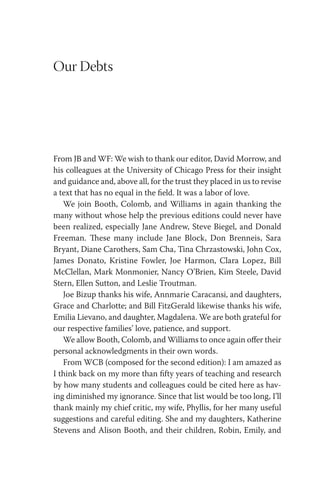
Our Debts
From JB and WF: We wish to thank our editor, David Morrow, and
his colleagues at the University of Chicago Press for their insight
and guidance and, above all, for the trust they placed in us to revise
a text that has no equal in the field. It was a labor of love.
We join Booth, Colomb, and Williams in again thanking the
many without whose help the previous editions could never have
been realized, especially Jane Andrew, Steve Biegel, and Donald
Freeman. These many include Jane Block, Don Brenneis, Sara
Bryant, Diane Carothers, Sam Cha, Tina Chrzastowski, John Cox,
James Donato, Kristine Fowler, Joe Harmon, Clara Lopez, Bill
McClellan, Mark Monmonier, Nancy O’Brien, Kim Steele, David
Stern, Ellen Sutton, and Leslie Troutman.
Joe Bizup thanks his wife, Annmarie Caracansi, and daughters,
Grace and Charlotte; and Bill FitzGerald likewise thanks his wife,
Emilia Lievano, and daughter, Magdalena. We are both grateful for
our respective families’ love, patience, and support.
We allow Booth, Colomb, and Williams to once again offer their
personal acknowledgments in their own words.
From WCB (composed for the second edition): I am amazed as
I think back on my more than fifty years of teaching and research
by how many students and colleagues could be cited here as hav-
ing diminished my ignorance. Since that list would be too long, I’ll
thank mainly my chief critic, my wife, Phyllis, for her many useful
suggestions and careful editing. She and my daughters, Katherine
Stevens and Alison Booth, and their children, Robin, Emily, and
xvi Our Debts
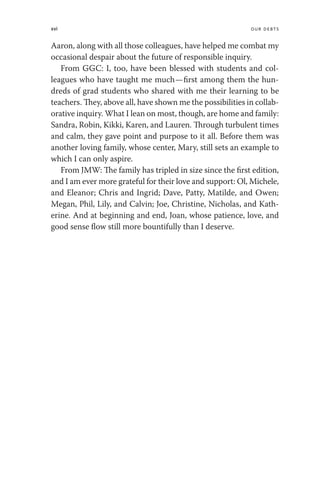
Aaron, along with all those colleagues, have helped me combat my
occasional despair about the future of responsible inquiry.
From GGC: I, too, have been blessed with students and col-
leagues who have taught me much—first among them the hun-
dreds of grad students who shared with me their learning to be
teachers. They, above all, have shown me the possibilities in collab-
orative inquiry. What I lean on most, though, are home and family:
Sandra, Robin, Kikki, Karen, and Lauren. Through turbulent times
and calm, they gave point and purpose to it all. Before them was
another loving family, whose center, Mary, still sets an example to
which I can only aspire.
From JMW: The family has tripled in size since the first edition,
and I am ever more grateful for their love and support: Ol, Michele,
and Eleanor; Chris and Ingrid; Dave, Patty, Matilde, and Owen;
Megan, Phil, Lily, and Calvin; Joe, Christine, Nicholas, and Kath-
erine. And at beginning and end, Joan, whose patience, love, and
good sense flow still more bountifully than I deserve.
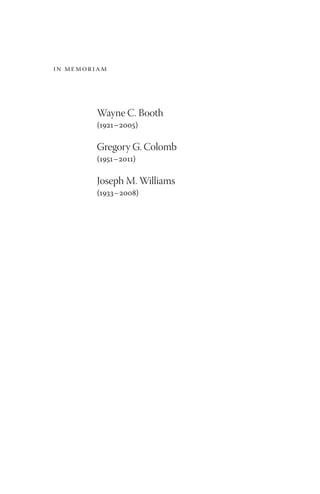
In MeMorIaM
Wayne C. Booth
(1921–2005)
Gregory G. Colomb
(1951–2011)
Joseph M. Williams
(1933–2008)
PA R T I
Research,
Researchers, and
Readers
P R O L O G U E
Becoming a Researcher
WHO NEEDS RESEARCH?
When you think of a researcher, what do you imagine? Someone in
a lab coat peering into a microscope? A solitary figure taking notes
in a library? That’s what most people imagine. But you might have
also pictured MSNBC’s Rachel Maddow, HBO’s John Oliver, or
anyone who prepares extensively before writing or speaking. Like
just about every successful person, they are not only experts in do-
ing research, but in using the research of others. In fact, that’s part
of what makes them successful. In an aptly named “age of informa-
tion,” they have learned not only how to find information, but how
to evaluate it, then how to report it clearly and accurately. (Often,
they challenge misinformation.) More than ever, those skills are
essential for success in any profession.
You may not yet be a professional, but learning to do research
now will help you today and prepare you for what’s to come. First,
it will help you understand what you read as nothing else will. You
can accurately judge the research of others only after you’ve done
your own and can understand the messy reality behind what is so
smoothly and confidently presented in your textbooks or by ex-
perts on TV. The Internet and cable TV flood us with “facts” about
the government, the economy, the environment, and the products
we buy. Some of these facts are sound, though many are not. That’s
why, as you learn to do research, you’ll also learn to value reliable
research reported clearly and accurately.
You’ll discover both how new knowledge depends on what ques-
tions you ask and how the way you think about and communicate
4 Prologue
your research shapes those questions and your answers. Most im-
portant, you’ll come to understand how the knowledge we all rely
on depends on the quality of the research that supports it and the
accuracy of its reporting. Although some might think it idealistic,
another reason for doing research is the sheer pleasure of solving a
puzzle, of discovering something that no one else knows.
But learning to do research is not like learning to ride a bike, the
sort of thing you learn once and never forget. Each of us has started
projects that forced us to rethink how we do our work. Whenever
we’ve addressed a new research community, we’ve had to learn its
ways to help us understand what its members think is important.
But even then, we could still rely on principles that all researchers
follow, principles that we describe in this book. We think you will
find them useful as your projects and readers become more de-
manding, both in school and after.
We must be candid, though: doing research carefully and re-
porting it clearly are hard work, consisting of many tasks, often
competing for your attention at the same time. And no matter
how carefully you plan, research follows a crooked path, taking
unexpected turns, sometimes up blind alleys, even looping back on
itself. As complex as that process is, we will work through it step-
by-step so that you can see how its parts work together. When you
can manage its parts, you can manage the often intimidating whole
and look forward to doing more research with greater confidence.
STARTING A RESEARCH PROJECT
If you are beginning your first project, the task may seem over-
whelming: How do I focus on a topic? Where do I find information
on it? What do I do when I find it? Even if you’ve done a “research
paper” in a writing class, the idea of another may be even more
intimidating if this time it’s the real thing. If so, you’re not alone.
Even experienced researchers feel anxious when they tackle a new
kind of project for a new audience. So whatever anxiety you feel,
most researchers have felt it too. The difference is that experienced
researchers know what lies ahead—hard work, but also pleasure;
some frustration, but more satisfaction; periods of confusion, but
Becoming a Researcher 5
confidence that, in the end, it will all come together and that the re-
sult is worth the effort. Most of all, experienced researchers know
how to get from start to finish not easily, perhaps, but as efficiently
as the complexity of their task allows. That’s the aim of this book.
WORKING WITH A PLAN
You will struggle with your project if you don’t know what readers
look for in a paper or how to help them find it. Experienced re-
searchers know that they most often produce a sound paper when
they have a plan, no matter how rough, even if only in their heads.
In fact, they create two kinds of plans: the first helps them pre-
pare and conduct their research; the second helps them draft their
paper.
They usually begin with a question and a plan to guide their
search for an answer. They may not know exactly what they’ll find,
but they know generally what it will look like, even if it surprises
them. They also know that once they have an answer, they don’t
just start writing, any more than an experienced carpenter just
starts sawing. They draw up a second plan, a rough blueprint for
a first draft—maybe no more than a sketch of an outline. Shrewd
researchers, though, don’t let that plan box them in: they change it
if they run into a problem or discover something that leads them in
a new direction. But before they start a first draft, they begin with
some plan, even when they know they’ll almost certainly change it.
That plan for a draft helps researchers write, but it also helps
their readers read. In fact, researchers of all kinds use standard
forms to anticipate what readers look for:
• A newspaper reporter writes her story in traditional “pyramid”
form, putting the most important information first, not just to
make her job of drafting easier, but also so that her readers can
find the gist of the news quickly, then decide whether to read on.
• An accountant follows a standard form for her audit report not
just to organize her own writing, but so that investors can find the
information they need to decide whether the company is another
Enron or the next Apple.
6 Prologue
• A Food and Drug Administration scientist follows the predictable
form for a scientific report—introduction, methods and mate-
rials, results, discussion, conclusion—not just to order his own
thoughts coherently, but to help readers find the specific issues
they have to consider before they accept his findings.
Within these forms, or genres, writers are free to emphasize differ-
ent ideas, to put a personal stamp on their work. But they know
that a plan helps them write efficiently and, no less important,
helps their readers read productively.
This book will help you create and execute a plan for doing your
research and another for reporting it in ways that not only encour-
age your best thinking but help your readers see its value.
HOW TO USE THIS BOOK
The best way to deal with the complexity of research (and its anx-
ieties) is to read this book twice. First skim it to understand what
lies ahead (flip past what seems tedious or confusing). But then as
you begin your work, carefully read the chapters relevant to your
immediate task. If you are new to research, reread from the begin-
ning. If you are in an intermediate course but not yet at home in
your field, skim part I, then concentrate on the rest. If you are an
experienced researcher, you will find chapter 4 and parts III and
IV most useful.
In part I, we address what those undertaking their first project
must think about deliberately: why readers expect us to write up
our research in particular ways (chapter 1), and why you should
think of your project not as solitary labor but as a conversation
with those whose work you read and with those who will in turn
read your work (chapter 2).
In part II, we discuss how to frame and develop your project.
We explain
• how to find a topic in an interest, then how to focus and question
it (chapter 3);
• how to transform those questions into a research problem (chap-
ter 4);
Becoming a Researcher 7
• how to find sources to guide your search for answers (chapter 5);
• how to engage sources in ways that encourage your own best
thinking (chapter 6).
In part III, we discuss how to assemble a sound case in support
of your claim. That includes
• an overview of a research argument (chapter 7);
• how to evaluate your claim for its significance (chapter 8);
• how to judge what count as good reasons and sound evidence
(chapter 9);
• how to acknowledge and respond to questions, objections, and
alternative views (chapter 10);
• how to make the logic of your argument clear (chapter 11).
In part IV, we lay out the steps in producing your paper:
• how to plan and execute a first draft (chapter 12);
• how to test and revise it (chapter 13);
• how to incorporate sources (chapter 14);
• how to present complex quantitative evidence clearly and point-
edly (chapter 15);
• how to write an introduction and conclusion that convince read-
ers your argument is worth their time (chapter 16);
• how to edit your style to make it clear, direct, and readable (chap-
ter 17).
Between some of the chapters you will find “Quick Tips,” brief
sections that complement the chapters with practical advice.
In an afterword, “The Ethics of Research,” we reflect on a matter
that goes beyond professional competence. Doing and reporting
research is a social activity with ethical implications. We often read
about the dishonest research of historians, scientists, stock ana-
lysts, and others. And we see plagiarism among writers at all lev-
els of achievement, from secondary-school students to leaders of
their professions. Such events highlight the importance of doing
and using your research ethically.
In a concluding essay, we address those who teach research. At
8 Prologue
the end of the book is a bibliography of sources for beginning re-
searchers and for advanced researchers in particular fields.
Research is hard work, but like any challenging job done well,
both its process and its results can bring great satisfaction. No
small part of that satisfaction comes from knowing that your work
sustains the fabric of a community of people who share your inter-
ests, especially when you discover something that you believe can
improve your readers’ lives by changing what and how they think.
1 Thinking in Print
The Uses of Research, Public and Private
In this chapter, we define research, then discuss how you benefit from learning to do
it well, why we value it, and why we hope you will too.
Whenever we read about a scientific breakthrough or a crisis in
world affairs, we benefit from the research of those who report
it, who in turn benefited from the research of countless others.
When we walk into a library, we are surrounded by more than
twenty-five centuries of research. When we go on the Internet, we
can read millions of reports written by researchers who have posed
questions beyond number, gathered untold amounts of informa-
tion from the research of others to answer them, then shared their
answers with the rest of us so that we can carry on their work by
asking new questions and, we hope, answering them.
Teachers at all levels devote their lives to research. Govern-
ments spend billions on it, businesses even more. Research goes on
in laboratories and libraries, in jungles and ocean depths, in caves
and in outer space, in offices and, in the information age, even in
our own homes. Research is in fact the world’s biggest industry.
Those who cannot do it well or evaluate that of others will find
themselves sidelined in a world increasingly dependent on sound
ideas based on good information produced by trustworthy inquiry
and then presented clearly and accurately.
Without trustworthy published research, we all would be locked
in the opinions of the moment, prisoners of what we alone experi-
ence or dupes to whatever we’re told. Of course, we want to believe
that our opinions are sound. Yet mistaken ideas, even dangerous
ones, flourish because too many people accept too many opinions
based on too little evidence. And as recent events have shown,
10 chapter one
those who act on unreliable evidence can lead us—indeed have
led us—into disaster.
That’s why in this book we will urge you to be amiably skeptical
of the research you read, to question it even as you realize how
much you depend on it.
1.1 WHAT IS RESEARCH?
In the broadest terms, we do research whenever we gather infor-
mation to answer a question that solves a problem:
problem: Where do I find a new head gasket for my ’65 Mustang?
research: Look in the yellow pages for an auto-parts store, then call to
see if it has one in stock.
problem: To settle a bet, I need to know when Michael Jordan was born.
research: You Google “Michael Jordan birthday.”
problem: I’m just curious about a new species of fish.
research: You search the Internet for articles in newspapers and aca-
demic journals.
We all do that kind of research every day, and though we rarely
write it up, we rely on those who wrote up theirs: Jordan’s biogra-
phers, the fish discoverers, the publishers of the yellow pages and
the catalogs of the auto-parts suppliers—they all wrote up their
research because they knew that one day someone would have a
question that they could answer.
If you’re preparing to do a research project not because you want
to but because it’s been assigned, you might think that it is just
make-work and treat it as an empty exercise. We hope you won’t.
Done well, your project prepares you to join the oldest and most
esteemed of human conversations, one conducted for millennia
among philosophers, engineers, biologists, social scientists, histo-
rians, literary critics, linguists, theologians, not to mention CEOs,
lawyers, marketers, investment managers—the list is endless.
Right now, if you are a beginner, you may feel that the conversa-
tion is one-sided, that you have to listen more than you can speak
because you have little to contribute. If you are a student, you may
Thinking in Print 11
feel that you have only one reader: your teacher. All that may be
true, for the moment. But at some point, you will join a conver-
sation that, at its best, can help you and your community free us
from ignorance, prejudice, and the half-baked ideas that so many
charlatans try to impose on us. It is no exaggeration to say that,
maybe not today or tomorrow but one day, the research you do
and the arguments you make using it can improve if not the whole
world, then at least your corner of it.
1.2 WHY WRITE IT UP?
For some of you, though, the invitation to join this conversation
may still seem easy to decline. If you accept it, you’ll have to find
a good question, search for sound data, formulate and support a
good answer, and then write it all up. Even if you turn out a first-
rate paper, it may be read not by an eager world but only by your
teacher. And, besides, you may think, my teacher knows all about
my topic. What do I gain from writing up my research, other than
proving I can do it?
One answer is that we write not just to share our work, but to
improve it before we do.
1.2.1 Write to Remember
Experienced researchers first write just to remember what they’ve
read. A few talented people can hold in mind masses of informa-
tion, but most of us get lost when we think about what Smith found
in light of Wong’s position, and compare both to the odd data in
Brunelli, especially as they are supported by Boskowitz—but what
was it that Smith said? When you don’t take notes on what you
read, you’re likely to forget or, worse, misremember it.
1.2.2 Write to Understand
A second reason for writing is to see larger patterns in what you
read. When you arrange and rearrange the results of your research
in new ways, you discover new implications, connections, and
complications. Even if you could hold it all in mind, you would
need help to line up arguments that pull in different directions,
12 chapter one
plot out complicated relationships, sort out disagreements among
experts. I want to use these claims from Wong, but her argument is
undercut by Smith’s data. When I put them side by side, I see that
Smith ignores this last part of Wong’s argument. Aha! If I introduce
it with this part from Brunelli, I can focus on Wong more clearly.
That’s why careful researchers never put off writing until they’ve
gathered all the data they need: they write from the start of their
projects to help them assemble their information in new ways.
1.2.3 Write to Test Your Thinking
A third reason to write is to get your thoughts out of your head
and onto paper, where you’ll see what you really can think. Just
about all of us, students and professionals alike, believe our ideas
are more compelling in the dark of our minds than they turn out
to be in the cold light of print. You can’t know how good your
ideas are until you separate them from the swift and muddy flow
of thought and fix them in an organized form that you—and your
readers—can study.
In short, we write to remember more accurately, understand
better, and evaluate what we think more objectively. (And as you
will discover, the more you write, the better you read.)
1.3 WHY A FORMAL PAPER?
But even when they agree that writing is an important part of
learning, thinking, and understanding, some still wonder why they
can’t write up their research in their own way, why they have to sat-
isfy demands imposed by a community that they have not joined
(or even want to) and conform to conventions they did nothing to
create. Why should I adopt language and forms that are not mine?
Aren’t you just trying to turn me into an academic like yourself? If I
write as you expect me to, I risk losing my identity.
Such concerns are legitimate (most teachers wish students
would raise them more often). But it would be a feeble education
that did not change you at all, and the deeper your education, the
more it will change the “you” that you are or want to be. That’s
why it is so important to choose carefully what you study and with
Thinking in Print 13
whom. But it would be a mistake to think that learning to report
sound research must threaten your true identity. It will change the
way you think, but only by giving you more ways of thinking. You
will be different by being freer to choose whom you want to be and
what you want to do with your life.
But the most important reason for learning to write in ways
readers expect is that when you write for others, you demand more
of yourself than when you write for yourself alone. By the time you
fix your ideas in writing, they are so familiar to you that you need
help to see them not for what you want them to be but for what
they really are. You will understand your own work better when
you try to anticipate your readers’ inevitable and critical questions:
How have you evaluated your evidence? Why do you think it’s rele-
vant? What ideas have you considered but rejected?
All researchers, including us, can recall moments when in writ-
ing to meet their readers’ expectations, they found a flaw or blun-
der in their thinking or even discovered a new insight that escaped
them in a first draft written for themselves. You can do that only
once you imagine and then meet the needs and expectations of
informed and careful readers. When you do that, you create what
we call a rhetorical community of shared values.
You might think, OK, I’ll write for readers, but why not in my
own way? The traditional forms that readers expect are more than
just empty vessels into which you must pour your ideas. They also
help writers think and communicate in ways they might not other-
wise, and they embody the shared values of a research community.
Whatever community you join, you’ll be expected to show that you
understand its practices by presenting your research in the standard
forms, or genres, that a community uses to represent what it knows
and how it knows. The various genres of research-based writing—
the research paper, the scholarly article, the research report, the
conference paper, the legal brief, and a great many others—have
evolved to meet the needs of the communities that use them. Rela-
tively stable, they allow both newcomers and longtime members of
a community to come together through shared practices and expec-
tations. Once you know the genres that belong to and define your
14 chapter one
particular research community, you’ll be better able to answer your
community’s predictable questions and understand what its mem-
bers care about and why. As you learn to write the genres of a field
or profession, you become a member of that research community.
But as different as research communities are, what counts as
good work is the same, whether it’s in the academic world or the
world of government, commerce, or technology. If you learn to do
research well now, you gain an immense advantage in the kind of
research you will do later, no matter where you do it.
1.4 WRITING IS THINKING
Writing up your research is, finally, thinking with and for your
readers. When you write for others, you disentangle your ideas
from your memories and wishes, so that you—and others—can
explore, expand, combine, and understand them more fully. Think-
ing for others is more careful, more sustained, more insightful—in
short, more thoughtful—than just about any other kind of thinking.
You can, of course, take the easy way: do just enough to sat-
isfy your teacher. This book will help you do that, but you’ll short-
change yourself if that’s all you do. If instead you find a topic that
you care about, ask a question that you want to answer, then pursue
that answer as best you can, your project can have the fascination
of a mystery whose solution richly rewards your efforts. Nothing
contributes more to successful research than your commitment to
Some of the world’s most important research has been done by those
who persevered in the face of indifference or even hostility, because
they never lost faith in their vision. The geneticist Barbara McClintock
struggled for years unappreciated because her research community
considered her work uninteresting. But she believed in it and pressed
on. When her colleagues finally realized that she had already answered
questions that they were just starting to ask, she won science’s highest
honor, the Nobel Prize.
Thinking in Print 15
it, and nothing teaches you more about how to think than making
a successful (or even unsuccessful) argument using it.
We wish we could tell you how to balance your belief in the
worth of your project with the need to accommodate the demands
of teachers and colleagues, but we cannot. If you believe in what
you’re doing and cannot find anyone else who shares your be-
liefs, all you can do is put your head down and press on. With our
admiration.
2 Connecting with Your Reader
Creating a Role for Yourself and Your Readers
Research counts for little if few read it. Yet even experienced researchers sometimes
forget to keep their readers in mind as they plan and draft. In this chapter, we show
you how to think about readers even before you begin your project.
Most of the important things we do, we do with others. Some stu-
dents think research is different. They imagine the lone scholar in
a hushed library. But no place is more filled with imagined voices
than a library or lab. The view of research you see walking by these
sites is only part of the story. When you read a book or a scientific
paper, you silently converse with its writers—and through them
with everyone else they have read. In fact, every time you go to a
written source for information, you join a conversation between
writers and readers that began more than five thousand years ago.
And when you report your own research, you add your voice and
can hope that other voices will respond to you, so that you can in
turn respond to them. So it goes and, we hope, will continue for a
long time to come.
2.1 CONVERSING WITH YOUR READERS
Conversations are social activities in which we are expected to
play our parts. Face-to-face, we can judge how well we and others
do that by sensing how a conversation is going. Do we treat each
other as equals, speaking and listening civilly, answering each oth-
er’s questions directly? Or does one of us seem to be playing the
role of expert, assigning others the role of audience? We can judge
how well a conversation is going as we have it, and we can adjust
our roles and behavior to repair mistakes and misunderstandings
as they occur. But writing is an imagined conversation. Once we
decide what role to play and what role to assign our readers, those
roles are fixed. If as we read we think, Well, Abrams acknowledges
Connecting with Your Reader 17
Stanik’s evidence, but he’s dogmatic in criticizing it and ignores ob-
vious counterexamples, Abrams can’t change what we read next to
recover from our judgment.
Of course, judgments go both ways: just as readers judge writ-
ers, so writers also judge readers, but they do so before they write.
Consider these two sentences:
Interruption of REM sleep has been shown not only to inhibit memory
consolidation, especially for declarative memories, but also to sig-
nificantly impair cognitive processes dependent on working memory
function.
If you don’t get enough sleep, not only will you struggle to retain facts
and concepts, but your working memory function will also be impaired,
making it difficult for you to hold information in mind and consequently
to understand, think, and learn.
Both writers make judgments about their readers’ needs and
goals. The first addresses herself to knowledgeable colleagues in-
terested in learning about the psychology of sleep and memory.
She therefore focuses on abstract concepts and freely uses techni-
cal terms. The second presents himself as an expert patiently ex-
plaining a complicated matter to readers who know little about it,
and so he largely avoids technical vocabulary. He also assumes that
his readers want practical advice, and so he addresses them directly
as “you” and shows them what his information means to them.
The two sentences are very different: the first reads like an ex-
cerpt from an advanced textbook; the second, like it comes from
a guide on good study habits. But both would be effective if their
writers judged their readers correctly.
But suppose the writers switched passages. Readers ignorant of
cognitive psychology looking for practical advice would think that
the writer of the first was indifferent to their needs; readers knowl-
edgeable about sleep and memory would think that the writer of
the second was talking down to them. When writers misjudge their
readers in this way, they risk losing them.
In fact, writers can’t avoid creating some role for themselves and
18 chapter two
their readers, planned or not. So those roles are worth thinking
about from the beginning, before you write a word. If you ignore
or miscast your readers, you’ll leave so many traces of that mistake
in your early drafts that you won’t easily fix them in the final one.
In writing this book, we tried to imagine you—what you’re
like, what you know about research, whether you even care about
it. We imagined a persona for you, a role we hoped you would
adopt: someone who is interested in learning how to do and re-
port research and who shares our belief in its importance (or at
least is open to being persuaded). Then we imagined a persona of
our own: writers committed to the value of research, interested
in sharing how it works, talking not at you like a lecturer or down
to you like a pedant, but with the “you” we hoped you want to be-
come. We tried to speak as easily to those of you starting your first
project as to those of you doing advanced work. We hoped that
new researchers would not be frustrated when we discussed issues
they haven’t yet faced and that more experienced readers would
be patient as we covered familiar ground. Only you can judge how
well we’ve succeeded.
2.2 UNDERSTANDING YOUR ROLE
Since few people read formal research papers for entertainment,
you have to create a relationship that encourages them to see why
it’s in their interest to read yours. That’s not easy. Too many be-
ginning researchers offer readers a relationship that caricatures a
bad classroom: Teacher, I know less than you. So my role is to show
you how many facts I can dig up. Yours is to say whether I’ve found
enough to give me a good grade. Do that and you turn your proj-
ect into a pointless drill that demeans both you and your teacher.
Worse, you cast yourself in a role exactly opposite to that of a true
researcher.
In true research, you must switch the roles of student and
teacher. When you do research, you learn something that others
don’t know. So when you report it, you must think of your reader
as someone who doesn’t know it but needs to and yourself as some-
one who will give her reason to want to know it. You must imagine
Connecting with Your Reader 19
a relationship that goes beyond Here are some facts I’ve dug up
about fourteenth-century Tibetan weaving. Are they enough of the
right ones?
There are three better reasons for offering those facts; the third
is most common in academic research.
2.2.1 I’ve Found Some New and Interesting Information
You take the first step toward true research when you say to your
reader, Here are some facts about fourteenth-century Tibetan
weaving that you do not know and may find interesting. This offer
assumes, of course, that your reader wants to know. But even if
not, you must still cast yourself in the role of someone who has
found something your reader will find interesting and your reader
as someone who wants to know, whether she really will or not.
Down the road, you’ll be expected to find (or create) a community
of readers who not only share an interest in your topic (or can be
convinced to), but also have questions about it that you can an-
swer. But even if you don’t have that audience right now, you must
write as if you do. You must present yourself as interested in, even
enthusiastic about, wanting to share something new, because the
interest you show in your work roughly predicts the interest your
reader will take in it.
2.2.2 I’ve Found a Solution to an Important Practical Problem
You take a step toward more significant research when you can say
to readers not just Here are some facts that should interest you, but
These facts will help you do something to solve a problem you care
about. That is the kind of research that people do every day in busi-
ness, government, and the professions. They confront practical
problems whose solutions require research into the facts of the mat-
ter, first to understand the problem, then to figure out how to solve
it—problems ranging from insomnia to falling profits to terrorism.
To help new researchers learn that role, teachers sometimes
invent “real world” scenarios: an environmental science professor
might assign you to write a report for the director of the state En-
vironmental Protection Agency on how to clean up a local lake. In
20 chapter two
this scenario you are playing the role not of a student delivering
data to a teacher, but of a professional giving practical advice to
someone who needs it. To make your report credible, however,
you must use the right terminology, cite the right sources, find and
present the right evidence, all in the right format. But most import-
ant, you have to design your report around a specific intention that
defines your role: to advise a decision maker on what to do to solve
a problem. That kind of research is typical in the world at large but
is less common in academic research than the next one.
2.2.3 I’ve Found an Answer to an Important Question
Although academic researchers sometimes advise EPA directors
on what to do, their more common role is that of scholars who
help their research community simply understand something bet-
ter. Others might use their findings to solve a practical problem—a
discovery about the distribution of prime numbers, for example,
helped cryptologists design an unbreakable code. But that research
itself was aimed at solving not the practical problem of keeping
secrets, but the conceptual problem of not entirely understanding
prime numbers. Some researchers call this kind of research “pure”
as opposed to “applied.”
Teachers occasionally invent “real world” scenarios involving
conceptual problems: a political science professor asks you to play
the role of a senator’s intern researching the voting habits of out-
of-state college students. But more typically they expect you to
imagine yourself as what you are learning to be: a researcher ad-
dressing a community of other researchers interested in issues that
they want to understand better. Your report on fourteenth-century
Tibetan weaving, for example, could possibly help rug designers
sell more rugs, but its main aim is to help scholars better under-
stand something about Tibetan art, such as How did fourteenth-
century Tibetan rugs influence the art of modern China?
2.3 IMAGINING YOUR READERS’ ROLE
You establish your side of the relationship with your readers when
you adopt one of those three roles—I have information for you; I
Connecting with Your Reader 21
can help you fix a problem; I can help you understand something
better. You must, however, cast your readers in a complementary
role by offering them a social contract: I’ll play my part if you play
yours. But that means you have to understand their role. If you cast
them in a role they won’t accept, you’re likely to lose them entirely.
In this case, the old advice to “consider your audience” means that
you must report your research in a way that motivates your readers
to play the role you have imagined for them.
For example, suppose you’re an expert on blimps and zeppe-
lins. You’ve been asked to share your research with three different
groups with three different reasons for wanting to hear about it.
How they receive you will depend on how accurately you imagine
the role each intends to play and how well you match your role
to theirs. For that, you must understand what they want and what
they are in return willing and able to do for you.
2.3.1 Entertain Me
Imagine the first group that invited you to speak is the local Zep-
pelin Club. Its members are not experts, but they know a lot about
zeppelins. They read about them, visit historic sites, and collect
zeppelin memorabilia. You decide to share some new facts you’ve
found in a letter from your Great-Uncle Otto describing his trans-
atlantic zeppelin flight in 1936, along with some photographs and
a menu he saved. His letter comments on the grilled oysters he had
for dinner and tells a funny story about why he happened to take
the trip in the first place.
In planning your talk, you judge that what’s at stake is just a
diverting hour of zeppelin trivia. You meet your side of the bar-
gain when you share whatever you think might interest them—
hunches, speculation, even unsubstantiated rumors. You won’t
show PowerPoint slides, present data, or cite scholarly sources to
substantiate your claims. Your audience will play its role by listen-
ing with interest, asking questions, maybe sharing their own anec-
dotes. You don’t expect them to challenge the authenticity of the
letter from Great-Uncle Otto or question how the photos are rel-
evant to the social history of zeppelins, much less of lighter-than-
22 chapter two
air travel in general. Your job is to give an engaging talk; theirs is
to be amiably engaged.
Some beginning researchers imagine their readers belong to a
Zeppelin Club, already fascinated by their topic and eager to hear
anything new about it. While that sometimes works for experts
with the right audience (see the box on page 24), it rarely works for
students learning to do and report serious research. Your teachers
expect you to report not just what you find, but what you can do
with it.
2.3.2 Help Me Solve My Practical Problem
Imagine that your next meeting is with True-to-Life Films. They
plan to make a movie about a zeppelin flight in 1936 and want you
to help them get the historical details right, including a scene in the
dining cabin. They want to know how the cabin was furnished, what
people ate, what the menus looked like, and so on. They don’t care
whether your facts are new, only whether they are right, so that they
can make the scene authentic. You show them your photos and the
menu and describe the oysters Great-Uncle Otto ate, but you don’t
bother with why he took the trip. To succeed in this role, you must
help them solve a practical problem whose solution you base not
on all the data you can find, no matter how new, but on just those
particular facts that are relevant to the problem of authenticity and
whose sources you can show are reliable. Your audience will listen
intently and critically, because they want to get the details right.
That’s the kind of task you’re likely to face if your teacher invents
a “real world” assignment—write to an EPA official who needs to
do something about a polluted lake. Academic researchers some-
times address practical problems like these, but for them another
kind of problem is far more common. So pose a practical problem
only if your teacher creates one; otherwise, check with her first.
(We’ll discuss practical problems in more detail in chapter 4.)
2.3.3 Help Me Understand Something Better
Now imagine that your audience is the faculty of Zeppo University’s
Department of Lighter-than-Air Studies. They study all aspects of
Connecting with Your Reader 23
blimps and zeppelins, do research on their economics and aerody-
namics, and participate in a worldwide conversation about their
history and social significance. They compete with other lighter-
than-air scholars to produce new lighter-than-air knowledge and
theories that they publish in lighter-than-air journals and books
read by everyone in their lighter-than-air field.
These scholars have invited you to talk about your specialty:
the social history of zeppelin travel in the 1930s. They don’t want
you just to amuse them with new facts (though they’ll be happy if
you do) or to help them do something (though they’d be pleased
if you got them consulting work with True-to-Life Films). They
want you to use whatever new facts you have to help them better
understand the social history of zeppelin travel or, better still, of
lighter-than-air culture in general.
Because these lighter-than-air scholars are intensely commit-
ted to finding the Truth about zeppelins, you know they expect
you to be objective, rigorously logical, and able to examine every
issue from all sides. You also know that if you don’t nail down your
facts, they’ll hammer you during the question period and if you
don’t have good answers, slice you up afterward over the wine and
cheese, not just to be contentious or even nasty (though some will
be), but to get as close as they can to the Truth about zeppelins in
the 1930s. If you offer new data, like Great-Uncle Otto’s photos,
letter, and menu, they’ll be glad to see them, but they’ll want to
know why they matter and might even question their authenticity.
Above all, they will care about your documents only if you can
show how they serve as evidence that helps you answer a ques-
tion important to understanding something about zeppelins that
is more important than your uncle’s trip. They will receive you es-
pecially well if you can convince them that they do not understand
the social history of zeppelins as well as they thought and that your
new data will improve their flawed understanding. If you can’t do
that, they’ll respond not with I don’t agree—we all learn to live with
that; some of us even thrive on it—but with a response far more
devastating: I don’t care.
So you begin your talk:
24 chapter two
We all have been led to believe by a number of studies on the food
service on transatlantic zeppelin flights in the 1930s (especially Schmidt
1986 and Kloepfer 1998) that items were never cooked over an open
flame because of the danger of explosions. However, I have recently
discovered a menu from the July 12, 1936, crossing of the Hindenburg
indicating that oysters grilled over charcoal were served. . . . [You then go
on to show why that new knowledge matters.]
That is the kind of conversation you join when you report re-
search to a community of scholars. You must imagine them imag-
ining this conversation with you: Never mind whether your style is
graceful (though I will admire your work more if it is); don’t bother
me with amusing anecdotes about your Great-Uncle Otto (though
I like hearing them if they help me understand your ideas better);
Who Cares about That?
Academic researchers are often scoffed at for studying esoteric topics
that matter to no one but themselves. The charge is usually unfair,
but some researchers do become fascinated with matters that seem
to have little significance. Williams once attended the dissertation
defense of a PhD candidate who had discovered reels and reels of
film shot by European anthropologists in Africa and Asia in the early
twentieth century. This previously unknown footage fascinated the
film scholars on the committee. But when Williams asked the candi-
date, “How do these new films improve our understanding of movies
then or now?” she could answer only that “no one has ever seen this
footage before.” Williams put his question in different ways but never
got a better answer. The film scholars, on the other hand, were un-
troubled (and found Williams’s questions naive), because they were
already imagining how the footage might change their thinking about
early film. And in any event, they all loved old film for its own sake. So
sometimes new data alone are enough to interest the right readers.
But if that candidate hopes to write anything that interests anyone but
a tiny coterie of specialists, she will have to make an offer better than
Here’s some new stuff.
Connecting with Your Reader 25
ignore whether what you know will make me rich (though I would
be happy if it did). Just tell me something I don’t know so that I can
better understand our common interest.
Your academic readers will almost always adopt this third role.
They will think you’ve fulfilled your side of the social contract only
when you treat them as who they think they are: scholars inter-
ested in greater knowledge and better understanding. To be sure,
the faculty over in chemistry or philosophy care little about zep-
pelins, much less their meal service. (Can you believe the trivia
they study over in Helium Hall?) But then you don’t much care
about their issues, either. You are concerned with your particular
community of readers, with their interests and expectations, with
improving their understanding, based on the best evidence you can
find. That’s the social contract that all researchers must establish
with their readers.
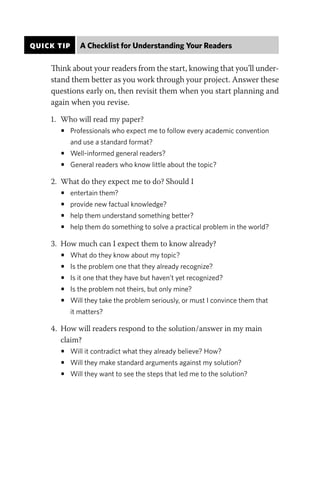
QUICK TIP A Checklist for Understanding Your Readers
Think about your readers from the start, knowing that you’ll under-
stand them better as you work through your project. Answer these
questions early on, then revisit them when you start planning and
again when you revise.
1. Who will read my paper?
• Professionals who expect me to follow every academic convention
and use a standard format?
• Well-informed general readers?
• General readers who know little about the topic?
2. What do they expect me to do? Should I
• entertain them?
• provide new factual knowledge?
• help them understand something better?
• help them do something to solve a practical problem in the world?
3. How much can I expect them to know already?
• What do they know about my topic?
• Is the problem one that they already recognize?
• Is it one that they have but haven’t yet recognized?
• Is the problem not theirs, but only mine?
• Will they take the problem seriously, or must I convince them that
it matters?
4. How will readers respond to the solution/answer in my main
claim?
• Will it contradict what they already believe? How?
• Will they make standard arguments against my solution?
• Will they want to see the steps that led me to the solution?
PA R T I I
Asking Questions,
Finding Answers
P R O L O G U E
Planning Your Project—An Overview
If you’ve skimmed this book once, you’re ready to begin your proj-
ect. If you have a research question and know how to look for its
answer, review the next two chapters quickly; then read the re-
maining ones carefully as they become relevant to your task. You
may, however, feel bewildered if you’re starting from scratch, with-
out even a topic to guide you. But you can manage if you have a
plan and take one step at a time.
If you are starting from scratch, your first task is to find a re-
search question worth investigating that will lead to a research
problem worth solving. Here are four steps to that end:
1. Find a topic specific enough to let you master a reasonable
amount of information on it in the time you have: not, for ex-
ample, the history of scientific writing but essays in the Proceed-
ings of the Royal Society (1675–1750) as precursors to the modern
scientific article; not doctors in seventeenth-century drama but
Molière’s mockery of doctors in three early plays.
2. Question that topic until you find questions that catch your in-
terest. For example, How did early Royal Society authors demon-
strate that their evidence was reliable? Or, Why did Molière mock
doctors?
3. Determine the kinds of evidence your readers will expect you
to offer in support of your answer. Will they accept reports of
facts from secondary sources, or will they expect you to consult
primary sources (see 5.1.1)? Will they expect quantitative data,
quotations from authorities, or firsthand observations?
30 Prologue
4. Determine whether you can find this evidence. There’s no point
researching a topic unless you have a good chance of finding the
right kind of evidence.
Once you think you have enough data to support at least a plau-
sible answer to your question, you’ll be ready to assemble an argu-
ment that makes your case (see part III), then to plan, draft, and
revise it (see part IV).
You’ll discover, however, that you can’t march through those
steps in the neat order we present them. You’ll think of a tentative
answer to your research question before you have all the evidence
you need to support it. And when you think you have an argu-
ment worth making, you may discover that you need more and
maybe different evidence from new sources. You may even modify
your topic. Doing research is not like strolling along an easy, well-
marked path to a familiar destination; it’s more like zigzagging up
and down a rocky hill through overgrown woods, sometimes in a
fog, searching for something you won’t recognize until you see it.
But no matter how indirect your path, you can make progress if at
each step of the way you plan for predictable detours (and maybe
even avoid some of them).
What Is Your Evidence?
No matter their field, researchers collect information to use as evi-
dence to support their claims. But researchers in different fields call
that information by different names. We call it data. By data we mean
not just the numbers that natural and social scientists collect, but any-
thing you find “out there” relevant to answering your research ques-
tion. The term is used less often by researchers in the humanities, but
they, too, gather data in the form of quotations, historical facts, and
so on. Data are inert, however, until you use them to support a claim
that answers your research question. At that point, your data become
evidence. If you don’t have more data than you can use as evidence,
you haven’t collected enough. (Incidentally, data is plural; a single bit
of data is a datum.)
Planning Your Project 31
Resolve to do lots of writing along the way. Much of it will be
routine note-taking, but you should also write reflectively, to un-
derstand: make outlines; explain why you disagree with a source;
draw diagrams to connect disparate facts; summarize sources,
positions, and schools; record even random thoughts. Many re-
searchers find it useful to keep a journal for hunches, new ideas,
random thoughts, problems, and so on. You might not include
much of this writing-to-discover-and-understand in your final
draft. But when you write as you go, every day, you encourage your
own best critical thinking, understand your sources better, and,
when the time comes, draft more productively.
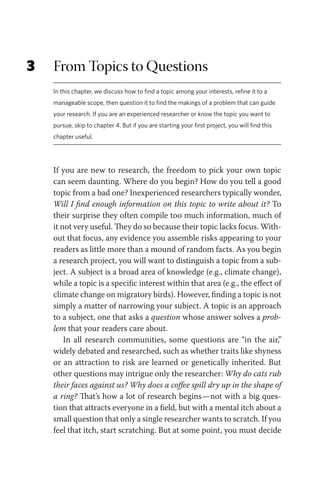
QUICK TIP Creating a Writing Group
A downside of academic research is its isolation. Except for group
projects, you’ll read and write mostly alone. But it doesn’t have
to be that way. Look for someone other than your instructor or
adviser who will talk with you about your progress, review your
drafts, even pester you about how much you’ve written. That might
be a generous friend, but even better is another writer so that you
can comment on each other’s ideas and drafts.
Best of all is a group of four or five people working on their
own projects who meet regularly to read and discuss one another’s
work. Early on, each meeting should start with a summary of each
person’s project in this three-part sentence: I’m working on X be-
cause I want to find out Y, so that I (and you) can better understand
Z (more about this in 3.4). As your projects advance, develop an
opening “elevator story,” a short summary of your project that you
could give someone on the way to a meeting. It should include
your research question, your best guess at an answer, and the kind
of evidence you expect to use to support it. The group can then
follow up with questions, responses, and suggestions.
Don’t limit your talk to just your story, however. Talk about
your readers: Why should they be interested in your question?
How might they respond to your argument? Will they trust your
evidence? Will they have other evidence in mind? Such questions
help you plan an argument that anticipates what your readers ex-
pect. Your group can even help you brainstorm when you bog
down. Later the group can read one another’s outlines and drafts
to imagine how their final readers will respond. If your group has a
problem with your draft, so will those readers. But for most writ-
ers, a writing group is most valuable for the discipline it imposes.
It is easier to meet a schedule when you know you must report to
others.
Writing groups are common for those writing theses or disser-
tations. But the rules differ for a class paper. Some teachers think
that a group or writing partner provides more help than is appro-
priate, so be clear what your instructor allows.
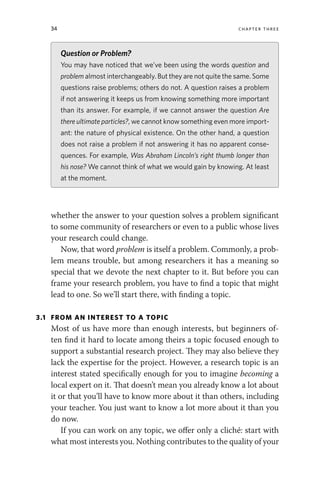
3 From Topics to Questions
In this chapter, we discuss how to find a topic among your interests, refine it to a
manageable scope, then question it to find the makings of a problem that can guide
your research. If you are an experienced researcher or know the topic you want to
pursue, skip to chapter 4. But if you are starting your first project, you will find this
chapter useful.
If you are new to research, the freedom to pick your own topic
can seem daunting. Where do you begin? How do you tell a good
topic from a bad one? Inexperienced researchers typically wonder,
Will I find enough information on this topic to write about it? To
their surprise they often compile too much information, much of
it not very useful. They do so because their topic lacks focus. With-
out that focus, any evidence you assemble risks appearing to your
readers as little more than a mound of random facts. As you begin
a research project, you will want to distinguish a topic from a sub-
ject. A subject is a broad area of knowledge (e.g., climate change),
while a topic is a specific interest within that area (e.g., the effect of
climate change on migratory birds). However, finding a topic is not
simply a matter of narrowing your subject. A topic is an approach
to a subject, one that asks a question whose answer solves a prob-
lem that your readers care about.
In all research communities, some questions are “in the air,”
widely debated and researched, such as whether traits like shyness
or an attraction to risk are learned or genetically inherited. But
other questions may intrigue only the researcher: Why do cats rub
their faces against us? Why does a coffee spill dry up in the shape of
a ring? That’s how a lot of research begins—not with a big ques-
tion that attracts everyone in a field, but with a mental itch about a
small question that only a single researcher wants to scratch. If you
feel that itch, start scratching. But at some point, you must decide
34 chapter three
whether the answer to your question solves a problem significant
to some community of researchers or even to a public whose lives
your research could change.
Now, that word problem is itself a problem. Commonly, a prob-
lem means trouble, but among researchers it has a meaning so
special that we devote the next chapter to it. But before you can
frame your research problem, you have to find a topic that might
lead to one. So we’ll start there, with finding a topic.
3.1 FROM AN INTEREST TO A TOPIC
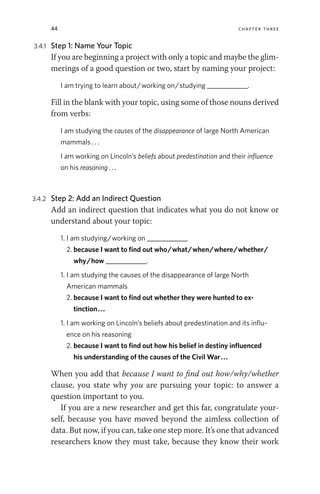
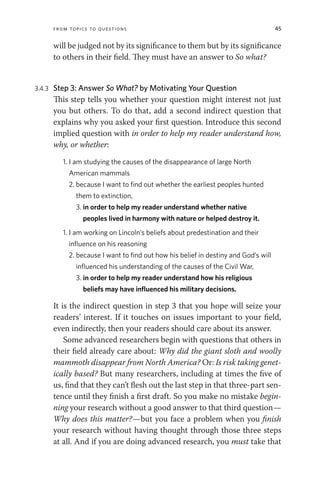
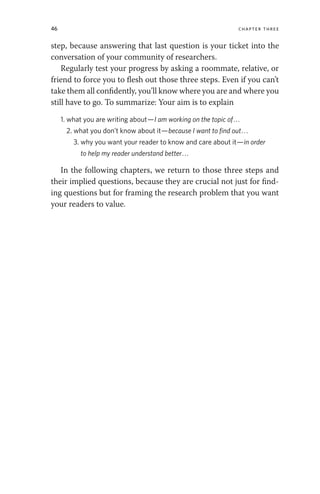
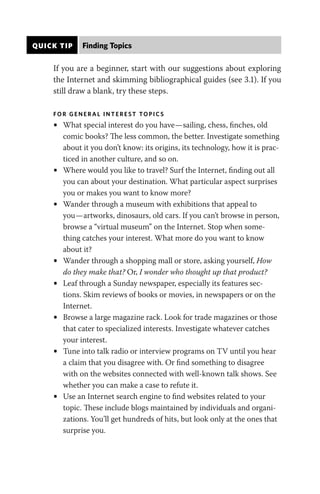
Most of us have more than enough interests, but beginners of-
ten find it hard to locate among theirs a topic focused enough to
support a substantial research project. They may also believe they
lack the expertise for the project. However, a research topic is an
interest stated specifically enough for you to imagine becoming a
local expert on it. That doesn’t mean you already know a lot about
it or that you’ll have to know more about it than others, including
your teacher. You just want to know a lot more about it than you
do now.
If you can work on any topic, we offer only a cliché: start with
what most interests you. Nothing contributes to the quality of your
Question or Problem?
You may have noticed that we’ve been using the words question and
problem almost interchangeably. But they are not quite the same. Some
questions raise problems; others do not. A question raises a problem
if not answering it keeps us from knowing something more important
than its answer. For example, if we cannot answer the question Are
there ultimate particles?, we cannot know something even more import-
ant: the nature of physical existence. On the other hand, a question
does not raise a problem if not answering it has no apparent conse-
quences. For example, Was Abraham Lincoln’s right thumb longer than
his nose? We cannot think of what we would gain by knowing. At least
at the moment.
From Topics to Questions 35
work more than your commitment to it. But also ask yourself:
What interests me about this topic? What would interest others?
3.1.1 Finding a Topic in a Writing Course
Start by listing as many interests as you can that you’d like to
explore. Don’t limit yourself to what you think might interest a
teacher or make you look like a serious student. Let your ideas flow.
Prime the pump by asking friends, classmates, even your teacher
about topics that interest them. If no good topics come to mind,
consult the Quick Tip at the end of this chapter.
Once you have a list of topics, choose the one or two that inter-
est you most and explore their research potential. Do this:
• In the library, look up your topic in a general guide such as CQ Re-
searcher and skim the subheadings. In an online database such as
Academic Search Premier, you can explore your topic through sub-
ject terms. If you have a more narrow focus, you can do the same
with specialized guides such as Women’s Studies International.
While some libraries will have copies of general and specialized
guides on the shelf, most now subscribe to their online equivalents,
but not all of them let you skim subject headings. (We discuss
these resources in chapter 5 and list several in the appendix.)
• On the Internet, Google your topic, but don’t surf indiscriminately.
Look first for websites that are roughly like sources you would
find in a library, such as online encyclopedias. Read the entry on
your general topic, and then copy the list of references at the end
for a closer look. Use Wikipedia to find ideas and sources, but al-
ways confirm what you find there in a reliable source. Few experi-
enced researchers trust Wikipedia, so under no circumstances cite
it as a source of evidence (unless your topic is Wikipedia itself).
• Remember, at this point you are exploring a topic to spur your
thinking and to see if that topic is viable. With that in mind, you
can also find ideas in blogs, which discuss almost every conten-
tious issue. Since most issues are usually too big for a research
paper, look for posts that take a position on narrow aspects of
larger issues. If you disagree with a view, investigate it.
36 chapter three
3.1.2 Finding a Topic for a First Research Project in a Particular Field
Start by listing topics relevant to your particular class and that in-
terest you, then narrow them to one or two promising ones. If the
topic is general, such as religious masks, you’ll have to do some
random reading to narrow it. But read with a plan:
• Skim encyclopedia entries in your library or online. Start with
standard ones such as the Encyclopaedia Britannica. Then consult
specialized ones such as the Encyclopedia of Religion or the Stan-
ford Encyclopedia of Philosophy.
• Skim headings in specialized indexes such as the Philosopher’s
Index, Psychological Abstracts, or Women’s Studies Abstracts. Use
subheadings for ideas of how others have narrowed your topic.
• Google your topic, but not indiscriminately. Use Google Scholar,
a search engine that focuses on scholarly journals and books.
Skim the articles it turns up, especially their lists of sources.
When you know the general outline of your topic and how others
have narrowed theirs, try to narrow yours. If you can’t, browse
through journals and websites until your topic becomes more
clearly defined. That takes time, so start early.
3.1.3 Finding a Topic for an Advanced Project
Most advanced students already have interests in topics relevant
to their field. Often topics find them as they become immersed
in a field. If that is not yet the case, focus on what interests you,
but remember that you must eventually show why it should also
interest others.
• Find what interests other researchers. Look online for recurring
issues and debates in the archives of professional discussion lists
relevant to your interests. Search online and in journals like the
Chronicle of Higher Education for conference announcements,
conference programs, calls for papers, anything that reflects what
others find interesting.
• Skim the latest issues of journals in your field, not just for articles,
but also for conference announcements, calls for papers, and
From Topics to Questions 37
reviews. Skim recent articles in your library’s online databases in
your field (e.g., the MLA International Bibliography).
• Investigate the resources that your library is particularly rich in.
If, for example, it (or a library nearby) holds a collection of rare
papers on an interesting topic, you have found not only a topic
but a way into it. Many unexpected finds await discovery in your
library’s archives.
3.2 FROM A BROAD TOPIC TO A FOCUSED ONE
The most useful way to think about a topic is as a starting place
for your research. (The word “topic” comes from topos, which is
Greek for “place.”) From this starting place, you can head off in a
particular direction and thus narrow an overly broad topic into a
productively focused one. At this point, your biggest risk is settling
on a topic so broad that it could be a subheading in a library cata-
log: spaceflight; Shakespeare’s problem plays; natural law. A topic is
probably too broad if you can state it in four or five words:
Free will in Tolstoy
The history of commercial aviation
A topic so broad can intimidate you with the task of finding,
much less reading, even a fraction of the sources available. So nar-
row it down:
Free will in Tolstoy → The conflict of free will and inevitability in
Tolstoy’s description of three battles in War
andPeace
The history of
commercial
aviation
→ The contribution of the military in developing
the DC-3 in the early years of commercial
aviation
We narrowed those topics by adding words and phrases, but of
a special kind: conflict, description, contribution, and developing.
Those nouns are derived from verbs expressing actions or relation-
ships: to conflict, to describe, to contribute, and to develop. Lacking
such “action” words, your topic is a static thing.
38 chapter three
Note what happens when we restate static topics as full sen-
tences. Topics (1) and (2) change almost not at all:
(1) Free will in Tolstoytopic → There is free will in Tolstoy’s novels.claim
(2) The history of commercial aviationtopic → Commercial aviation has
a history.claim
In reality, (1) and (2) are not topics at all because they do not lead
anywhere. But when (3) and (4) are revised into full sentences, they
are closer to claims that a reader might find interesting.
(3) The conflict of free will and inevitability in Tolstoy’s description of
three battles in War and Peacetopic → In War and Peace, Tolstoy describes
three battles in which free will and inevitability conflict.claim
(4) The contribution of the military in developing the DC-3 in the early
years of commercial aviationtopic → In the early years of commercial
aviation, the military contributed to the way the DC-3 developed.claim
Such claims may at first seem thin, but you’ll make them richer as
you work through your project. And that’s the point: these topics
are actually paths to pursue when devising your project.
Caution: Don’t narrow your topic so much that you can’t find
information on it. Too much information is available on the his-
tory of commercial aviation but too little (at least for beginning
researchers) on the decision to lengthen the wingtips on the DC-3
prototype for military use as a cargo carrier.
3.3 FROM A FOCUSED TOPIC TO QUESTIONS
Once they have a focused topic, many new researchers make a
beginner’s mistake: they immediately start plowing through all the
sources they can find on the topic, taking notes on everything they
read. With a promising topic such as the political origins of legends
about the Battle of the Alamo, they mound up endless facts con-
nected with the battle: what led up to it, histories of the Texas Rev-
olution, the floor plan of the mission, even biographies of generals
Santa Anna and Sam Houston. They accumulate notes, summaries,
descriptions of differences and similarities, ways in which the sto-
From Topics to Questions 39
ries conflict with one another and with what historians think really
happened, and so on. Then they dump it all into a paper that con-
cludes, Thus we see many differences and similarities between . . .
Many high school teachers would reward such a paper with a
good grade, because it shows that the writer can focus on a topic,
find information on it, and assemble that information into a re-
port, no small achievement—for a first project. But in any college
course, such a report falls short if it is seen as just a pastiche of
vaguely related facts. If a writer asks no specific question worth
asking, he can offer no specific answer worth supporting. And
without an answer to support, he cannot select from all the data
he could find on a topic just those relevant to his answer. To be
sure, those fascinated by Elvis Presley movie posters or the first
generation of video games will read anything new about them, no
matter how trivial. Serious researchers, however, do not document
information for its own sake, but to support the answer to a ques-
tion that they (and they hope their readers) think is worth asking.
So the best way to begin working on your focused topic is not to
find all the information you can on it, but to formulate questions
that direct you to just that information you need to answer them.
Start with the standard journalistic questions: who, what, when,
and where, but focus on how and why. To engage your best critical
thinking, systematically ask questions about your topic’s history,
composition, and categories. Then ask any other question you can
think of or find in your sources. Record all the questions, but don’t
stop to answer them even when one or two grab your attention.
This inventory of possible questions will help to direct your search
activities and enable you to make sense of information you find.
(Don’t worry about keeping these categories straight; their only
purpose is to stimulate questions and organize your answers.) Let’s
take up the example of masks mentioned earlier.
3.3.1 Ask about the History of Your Topic
• How does it fit into a larger developmental context? Why did
your topic come into being? What came before masks? How were
masks invented? Why? What might come after masks?
40 chapter three
• What is its own internal history? How and why has the topic
itself changed through time? How have Native American masks
changed? Why? How have Halloween masks changed? How has
the role of masks in society changed? How has the booming mar-
ket for kachina masks influenced traditional design? Why have
masks helped make Halloween the biggest American holiday after
Christmas?
3.3.2 Ask about Its Structure and Composition
• How does your topic fit into the context of a larger structure or
function as part of a larger system? How do masks reflect the
values of different societies and cultures? What roles do masks play
in Hopi dances? In scary movies? In masquerade parties? How are
masks used other than for disguise?
• How do its parts fit together as a system? What parts of a
mask are most significant in Hopi ceremonies? Why? Why do
some masks cover only the eyes? Why do few masks cover just the
bottom half of the face? How do their colors play a role in their
function?
3.3.3 Ask How Your Topic Is Categorized
• How can your topic be grouped into kinds? What are the dif-
ferent kinds of masks? Of Halloween masks? Of African masks?
How are they categorized by appearance? By use? By geography or
society? What are the different qualities of masks?
• How does your topic compare to and contrast with others like
it? How do Native American ceremonial masks differ from those
in Japan? How do Halloween masks compare with Mardi Gras
masks?
3.3.4 Turn Positive Questions into Negative Ones
• Why have masks not become a part of other holidays, like Presi-
dents’ Day or Memorial Day? How do Native American masks not
differ from those in Africa? What parts of masks are typically not
significant in religious ceremonies?
From Topics to Questions 41
3.3.5 Ask What If? and Other Speculative Questions
• How would things be different if your topic never existed, disap-
peared, or were put into a new context? What if no one ever wore
masks except for safety? What if everyone wore masks in public?
What if it were customary to wear masks on blind dates? In mar-
riage ceremonies? At funerals? Why are masks common in African
religions but not in Western ones? Why don’t hunters in camou-
flage wear masks? How are masks and cosmetic surgery alike?
3.3.6 Ask Questions Suggested by Your Sources
You won’t be able to do this until you’ve done some reading on
your topic. Ask questions that build on agreement:
• If a source makes a claim you think is persuasive, ask questions
that might extend its reach. Elias shows that masked balls became
popular in eighteenth-century London in response to anxieties
about social mobility. Did the same anxieties cause similar devel-
opments in Venice?
• Ask questions that might support the same claim with new evi-
dence. Elias supports his claim about masked balls with published
sources. Is it also supported by letters and diaries?
• Ask questions analogous to those that sources have asked about
similar topics. Smith analyzes costumes from an economic point of
view. What would an economic analysis of masks turn up?
Now ask questions that reflect disagreement:
• Martinez claims that carnival masks uniquely allow wearers to es-
cape social norms. But could there be a larger pattern of all masks
creating a sense of alternative forms of social or spiritual life?
(We discuss in more detail how to use disagreements with sources
in 6.4.)
If you are an experienced researcher, look for questions that
other researchers ask but don’t answer. Many journal articles end
with a paragraph or two about open questions, ideas for more re-
search, and so on (see 4.3.2 for an example). You might not be able
42 chapter three
to do all the research they suggest, but you might carve out a piece
of it. You can also look for Internet discussions on your topic, then
“lurk,” just reading the exchanges to understand the kinds of ques-
tions those on the list debate. Record questions that spark your
interest. You can also post questions to the list if they are specific
and narrowly focused.
3.3.7 Evaluate Your Questions
After asking all the questions you can think of, evaluate them, be-
cause not all questions are equally good. Look for questions whose
answers might make you (and, ideally, your readers) think about
your topic in a new way. Avoid questions like these:
• Their answers are settled fact that you could just look up. Do the
Inuit use masks in their wedding ceremonies? Questions that ask
how and why invite deeper thinking than who, what, when, or
where, and deeper thinking leads to more interesting answers.
• Their answers would be merely speculative. Would church services
be as well attended if the congregation all wore masks? If you can’t
imagine finding hard data that might settle the question, it’s a
question you can’t settle.
• Their answers are dead ends. How many black cats slept in the
Alamo the night before the battle? It is hard to see how an answer
would help us think about any larger issue worth understanding
better, so it’s a question that’s probably not worth asking.
You might, however, be wrong about that. Some questions that
seemed trivial, even silly, have answers more significant than ex-
pected. One researcher wondered why a coffee spill dries up in
the form of a ring and discovered things about the properties of
fluids that others in his field thought important—and that paint
manufacturers found valuable. So who knows where a question
about cats in the Alamo might take you? You can’t know until you
get there.
Once you have a few promising questions, try to combine them
into larger ones. For example, many questions about the Alamo
story ask about the interests of the storytellers and their effects
From Topics to Questions 43
on their stories: How have politicians used the story? How have
the storytellers’ motives changed? Whose purposes does each story
serve? These can be combined into a single question:
How and why have users of the Alamo story given the event a mythic quality?
A question like this gives direction to your research (and helps
avoid the gathering of endless information). And it begins to imag-
ine readers who will judge whether your question is significant.
3.4 THE MOST SIGNIFICANT QUESTION: SO WHAT?
Even if you are an experienced researcher, you might not be able
to take the next step until you are well into your project, and if you
are a beginner, you may find it frustrating. Even so, once you have
a question that holds your interest, you must pose a tougher one
about it: So what? Beyond your own interest in its answer, why
would others think it a question worth asking? You might not be
able to answer that So what? question early on, but it’s one you
have to start thinking about, because it forces you to look beyond
your own interests to consider how your work might strike others.
Think of it like this: What will be lost if you don’t answer your
question? How will not answering it keep us from understanding
something else better than we do? Start by asking So what? at first
of yourself:
So what if I don’t know or understand how butterflies know where to go
in the winter, or how fifteenth-century musicians tuned their instru-
ments, or why the Alamo story has become a myth? So what if I can’t
answer my question? What do we lose?
Your answer might be Nothing. I just want to know. Good
enough to start, but not to finish, because eventually your readers
will ask as well, and they will want an answer beyond Just curious.
Answering So what? vexes all researchers, beginners and experi-
enced alike, because when you have only a question, it’s hard to
predict whether others will think its answer is significant. But you
must work toward that answer throughout your project. You can
do that in three steps.
44 chapter three
3.4.1 Step 1: Name Your Topic
If you are beginning a project with only a topic and maybe the glim-
merings of a good question or two, start by naming your project:
I am trying to learn about/working on/studying ____________.
Fill in the blank with your topic, using some of those nouns derived
from verbs:
I am studying the causes of the disappearance of large North American
mammals . . .
I am working on Lincoln’s beliefs about predestination and their influence
on his reasoning . . .
3.4.2 Step 2: Add an Indirect Question
Add an indirect question that indicates what you do not know or
understand about your topic:
1. I am studying/working on ____________
2. because I want to find out who/what/when/where/whether/
why/how ____________.
1. I am studying the causes of the disappearance of large North
American mammals
2. because I want to find out whether they were hunted to ex­
tinction...
1. I am working on Lincoln’s beliefs about predestination and its influ-
ence on his reasoning
2. because I want to find out how his belief in destiny influenced
his understanding of the causes of the Civil War...
When you add that because I want to find out how/why/whether
clause, you state why you are pursuing your topic: to answer a
question important to you.
If you are a new researcher and get this far, congratulate your-
self, because you have moved beyond the aimless collection of
data. But now, if you can, take one step more. It’s one that advanced
researchers know they must take, because they know their work
From Topics to Questions 45
will be judged not by its significance to them but by its significance
to others in their field. They must have an answer to So what?
3.4.3 Step 3: Answer So What? by Motivating Your Question
This step tells you whether your question might interest not just
you but others. To do that, add a second indirect question that
explains why you asked your first question. Introduce this second
implied question with in order to help my reader understand how,
why, or whether:
1. I am studying the causes of the disappearance of large North
American mammals
2. because I want to find out whether the earliest peoples hunted
them to extinction,
3. in order to help my reader understand whether native
peoples lived in harmony with nature or helped destroy it.
1. I am working on Lincoln’s beliefs about predestination and their
influence on his reasoning
2. because I want to find out how his belief in destiny and God’s will
influenced his understanding of the causes of the Civil War,
3. in order to help my reader understand how his religious
beliefs may have influenced his military decisions.
It is the indirect question in step 3 that you hope will seize your
readers’ interest. If it touches on issues important to your field,
even indirectly, then your readers should care about its answer.
Some advanced researchers begin with questions that others in
their field already care about: Why did the giant sloth and woolly
mammoth disappear from North America? Or: Is risk taking genet-
ically based? But many researchers, including at times the five of
us, find that they can’t flesh out the last step in that three-part sen-
tence until they finish a first draft. So you make no mistake begin-
ning your research without a good answer to that third question—
Why does this matter?—but you face a problem when you finish
your research without having thought through those three steps
at all. And if you are doing advanced research, you must take that
46 chapter three
step, because answering that last question is your ticket into the
conversation of your community of researchers.
Regularly test your progress by asking a roommate, relative, or
friend to force you to flesh out those three steps. Even if you can’t
take them all confidently, you’ll know where you are and where you
still have to go. To summarize: Your aim is to explain
1. what you are writing about—I am working on the topic of...
2. what you don’t know about it—because I want to find out...
3. why you want your reader to know and care about it—in order
to help my reader understand better...
In the following chapters, we return to those three steps and
their implied questions, because they are crucial not just for find-
ing questions but for framing the research problem that you want
your readers to value.
QUICK TIP Finding Topics
If you are a beginner, start with our suggestions about exploring
the Internet and skimming bibliographical guides (see 3.1). If you
still draw a blank, try these steps.
FO R GENERAL I NT EREST TOP I CS
• What special interest do you have—sailing, chess, finches, old
comic books? The less common, the better. Investigate something
about it you don’t know: its origins, its technology, how it is prac-
ticed in another culture, and so on.
• Where would you like to travel? Surf the Internet, finding out all
you can about your destination. What particular aspect surprises
you or makes you want to know more?
• Wander through a museum with exhibitions that appeal to
you—artworks, dinosaurs, old cars. If you can’t browse in person,
browse a “virtual museum” on the Internet. Stop when some-
thing catches your interest. What more do you want to know
about it?
• Wander through a shopping mall or store, asking yourself, How
do they make that? Or, I wonder who thought up that product?
• Leaf through a Sunday newspaper, especially its features sec-
tions. Skim reviews of books or movies, in newspapers or on the
Internet.
• Browse a large magazine rack. Look for trade magazines or those
that cater to specialized interests. Investigate whatever catches
your interest.
• Tune into talk radio or interview programs on TV until you hear
a claim that you disagree with. Or find something to disagree
with on the websites connected with well-known talk shows. See
whether you can make a case to refute it.
• Use an Internet search engine to find websites related to your
topic. These include blogs maintained by individuals and organi-
zations. You’ll get hundreds of hits, but look only at the ones that
surprise you.
48 quick tip
• Is there a common belief that you suspect is simplistic or just
wrong? A common practice that you find pointless or irritating?
Do research to make a case against it.
• What courses will you take in the future? What research would
help you prepare for them?
FO R TO PICS FO CUSE D ON A PART I CU LAR FI ELD
If you have experience in your field, review 3.1.2–3.
• Browse through a textbook of a course that is one level beyond
yours or a course that you know you will have to take. Look espe-
cially hard at the study questions.
• Attend a lecture for an advanced class in your field, and listen for
something you disagree with, don’t understand, or want to know
more about.
• Ask your instructor about the most contested issues in your field.
• Find an Internet discussion list in your field. Browse its archives,
looking for matters of controversy or uncertainty.
• Surf the websites of departments at major universities, including
class sites. Also check websites of museums, national associa-
tions, and government agencies, if they seem relevant.
4 From Questions to a Problem
In this chapter, we explain how to turn a question into a problem that readers think is
worth solving. If you are an advanced researcher, you know how essential this step is.
If you are new to research, we hope to convince you of its importance, because what
you learn here will be essential to all your future projects.
In the last chapter, we suggested that you can identify the signif-
icance of your research question by fleshing out this three-step
formula:
1. Topic: I am studying _________
2. Question: because I want to find out what/why/how ________,
3. Significance: in order to help my reader understand _________.
These steps describe not only the development of your project but
your own development as a researcher.
• When you move from step 1 to 2, you are no longer a mere data
collector but a researcher interested in understanding something
better.
• When you then move from step 2 to 3, you focus on why that
understanding is significant.
That significance might at first be just for yourself, but you join
a community of researchers when you can state that significance
from your readers’ point of view. In so doing, you create a stronger
relationship with readers because you promise something in re-
turn for their interest in your report—a deeper understanding of
something that matters to them. At that point, you have posed a
problem that they recognize needs a solution.
4.1 UNDERSTANDING RESEARCH PROBLEMS
Too many researchers at all levels write as if their task is to an-
swer a question that interests themselves alone. That’s wrong:
50 chapter four
to make your research matter, you must address a problem that
others in your community—your readers—also want to solve. To
understand why, you have to understand what research problems
look like. And to do that, you have to understand two other kinds
of problems, what we’ll call practical problems and conceptual
problems.
4.1.1 Practical Problems: What Should We Do?
Everyday research usually begins not with dreaming up a topic to
think about but with a practical problem that if you ignore it means
trouble. When its solution is not obvious, you have to find out
how to solve it. To do that, you must pose and solve a problem of
another kind, a research problem defined by what you do not know
or understand about your practical problem.
It’s a familiar task that typically looks like this:
practical problem: The chain on my bicycle broke.
research problem: Can I find a bike shop that will replace it?
research solution: Here it is: Cycle Source, 1401 East 55th Street.
practical solution: Walk over to get my bike fixed.
Problems like that are in essence no different from more com-
plicated ones.
• The National Rifle Association is lobbying me to oppose gun
control. How many votes do I lose if I refuse? Do a survey. Most of
my constituents support gun control. I can reject the request.
• Costs are up at the Omaha plant. What changed? Hire a con-
sulting firm to figure it out. Increase in turnover. If we improve
training and morale, our workers will stick with us.
Put in general terms, a practical problem is caused by some con-
dition in the world (from spam to losing money in Omaha to ter-
rorism) that troubles us because it costs us time, money, respect,
security, opportunity, even our lives. We solve a practical problem
by doing something (or by encouraging others to do something) to
From Questions to a Problem 51
eliminate or at least mitigate the condition creating these tangible
costs.
But to know what to do, someone first has to understand some-
thing better. That politician being lobbied by the NRA, for ex-
ample, needs to know how his constituents feel about gun control
so he can decide where he stands; the managers of the Omaha
plant need to know the cause of their increasing costs so they can
address it.
4.1.2 Conceptual Problems: What Should We Think?
That need for knowledge or understanding raises a conceptual
problem. In research, a conceptual problem arises when we do not
understand something about the world as well as we would like. We
solve a conceptual problem not by doing something to change the
world but by answering a question that helps us understand it better.
We usually answer these questions through research, which is
why conceptual problems are also called research problems: the
word conceptual describes their condition and costs or conse-
quences; the word research refers to how we solve them. Graphi-
cally, the relationship between practical and conceptual or research
problems looks like this:
Practical
Problem
Research
Problem
motivates
leads to defines
helps to solve
Research
Question
Research
Answer
Conceptual/
The term problem thus has a special meaning in the world of
research, one that sometimes confuses beginners. In our everyday
52 chapter four
world, a problem is something we try to avoid. But in academic re-
search, a problem is something we seek out, even invent if we have
to. Indeed, a researcher without a good conceptual or research
problem to work on faces a bad practical problem because without
one a researcher is out of work.
Inexperienced researchers sometimes struggle with these no-
tions because experienced researchers often talk about their
work in shorthand. When asked what they are working on, they
often answer with what sounds like one of those general topics
we warned you about: adult measles, mating calls of Wyoming elk,
zeppelins in the 1930s. As a result, beginners sometimes think that
having a topic to read about is the same as having a problem to
solve.
When they do, they create a big practical problem for them-
selves, because with only a topic to guide their work, they gather
data aimlessly and endlessly. Without a specific question to answer,
they have no way of knowing when they have enough. When they
write, they struggle to decide what to include, usually throwing in
everything just to be on the safe side. So it’s not surprising that they
feel frustrated when a reader says, I don’t see the point here; this is
just a data dump.
To avoid that judgment, you need a problem that focuses you
on finding just those data that will help you solve it. It might take
a while to figure out what that problem is, but from the outset you
have to think about it. That begins with understanding how con-
ceptual problems work.
4.2 UNDERSTANDING THE COMMON STRUCTURE OF PROBLEMS
Practical problems and conceptual problems have the same two-
part structure:
• a situation or condition, and
• undesirable consequences caused by that condition, costs that you
(or, better, your readers) don’t want to pay
What distinguishes them is the nature of those conditions and
costs.
From Questions to a Problem 53
4.2.1 The Nature of Practical Problems
Consider a flat tire. Ordinarily, it would be a practical problem,
because it is (1) a condition in the world (the flat) that imposes
(2) a tangible cost that you don’t want to pay, like missing a dinner
date. But suppose you were bullied into the date and would rather
be anywhere else. In that case, the benefit of the flat is more than
its cost, so the flat is not a problem but a solution to the bigger
problem of an evening spent with someone you don’t like. Low
cost, big benefit, no problem.
On the other hand, suppose the police set up a sting in which
they lure criminals out of hiding by announcing that they have won
the lottery. Ordinarily, winning the lottery is not a problem, but
here it is, because it has a tangible cost: arrest.
A practical problem has two parts: a condition, which can be
anything that imposes intolerable costs, and those costs. To state
a practical problem so that others understand it clearly, you must
describe both of its parts.
1. Its condition:
I missed the bus.
The ozone layer is thinning
2. The costs of that condition that you (or your reader) don’t like:
I’ll be late for work and lose my job.
Many will die from skin cancer.
But a caution: When you write, readers judge the significance
of your problem not by the cost you pay, but by the cost they pay if
you don’t solve it. So what you think is a problem they might not.
To make your problem their problem, you must frame it from their
point of view, so that they see its costs to them. To do that, imag-
ine that when you pose the condition part of your problem, your
reader responds, So what?
The ozone layer is thinning.
So what?
54 chapter four
You answer with the cost of the problem:
A thinner ozone layer exposes us to more ultraviolet light.
Suppose he again asks, So what?, and you respond with the cost of
more ultraviolet light:
Too much ultraviolet light can cause skin cancer.
If, however improbably, he again asks, So what?, you have failed to
convince him that he has a problem. We acknowledge a problem
only when we stop asking So what? and say, instead, What do we
do about it?
Practical problems like cancer are easy to grasp because they are
concrete: when someone has cancer, we don’t ask, So what? In aca-
demic research, however, your problems will usually be conceptual
ones, which are harder to grasp because both their conditions and
costs are abstract.
4.2.2 The Nature of Conceptual Problems
Practical and conceptual problems have the same two-part struc-
ture, but they have different kinds of conditions and costs.
• The condition of a practical problem can be any state of affairs
that has a tangible cost for you or, better, for your readers.
• The condition of a conceptual problem, however, is always some
version of not knowing or not understanding something.
You can identify the condition of a conceptual problem by com-
pleting that three-step sentence (see 3.4): The first step is I am
studying/working on the topic of ________. In the second step, the
indirect question states the condition of a conceptual problem,
what you do not know or understand:
I am studying stories of the Alamo, because I want to understand why
voters responded to them in ways that served the interests of Texas
politicians.
That’s why we emphasize the value of questions: they force you to
state what you don’t know or understand but want to.
From Questions to a Problem 55
The two kinds of problems also have two different kinds of
costs.
• The cost of a practical problem is always some tangible thing or
situation we don’t like.
A conceptual problem does not have such a tangible cost. In fact,
we’ll emphasize this difference by calling the cost of a conceptual
problem its consequence.
• The consequence of a conceptual problem is a particular kind
of ignorance: it is a lack of understanding that keeps us from
understanding something else even more significant. Put another
way, because we haven’t answered one question, we can’t answer
another that is more important.
Researchers often choose projects simply because they are cu-
rious. In fact, that’s how most of us first become interested in the
subjects we study. But to make your research matter to others, you
have to say more than Here is something I find interesting. You have
to show them how solving your problem helps them solve theirs.
You do that by explaining your problem’s consequence.
You express a problem’s consequence in the indirect question in
step 3 of our formula:
I am studying stories of the Alamo, because I want to understand why
voters responded to them in ways that served the interests of local
Texas politicians, in order to help readers understand the bigger and
more important question of how regional self­images influence national
politics.
All of this may sound confusing, but it’s simpler than it seems.
The condition and the consequence of a conceptual problem are
questions that relate to each other in two ways:
• The answer to the first question (Q1) helps you answer the sec-
ond (Q2).
• The answer to the second question (Q2) is more important than
the answer to the first (Q1).
56 chapter four
Q 1 Q 2
helps you answer
Here it is again: The first part of a conceptual or research prob-
lem is something you don’t know but want to. You can phrase that
gap in knowledge or understanding as a direct question: How have
romantic movies changed in the last fifty years? Or as an indirect
question: I want to find out how romantic movies have changed in
the last fifty years.
Now imagine someone asking, So what if you can’t answer
that question? You answer by stating something else more import-
ant that you can’t know until you answer the first question. For
example:
If we can’t answer the question of how romantic movies have changed
in the last fifty years,condition/first question then we can’t answer a more
important question: How have our cultural depictions of romantic love
changed?consequence/larger, more important second question
If you think that it’s important to answer that second question,
you’ve stated a consequence that makes your problem worth pur-
suing, and if your readers agree, you’re in business.
But what if you imagine a reader again asking, So what if I don’t
know whether we depict romantic love differently than we did? You
have to pose a yet larger question that you hope your readers will
think is significant:
If we can’t answer the question of how our depictions of romantic
love have changed,second question then we can’t answer an even more
important one: How does our culture shape the expectations of young
men and women about marriage and families?consequence/larger, more
important question
If you imagine that reader again asking, So what?, you might think,
Wrong audience. But if that’s the audience you’re stuck with, you
just have to try again: Well, if we don’t answer that question, we
can’t . . .
Those outside an academic field often think that its specialists
ask ridiculously trivial questions: How did hopscotch originate?
From Questions to a Problem 57
But they fail to realize that researchers want to answer a question
like that so that they can answer a second, more important one.
For those who care about the way folk games influence the so-
cial development of children, the conceptual consequences of not
knowing justifies the research. If we can discover how children’s
folk games originate, we can better understand how games social-
ize children, and, before you ask, once we know that, we can better
understand . . .
4.2.3 Distinguishing “Pure” and “Applied” Research
We call research pure when it addresses a conceptual problem that
does not bear directly on any practical situation in the world, when
it only improves the understanding of a community of researchers.
We call research applied when it addresses a conceptual problem
that does have practical consequences. You can tell whether re-
search is pure or applied by looking at the last of the three steps
defining your project. Does it refer to knowing or doing?
1. Topic: I am studying the electromagnetic radiation in a section of
the universe
2. Question: because I want to find out how many galaxies are in
the sky,
3. Significance: in order to help readers understand whether the
universe will expand forever or eventually collapse into a point.
That is pure research, because step 3 refers only to understanding.
In applied research, the second step still refers to knowing or
understanding, but that third step refers to doing:
1. Topic: I am studying how readings from the Hubble telescope
differ from readings for the same stars measured by earthbound
telescopes
2. Question: because I want to find out how much the atmosphere
distorts measurements of electromagnetic radiation,
3. Practical Significance: so that astronomers can use data from
earthbound telescopes to measure more accurately the density
of electromagnetic radiation.
58 chapter four
That problem calls for applied research because only when astron-
omers know how to account for atmospheric distortion can they do
what they want to—measure light more accurately.
4.2.4 Connecting Research to Practical Consequences
Some inexperienced researchers are uneasy with pure research
because the consequence of a conceptual problem—merely not
knowing something—is so abstract. Since they are not yet part of
a community that cares deeply about understanding its part of the
world, they feel that their findings aren’t good for much. So they
try to cobble a practical cost onto a conceptual question to make it
seem more significant:
1. Topic: I am studying differences among nineteenth-century ver-
sions of the Alamo story
2. Research Question: because I want to find out how politicians
used stories of such events to shape public opinion,
3. Potential Practical Significance: in order to protect ourselves
from unscrupulous politicians.
Most readers would think that the link between steps 2 and 3 is a
bit of a stretch.
To formulate a good applied research project, you have to show
that the answer to the indirect question in step 2 plausibly helps
answer the indirect question in step 3. Ask this question:
(a) If my readers want to achieve the goal of ________ [state your objec-
tive from step 3],
(b) would they think that they could do it if they found out ________?
[state your question from step 2]
Try that test on this applied astronomy problem:
(a) If my readers want to use data from earthbound telescopes to mea-
sure more accurately the density of electromagnetic radiation,
(b) would they think that they could if they knew how much the atmo-
sphere distorts measurements?
The answer would seem to be Yes.
From Questions to a Problem 59
Now try the test on the Alamo problem:
(a) If my readers want to protect themselves from unscrupulous
politicians,
(b) would they think they could if they knew how nineteenth-century
politicians used stories about the Alamo to shape public opinion?
The answer would probably be No. We may see a connection, but
it’s a stretch.
If you think that the solution to your conceptual problem might
apply to a practical one, formulate your project as pure research,
then add your application as a fourth step:
1. Topic: I am studying how nineteenth-century versions of the Alamo
story differ
2. Conceptual Question: because I want to find out how politicians
used stories of great events to shape public opinion,
3. Conceptual Significance: in order to help readers understand
how politicians use popular culture to advance their political
goals,
4. Potential Practical Application: so that readers might better
protect themselves from unscrupulous politicians.
When you state your problem in your introduction, however,
present it as a purely conceptual research problem whose signifi-
cance is in its conceptual consequences. Then wait until your con-
clusion to suggest its practical application. (For more on this, see
chapter 16.)
Most research projects in the humanities and many in the nat-
ural and social sciences have no direct application to daily life. But
as the term pure suggests, many researchers value such research
more than they do applied research. They believe that the pursuit
of knowledge “for its own sake” reflects humanity’s highest call-
ing: to know more, not for the sake of money or power, but for the
transcendental good of greater understanding and a richer life of
the mind.
As you may have guessed, we are deeply committed to pure
research, but also to applied—so long as the research is done well
60 chapter four
and is not corrupted by malign motives. For example, the potential
for profit might compromise the integrity of both pure and applied
research in the biological sciences, because it can influence not
only what problems some researchers choose to address but also
their solutions: Tell us what to look for, and we’ll provide it! Such
situations raise ethical questions that we touch on in our after-
word, “The Ethics of Research.”
4.3 FINDING A GOOD RESEARCH PROBLEM
What distinguishes great researchers from the rest of us is the
brilliance, knack, or just dumb luck of stumbling over a problem
whose solution makes all of us see the world in a new way. It’s easy
to recognize a good problem when we bump into it, or it bumps
into us. But researchers often begin a project without being clear
about what their real problem is. Sometimes they hope just to de-
fine a puzzle more clearly. Indeed, those who find a new problem
or clarify an old one often make a bigger contribution to their field
than those who solve a problem already defined. Some researchers
have even won fame for disproving a plausible hypothesis that they
had set out to prove.
So don’t be discouraged if you can’t formulate your problem
fully at the outset of your project. Few of us can. But thinking about
it early will save you hours of work along the way (and perhaps
panic toward the end). It also gets you into a frame of mind crucial
to advanced work. Here are some things you can do to identify and
refine a good problem.
4.3.1 Ask for Help
Do what experienced researchers do: talk to colleagues, teachers,
classmates, relatives, friends, neighbors—anyone who might be
interested. Why would anyone want an answer to your question?
What would they do with it? What new questions might an answer
raise?
If you are free to work on any problem, look for a small one
that is part of a bigger one. Though you won’t solve the big one,
your small piece of it will inherit some of its larger significance.
From Questions to a Problem 61
(You will also educate yourself about the problems of your field,
no small benefit.) If you are a student, ask your teacher what she
is working on and whether you can work on part of it. Don’t let
her suggestions define the limits of your research. Nothing dis-
courages a teacher more than a student who does exactly what is
suggested and no more. Teachers want you to use their suggestions
to start your thinking, not end it. Nothing makes a teacher happier
than when you use her suggestions to find something she never
expected.
4.3.2 Look for Problems as You Read
You can also find research problems in your sources. Where in
them do you see contradictions, inconsistencies, incomplete ex-
planations? Tentatively assume that other readers would or should
feel the same. Many research projects begin with an imaginary
conversation with the author of a source: Wait a minute, he’s ignor-
ing . . . But before you set out to correct a gap or misunderstanding,
be sure it’s real, not just your own misreading. Countless research
papers have refuted a point that no one ever made. Before you
correct a source, reread it carefully. (In 6.3 we list several common
“moves” that writers make to find a problem in a source, variations
on Source thinks X, but I think Y.)
Once you think you’ve found a real puzzle or error, do more
than just point to it. If a source says X and you think Y, you may
have a research problem, but only if you can show that those who
think X misunderstand some larger issue as well.
Finally, read the last few pages of your sources closely. That’s
where many researchers suggest more questions that need an-
swers. The author of the following paragraph had just finished
explaining how the life of nineteenth-century Russian peasants
influenced their performance as soldiers:
And just as the soldier’s peacetime experience influenced his battle-
field performance, so must the experience of the officer corps have
influenced theirs. Indeed, a few commentators after the Russo-Japanese
War blamed the Russian defeat on habits acquired by officers in the
62 chapter four
course of their economic chores. In any event, to appreciate the service
habits of Tsarist officers in peace and war, we need a structural—if you
will, an anthropological—analysis of the officer corps like that offered here for
enlisted personnel. [our emphasis]
That last sentence offers a new problem waiting for you to tackle.
4.3.3 Look at Your Own Conclusion
Critical reading can also help you discover a good research prob-
lem in your own drafts. We often do our best thinking in the last
few pages that we write, because there we formulate claims we did
not anticipate when we started. If in an early draft you arrive at an
unanticipated claim, ask yourself what question it might answer.
Paradoxical as it might seem, you may have answered a question
that you have not yet asked, and thereby solved a problem that you
have not yet posed. Your task is to figure out what that problem
might be.
4.4 LEARNING TO WORK WITH PROBLEMS
Experienced researchers dream of finding new problems to solve.
A still bigger dream is to solve a problem that no one even knew
they had. But that new problem isn’t worth much until others think
(or can be persuaded) that it needs solving. So the first question
an experienced researcher should ask about a problem is not Can
I solve it? but Will readers think it should be solved?
No one expects you to do all that the first time out. But you
should begin to develop mental habits that will prepare you for that
moment. Research is more than just accumulating and reporting
facts. Try to formulate a question that you think is worth answer-
ing, so that down the road, you’ll know how to find a problem
that others think is worth solving. Until you can do that, you risk
the worst response a researcher can get: not I don’t agree, but I
don’t care.
By now, all this talk about airy academic research may seem
disconnected from what some call the “real world.” But in business
and government, in law and medicine, in politics and international
From Questions to a Problem 63
diplomacy, no skill is valued more highly than the ability to recog-
nize a problem, then to articulate it in a way that convinces others
both to care about it and to believe it can be solved, especially by
you. If you can do that in a class on Byzantine pottery, you can
do it in an office on Main Street, Wall Street, or Queen’s Road in
Hong Kong.
QUICK TIP Manage the Unavoidable Problem of Inexperience
We all feel anxious when we start work in a new field whose val-
ues, concerns, and ways of thinking and arguing we don’t entirely
understand. In fact, we authors still experience that newcomer’s
anxiety again when we begin new kinds of projects on new topics.
You can’t avoid experiencing that feeling at times, but there are
ways to manage it:
• Know that uncertainty and anxiety are natural and inevitable.
Those feelings don’t signal incompetence, only inexperience.
• Get control over your topic by writing about it along the way. Don’t
just retype or photocopy sources: write summaries, critiques,
questions, responses to your sources. Keep a journal in which you
reflect on your progress. This kind of writing not only helps you
understand what you read but stimulates your thinking about it.
The more you write early on, no matter how sketchily, the easier it
will be to face that intimidating first draft.
• Break the task into manageable steps and know that they are
mutually supportive. Once you formulate a good question, you’ll
draft and revise more effectively. The more you anticipate how
you will write and revise a first draft, the more effectively you will
produce it.
• If you are a student, count on your teachers to understand your
struggles. They want you to succeed, and you can expect their
help. (If they don’t help, look for others who will.)
• Set realistic goals. You do something significant when you wind
up your project feeling that it has changed just what you think
and that your readers think you did it well, even if they don’t
agree with your claims.
• Most important, recognize the struggle for what it is—a learning
experience. To overcome the problems that all beginners face, do
what successful researchers do, especially when discouraged: re-
view your plan and what you’ve written, then press on, confident
that it will turn out OK. Perhaps only “OK—considering,” but
probably a lot better than that.
5 From Problems to Sources
If you are a new researcher and expect to find most of your sources in your library or
on the Internet, this chapter will help you develop a plan for your research. If you are
more experienced, you might skip to the next chapter.
If you have not yet formulated a research question, you may have
to spend time reading generally on your topic to find one. But if
you have a question and at least one promising answer (the philos-
opher C. S. Peirce called it a hypothesis on probation), you can start
looking for data to test it.
To do that efficiently, you need to have a plan. If you plunge
into any and all sources on your topic, you risk losing yourself in
an endless trail of books and articles. To be sure, aimless browsing
can be fun, even productive. We indulge in it a lot. Many important
discoveries have begun in a chance encounter with an unexpected
idea. But if you have a deadline, you need more than luck to find
good sources in time: you have to search systematically for those
sources that will help you advance your research project or, just
as usefully, challenge you to improve it. In this chapter, we discuss
different ways you can use sources in your research, how you can
find useful sources, and how you can winnow your sources to a
manageable number. In the next chapter, we focus on how to use
sources in your writing.
5.1 THREE KINDS OF SOURCES AND THEIR USES
Sources are conventionally categorized into three kinds: primary,
secondary, and tertiary. Their boundaries are fuzzy, but knowing
these categories can help you plan your research.
66 chapter five
5.1.1 Primary Sources
Primary sources are “original” materials that provide you with the
“raw data” or evidence you will use to develop, test, and ultimately
justify your hypothesis or claim. What kinds of materials count
as primary sources vary significantly by field. In history, primary
sources are artifacts or documents that come directly from the pe-
riod or event you are studying: letters, diaries, objects, maps, even
clothing. In literature or philosophy, your main primary source is
usually the text you are analyzing, and your data are the words on
the page. In arts criticism, your primary source would be the work
of art you are interpreting. In social sciences, such as sociology or
political science, census or survey data would also count as pri-
mary sources. In the natural sciences, reports of original research
are sometimes characterized as primary sources (although scien-
tists themselves rarely use that term).
5.1.2 Secondary Sources
Secondary sources are books, articles, or reports that are based
on primary sources and are intended for scholarly or professional
audiences. The body of secondary sources in a field is sometimes
called that field’s “literature.” The best secondary sources are books
from reputable university presses and articles or reports that have
been “peer-reviewed,” meaning that they were vetted by experts in
the field before they were published. Researchers read secondary
sources to keep up with developments in their fields and, in this
way, to stimulate their own thinking. The standard way of framing
new research problems is to challenge or build on the conclusions
or methods of others, as presented in secondary sources they have
written. You can also borrow evidence from secondary sources to
use in your own arguments, but you should do so only if you do
not have access to the primary sources from which that evidence
was originally taken. Otherwise you risk appearing careless or lazy.
5.1.3 Tertiary Sources
These are books and articles that synthesize and report on second-
ary sources for general readers, such as textbooks, articles in ency-
From Problems to Sources 67
clopedias (including Wikipedia), and articles in mass-circulation
publications like Psychology Today. In the early stages of research,
you can use tertiary sources to get a feel for a topic. But if you
are making a scholarly argument, you should rely on secondary
sources, because these make up the “conversation” in which you
are seeking to participate. If you cite tertiary sources in a scholarly
argument, you will mark yourself as either a novice or an outsider,
and many readers won’t take you—or your argument—seriously.
This response may seem unfair, but it’s not. Tertiary sources
aren’t necessarily wrong—many are in fact written by distin-
guished scholars—but they are limited. Because they are intended
for broad audiences who are unfamiliar with the topics that they
address, they can sometimes oversimplify the research on which
they are based, and they are susceptible to becoming outdated. But
if you keep these limitations in mind, tertiary sources can be valu-
able resources: they can inform you about topics that are new to
you, and if they have bibliographies, they can sometimes lead you
to valuable secondary sources.
5.1.4 Differentiating Primary, Secondary, and Tertiary Sources
Researchers haven’t always divided their sources into these three
categories. The distinction between primary and secondary
sources originated with historians in the nineteenth century and
then spread to other fields. The category of tertiary sources was
added later. Although this scheme is now the standard way that
students are taught to classify sources, it fits some disciplines bet-
ter than others: it works very well for history, in which primary
sources are materials directly connected to a historical event or
moment, and for criticism, in which primary sources are the orig-
inal works of art, music, or literature that you are interpreting. But
it works less well for, say, philosophy, chemistry, or nursing.
It is also important to understand that the classifications of pri-
mary, secondary, and tertiary are not absolute but relative to a re-
searcher’s project. In most instances, an article in a scholarly jour-
nal would generally be considered a secondary source. But it would
become a primary source if your research problem concerned its
68 chapter five
author or the field itself: if, for example, you are writing the au-
thor’s biography or trying to figure out whether patriotic histori-
ans have distorted stories of the Alamo. Likewise, an encyclopedia
article would usually be considered a tertiary source, but it would
become a primary source if you were studying the way encyclo-
pedias deal with gender issues. T. S. Eliot’s essay “Hamlet and His
Problems” would be a primary source if you were studying Eliot
but a secondary source if you were studying Shakespeare. Change
your focus and you change the classification of your sources.
If this is confusing, it need not be. Remember that these classifi-
cations are just a means to an end. The important thing, ultimately,
is not what you call your sources but how well you use them to
address your research problems, develop new ideas, and make in-
teresting arguments. In the next chapter, we will talk more about
how you can use sources in your writing.
5.2 NAVIGATING THE TWENTY-FIRST-CENTURY LIBRARY
Walk into a university library today and you might wonder, “Where
are the books?” (Answer: they are still there, though many have
been moved to off-site storage.) The card catalog has long since
been replaced by electronic search engines, and print materials—
books, journals, photographs, films, video and audio recordings—
are increasingly being digitized. Today you don’t even need to en-
ter the library to use many of its resources. But whether you visit
in person or through a website, the library is an indispensable tool
for research.
Given the volume of data available on the Internet, you might
think that libraries are no longer necessary—except, perhaps, for
highly specialized research. We believe the opposite is true. Because
so much information is now at our fingertips, libraries are more es-
sential than ever when conducting research. Libraries not only let
us access information but also ensure that our sources are reliable.
Even if your public or academic library is comparatively small, it can
serve as a portal to a much broader range of resources—research
guides, reference works, and online databases—that extends the li-
From Problems to Sources 69
brary’s reach. Of course, to benefit from these resources, you must
learn to navigate the twenty-first-century library.
5.2.1 Planning Your Library Search
Before you can use sources, you must first find and evaluate them.
Some materials that will eventually serve as sources will be phys-
ically located in your library, but others are likely to be located
elsewhere, whether online or at another library. To take advantage
of what libraries have to offer, then, you must plan your search.
Fortunately, this is where libraries—and librarians—are most
useful.
Knowing where to begin your search can be overwhelming
at first. It is tempting to simply search a few terms and see what
comes up. We do this too, but we also know that the library offers
more systematic and productive methods for discovering useful
and credible sources. Use the library to learn more about your
topic and about promising avenues for exploring your research
question.
Ask a Librarian. Perhaps the best advice we can offer is to rely on
the research expertise of librarians. Both general reference librar-
ians and (in larger libraries) subject area specialists can help you
refine your search parameters and direct you to the right tools for
your specific research question. They can help you use the cata-
log to locate materials held by your library or by other libraries
(and obtainable through interlibrary loan). These same librarians
typically design research guides that identify reference works and
online databases for specific fields.
And don’t be shy. Librarians love to assist researchers of all lev-
els and at all stages of the research process. They can help you
formulate your research question and plan, develop search terms,
and inventory your results to ensure you haven’t overlooked some-
thing of value. The only embarrassing question is the one you failed
to ask but should have. Of course, it pays to meet busy librarians
halfway by preparing in advance. If you have a well-developed re-
70 chapter five
search question ready to share, your librarian will be able to give
you better advice. You might describe your project using the three-
step rubric from chapter 3:
1. I am working on educational policy in the 1980s
2. to find out how school boards in the Midwest dealt with deseg-
regation,
3. because I want to understand regional differences in race
relations.
Consult Reference Works. If you already know a lot about your topic,
you probably also know how to find sources on it. But if you are
new to a topic, resist the temptation to go straight to primary or
secondary sources that strike you as relevant. This approach is un-
reliable and unpredictable and probably won’t save you any time.
A more successful strategy is to allow reference works to shape
your search efforts. Compiled by experts, both general reference
works such as the Encyclopaedia Britannica and more specialized
works such as the Encyclopedia of Philosophy will give you the lay
of the land, so that later it will be easier to see how your sources
fit within the bigger picture. In addition, reference works often in-
clude citations or bibliographies that can lead you to sources you
might otherwise overlook.
Especially valuable at early stages of research are bibliographic
works, many of which provide abstracts summarizing significant
articles or books on a topic. Look, especially, for annotated bibli-
ographies or annual literature reviews that sum up recent books
or articles; these offer the most promising leads for your research.
Explore Online Databases. What sets libraries apart from the Inter-
net are their subscriptions to indexes and databases. After books,
these are arguably a library’s most valuable assets, since they give
researchers access to materials they could not obtain otherwise.
Each library’s subscriptions will differ, with major research librar-
ies offering the most comprehensive access to specialized indexes
and databases. However, every academic library and many pub-
From Problems to Sources 71
lic libraries offer a powerful set of online tools that greatly extend
their actual collections. You will certainly want to make use of
these general and specialized resources in your research. At least
become familiar with the major databases to which your library
subscribes, such as Academic Search Premier, MLA International
Bibliography, or PubMed. Many academic databases either provide
abstracts or direct you to articles that include abstracts. Looking
at these can help you decide if an article itself is worth reading
carefully. Some databases allow you to access full-text articles and
even books. But be aware: If your library does not subscribe to a
particular journal included in a database, you might be asked to
pay a fee to access a full-text article. Before doing so, always speak
with a librarian about other means of access.
5.2.2 Finding Specific Sources
Having identified a range of search strategies and resources, you
are now in a position to look for specific sources in and beyond
the library. Of course, this process is not strictly linear. A single
source can lead to others and return you to catalogs and databases
you have already visited, only this time with new search terms.
Novice researchers often rely too heavily on only a few terms or
on terms that prove to be too broad—or narrow—to call up rele-
vant sources. Successful researchers know they have to be flexible:
searches typically involve trial and error to discover those terms
that will yield the most relevant sources.
Search Your Library Catalog. In your research, you will probably
need to use your library’s catalog in two complementary ways:
keyword searching and browsing. When you have examined some
sources to identify a list of keywords associated with your topic,
you are ready to use these terms to search the catalog. In most
libraries, you must choose the category (books, articles, journals,
etc.) you wish to use for your search.
If your sources include books, you can use Library of Congress
subject headings, found either on the back of their title page or on
72 chapter five
their “details” page in the online catalog, to search for related mate-
rials. On the back of this book’s title page are the terms
1. Research—Methodology. 2. Technical writing.
If you search an online catalog for those terms, you will find all the
books on those subjects in that library. A book may be cross-listed
under multiple subject headings. In that case, take a quick look at
the titles listed under those headings as well. You may find useful
sources you would have missed otherwise. You can also browse
the catalog for books with similar call numbers. Once you identify
a book that seems on target, use its call number to find others
shelved along with it. Look for the browse link in your book’s cat-
alog entry. This list will be less focused than a keyword list, but it
may also contain unexpected gems. So don’t restrict yourself to
books nearest your target. Invest the time to browse widely.
The problem with any online search is that it may produce an
overwhelming number of titles. The University of Chicago library
has more than three hundred books on Napoleon and thousands
with the word environment in their titles. If your search turns up
too many sources, narrow it down. Today’s online catalogs let you
limit searches in many ways: by date of publication, language, sub-
ject, resource type (books, articles, databases, etc.), and possibly
others depending on the catalog. If you can’t decide how to narrow
your search, start with the date of publication. Restrict it to those
sources published in the last fifteen years; if that still turns up too
many, cut to the last ten years.
After you search the Library of Congress or a large university
catalog, you may discover that your own library holds only a frac-
tion of what you found, but that it can borrow most of what you
need. For books too new to be in a library catalog but crucial to
your research, find an online bookseller. Those books might turn
up on your library’s new acquisitions shelf, and you can always
recommend books to your library for acquisition. But if you need
those books quickly, you’ll probably have to buy them.
On the other hand, if you find nothing, your topic may be too
narrow or too far off the beaten track to yield quick results. But
From Problems to Sources 73
you could also be on to an important question that nobody else has
thought about, at least not for a while. For example, “friendship”
was once an important topic for philosophers, but it was then ig-
nored by major encyclopedias for centuries. Recently, though, it
has reemerged as a topic of serious research. Chances are you’ll
make something of a neglected topic only through your own hard
thinking. In the long run, that research might make you famous,
but it probably won’t work for a paper due in a few weeks.
Prowl the Stacks. Doing research online is faster than on foot, but
if you never go into the stacks of your library (assuming you’re al-
lowed to), you may miss crucial sources that you’ll find only there.
More important, you’ll miss the benefits of serendipity—a chance
encounter with a valuable source that occurs only when a title hap-
pens to catch your eye. (All of us have found important sources in
this way.)
If you can get into the stacks, find the shelf with books on your
topic, then scan the titles on that shelf, then on the ones above,
below, and on either side, especially for books with new bindings
published by university presses. Then turn around and skim titles
behind you; you never know. When you spot a promising title,
skim its table of contents and index for keywords related to your
question and answer. Then skim its bibliography for titles that look
relevant. You can do all that faster with a book in your hand than
you can online. Be suspicious of a book with no index or bibliogra-
phy. (See 5.4 for more on systematic skimming.)
You can check tables of contents for most journals online, but
browsing among shelved journals can be more productive. Once
you identify promising journals online or in bibliographies, find
them on the shelf. Skim the bound volumes for the last ten years
(most have an annual table of contents in front). Then take a quick
look at journals shelved nearby. You’ll be surprised how often you
find a relevant article that you would have missed online.
Follow Bibliographic Trails. Most sources will give you trailheads for
bibliographical searches. When you find a book that seems useful,
74 chapter five
skim its bibliography or works cited. Its index will list the authors
cited most often (generally, the more citations, the more important
an author is). Journal articles usually begin with a review of previ-
ous research, all cited. By following this bibliographic trail, you can
navigate the most difficult research territory, because one source
always leads to others, which lead to others, which lead to . . .
Use Citation Indexing. Many online catalogs and databases let you
look up other sources that cite one that you already know. This
technique, called citation indexing, is like following a bibliographic
trail, forward or backward. Instead of searching for sources that a
given source cites, backward citation, you can search for sources
that cite a given source, or forward citation. A source’s credibility
can thus be gauged both by the sources it cites and by the sources
that cite it. The more a given source is later cited, the greater its
reputation and its impact factor.
To do this kind of research, researchers used to have to consult
printed citation indexes, a process that could take hours or even
days. But today’s online catalogs and databases make it easy. By
following bibliographic trails and using citation indexing in tan-
dem, you can build up a rich network of sources to support your
own research.
5.3 LOCATING SOURCES ON THE INTERNET
You probably already know how to search the publicly available In-
ternet: type a few words into the text box of a public search engine
like Google, and pages of links—delivered as URLs, or uniform
resource locators—arrive on your screen. We use this technique
all the time, to find movie times, restaurant reviews, stock prices,
news items, and so on. Its ubiquity in our everyday lives is reflected
in our language. We’ve turned the name of a company into a verb:
in everyday parlance, to “Google” something is to search for it.
Your practical experience with such everyday research might
lead you to regard the Internet as comprehensive and reliable. (You
use it to price a smartphone or pair of jeans, so why not for your
academic or professional research?) But that would be a mistake.
From Problems to Sources 75
Again, remember that your library’s catalogs and databases will
allow you to access a great deal of information that you cannot get
through a search engine. When using the Internet for research,
maintain a healthy skepticism: most of what we retrieve using
Google or some other search engine is perfectly reliable, but not
everything is. In contrast to your library’s catalogs and databases,
the Internet is essentially unmonitored. There is no one to vouch
for the credibility of materials posted to, and sent from, count-
less websites. And finally, keep in mind that companies offering
free search engines make their money by acquiring data about
you through your online behavior and by selling advertising, and
that webmasters routinely modify their sites to make them appear
higher in search results. These practices are not necessarily nefar-
ious, but you should remember that search engine companies and
websites themselves have an interest in where you go and what you
see online.
But if you keep these limitations in mind, using the Internet
can be a valuable component of your research plan. Here are some
ways in which we use the Internet in our own research:
• To get our bearings with respect to a new topic—regarding ev-
erything we learn at this stage as provisional
• To explore potential keywords to use in a more systematic search
• To remind ourselves of dates or facts—again remembering to
check these against more reliable sources
• To locate the authors of sources whom we might wish to contact:
profiles of many scholars and researchers are available on college
and university websites
• To get a “ballpark” sense of what we are likely to find through a
search of specialized databases by a quick search using Google
Scholar
Publicly available general tertiary sources such as Wikipedia and
specialized ones such as the Victorian Web are often quite reli-
able. But you should still view them skeptically. In general, don’t
use the Internet to find secondary sources, as these depend for
their credibility on the checks inherent in the academic publishing
76 chapter five
system, especially that of peer review. You can, however, use the
Internet freely as a primary source. For example, if you study how
soap opera story lines respond to their fans’ reactions, fan blogs
would be fine primary sources. (We discuss evaluating sources in
the next section.)
Respecting Authors’ Rights. Sites such as Project Gutenberg and
Google Books can provide reliable online copies of older texts
no longer in copyright. But postings of more recent texts (in the
United States, those published in 1923 or later) may violate the au-
thor’s copyright. Careful readers dislike seeing unauthorized cop-
ies cited not only because that breaks the law but also because such
texts are often inaccurately reproduced. So unless a recent text is
posted with the author’s clear permission (as in a database), use its
print rather than its e-version.
5.4 EVALUATING SOURCES FOR RELEVANCE AND RELIABILITY
When you start looking for sources, you’ll find more than you can
use, so you must quickly evaluate their usefulness. To do so use two
criteria: relevance and reliability.
5.4.1 Evaluating Sources for Relevance
If your source is a book, do this:
• Skim its index for your keywords, then skim the pages on which
those words occur.
• Skim the first and last paragraphs in chapters that use a lot of
your keywords.
• Skim prologues, introductions, summary chapters, and so on.
• Skim the last chapter, especially the first and last two or three
pages.
• If the source is a collection of articles, skim the editor’s intro-
duction.
• Check the bibliography for titles relevant to your topic.
If your source is an e-book, you should still follow these steps, but
you can also search the whole text for your keywords.
From Problems to Sources 77
If your source is an article, do this:
• Read the abstract, if it has one.
• Skim the introduction and conclusion; or if they are not marked
off by headings, skim the first six or seven paragraphs and the last
four or five.
• Skim for section headings, and read the first and last paragraphs
of those sections.
• Check the bibliography for titles relevant to your topic.
If your source is online, do this:
• If it looks like a printed article, follow the steps for a journal ar-
ticle, and also search on your keywords.
• Skim sections labeled “introduction,” “overview,” “summary,” or
the like. If there are none, look for a link labeled “About the Site”
or something similar.
• If the site has a link labeled “Site Map” or “Index,” check it for
your keywords and skim the referenced pages.
• If the site has a “search” resource, type in your keywords.
This kind of speedy reading can guide your own writing and re-
vision. If you do not structure your paper so your readers can skim
it quickly and see the outlines of your argument, your paper has a
problem, an issue we discuss in chapters 12 and 13.
5.4.2 Evaluating Sources for Reliability
You can’t judge a source until you read it, but there are signs of its
reliability:
1. Is the source published or posted online by a reputable press?
Most university presses are reliable, especially if you recognize
the name of the university. Some commercial presses, which are
presses not associated with a university, are reliable in some fields,
such as Norton in literature, Ablex in sciences, or West in law.
Be skeptical of a commercial book that makes sensational claims,
even if its author has a PhD after his name. Be especially careful
about sources on hotly contested social issues such as stem-cell
78 chapter five
research, gun control, and global warming. Many books and
articles are published by individuals or organizations driven by
ideology. Libraries often include them for the sake of coverage,
but don’t assume they are reliable.
2. Was the book or article peer-reviewed? Most reputable presses
and journals ask experts to review a book or article before it is
published; this is called peer review. Essay collections published
by university presses are often but not always peer-reviewed;
sometimes they are reviewed only by the named editor or editors.
Few commercial magazines use peer review. If a publication
hasn’t been peer-reviewed, be suspicious.
3. Is the author a reputable scholar? This is hard to answer if you
are new to a field. Most publications cite an author’s academic
credentials; you can find more with a search engine. Most
established scholars are reliable, but be cautious if the topic is a
contested social issue such as gun control or abortion. Even rep-
utable scholars can have axes to grind, especially if their research
is financially supported by a special interest group. Go online to
check out anyone an author thanks for support, including founda-
tions that supported her work.
4. If the source is available only online, is it sponsored by a reputa-
ble organization? A website is only as reliable as its sponsor. You
can usually trust one that is sponsored and maintained by a rep-
utable organization. But if the site has not been updated recently,
it may have been abandoned and may no longer be endorsed by
its sponsor. Some sites supported by individuals are reliable; most
are not. Do a web search for the name of the sponsor to find out
more about it.
5. Is the source current? You must use up-to-date sources, but
what counts as current depends on the field. In computer sci-
ence, a journal article can be out-of-date in months; in the social
sciences, ten years pushes the limit. Publications have a longer
shelf life in the humanities: literary or art criticism, for example,
can remain relevant for decades and even centuries. In general, a
source that sets out a major position or theory that other re-
searchers accept will stay current longer than those that respond
From Problems to Sources 79
to or develop it. Assume that most textbooks are not current. If
you are unsure whether a source will be considered current, take
your lead from the practice of established researchers in the field.
Look at the dates of articles in the works cited lists of a few recent
books or articles in the field: a good rule of thumb is that you
can cite works as old as the older ones in that list (but to be safe,
perhaps not as old as the oldest). Try to find a standard edition
of primary works such as novels, plays, letters, and so on: it is
usually not the most recent. Be sure that you consult the most
recent edition of a secondary or tertiary source: researchers often
change their views, even rejecting ones they espoused in earlier
editions.
6. If the source is a book, does it have notes and a bibliography?
If not, be suspicious, because you have no way to follow up on
anything that the source claims.
7. If the source is a website, does it include bibliographical data?
You cannot judge the reliability of a site that does not indicate
who sponsors and maintains it, who wrote what’s posted there,
and when it was posted or last updated.
8. If the source is a website, does it approach its topic judiciously?
Your readers are unlikely to trust a site that engages in heated
advocacy, attacks those who disagree, makes wild claims, uses
abusive language, or makes errors of spelling, punctuation, and
grammar.
The following criteria are particularly important for advanced stu-
dents:
9. If the source is a book, has it been well reviewed? Many fields
have indexes to published reviews that tell you how others evalu-
ate a source (see our “Appendix: Bibliographic Resources”).
10. Has the source been frequently cited by others? You can roughly
estimate how influential a source is by how often others cite it.
Citation indexing makes this easy to do (see 5.2.2). If you find
that a source is cited repeatedly by other scholars, you can infer
that experts in the field regard it as reliable and significant. Such
sources are said to have a high “impact factor.” You should keep an
80 chapter five
eye out for such sources and use them to orient yourself in your
field of research.
These indicators do not guarantee reliability. Reviewers some-
times recommend that a reputable press publish something weakly
argued or with thin data because other aspects of its argument are
too important to miss—we have each done so. So don’t assume
that you can read uncritically just because a report is written by a
reputable researcher and published by a reputable press.
5.5 LOOKING BEYOND PREDICTABLE SOURCES
For a class paper, you’ll probably use the sources typical in your
field. But if you are doing an advanced project, an MA thesis, or a
PhD dissertation, search beyond them. If, for example, your proj-
ect were on the economic effects of agricultural changes in late
Whom Can You Trust?
The highly respected Journal of the American Medical Association ap-
pointed a committee to review articles published by reputable journals
for reliability. Even though those papers had been approved by experts
in the field, the reviewers reported that “statistical and methodolog-
ical errors were common” (“When Peer Review Produces Unsound
Science,” New York Times, June 11, 2002, p. D6). In the face of such
revelations, some just dismiss what scientists publish: if the reviewers
of scientific articles can’t guarantee reliable data, what is a mere lay-
person to do? You do what we all do—the best you can: read critically,
and when you report data, do so as accurately as you can. We’ll return
to this question in chapter 8.
Error is bad, but dishonesty is worse. One of Booth’s students got
a summer job with a drug company and was assigned to go through
stacks of doctors’ answers to questionnaires and shred certain ones
until nine out of ten of those left endorsed the company’s product.
These bogus data were then used to “prove” that the product worked.
The student quit in disgust and was, no doubt, replaced by someone
less ethical.
From Problems to Sources 81
sixteenth-century England, you might read Elizabethan plays in-
volving country characters, look at wood prints of agricultural life,
find commentary by religious figures on rural social behavior. Con-
versely, if you were working on visual representations of daily life
in London, you might research the economic history of the time
and place. When you look beyond the standard kinds of references
relevant to your question, you enrich not only your analysis but
your range of intellectual reference and your ability to synthesize
diverse kinds of data, a crucial competence of an inquiring mind.
Don’t ignore a work on your topic that is not mentioned in the bib-
liographies of your most relevant sources—you will get credit for
originality if you turn up a good source that others have ignored.
5.6 USING PEOPLE TO FURTHER YOUR RESEARCH
One of the paradoxes of twenty-first-century research is that even
as new technologies allow us to access an unprecedented wealth
of materials with unprecedented ease, research has also become
more personal. So as you undertake your project, don’t forget
about the human element.
Most obviously, people can be sources of primary data, collected
through observation, surveys, or interviews. Be creative when us-
When They Beat You to the Punch
Don’t panic if you find a source that seems to pose and solve precisely
your problem: “Transforming the Alamo Legend: History in the Ser-
vice of Politics.” At that moment you might think, I’m dead. Nothing
new to say. (It happened to Williams when he was writing his doctoral
dissertation and to Colomb just before his first book came out.) You
may be right, but probably not. If the source does in fact settle your
exact question, you have to formulate a new one. But the question your
source asked is probably not as close to yours as you first feared. And
you may find that you can do the source one better: if the author failed
to get things entirely right, you have an unwitting ally in formulating
your problem.