The waterfall model, Conventional Software Management performance.
Explore the fundamentals of software project management, conventional practices, the waterfall model, its challenges, and essential improvements for effective software development.
UNIT I
Conventional SoftwareManagement:
The waterfall model, conventional software Management performance.
Evolution of Software Economics: Software Economics, pragmatic software cost
estimation.
3.
Software project management(SPM)
Software project management (SPM) is
• the process of planning,
• organizing, and
• overseeing software development projects
to ensure they are
• completed efficiently,
• on time,
• within budget, and
• meet client requirements
It involves various activities like defining scope, estimating time and resources,
scheduling tasks, and tracking progress.
4.
Conventional Software Management:
Conventionalsoftware management practices are sound in theory, but practice is
still tied to archaic (outdated) technology and techniques.
The best thing about software is its flexibility:
It can be programmed to do almost anything.
The worst thing about software is also its flexibility:
The "almost anything" characteristic has made it difficult to plan, monitors, and
control software development.
5.
Three important analysesof the state of the software engineering industry are
In the mid-1990s, at least three important analyses were performed.
1. Software development is still highly unpredictable. Only about 10% of software
projects are delivered successfully within initial budget and schedule estimates.
2. Management discipline is more of a discriminator in success or failure than are
technology advances.
3. The level of software scrap and rework is indicative of an immature process.
All three analyses reached the same general conclusion:
The success rate for software projects is very low.
The three analyses provide a good introduction to the magnitude of the software
problem and the current norms for conventional software management
performance.
6.
THE WATERFALL MODEL
Mostsoftware engineering texts present the waterfall model as the source of the
"conventional" software process.
In 1970 Winston Royce, presented a paper titled “Managing the development of
large scale software systems”.
This paper based on lessons he had learned managing large software projects,
remains the most quoted source of the waterfall model.
7.
IN THEORY
It providesan insightful and concise (brief ) summary of conventional software
management
Three main primary points are
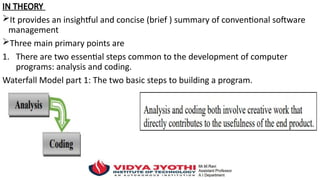
1. There are two essential steps common to the development of computer
programs: analysis and coding.
Waterfall Model part 1: The two basic steps to building a program.
8.
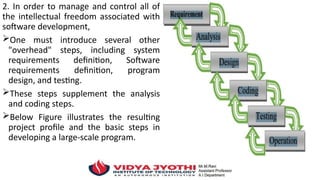
2. In orderto manage and control all of
the intellectual freedom associated with
software development,
One must introduce several other
"overhead" steps, including system
requirements definition, Software
requirements definition, program
design, and testing.
These steps supplement the analysis
and coding steps.
Below Figure illustrates the resulting
project profile and the basic steps in
developing a large-scale program.
9.
3. The basicframework described in the waterfall model is risky and invites failure.
The testing phase that occurs at the end of the development cycle is the first
event for which timing, storage, input/output transfers, etc., are experienced as
distinguished from analyzed.
The resulting design changes are likely to be so disruptive that the software
requirements upon which the design is based are likely violated.
Either the requirements must be modified or a substantial design change is
warranted.
10.
Five necessary improvementsfor waterfall model are:-
1. Program design comes first.
Insert a preliminary program design phase between the software requirements
generation phase and the analysis phase.
By this technique, the program designer assures that the software will not fail
because of storage, timing, and data flux (continuous change).
As analysis proceeds in the succeeding phase, the program designer must impose
on the analyst the storage, timing, and operational constraints in such a way that
he senses the consequences.
If the total resources to be applied are insufficient or if the embryonic(in an early
stage of development) operational design is wrong, it will be recognized at this
early stage and the iteration with requirements and preliminary design can be
redone before final design, coding, and test commences.
How is this program design procedure implemented?
11.
The following stepsare required:
Begin the design process with program designers, not analysts or programmers.
Design, define, and allocate the data processing modes even at the risk of being
wrong.
Allocate processing functions, design the database, allocate execution time,
define interfaces and processing modes with the operating system, describe input
and output processing, and define preliminary operating procedures.
Write an overview document that is understandable, informative, and current so
that every worker on the project can gain an elemental understanding of the
system.
12.
2. Document thedesign.
The amount of documentation required on most software programs is quite a lot,
certainly much more than most programmers, analysts, or program designers are
willing to do if left to their own devices.
Why do we need so much documentation?
(1) Each designer must communicate with interfacing designers, managers, and
possibly customers.
(2) During early phases, the documentation is the design.
(3) The real monetary value of documentation is to support later modifications by a
separate test team, a separate maintenance team, and operations personnel who
are not software literate.
13.
3. Do ittwice.
If a computer program is being developed for the first time, arrange matters so
that the version finally delivered to the customer for operational deployment is
actually the second version in so far as critical design/operations are concerned.
Note that this is simply the entire process done in miniature, to a time scale
Requirement Analysis Design Coding Testing Operation 3 that is relatively small
with respect to the overall effort. In the first version, the team must have a
special broad competence where they can quickly sense trouble spots in the
design, model them, model alternatives, forget the straightforward aspects of the
design that aren't worth studying at this early point, and, finally, arrive at an
error-free program.
14.
4. Plan, control,and monitor testing.
The previous three recommendations were all aimed at uncovering and solving
problems before entering the test phase.
However, even after doing these things, there is still a test phase and there are
still important things to be done, including:
(1) employ a team of test specialists who were not responsible for the original
design;
(2) employ visual inspections to spot the obvious errors like dropped minus signs,
missing factors of two, jumps to wrong addresses (do not use the computer to
detect this kind of thing, it is too expensive);
(3) test every logic path;
(4) employ the final checkout on the target computer.
15.
5. Involve thecustomer.
It is important to involve the customer in a formal way so that he has committed
himself at earlier points before final delivery.
There are three points following requirements definition where the insight,
judgment, and commitment of the customer can bolster the development effort.
These include a "preliminary software review" following the preliminary program
design step, a sequence of "critical software design reviews" during program
design, and a "final software acceptance review".