The Ultimate Guide to Buying and Verifying Google Ads Accounts Safely in 2026
Learn legitimate methods to obtain verified Google Ads accounts, avoid risks of buying pre-verified accounts, and ensure compliance with Google's verification policies for stable advertising campaigns.
The Ultimate Guide to Buying and Verifying Google Ads Accounts Safely in 2026
1.
The Ultimate Guideto Buying Aged
Google Ads Accounts
A verified Google Ads account is increasingly essential for businesses that want to
advertise consistently, build customer trust, and reduce disruption from
verification-related campaign pauses. However, the safest approach is not to buy a
pre-verified account from an unknown seller—it is to establish or use an account that
is verifiably connected to your real business, payment method, website, and
advertising operations.
Google’s verification systems are designed to establish advertiser accountability. If
verification is required and not completed by the deadline, campaigns may be
paused. This guide explains five legitimate, lower-risk ways to obtain and operate a
verified Google Ads account in 2026.
➤If you want to more information just knock us–
✅Telegram: @usapvastore
✅WhatsApp:+1(605)3716206
What Is a Verified Google Ads Account?
A verified Google Ads account is an advertising account where Google has confirmed
information about the advertiser, such as the individual or business entity
responsible for ads, the organization’s details, payment profile, and—in some
cases—business operations or identity documents.
2.
Verification is partof Google’s effort to improve ad transparency, prevent fraud, and
help users understand who is behind an advertisement. Advertisers may be asked to
submit business registration documents, government-issued identification for an
authorized representative, proof of address, payment details, phone verification,
email confirmation, or answers about how the company operates.
Once verified, Google may display advertiser transparency information through an
“About this advertiser” disclosure. This means the advertiser identity should
accurately represent the company, product owner, or agency responsible for the
advertising activity.
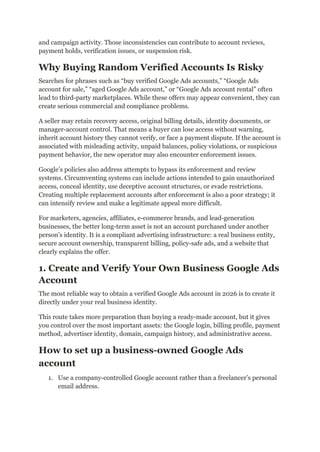
It is important to distinguish between:
Term Meaning Risk level
Verified
business-owned
account
Your company creates the account
and completes verification using its
own documents
Lowest
Agency-managed client
account
A qualified agency manages
campaigns through proper access
permissions
Low when
transparent
Account transferred
after a business
acquisition
Account ownership and billing are
updated as part of a legitimate
corporate transaction
Moderate;
requires
documentation
“Aged” or “pre-verified”
account from a
marketplace
An unrelated seller offers an
account under another identity
Very high
Account rental or
shared login
You pay to use another entity’s
account credentials
Very high
The key issue is simple: advertiser verification is tied to identity and accountability.
Buying an account verified under someone else’s business details can create
mismatches between the advertiser, billing information, website, payment method,
3.
and campaign activity.Those inconsistencies can contribute to account reviews,
payment holds, verification issues, or suspension risk.
Why Buying Random Verified Accounts Is Risky
Searches for phrases such as “buy verified Google Ads accounts,” “Google Ads
account for sale,” “aged Google Ads account,” or “Google Ads account rental” often
lead to third-party marketplaces. While these offers may appear convenient, they can
create serious commercial and compliance problems.
A seller may retain recovery access, original billing details, identity documents, or
manager-account control. That means a buyer can lose access without warning,
inherit account history they cannot verify, or face a payment dispute. If the account is
associated with misleading activity, unpaid balances, policy violations, or suspicious
payment behavior, the new operator may also encounter enforcement issues.
Google’s policies also address attempts to bypass its enforcement and review
systems. Circumventing systems can include actions intended to gain unauthorized
access, conceal identity, use deceptive account structures, or evade restrictions.
Creating multiple replacement accounts after enforcement is also a poor strategy; it
can intensify review and make a legitimate appeal more difficult.
For marketers, agencies, affiliates, e-commerce brands, and lead-generation
businesses, the better long-term asset is not an account purchased under another
person’s identity. It is a compliant advertising infrastructure: a real business entity,
secure account ownership, transparent billing, policy-safe ads, and a website that
clearly explains the offer.
1. Create and Verify Your Own Business Google Ads
Account
The most reliable way to obtain a verified Google Ads account in 2026 is to create it
directly under your real business identity.
This route takes more preparation than buying a ready-made account, but it gives
you control over the most important assets: the Google login, billing profile, payment
method, advertiser identity, domain, campaign history, and administrative access.
How to set up a business-owned Google Ads
account
1. Use a company-controlled Google account rather than a freelancer’s personal
email address.
4.
2. Ensure yourbusiness name, website domain, phone number, legal entity
details, and contact email are consistent across your website, Google Ads
billing profile, business registration records, and customer-facing policies.
3. Add a payment method owned by the business or authorized payer.
4. Build a complete website before launching campaigns. Include an About page,
Contact page, Privacy Policy, Terms and Conditions, Refund or Returns Policy
where relevant, product information, and accurate claims.
5. Navigate to the advertiser verification area when Google requests verification.
Google’s verification process may involve questions about the organization,
operations, payment history, payer, phone number, email address, and
supporting documents.
6. Submit genuine, current documents. Do not alter, reuse, or borrow documents
from another business.
7. Keep a secure internal record of who owns the account, who has administrator
privileges, who can change billing details, and who is responsible for policy
compliance.
Why this is the best option
A self-owned verified account gives your business a stable foundation. Instead of
trying to make a purchased account look legitimate, every major data point naturally
aligns:
● Legal business entity.
● Advertiser verification profile.
● Website ownership.
● Customer support contact details.
● Billing profile.
● Payment method.
● Landing pages.
● Product and service descriptions.
● Tax, invoicing, and accounting records.
This consistency matters. It also makes it easier to appeal a decision, respond to a
verification request, change employees or agencies, and expand your campaigns
without losing control of the account.
Best for
● E-commerce stores.
● SaaS companies.
● Local service businesses.
● Legitimate affiliate publishers.
● Lead-generation companies.
● Brands launching a long-term paid-search strategy.
● Businesses planning to spend consistently over time.
5.
2. Work Witha Google Ads Agency Through Proper
Account Access
A reputable Google Ads agency can manage campaigns for your business without
selling you an account or sharing credentials. This is one of the most practical
alternatives for companies that need expert setup, account structure, conversion
tracking, policy guidance, and campaign management.
The right setup is that your business owns the Google Ads account, while the agency
receives access through a Google Ads manager account. The agency should not
require you to surrender ownership of your Google login, billing profile, website, or
advertising identity.
What a legitimate agency arrangement looks like
A compliant agency relationship usually includes:
● The client retains ownership of the Google Ads account.
● The client controls billing and payment information.
● The agency requests access through a manager account.
● Individual team members receive role-based permissions.
● The agency uses its own business identity for management but the advertiser
identity reflects the client or payer, as appropriate.
● The contract clearly defines campaign ownership, access, reporting, fees, and
exit procedures.
● The client can remove the agency’s access if the relationship ends.
This approach is fundamentally different from “account rental.” With account rental,
an advertiser may be asked to run campaigns through an unrelated company’s
verified profile or pay for access to a third party’s account. That creates an identity
mismatch and can leave the advertiser dependent on the seller.
Questions to ask before hiring an agency
● Will my company own the Google Ads account?
● Will I have administrator access from the beginning?
● Is the billing profile in my company’s name?
● Will you use a manager account rather than shared passwords?
● Will you document all conversion tracking, campaign assets, and landing-page
changes?
● What happens to the account if we end the contract?
● Do you have experience with my industry’s policy requirements?
● Will you review the website for advertising-policy risks before launch?
6.
A strong agencyshould welcome these questions. If an agency promises “guaranteed
suspension-proof accounts,” “unlimited replacement accounts,” “secret verified
accounts,” or “bypass methods,” treat that as a major warning sign.
Best for
● Businesses without an in-house PPC specialist.
● Brands launching Google Ads for the first time.
● Companies operating in regulated or policy-sensitive sectors.
● Businesses that need campaign scaling but want to retain account ownership.
● Marketing teams that need technical help with tracking, feeds, scripts, or
reporting.
3. Acquire a Business With Its Google Ads Assets
A legitimate corporate acquisition can include marketing assets such as a website,
brand, customer database, analytics properties, social accounts, merchant accounts,
and Google Ads accounts. This is very different from purchasing an anonymous
account from a marketplace.
For example, a company acquiring an established e-commerce brand may also
acquire its domain, product catalog, advertising account history, customer-service
systems, and related business records. In such a case, it may be appropriate to
maintain the advertising asset while updating business information, billing
arrangements, access permissions, and verification details.
When this route can make sense
This option may be relevant when you are buying:
● An e-commerce business.
● A local service company.
● A SaaS product.
● A content site with an established brand.
● A franchise location.
● A company undergoing a merger or restructuring.
● A digital asset package that includes a real operating business.
The account should be one component of a genuine transaction—not the sole item
being purchased.
Steps to reduce risk during an acquisition
1. Perform due diligence before completing the acquisition.
2. Review account policy history, billing status, campaign performance,
conversion tracking, linked accounts, merchant data, and user access.
7.
3. Verify thatthe seller actually owns the business, domain, payment profile, and
advertising assets.
4. Obtain a written asset-transfer agreement that identifies what is being
transferred.
5. Update administrator access immediately after closing.
6. Remove former employees, contractors, and unknown users.
7. Update the billing profile and payment method lawfully and transparently.
8. Review advertiser verification status and follow Google’s instructions if
re-verification is needed.
9. Audit all ads and landing pages before resuming or scaling campaigns.
10.Keep corporate documents available to explain changes in ownership if Google
requests them.
Important caution
Do not assume that acquiring an account means all historical verification status will
automatically remain valid forever. A change in business ownership, payer, website,
brand, domain, products, or account activity may trigger fresh scrutiny. The proper
approach is to be transparent and prepared to provide documents that explain the
business transaction.
Best for
● Entrepreneurs acquiring established online businesses.
● Holding companies.
● E-commerce aggregators.
● Private investors buying operational brands.
● Businesses involved in mergers, restructurings, or franchise transfers.
4. Use an Existing Corporate Google Ads Account
If your organization already operates Google Ads through a parent company,
approved brand, regional office, franchise structure, or established business unit, you
may not need to open a separate account at all.
Instead, you may be able to create a compliant account structure within the
organization’s existing advertising environment. This can be done through
appropriate account permissions, manager-account hierarchies, and clear
documentation of who is advertising, who pays, and which website or product line is
being promoted.
Examples of legitimate use cases
A parent company may manage advertising for several brands. A franchisor may
manage certain national campaigns while franchisees run local campaigns. A
multi-location company may have separate campaigns or accounts for each region. A
8.
group business maycentralize billing and technical campaign management while
each brand operates its own landing pages and customer-service process.
In each scenario, the relationship should be real and documentable.
For example, a UK home-services group might use a central Google Ads manager
account for its branches in Manchester, Birmingham, and Leeds. Each branch can
have a separate campaign structure, location targeting, phone tracking number, and
landing page, while the parent business maintains authorized billing and governance.
How to keep the structure compliant
● Make the advertiser-business relationship clear.
● Use accurate brand names and landing-page disclosures.
● Do not conceal ownership or payer information.
● Avoid duplicate ads that compete unfairly for the same product, location, and
audience.
● Give access to staff and agencies through role permissions rather than sharing
passwords.
● Keep company records that explain the brand, franchise, subsidiary, or agency
relationship.
● Use consistent business information across the ads, landing pages, billing
records, and customer support channels.
A central structure can be efficient, but it must not be used to create artificial account
volume or to evade restrictions. The aim should be organized campaign
management, not avoidance of platform controls.
Best for
● Multi-brand companies.
● Franchise organizations.
● Multi-location service businesses.
● Enterprise advertisers.
● Agencies managing several authorized client accounts.
● Groups with separate divisions or regional business units.
5. Build a Policy-Ready Account With Professional
Compliance Support
Some businesses do not need to buy a verified Google Ads account; they need help
becoming verification-ready. A professional consultant, legal adviser, compliance
specialist, web developer, or experienced PPC manager can help prepare the business
for a legitimate verification process.
9.
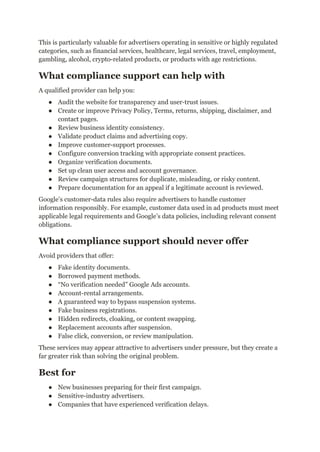
This is particularlyvaluable for advertisers operating in sensitive or highly regulated
categories, such as financial services, healthcare, legal services, travel, employment,
gambling, alcohol, crypto-related products, or products with age restrictions.
What compliance support can help with
A qualified provider can help you:
● Audit the website for transparency and user-trust issues.
● Create or improve Privacy Policy, Terms, returns, shipping, disclaimer, and
contact pages.
● Review business identity consistency.
● Validate product claims and advertising copy.
● Improve customer-support processes.
● Configure conversion tracking with appropriate consent practices.
● Organize verification documents.
● Set up clean user access and account governance.
● Review campaign structures for duplicate, misleading, or risky content.
● Prepare documentation for an appeal if a legitimate account is reviewed.
Google’s customer-data rules also require advertisers to handle customer
information responsibly. For example, customer data used in ad products must meet
applicable legal requirements and Google’s data policies, including relevant consent
obligations.
What compliance support should never offer
Avoid providers that offer:
● Fake identity documents.
● Borrowed payment methods.
● “No verification needed” Google Ads accounts.
● Account-rental arrangements.
● A guaranteed way to bypass suspension systems.
● Fake business registrations.
● Hidden redirects, cloaking, or content swapping.
● Replacement accounts after suspension.
● False click, conversion, or review manipulation.
These services may appear attractive to advertisers under pressure, but they create a
far greater risk than solving the original problem.
Best for
● New businesses preparing for their first campaign.
● Sensitive-industry advertisers.
● Companies that have experienced verification delays.
10.
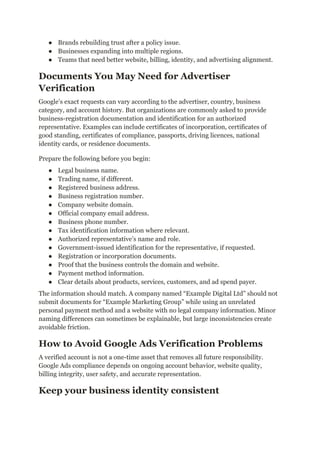
● Brands rebuildingtrust after a policy issue.
● Businesses expanding into multiple regions.
● Teams that need better website, billing, identity, and advertising alignment.
Documents You May Need for Advertiser
Verification
Google’s exact requests can vary according to the advertiser, country, business
category, and account history. But organizations are commonly asked to provide
business-registration documentation and identification for an authorized
representative. Examples can include certificates of incorporation, certificates of
good standing, certificates of compliance, passports, driving licences, national
identity cards, or residence documents.
Prepare the following before you begin:
● Legal business name.
● Trading name, if different.
● Registered business address.
● Business registration number.
● Company website domain.
● Official company email address.
● Business phone number.
● Tax identification information where relevant.
● Authorized representative’s name and role.
● Government-issued identification for the representative, if requested.
● Registration or incorporation documents.
● Proof that the business controls the domain and website.
● Payment method information.
● Clear details about products, services, customers, and ad spend payer.
The information should match. A company named “Example Digital Ltd” should not
submit documents for “Example Marketing Group” while using an unrelated
personal payment method and a website with no legal company information. Minor
naming differences can sometimes be explainable, but large inconsistencies create
avoidable friction.
How to Avoid Google Ads Verification Problems
A verified account is not a one-time asset that removes all future responsibility.
Google Ads compliance depends on ongoing account behavior, website quality,
billing integrity, user safety, and accurate representation.
Keep your business identity consistent
11.
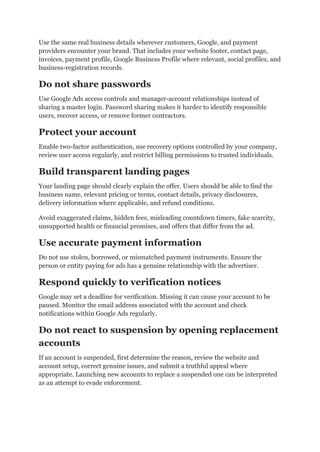
Use the samereal business details wherever customers, Google, and payment
providers encounter your brand. That includes your website footer, contact page,
invoices, payment profile, Google Business Profile where relevant, social profiles, and
business-registration records.
Do not share passwords
Use Google Ads access controls and manager-account relationships instead of
sharing a master login. Password sharing makes it harder to identify responsible
users, recover access, or remove former contractors.
Protect your account
Enable two-factor authentication, use recovery options controlled by your company,
review user access regularly, and restrict billing permissions to trusted individuals.
Build transparent landing pages
Your landing page should clearly explain the offer. Users should be able to find the
business name, relevant pricing or terms, contact details, privacy disclosures,
delivery information where applicable, and refund conditions.
Avoid exaggerated claims, hidden fees, misleading countdown timers, fake scarcity,
unsupported health or financial promises, and offers that differ from the ad.
Use accurate payment information
Do not use stolen, borrowed, or mismatched payment instruments. Ensure the
person or entity paying for ads has a genuine relationship with the advertiser.
Respond quickly to verification notices
Google may set a deadline for verification. Missing it can cause your account to be
paused. Monitor the email address associated with the account and check
notifications within Google Ads regularly.
Do not react to suspension by opening replacement
accounts
If an account is suspended, first determine the reason, review the website and
account setup, correct genuine issues, and submit a truthful appeal where
appropriate. Launching new accounts to replace a suspended one can be interpreted
as an attempt to evade enforcement.
12.
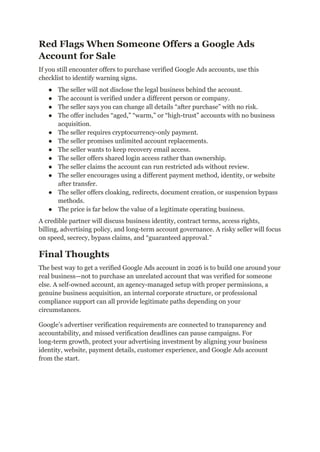
Red Flags WhenSomeone Offers a Google Ads
Account for Sale
If you still encounter offers to purchase verified Google Ads accounts, use this
checklist to identify warning signs.
● The seller will not disclose the legal business behind the account.
● The account is verified under a different person or company.
● The seller says you can change all details “after purchase” with no risk.
● The offer includes “aged,” “warm,” or “high-trust” accounts with no business
acquisition.
● The seller requires cryptocurrency-only payment.
● The seller promises unlimited account replacements.
● The seller wants to keep recovery email access.
● The seller offers shared login access rather than ownership.
● The seller claims the account can run restricted ads without review.
● The seller encourages using a different payment method, identity, or website
after transfer.
● The seller offers cloaking, redirects, document creation, or suspension bypass
methods.
● The price is far below the value of a legitimate operating business.
A credible partner will discuss business identity, contract terms, access rights,
billing, advertising policy, and long-term account governance. A risky seller will focus
on speed, secrecy, bypass claims, and “guaranteed approval.”
Final Thoughts
The best way to get a verified Google Ads account in 2026 is to build one around your
real business—not to purchase an unrelated account that was verified for someone
else. A self-owned account, an agency-managed setup with proper permissions, a
genuine business acquisition, an internal corporate structure, or professional
compliance support can all provide legitimate paths depending on your
circumstances.
Google’s advertiser verification requirements are connected to transparency and
accountability, and missed verification deadlines can pause campaigns. For
long-term growth, protect your advertising investment by aligning your business
identity, website, payment details, customer experience, and Google Ads account
from the start.