Presentation at the
2026Mileage-Based User Fee Alliance National Conference
June 16, 2026
Chad Shirley
Microeconomic Studies Division
The Status of the Highway
Trust Fund in 2026
For information about the 2026 MBUFA Annual Conference, see https://mbufa.org/.
2.
1
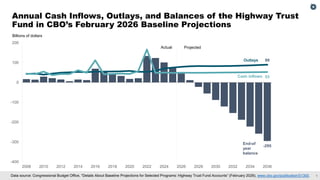
Data source: CongressionalBudget Office, “Details About Baseline Projections for Selected Programs: Highway Trust Fund Accounts” (February 2026), www.cbo.gov/publication/51300.
Annual Cash Inflows, Outlays, and Balances of the Highway Trust
Fund in CBO’s February 2026 Baseline Projections
-295
89
53
-400
-300
-200
-100
0
100
200
2008 2010 2012 2014 2016 2018 2020 2022 2024 2026 2028 2030 2032 2034 2036
Actual Projected
Outlays
Cash inflows
End-of
year
balance
Billions of dollars
3.
2
▪ Under currentlaw, the Highway Trust Fund cannot incur obligations that would result
in a negative balance. However, the rules governing baseline projections in the
Balanced Budget and Emergency Deficit Control Act of 1985 require that CBO’s
baseline projections for surface transportation spending reflect the assumption that
obligations presented to the Highway Trust Fund will be paid in full.
▪ The figure on the previous slide shows the cumulative shortfall of fund balances in
CBO’s February 2026 baseline projections. In accordance with the rules for baseline
construction, outlays are projected from obligation limitations enacted under the
Continuing Appropriations Act, 2026 (Public Law 119-37), and adjusted annually at
the projected rate of inflation.
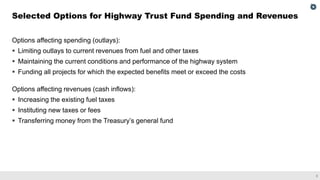
▪ Some of the taxes that are credited to the Highway Trust Fund are scheduled to
expire on September 30, 2028, including the taxes on tires and all but 4.3 cents of the
federal tax on motor fuels. However, as required by the Deficit Control Act, the
projections shown here reflect the assumption that all the expiring taxes credited to
the fund will continue to be collected after fiscal year 2028.
Things to Know About CBO’s Projections for the
Highway Trust Fund Accounts
4.
3
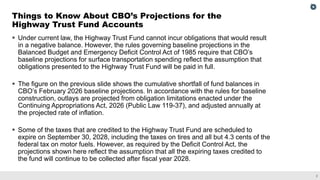
Options affecting spending(outlays):
▪ Limiting outlays to current revenues from fuel and other taxes
▪ Maintaining the current conditions and performance of the highway system
▪ Funding all projects for which the expected benefits meet or exceed the costs
Options affecting revenues (cash inflows):
▪ Increasing the existing fuel taxes
▪ Instituting new taxes or fees
▪ Transferring money from the Treasury’s general fund
Selected Options for Highway Trust Fund Spending and Revenues
5.
4
Data source: CongressionalBudget Office, “Details About Baseline Projections for Selected Programs: Highway Trust Fund Accounts” (February 2026), www.cbo.gov/publication/51300.
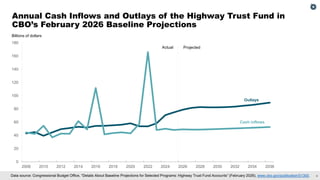
Annual Cash Inflows and Outlays of the Highway Trust Fund in
CBO’s February 2026 Baseline Projections
0
20
40
60
80
100
120
140
160
180
2008 2010 2012 2014 2016 2018 2020 2022 2024 2026 2028 2030 2032 2034 2036
Actual Projected
Outlays
Cash inflows
Billions of dollars
6.
5
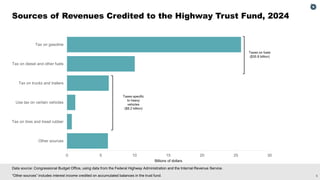
Data source: CongressionalBudget Office, using data from the Federal Highway Administration and the Internal Revenue Service.
“Other sources” includes interest income credited on accumulated balances in the trust fund.
Sources of Revenues Credited to the Highway Trust Fund, 2024
0 5 10 15 20 25 30
Other sources
Tax on tires and tread rubber
Use tax on certain vehicles
Tax on trucks and trailers
Tax on diesel and other fuels
Tax on gasoline
Taxes on fuels
($35.8 billion)
Taxes specific
to heavy
vehicles
($8.2 billion)
Billions of dollars
7.
6
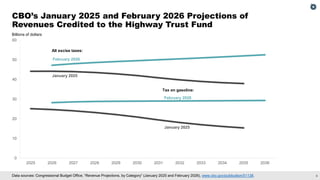
Data sources: CongressionalBudget Office, “Revenue Projections, by Category” (January 2025 and February 2026), www.cbo.gov/publication/51138.
CBO’s January 2025 and February 2026 Projections of
Revenues Credited to the Highway Trust Fund
0
10
20
30
40
50
60
2025 2026 2027 2028 2029 2030 2031 2032 2033 2034 2035 2036
February 2026
January 2025
February 2026
January 2025
All excise taxes:
Tax on gasoline:
Billions of dollars
8.
7
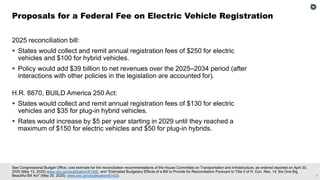
See Congressional BudgetOffice, cost estimate for the reconciliation recommendations of the House Committee on Transportation and Infrastructure, as ordered reported on April 30,
2025 (May 13, 2025) www.cbo.gov/publication/61400, and “Estimated Budgetary Effects of a Bill to Provide for Reconciliation Pursuant to Title II of H. Con. Res. 14, the One Big
Beautiful Bill Act” (May 20, 2025), www.cbo.gov/publication/61420.
2025 reconciliation bill:
▪ States would collect and remit annual registration fees of $250 for electric
vehicles and $100 for hybrid vehicles.
▪ Policy would add $39 billion to net revenues over the 2025–2034 period (after
interactions with other policies in the legislation are accounted for).
H.R. 8870, BUILD America 250 Act:
▪ States would collect and remit annual registration fees of $130 for electric
vehicles and $35 for plug-in hybrid vehicles.
▪ Rates would increase by $5 per year starting in 2029 until they reached a
maximum of $150 for electric vehicles and $50 for plug-in hybrids.
Proposals for a Federal Fee on Electric Vehicle Registration