The State of the Art of Salesforce DevOps: Advanced Architectures and AI Integration
Explore modern Salesforce DevOps practices, including source-driven development, CI/CD, environment strategy, governance, and AI-native pipelines for enhanced delivery and quality.
The State of the Art of Salesforce DevOps: Advanced Architectures and AI Integration
1.
THE STATE OFTHE ART OF SALESFORCE
DEVOPS
A pragmatic guide for architects and advanced developers
Aldo Fernandez — Salesforce Technical Architect
Montevideo Salesforce Architects Group
THE STATE OFTHE ART OF
SALESFORCE DEVOPS
Evolution to Core Discipline
Salesforce DevOps evolved into a key discipline impacting
delivery speed, quality, and team sustainability.
From Configuration to Engineering
Modern DevOps treats Salesforce as a software platform
applying version control, automated testing, and continuous
delivery.
Architectural Focus Over Tooling
DevOps emphasizes architecture principles like source-driven
development and environment strategy over tools alone.
Designing Adaptive Systems
Adaptive systems in Salesforce DevOps enable continuous
value delivery without compromising quality, control, or
compliance.
4.
WHY SALESFORCE DEVOPSMATTERS
NOW
Shift in Salesforce Role
Salesforce has evolved from CRM customization to a core digital backbone supporting multiple
business functions.
Complex Delivery Models
Managing sandboxes, packages, and integrations increases complexity and risks with manual
deployment approaches.
Risks of Manual Deployments
Manual deployments cause missing dependencies, lack of traceability, and inconsistent results across
environments.
Impact on Developer Well-being
Lack of DevOps practices leads to burnout, stress, and reduced morale due to manual work and late
releases.
DEFINING MODERN SALESFORCE
DEVOPS
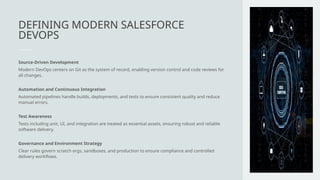
Source-DrivenDevelopment
Modern DevOps centers on Git as the system of record, enabling version control and code reviews for
all changes.
Automation and Continuous Integration
Automated pipelines handle builds, deployments, and tests to ensure consistent quality and reduce
manual errors.
Test Awareness
Tests including unit, UI, and integration are treated as essential assets, ensuring robust and reliable
software delivery.
Governance and Environment Strategy
Clear rules govern scratch orgs, sandboxes, and production to ensure compliance and controlled
delivery workflows.
7.
THE EVOLUTION OFSALESFORCE DEVOPS PRACTICES
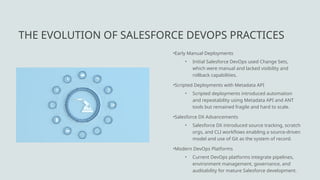
•Early Manual Deployments
• Initial Salesforce DevOps used Change Sets,
which were manual and lacked visibility and
rollback capabilities.
•Scripted Deployments with Metadata API
• Scripted deployments introduced automation
and repeatability using Metadata API and ANT
tools but remained fragile and hard to scale.
•Salesforce DX Advancements
• Salesforce DX introduced source tracking, scratch
orgs, and CLI workflows enabling a source-driven
model and use of Git as the system of record.
•Modern DevOps Platforms
• Current DevOps platforms integrate pipelines,
environment management, governance, and
auditability for mature Salesforce development.
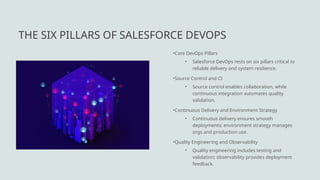
THE SIX PILLARSOF SALESFORCE DEVOPS
•Core DevOps Pillars
• Salesforce DevOps rests on six pillars critical to
reliable delivery and system resilience.
•Source Control and CI
• Source control enables collaboration, while
continuous integration automates quality
validation.
•Continuous Delivery and Environment Strategy
• Continuous delivery ensures smooth
deployments; environment strategy manages
orgs and production use.
•Quality Engineering and Observability
• Quality engineering includes testing and
validation; observability provides deployment
feedback.
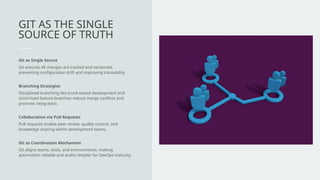
GIT AS THESINGLE
SOURCE OF TRUTH
Git as Single Source
Git ensures all changes are tracked and versioned,
preventing configuration drift and improving traceability.
Branching Strategies
Disciplined branching like trunk-based development and
short-lived feature branches reduce merge conflicts and
promote integration.
Collaboration via Pull Requests
Pull requests enable peer review, quality control, and
knowledge sharing within development teams.
Git as Coordination Mechanism
Git aligns teams, tools, and environments, making
automation reliable and audits simpler for DevOps maturity.
12.
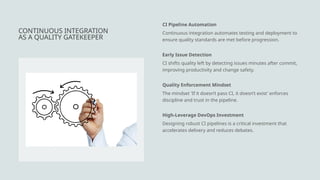
CONTINUOUS INTEGRATION
AS AQUALITY GATEKEEPER
CI Pipeline Automation
Continuous integration automates testing and deployment to
ensure quality standards are met before progression.
Early Issue Detection
CI shifts quality left by detecting issues minutes after commit,
improving productivity and change safety.
Quality Enforcement Mindset
The mindset 'If it doesn’t pass CI, it doesn’t exist' enforces
discipline and trust in the pipeline.
High-Leverage DevOps Investment
Designing robust CI pipelines is a critical investment that
accelerates delivery and reduces debates.
CONTINUOUS DELIVERY ON
THESALESFORCE PLATFORM
Validation and Environment Promotion
CD promotes validated changes through environments,
ensuring readiness for production deployment at any time.
Governance and Traceability
Click-to-promote workflows enable traceability and governance
with approvals and audit trails, reducing manual errors.
Rollback and Risk Management
Rollback strategies via source reversion or package versioning
minimize risks and ensure deployment safety.
CD as Routine Operation
CD transforms deployments into routine, predictable
operations, enabling frequent, low-stress releases.
15.
SALESFORCE DX ASTHE DEVOPS FOUNDATION
•Scratch Orgs for Flexibility
• Scratch orgs offer ephemeral and reproducible
environments, supporting cloud-native
Salesforce development practices.
•Source Tracking Simplification
• Source tracking improves synchronization
between local code and org state, simplifying
development workflows.
•CLI Automation in CI/CD
• Salesforce CLI enables automation of
deployments and validations across CI/CD
pipelines, enhancing repeatability.
•Modular Packaging Benefits
• Modular packaging allows decomposition of
large orgs into manageable units with clear
dependencies.
STRATEGIC ENVIRONMENT MANAGEMENT
•EnvironmentTypes and Purposes
• Different environment types support various
DevOps stages such as development, testing,
staging, and production.
•Ephemeral vs Long-lived Environments
• Treat environments as temporary assets to
reduce configuration drift and simplify recovery
processes.
•Rules and Automation
• Clear guidelines and automation ensure
consistent provisioning and prevent conflicts in
environment usage.
•Balancing Cost, Speed, and Fidelity
• Architects balance cost, speed, and accuracy to
achieve predictable deployments and reduce
risks.
18.
DATA MANAGEMENT ANDQUALITY ENGINEERING
Data Challenges in DevOps
Data issues cause deployment failures and gaps due to
test data creation and integrity challenges.
Modern Data Management
Techniques like scripted data seeding and synthetic data
integrate data management into pipelines.
Quality Engineering Practices
Quality engineering includes static analysis, UI testing, and
integration testing beyond code coverage.
Proactive Risk Management
Integrating data and quality into pipelines shifts teams
from reactive fixes to proactive risk management.
DEVOPS PLATFORMS: BUILDVS BUY
•Build Approach Benefits
• Building custom DevOps pipelines allows
flexibility and deep customization tailored to
specific organizational needs but requires
ongoing maintenance and expertise.
•Buy Approach Benefits
• Buying DevOps platforms accelerates adoption
and standardization with integrated features but
may involve licensing costs and some constraints.
•Hybrid Strategy
• Many organizations combine native CI/CD tools
with specialized Salesforce DevOps platforms to
balance flexibility and efficiency.
•Strategic Architectural Trade-off
• Selecting build versus buy is an architectural
decision that considers complexity, compliance,
scale, and risk tolerance to optimize delivery.
21.
GOVERNANCE, COMPLIANCE, ANDOBSERVABILITY
•Governance and Compliance Needs
• Growing system criticality drives stringent
governance, audit trails, and segregation of
duties without manual delays.
•Modern Policy Enforcement
• Policies encoded as code ensure consistent and
fast enforcement within automated DevOps
pipelines.
•Role of Observability
• Metrics, logs, and user feedback provide critical
insights into system behavior and deployment
success.
•Balancing Speed and Control
• Combining governance and observability enables
fast yet responsible innovation in regulated
environments.
THE SHIFT TOWARDAI‑NATIVE DEVOPS
AI-Augmented DevOps Evolution
DevOps evolves from automating fixed steps to AI systems understanding context, intent, and
risk in workflows.
Dynamic AI-Driven Pipelines
AI enables adaptive pipelines that optimize tests and deployments based on data and context,
reducing cycle times.
Responsible AI Usage
Ensuring trust, auditability, and security is crucial for architects harnessing AI in DevOps systems.
MCP as a Foundational Protocol
MCP protocol underpins the intelligent next-generation DevOps, enabling AI-native capabilities
responsibly.
24.
MODEL CONTEXT PROTOCOL
ANDSALESFORCE DX
Structured AI Access
MCP provides AI systems with structured access to tools, code,
and environments using meaningful context.
Intelligent DevOps Integration
MCP and Salesforce DX combine to create an AI-operable
DevOps platform enabling adaptive pipelines and intelligent
automation.
Human Oversight and Guardrails
Architects define guardrails to ensure policy enforcement,
traceability, and human oversight in AI-augmented DevOps
workflows.
AI as a Force Multiplier
MCP enhances human capabilities, positioning AI as a
complement to DevOps fundamentals rather than a
replacement.
Editor's Notes
#2 The State of the Art of Salesforce DevOps, Why Salesforce DevOps Matters Now
#3
Salesforce DevOps has evolved from a niche concern into a core architectural discipline that directly impacts delivery speed, system quality, and team sustainability. As organizations increasingly depend on Salesforce as a mission‑critical platform, expectations around reliability, traceability, and deployment frequency have risen dramatically. Modern Salesforce DevOps represents the convergence of software engineering best practices with the unique constraints of the Salesforce platform, including metadata‑driven development, multi‑tenant architecture, and strict governance requirements. For architects and advanced developers, understanding the current state of the art is no longer optional; it is essential for designing systems that scale both technically and organizationally.
Historically, Salesforce development was treated as configuration rather than engineering. This mindset led to practices such as manual deployments, point‑and‑click changes in production, and limited use of source control. While workable for small teams, these approaches break down rapidly as complexity increases. Modern DevOps reframes Salesforce as a full‑fledged software platform, applying principles such as version control, automated testing, continuous integration, and continuous delivery. The result is not just faster releases, but more predictable outcomes and higher confidence in change.
This presentation positions DevOps as an architectural concern rather than a tooling discussion. Tools matter, but they are secondary to principles such as source‑driven development, environment strategy, and quality engineering. By grounding DevOps decisions in architecture, teams avoid brittle pipelines and instead build resilient delivery systems. This slide establishes the framing for the rest of the deck: Salesforce DevOps is about designing adaptive systems that enable teams to deliver value continuously without sacrificing control, quality, or compliance.
#4
The urgency around Salesforce DevOps is driven by a fundamental shift in how Salesforce is used within enterprises. What was once a CRM customization platform is now a core digital backbone supporting sales, service, marketing, integrations, and industry‑specific processes. Release expectations have changed accordingly. Business stakeholders expect faster turnaround, safer deployments, and the ability to respond quickly to market or regulatory changes. Without a robust DevOps approach, these expectations become impossible to meet sustainably.
At the same time, Salesforce delivery models have grown more complex. Teams now manage multiple sandboxes, scratch orgs, managed or unlocked packages, and extensive integrations with external systems. Manual deployment approaches such as Change Sets introduce risk at every step: missing dependencies, lack of traceability, and inconsistent results across environments. These risks compound as team size and deployment frequency increase, leading to slower releases and declining confidence.
From a human perspective, the absence of DevOps practices directly contributes to developer burnout. Manual deployments, late‑night release windows, and fear‑driven change management create stress and reduce morale. In contrast, automated pipelines and clear governance reduce cognitive load and allow teams to focus on solving business problems. In today’s Salesforce ecosystem, DevOps is table stakes. Organizations that delay adoption are not standing still; they are falling behind competitors who can deliver faster, safer, and with greater transparency.
#5 Defining Modern Salesforce DevOps, The Evolution of Salesforce DevOps Practices
#6
Modern Salesforce DevOps is defined less by specific tools and more by a set of guiding principles that shape how changes flow from idea to production. At its core is source‑driven development, where Git—not an org—is the system of record. All changes begin life in version control, are reviewed as code, and move through environments via automated processes. This shift alone fundamentally changes team behavior, encouraging collaboration, transparency, and accountability.
Automation is the second defining characteristic. Continuous integration pipelines validate every change through automated builds, deployments, and tests. Rather than relying on manual verification or tribal knowledge, quality gates are encoded into pipelines. This creates consistent outcomes regardless of who authored the change or when it was made. Test awareness is equally critical. Modern DevOps treats tests as first‑class assets, encompassing not just Apex unit tests but also UI and integration testing where appropriate.
Finally, modern DevOps is governed and environment‑strategic. Scratch orgs, sandboxes, and production are used intentionally, with clear rules about their purpose and lifespan. Compliance, auditability, and segregation of duties are designed into the delivery process rather than bolted on later. Together, these elements form a cohesive system that allows Salesforce teams to move quickly without losing control, setting the foundation for scalable, enterprise‑grade delivery.
#7
Salesforce DevOps has progressed through several distinct phases, each shaped by the platform’s capabilities and the maturity of its user base. The earliest phase relied heavily on Change Sets, a manual, org‑to‑org deployment mechanism. While accessible, Change Sets offered little visibility, no true rollback, and high risk for complex changes. As teams grew, these limitations became increasingly painful.
The next phase introduced scripted deployments using the Metadata API and tools like ANT. This represented a step forward by enabling repeatability and basic automation. However, deployments were still fragile, tightly coupled to org state, and difficult to scale across multiple teams. Version control was often an afterthought rather than the central pillar of development.
The introduction of Salesforce DX marked a turning point. Source tracking, scratch orgs, and CLI‑driven workflows enabled a true source‑driven model. Git became the system of record, and modularization through packaging became viable. The current phase builds on this foundation with full DevOps platforms that integrate pipelines, environment management, governance, and auditability. Understanding this evolution helps architects recognize why certain legacy practices persist—and why they must be intentionally retired to achieve modern DevOps maturity.
#9
High‑performing Salesforce DevOps implementations consistently rest on six core pillars: source control, continuous integration, continuous delivery, environment strategy, quality engineering, and observability. Each pillar addresses a different dimension of delivery, and weakness in any one creates systemic risk. Source control establishes a single source of truth and enables collaboration. Continuous integration enforces quality through automated validation. Continuous delivery ensures changes can move reliably between environments.
Environment strategy defines how scratch orgs, sandboxes, and production are used, emphasizing ephemerality and repeatability. Quality engineering goes beyond code coverage to include static analysis, integration testing, and UI validation. Observability closes the loop by providing feedback after deployment, allowing teams to understand the real‑world impact of changes.
These pillars are interdependent. For example, CI is ineffective without strong source control, and CD without observability invites blind risk. Architects must evaluate DevOps maturity holistically, resisting the temptation to focus on a single tool or practice. The six‑pillar model provides a practical framework for assessing current state, identifying gaps, and prioritizing investments that move teams toward a resilient, scalable delivery system.
#10 Git as the Single Source of Truth, Continuous Integration as a Quality Gatekeeper
#11
In modern Salesforce DevOps, Git is non‑negotiable as the single source of truth. This means that no change is considered real unless it exists in version control. Direct changes in production or sandboxes undermine traceability and create configuration drift that is difficult to detect or reverse. By enforcing Git‑first workflows, teams gain a complete history of who changed what, why it changed, and when it was promoted.
Effective Git usage also requires disciplined branching strategies. Trunk‑based development and short‑lived feature branches reduce merge complexity and encourage frequent integration. Pull requests serve as both a quality gate and a collaboration mechanism, enabling peer review and knowledge sharing. Metadata decomposition further improves Git usability by breaking large XML files into smaller, more manageable components.
From an architectural perspective, Git is more than a repository; it is a coordination mechanism that aligns teams, tools, and environments. When Git is treated as authoritative, automation becomes reliable, audits become straightforward, and recovery from failures becomes significantly easier. This slide reinforces the idea that without Git discipline, no amount of tooling can deliver true DevOps maturity.
#12
Continuous integration (CI) is the enforcement layer of Salesforce DevOps, ensuring that every change meets defined quality standards before it progresses. A typical CI pipeline spins up an environment, deploys metadata, runs Apex tests, performs static analysis, and validates packaging or deployment rules. By automating these steps, CI removes subjectivity and reduces the risk of human error.
CI shifts quality left in the development lifecycle. Issues are detected minutes after a commit rather than days or weeks later during release testing. This rapid feedback loop improves developer productivity and encourages smaller, safer changes. Tools such as GitHub Actions, Jenkins, and CircleCI are commonly used, but the underlying principle remains the same regardless of platform.
A critical mindset shift is captured in the phrase: “If it doesn’t pass CI, it doesn’t exist.” This enforces discipline and builds trust in the pipeline. Over time, teams learn to rely on CI as an impartial arbiter of quality, reducing debates and accelerating delivery. For architects, designing robust CI pipelines is one of the highest‑leverage DevOps investments available.
#13 Continuous Delivery on the Salesforce Platform, Salesforce DX as the DevOps Foundation
#14
Continuous delivery (CD) extends CI by focusing on how validated changes are promoted through environments toward production. In Salesforce, CD encompasses environment promotion, automated validation, rollback strategies, and often data migration. The goal is not necessarily continuous deployment, but the ability to deploy at any time with confidence.
Effective CD pipelines provide traceability, allowing teams to answer questions such as which features are in which environment and when they were promoted. Click‑to‑promote workflows reduce manual steps while preserving governance through approvals and audit trails. Rollback strategies, whether through source reversion or package versioning, are essential for managing risk.
From an architectural standpoint, CD transforms deployments from events into routine operations. This normalization reduces fear and enables higher deployment frequency. By designing CD as a system rather than a script, Salesforce teams achieve predictable, low‑stress releases that align with modern engineering expectations.
#15
Salesforce DX (Developer Experience) provides the technical foundation upon which modern DevOps is built. Key DX capabilities include scratch orgs, source tracking, CLI automation, and support for modular packaging. Scratch orgs enable ephemeral, reproducible environments that can be created and destroyed on demand, aligning Salesforce development with cloud‑native practices.
Source tracking bridges the gap between local development and org state, reducing ambiguity and simplifying workflows. The Salesforce CLI enables automation across CI/CD pipelines, making deployments and validations scriptable and repeatable. Modular packaging, particularly unlocked packages, allows teams to decompose large orgs into manageable units with explicit dependencies.
Without DX, DevOps efforts tend to be brittle and heavily dependent on manual intervention. With DX, architects can design delivery systems that scale across teams and projects. This slide emphasizes that DX is not optional infrastructure, but a prerequisite for sustainable Salesforce DevOps maturity.
#16 Strategic Environment Management, Data Management and Quality Engineering
#17
A deliberate environment strategy is essential for effective Salesforce DevOps. Different environment types serve different purposes: scratch orgs for development and CI, developer sandboxes for feature testing, partial or full sandboxes for staging, and production for live users. Treating environments as ephemeral assets rather than long‑lived pets reduces drift and simplifies recovery.
Clear rules about what work happens where prevent confusion and conflict. For example, scratch orgs should never be used for long‑term testing, and production should never be a development environment. Automation plays a key role in provisioning and configuring environments consistently.
Architects must balance cost, speed, and fidelity when designing environment strategies. The payoff is significant: predictable deployments, faster onboarding, and reduced operational risk. This slide reinforces the idea that environments are a design choice, not an afterthought.
#18
Data is often the most neglected aspect of Salesforce DevOps, yet it is frequently the source of deployment failures and testing gaps. Challenges include creating realistic test data, maintaining data integrity across environments, and complying with privacy regulations. Without a strategy, teams resort to ad‑hoc data copies or manual fixes.
Modern approaches include scripted data seeding, synthetic data generation, and tools such as CumulusCI that integrate data management into pipelines. Quality engineering extends beyond Apex code coverage to include static analysis, UI testing, and integration testing. These practices provide a more accurate picture of system health.
By integrating data and quality considerations into DevOps pipelines, teams move from reactive firefighting to proactive risk management. Architects play a critical role in elevating quality from a metric to a mindset embedded throughout the delivery lifecycle.
#19 DevOps Platforms: Build vs Buy, Governance, Compliance, and Observability
#20
The Salesforce ecosystem offers a range of DevOps platforms such as Gearset, Copado, Flosum, and AutoRABIT. These tools provide integrated pipelines, environment management, governance, and auditability. Choosing between building custom pipelines and buying a platform is a strategic decision influenced by complexity, compliance requirements, and team capacity.
Building offers flexibility and deep customization but requires ongoing maintenance and expertise. Buying accelerates adoption and standardization at the cost of licensing and potential constraints. Many organizations adopt a hybrid approach, combining native CI/CD tools with specialized Salesforce DevOps platforms.
Architects must evaluate not just current needs but future scale. The right choice reduces friction, increases visibility, and aligns delivery practices with organizational risk tolerance. This slide frames the decision as an architectural trade‑off rather than a tooling preference.
#21
As Salesforce systems become more critical, governance and compliance requirements intensify. DevOps must support audit trails, segregation of duties, and approval workflows without reverting to manual bottlenecks. Modern pipelines encode policies as code, ensuring consistent enforcement while preserving speed.
Observability complements governance by providing insight into system behavior after deployment. Metrics, logs, and user feedback reveal the real‑world impact of changes on performance and reliability. Without observability, teams operate blind, unable to distinguish between successful deployments and silent failures.
Together, governance and observability transform DevOps from a delivery mechanism into a learning system. Architects who design for both enable organizations to move fast responsibly, balancing innovation with control in highly regulated or mission‑critical environments.
#22 The Shift Toward AI‑Native DevOps, Model Context Protocol and Salesforce DX
#23
Salesforce DevOps is entering a new phase characterized by AI‑augmented and AI‑native capabilities. The focus shifts from automating predefined steps to building systems that understand context, intent, and risk. This evolution mirrors broader trends in software engineering, where AI assists with code generation, review, and operations.
In DevOps, AI promises dynamic pipelines that adapt based on change impact, historical data, and environmental context. Rather than running the same tests for every change, systems can make informed decisions about what is necessary. This reduces cycle time without sacrificing confidence.
For architects, the challenge is to harness AI responsibly. Trust, auditability, and security become paramount. This slide sets the stage for understanding MCP as a foundational protocol enabling this next generation of intelligent DevOps systems.
#24
Model Context Protocol (MCP) provides a structured way for AI systems to access tools, code, and environments with meaningful context. In a Salesforce setting, MCP acts as the intelligence layer, while Salesforce DX provides the execution layer. Together, they enable AI‑operable DevOps platforms.
With MCP, AI can reason about metadata relationships, deployment dependencies, and environmental constraints. This enables advanced use cases such as intelligent deployments, context‑aware code review, smart test selection, and natural language DevOps commands. Instead of static scripts, pipelines become adaptive systems.
Architects must define guardrails that ensure human oversight, policy enforcement, and traceability. When implemented thoughtfully, MCP augments human capability rather than replacing it. This final section positions AI not as a replacement for DevOps fundamentals, but as a force multiplier built on a solid DX and DevOps foundation.

 Most read
 Most read