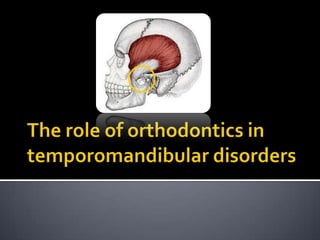
   Temporomandibular Disorder (TMD) is
    the main cause of pain of non-dental origin in
    the oro-facial region including head, face and
    related structures.
   The aetiology and the pathophysiology
     of TMD is poorly understood.
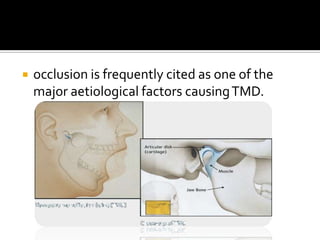
   occlusion is frequently cited as one of the
    major aetiological factors causing TMD.
   It is well known from epidemiologic studies
    that TMD-related signs and symptoms,
    particularly temporomandibular joint (TMJ)
    sounds, are frequently found in children and
    adolescents and show increased prevalence
    among subjects between 15 and 45 years old.
   Aesthetic awareness has increased the
    number of adults seeking orthodontic
    treatment.

   The attention of the orthodontic community
    regarding TMD was heightened in the late
    1980s after litigation involving orthodontic
    treatment as the cause of TMD in orthodontic
    patients
   on examining the publications from 1995 to
    2009, an increasing number of studies refute
    or reduce the importance of the role of
    occlusal factors in the aetiology of TMD.
   It can be concluded that occlusion is currently
    declining in importance and is now
    considered as a cofactor.

   Other aetiological factors, such as trauma,
    parafunctional behaviour, psychosocial
    disorders, gender, genetics and centrally
    mediated mechanisms, are considered more
    important.
   In 1995, a review of this topic by McNamara,
    Seligman and Okeson (70) listed eight
    conclusions that refute this possible
    association.

1 .Signs and symptoms of TMD occur in healthy
individuals
2. Signs and symptoms of TMD increase with
age,particularly during adolescence. Thus,
TMD that originates during orthodontic
treatment may not be related to the
treatment.
3 .Orthodontic treatment performed during
   adolescence generally does not increase or
   decrease the chances of developing TMD
   later in life.
4 .The extraction of teeth as part of an
  orthodontic treatment plan does not increase
  the risk of developing TMD.
5 .There is no elevated risk for TMD associated
   with any particular type of orthodontic
   mechanics.
6. Although a stable occlusion is a reasonable
  orthodontic treatment goal, not achieving a
  specific gnathologically ideal occlusion does
  not result in TMD signs and symptoms.
7. No method of TM disorder prevention has
  been demonstrated.

8 .When more severe TMD signs and symptoms
  are present, simple treatments can alleviate
  them in most patients.
Even though most of the studies consistently
do not support the correlation between
orthodontic treatment and
temporomandibular disorders, it must be
stressed that definitive conclusions cannot be
drawn because of the unknown cause of
TMD,
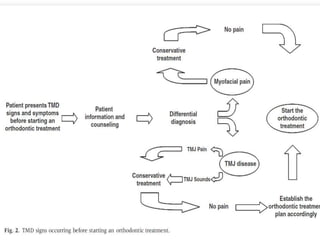
   Before starting orthodontic treatment, it is
    advisable to perform always a screening
    examination for the presence of TMD.

   Any findings, including TMJ sounds, deviation
    during mandibular movements or pain,
    should be recorded and updated at 6-month
    intervals, and informed consent should be
    signed by the patient
   first step is to make the diagnosis. When the
    patient’s chief complaint is pain, it is
    important to make a differential diagnosis to
    determine whether the pain is because of
    TMD, i.e. musculoskeletal condition, or to
    another disease.
   The second step is to resolve the pain by
    following a conservative treatment protocol
    including pharmacotherapy, counselling,
    behavioural therapy, home exercises,
    physical therapy and ⁄ or occlusal appliances.
   As a rule, orthodontic treatment should not
    be initiated as long as a patient suffers from
    facial pain.
   TMD is a multifactorial pathology, and it is
    difficult to demonstrate a direct correlation
    between one of the causes, such as occlusion,
    and TMD.
   With regard to TMJ dysfunction, the
    treatment goals should of course be to
    reduce pain and to improve function.
The role of orthodontics in temporomandibular disorders