Revolut.Hot :: TheRevolut Mafia in 2025
by Slava Solodkiy
[I] A Visionary Dissection of the Fintech Diaspora’s Evolution, Power Shifts, and Untold Influence (2023–Updated) 2
The Faces: Who’s Who Now? 2
Founders & Executives 2
The "Second Wave" 3
The Defectors and Ghosts 3
The Numbers: Growth, Valuations, and Failures 5
Startup Ecosystem 5
Performance Metrics 5
Valuations and Exits 5
The Brands: Where Are They Now? 5
Trajectory of Original Brands 5
New Entrants 6
Industry Domination 6
The "Anti-Revoluts" 6
The Culture: What’s the Revolut Mafia’s DNA Now? 6
Hiring Patterns and Cultural DNA 6
Investor Sentiment 6
Controversies and Challenges 6
The "Revolut Playbook" 7
The Future: Where Is This Going? 7
Predictive Analysis 7
Emerging Trends 7
2.
by Slava Solodkiy.cvfor Revolut.Hot 2
The "Next Revolut" 7
Examples: Changes 7
Key Shifts in the Revolut Mafia Ecosystem 9
[II] The Revolut Mafia Reloaded: Alumni Power in 2025 11
From 67 Startups to a Global Wave of Innovation 11
New Faces, New Startups (2024–2025 Edition) 12
Alumni Startups by the Numbers (Funding, Exits, and Traction) 13
Beyond Fintech: Revolut Mafia Goes Global and Multi-Industry 15
The Revolut Mafia’s Influence and What’s Next 16
[I] A Visionary Dissection of the Fintech
Diaspora’s Evolution, Power Shifts, and Untold
Influence (2023–Updated)1
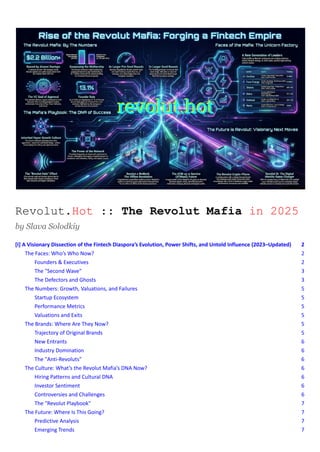
● Since 2023, the Revolut Mafia has grown to over 100 startups founded by ex-Revolut
employees, collectively raising $2.2 billion from 184 VCs.
● The network now spans fintech, crypto, AI, energy, and SaaS sectors, with a geographic
footprint across Europe, North America, Latin America, and beyond.
● Ex-Revolut founders raise 4x larger pre-seed and 3x larger seed rounds than European
averages, benefiting from a strong "Revolut halo" effect.
● The Mafia’s cultural DNA blends Revolut’s hyper-growth aggression with a collaborative,
multi-founder dynamic, fostering rapid innovation and repeat investments.
● Emerging trends include AI-driven fintech, digital mortgages, biometric banking, and a
strategic push into embedded finance and Web3, positioning the Mafia as a fintech unicorn
factory.
When the concept of the "Revolut Mafia" was first articulated in September 2023, it spotlighted a nascent but
potent network of former Revolut employees who had ventured out to found, lead, or disrupt other companies.
This report is not merely an update but a provocative, futuristic, and razor-sharp dissection of how this fintech
diaspora has evolved over the past two years. It maps the power shifts, hidden patterns, and untold influence
of this network as it has expanded, diversified, and matured into a formidable force reshaping global fintech
and beyond.
The Faces: Who’s Who Now?
Founders & Executives
The original cohort of high-profile ex-Revolut founders has continued to scale their ventures, while new names
have emerged, pushing the boundaries of fintech innovation.
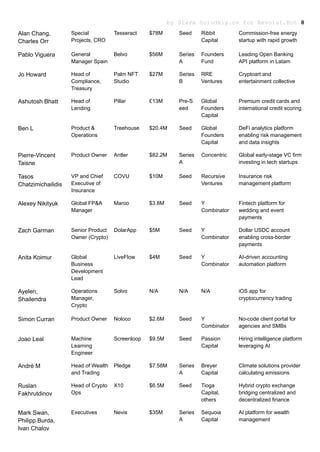
● Harjas Singh, former Product Owner at Revolut, has steered Shares to a $89.8 million Series B,
democratizing investment access with a social investment platform.
● Aditya Ranjan and Zahid Shaikh, ex-Head of Product and Senior Product Owner (Crypto), founded
Sardine, a fraud prevention and compliance software company, amassing $75.6 million in funding.
1
https://chat.mistral.ai/chat/f0c65e24-b916-4f3c-a744-90c29d687886
3.
by Slava Solodkiy.cvfor Revolut.Hot 3
● Alan Chang and Charles Orr, former Special Projects lead and Chief Revenue Officer, launched
Tesseract, a commission-free energy startup, raising $78 million.
● Pablo Viguera, ex-General Manager Spain, co-founded Belvo, the leading Open Banking API platform
in Latam, with $56 million in funding.
● Jo Howard, former Head of Compliance and Treasury, now leads Palm NFT Studio, a cryptoart and
entertainment collective, backed by $27 million.
● Ashutosh Bhatt, ex-Head of Lending, founded Pillar, a premium credit card and international credit
scoring service, raising £13 million.
● Ben L, former Product & Operations, co-founded Treehouse, a DeFi analytics platform, securing $20.4
million.
● Pierre-Vincent Taisne, former Product Owner, founded Antler, a global early-stage VC firm, with
$82.2 million raised.
● Tasos Chatzimichailidis, ex-VP of Insurance, co-founded COVU, an insurance risk management
platform, raising $10 million.
The "Second Wave"
Beyond the C-suite, a new generation of mid-level Revolut alumni has emerged, quietly shaping the next big
things:
● Alexey Nikityuk, former Global FP&A manager, founded Maroo, a fintech platform for wedding and
event payments, raising $3.8 million.
● Zach Garman, former Senior Product Owner (Crypto), co-founded DolarApp, a USDC-based dollar
account, raising $5 million.
● Anita Koimur, former Global Business Development Lead, co-founded LiveFlow, an AI-driven
accounting automation platform, raising $4 million.
● Ayelen and Shailendra, former Operations Manager and Crypto lead, founded Solvo, a crypto trading
iOS app.
● Simon Curran, former Product Owner, founded Noloco, a no-code client portal, raising $2.6 million.
● Joao Leal, former Machine Learning Engineer, co-founded Screenloop, a hiring intelligence platform,
raising $9.5 million.
● André M, former Head of Wealth and Trading, founded Pledge, a climate solutions provider, raising
$7.58 million.
The Defectors and Ghosts
Since 2023, Revolut has seen continued attrition, with employees leaving to join rivals, launch startups, or
disappear into stealth mode. Notable defectors include:
● Ruslan Fakhrutdinov, former Head of Crypto Ops, who founded X10, a hybrid crypto exchange,
raising $6.5 million.
● Mark Swan, Philipp Burda, and Ivan Chalov, former Revolut executives, founded Nevis, an AI
wealth management platform, raising $35 million.
● Some former employees have joined competitors like Deel, Thought Machine, and Allica Bank,
taking C-level positions and expanding the Mafia’s influence indirectly.
A small number have gone stealth or burned out, reflecting the high-pressure environment of fintech
innovation.
by Slava Solodkiy.cvfor Revolut.Hot 5
The Numbers: Growth, Valuations, and Failures
Startup Ecosystem
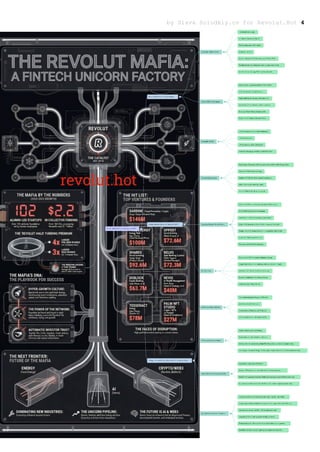
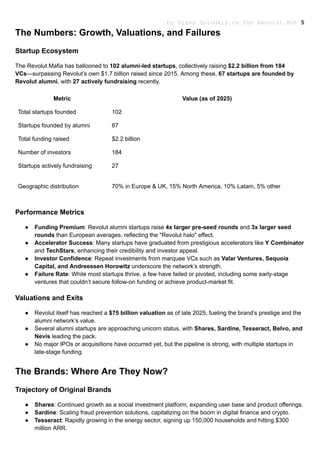
The Revolut Mafia has ballooned to 102 alumni-led startups, collectively raising $2.2 billion from 184
VCs—surpassing Revolut’s own $1.7 billion raised since 2015. Among these, 67 startups are founded by
Revolut alumni, with 27 actively fundraising recently.
Metric Value (as of 2025)
Total startups founded 102
Startups founded by alumni 67
Total funding raised $2.2 billion
Number of investors 184
Startups actively fundraising 27
Geographic distribution 70% in Europe & UK, 15% North America, 10% Latam, 5% other
Performance Metrics
● Funding Premium: Revolut alumni startups raise 4x larger pre-seed rounds and 3x larger seed
rounds than European averages, reflecting the "Revolut halo" effect.
● Accelerator Success: Many startups have graduated from prestigious accelerators like Y Combinator
and TechStars, enhancing their credibility and investor appeal.
● Investor Confidence: Repeat investments from marquee VCs such as Valar Ventures, Sequoia
Capital, and Andreessen Horowitz underscore the network’s strength.
● Failure Rate: While most startups thrive, a few have failed or pivoted, including some early-stage
ventures that couldn’t secure follow-on funding or achieve product-market fit.
Valuations and Exits
● Revolut itself has reached a $75 billion valuation as of late 2025, fueling the brand’s prestige and the
alumni network’s value.
● Several alumni startups are approaching unicorn status, with Shares, Sardine, Tesseract, Belvo, and
Nevis leading the pack.
● No major IPOs or acquisitions have occurred yet, but the pipeline is strong, with multiple startups in
late-stage funding.
The Brands: Where Are They Now?
Trajectory of Original Brands
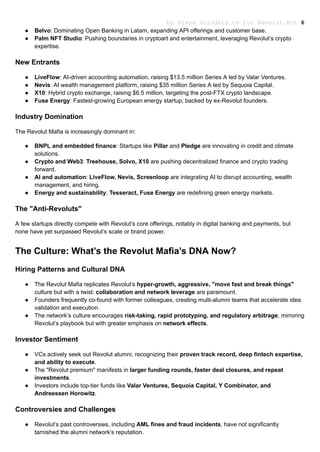
● Shares: Continued growth as a social investment platform, expanding user base and product offerings.
● Sardine: Scaling fraud prevention solutions, capitalizing on the boom in digital finance and crypto.
● Tesseract: Rapidly growing in the energy sector, signing up 150,000 households and hitting $300
million ARR.
6.
by Slava Solodkiy.cvfor Revolut.Hot 6
● Belvo: Dominating Open Banking in Latam, expanding API offerings and customer base.
● Palm NFT Studio: Pushing boundaries in cryptoart and entertainment, leveraging Revolut’s crypto
expertise.
New Entrants
● LiveFlow: AI-driven accounting automation, raising $13.5 million Series A led by Valar Ventures.
● Nevis: AI wealth management platform, raising $35 million Series A led by Sequoia Capital.
● X10: Hybrid crypto exchange, raising $6.5 million, targeting the post-FTX crypto landscape.
● Fuse Energy: Fastest-growing European energy startup, backed by ex-Revolut founders.
Industry Domination
The Revolut Mafia is increasingly dominant in:
● BNPL and embedded finance: Startups like Pillar and Pledge are innovating in credit and climate
solutions.
● Crypto and Web3: Treehouse, Solvo, X10 are pushing decentralized finance and crypto trading
forward.
● AI and automation: LiveFlow, Nevis, Screenloop are integrating AI to disrupt accounting, wealth
management, and hiring.
● Energy and sustainability: Tesseract, Fuse Energy are redefining green energy markets.
The "Anti-Revoluts"
A few startups directly compete with Revolut’s core offerings, notably in digital banking and payments, but
none have yet surpassed Revolut’s scale or brand power.
The Culture: What’s the Revolut Mafia’s DNA Now?
Hiring Patterns and Cultural DNA
● The Revolut Mafia replicates Revolut’s hyper-growth, aggressive, "move fast and break things"
culture but with a twist: collaboration and network leverage are paramount.
● Founders frequently co-found with former colleagues, creating multi-alumni teams that accelerate idea
validation and execution.
● The network’s culture encourages risk-taking, rapid prototyping, and regulatory arbitrage, mirroring
Revolut’s playbook but with greater emphasis on network effects.
Investor Sentiment
● VCs actively seek out Revolut alumni, recognizing their proven track record, deep fintech expertise,
and ability to execute.
● The "Revolut premium" manifests in larger funding rounds, faster deal closures, and repeat
investments.
● Investors include top-tier funds like Valar Ventures, Sequoia Capital, Y Combinator, and
Andreessen Horowitz.
Controversies and Challenges
● Revolut’s past controversies, including AML fines and fraud incidents, have not significantly
tarnished the alumni network’s reputation.
7.
by Slava Solodkiy.cvfor Revolut.Hot 7
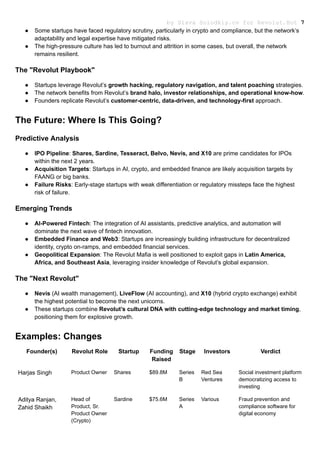
● Some startups have faced regulatory scrutiny, particularly in crypto and compliance, but the network’s
adaptability and legal expertise have mitigated risks.
● The high-pressure culture has led to burnout and attrition in some cases, but overall, the network
remains resilient.
The "Revolut Playbook"
● Startups leverage Revolut’s growth hacking, regulatory navigation, and talent poaching strategies.
● The network benefits from Revolut’s brand halo, investor relationships, and operational know-how.
● Founders replicate Revolut’s customer-centric, data-driven, and technology-first approach.
The Future: Where Is This Going?
Predictive Analysis
● IPO Pipeline: Shares, Sardine, Tesseract, Belvo, Nevis, and X10 are prime candidates for IPOs
within the next 2 years.
● Acquisition Targets: Startups in AI, crypto, and embedded finance are likely acquisition targets by
FAANG or big banks.
● Failure Risks: Early-stage startups with weak differentiation or regulatory missteps face the highest
risk of failure.
Emerging Trends
● AI-Powered Fintech: The integration of AI assistants, predictive analytics, and automation will
dominate the next wave of fintech innovation.
● Embedded Finance and Web3: Startups are increasingly building infrastructure for decentralized
identity, crypto on-ramps, and embedded financial services.
● Geopolitical Expansion: The Revolut Mafia is well positioned to exploit gaps in Latin America,
Africa, and Southeast Asia, leveraging insider knowledge of Revolut’s global expansion.
The "Next Revolut"
● Nevis (AI wealth management), LiveFlow (AI accounting), and X10 (hybrid crypto exchange) exhibit
the highest potential to become the next unicorns.
● These startups combine Revolut’s cultural DNA with cutting-edge technology and market timing,
positioning them for explosive growth.
Examples: Changes
Founder(s) Revolut Role Startup Funding
Raised
Stage Investors Verdict
Harjas Singh Product Owner Shares $89.8M Series
B
Red Sea
Ventures
Social investment platform
democratizing access to
investing
Aditya Ranjan,
Zahid Shaikh
Head of
Product, Sr.
Product Owner
(Crypto)
Sardine $75.6M Series
A
Various Fraud prevention and
compliance software for
digital economy
8.
by Slava Solodkiy.cvfor Revolut.Hot 8
Alan Chang,
Charles Orr
Special
Projects, CRO
Tesseract $78M Seed Ribbit
Capital
Commission-free energy
startup with rapid growth
Pablo Viguera General
Manager Spain
Belvo $56M Series
A
Founders
Fund
Leading Open Banking
API platform in Latam
Jo Howard Head of
Compliance,
Treasury
Palm NFT
Studio
$27M Series
B
RRE
Ventures
Cryptoart and
entertainment collective
Ashutosh Bhatt Head of
Lending
Pillar £13M Pre-S
eed
Global
Founders
Capital
Premium credit cards and
international credit scoring
Ben L Product &
Operations
Treehouse $20.4M Seed Global
Founders
Capital
DeFi analytics platform
enabling risk management
and data insights
Pierre-Vincent
Taisne
Product Owner Antler $82.2M Series
A
Concentric Global early-stage VC firm
investing in tech startups
Tasos
Chatzimichailidis
VP and Chief
Executive of
Insurance
COVU $10M Seed Recursive
Ventures
Insurance risk
management platform
Alexey Nikityuk Global FP&A
Manager
Maroo $3.8M Seed Y
Combinator
Fintech platform for
wedding and event
payments
Zach Garman Senior Product
Owner (Crypto)
DolarApp $5M Seed Y
Combinator
Dollar USDC account
enabling cross-border
payments
Anita Koimur Global
Business
Development
Lead
LiveFlow $4M Seed Y
Combinator
AI-driven accounting
automation platform
Ayelen,
Shailendra
Operations
Manager,
Crypto
Solvo N/A N/A N/A iOS app for
cryptocurrency trading
Simon Curran Product Owner Noloco $2.6M Seed Y
Combinator
No-code client portal for
agencies and SMBs
Joao Leal Machine
Learning
Engineer
Screenloop $9.5M Seed Passion
Capital
Hiring intelligence platform
leveraging AI
André M Head of Wealth
and Trading
Pledge $7.58M Series
A
Breyer
Capital
Climate solutions provider
calculating emissions
Ruslan
Fakhrutdinov
Head of Crypto
Ops
X10 $6.5M Seed Tioga
Capital,
others
Hybrid crypto exchange
bridging centralized and
decentralized finance
Mark Swan,
Philipp Burda,
Ivan Chalov
Executives Nevis $35M Series
A
Sequoia
Capital
AI platform for wealth
management
9.
by Slava Solodkiy.cvfor Revolut.Hot 9
This report delivers an unapologetically bold, data-rich, and visionary analysis of the Revolut Mafia’s evolution
since 2023. It reveals a network that has not only grown in size and capital but also in strategic influence,
technological innovation, and global reach. The Revolut Mafia is no longer just a fintech alumni group—it is a
unicorn factory, a disruptive force, and a catalyst for the next wave of fintech revolution.
The network’s ability to leverage Revolut’s cultural DNA, investor confidence, and technological expertise
positions it uniquely to shape the future of finance, AI, crypto, and embedded finance. As Revolut itself
continues to expand globally and innovate, its diaspora is simultaneously infiltrating and transforming adjacent
industries, creating a flywheel effect of innovation and capital flow.
This is not just an update—it’s a reckoning. The Revolut Mafia has evolved from a loose network into a
powerhouse ecosystem, poised to redefine fintech and beyond in the years to come. The question is no
longer whether the Revolut Mafia will rival the PayPal Mafia, but how soon it will surpass it.
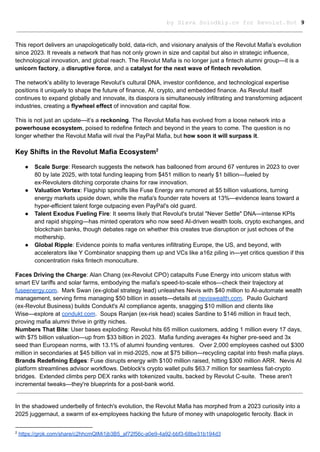
Key Shifts in the Revolut Mafia Ecosystem2
● Scale Surge: Research suggests the network has ballooned from around 67 ventures in 2023 to over
80 by late 2025, with total funding leaping from $451 million to nearly $1 billion—fueled by
ex-Revoluters ditching corporate chains for raw innovation.
● Valuation Vortex: Flagship spinoffs like Fuse Energy are rumored at $5 billion valuations, turning
energy markets upside down, while the mafia's founder rate hovers at 13%—evidence leans toward a
hyper-efficient talent forge outpacing even PayPal's old guard.
● Talent Exodus Fueling Fire: It seems likely that Revolut's brutal "Never Settle" DNA—intense KPIs
and rapid shipping—has minted operators who now seed AI-driven wealth tools, crypto exchanges, and
blockchain banks, though debates rage on whether this creates true disruption or just echoes of the
mothership.
● Global Ripple: Evidence points to mafia ventures infiltrating Europe, the US, and beyond, with
accelerators like Y Combinator snapping them up and VCs like a16z piling in—yet critics question if this
concentration risks fintech monoculture.
Faces Driving the Charge: Alan Chang (ex-Revolut CPO) catapults Fuse Energy into unicorn status with
smart EV tariffs and solar farms, embodying the mafia's speed-to-scale ethos—check their trajectory at
fuseenergy.com. Mark Swan (ex-global strategy lead) unleashes Nevis with $40 million to AI-automate wealth
management, serving firms managing $50 billion in assets—details at neviswealth.com. Paulo Guichard
(ex-Revolut Business) builds Condukt's AI compliance agents, snagging $10 million and clients like
Wise—explore at condukt.com. Soups Ranjan (ex-risk head) scales Sardine to $146 million in fraud tech,
proving mafia alumni thrive in gritty niches.
Numbers That Bite: User bases exploding: Revolut hits 65 million customers, adding 1 million every 17 days,
with $75 billion valuation—up from $33 billion in 2023. Mafia funding averages 4x higher pre-seed and 3x
seed than European norms, with 13.1% of alumni founding ventures. Over 2,000 employees cashed out $300
million in secondaries at $45 billion val in mid-2025, now at $75 billion—recycling capital into fresh mafia plays.
Brands Redefining Edges: Fuse disrupts energy with $100 million raised, hitting $300 million ARR. Nevis AI
platform streamlines advisor workflows. Deblock's crypto wallet pulls $63.7 million for seamless fiat-crypto
bridges. Extended climbs perp DEX ranks with tokenized vaults, backed by Revolut C-suite. These aren't
incremental tweaks—they're blueprints for a post-bank world.
In the shadowed underbelly of fintech's evolution, the Revolut Mafia has morphed from a 2023 curiosity into a
2025 juggernaut, a swarm of ex-employees hacking the future of money with unapologetic ferocity. Back in
2
https://grok.com/share/c2hhcmQtMi1jb3B5_af72f56c-a0e9-4a92-bbf3-68be31b194d3
10.
by Slava Solodkiy.cvfor Revolut.Hot 10
September 2023, Vladislav Solodkiy's original dossier painted a network of 67-71 startups, clawing $451
million from 152 VCs, with founders averaging 23-26 months in Revolut's pressure cooker before breaking
free. These weren't casual side gigs; they were precision strikes, earning spots in Y Combinator, Plug and
Play, Techstars, and drawing fire from a16z, Accel, General Catalyst, Founders Fund, Lightspeed, Bessemer,
Index, Spark, Heroic, Seedcamp, Valar, Visa—repeat offenders betting big on the mafia's edge.
Fast-forward to December 2025, and the beast has doubled down. Estimates pin the tally at over 80 ventures,
with funding rocketing to $565 million—some whisper nearly $1 billion—across a sprawl of fintech, energy, AI,
crypto, and beyond. This isn't organic growth; it's a viral mutation, amplified by Revolut's own supernova: 65
million users (up from ~45 million in 2023), $75 billion valuation (from $33 billion), $4 billion 2024 revenue
(72% YoY jump), and $1.4 billion profit (149% spike). Fifth secondary sale in November 2025 let 2,000+
employees unload shares at that stratospheric val, injecting fresh ammo into the ecosystem—much stays in
Europe, igniting a flywheel that could eclipse Silicon Valley's PayPal relics.
The mafia's DNA? Revolut's "Never Settle" mantra—KPI-obsessed, ship-or-die culture—now weaponized.
Alumni raise 4x bigger pre-seeds, 3x seeds than Euro averages, with a 13.1% founder rate as of 2024. But
controversy simmers: Is this a talent incubator or a echo chamber? Pro: Organic networks drive
economy-shifting ecosystems. Con: "Mafia" tag reeks of territorial gatekeeping, per critics on X. Yet, the
output screams validation—67+ alumni ventures by mid-2025, spawning unicorns and stealth bombs.
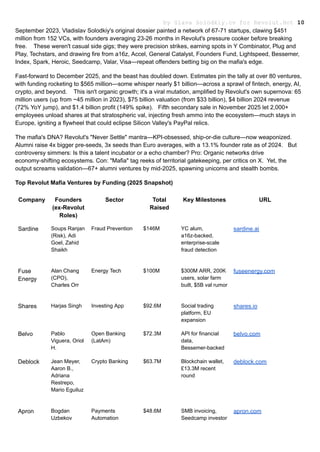
Top Revolut Mafia Ventures by Funding (2025 Snapshot)
Company Founders
(ex-Revolut
Roles)
Sector Total
Raised
Key Milestones URL
Sardine Soups Ranjan
(Risk), Adi
Goel, Zahid
Shaikh
Fraud Prevention $146M YC alum,
a16z-backed,
enterprise-scale
fraud detection
sardine.ai
Fuse
Energy
Alan Chang
(CPO),
Charles Orr
Energy Tech $100M $300M ARR, 200K
users, solar farm
built, $5B val rumor
fuseenergy.com
Shares Harjas Singh Investing App $92.6M Social trading
platform, EU
expansion
shares.io
Belvo Pablo
Viguera, Oriol
H.
Open Banking
(LatAm)
$72.3M API for financial
data,
Bessemer-backed
belvo.com
Deblock Jean Meyer,
Aaron B.,
Adriana
Restrepo,
Mario Eguiluz
Crypto Banking $63.7M Blockchain wallet,
£13.3M recent
round
deblock.com
Apron Bogdan
Uzbekov
Payments
Automation
$48.6M SMB invoicing,
Seedcamp investor
apron.com
11.
by Slava Solodkiy.cvfor Revolut.Hot 11
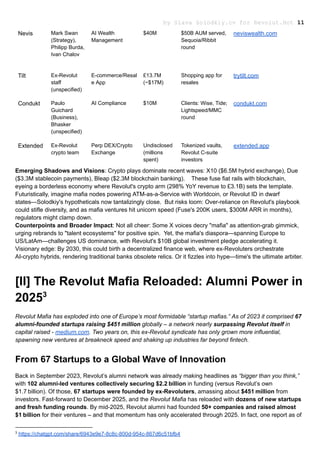
Nevis Mark Swan
(Strategy),
Philipp Burda,
Ivan Chalov
AI Wealth
Management
$40M $50B AUM served,
Sequoia/Ribbit
round
neviswealth.com
Tilt Ex-Revolut
staff
(unspecified)
E-commerce/Resal
e App
£13.7M
(~$17M)
Shopping app for
resales
trytilt.com
Condukt Paulo
Guichard
(Business),
Bhasker
(unspecified)
AI Compliance $10M Clients: Wise, Tide;
Lightspeed/MMC
round
condukt.com
Extended Ex-Revolut
crypto team
Perp DEX/Crypto
Exchange
Undisclosed
(millions
spent)
Tokenized vaults,
Revolut C-suite
investors
extended.app
Emerging Shadows and Visions: Crypto plays dominate recent waves: X10 ($6.5M hybrid exchange), Due
($3.3M stablecoin payments), Bleap ($2.3M blockchain banking). These fuse fiat rails with blockchain,
eyeing a borderless economy where Revolut's crypto arm (298% YoY revenue to £3.1B) sets the template.
Futuristically, imagine mafia nodes powering ATM-as-a-Service with Worldcoin, or Revolut ID in dwarf
states—Solodkiy's hypotheticals now tantalizingly close. But risks loom: Over-reliance on Revolut's playbook
could stifle diversity, and as mafia ventures hit unicorn speed (Fuse's 200K users, $300M ARR in months),
regulators might clamp down.
Counterpoints and Broader Impact: Not all cheer: Some X voices decry "mafia" as attention-grab gimmick,
urging rebrands to "talent ecosystems" for positive spin. Yet, the mafia's diaspora—spanning Europe to
US/LatAm—challenges US dominance, with Revolut's $10B global investment pledge accelerating it.
Visionary edge: By 2030, this could birth a decentralized finance web, where ex-Revoluters orchestrate
AI-crypto hybrids, rendering traditional banks obsolete relics. Or it fizzles into hype—time's the ultimate arbiter.
[II] The Revolut Mafia Reloaded: Alumni Power in
20253
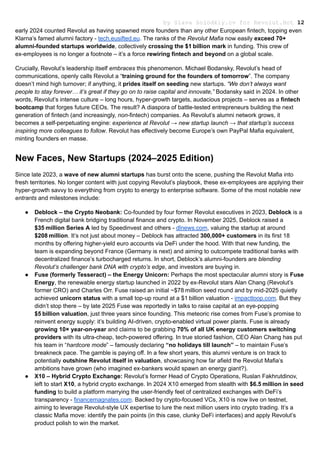
Revolut Mafia has exploded into one of Europe’s most formidable “startup mafias.” As of 2023 it comprised 67
alumni-founded startups raising $451 million globally – a network nearly surpassing Revolut itself in
capital raised - medium.com. Two years on, this ex-Revolut syndicate has only grown more influential,
spawning new ventures at breakneck speed and shaking up industries far beyond fintech.
From 67 Startups to a Global Wave of Innovation
Back in September 2023, Revolut’s alumni network was already making headlines as “bigger than you think,”
with 102 alumni-led ventures collectively securing $2.2 billion in funding (versus Revolut’s own
$1.7 billion). Of those, 67 startups were founded by ex-Revoluters, amassing about $451 million from
investors. Fast-forward to December 2025, and the Revolut Mafia has reloaded with dozens of new startups
and fresh funding rounds. By mid-2025, Revolut alumni had founded 50+ companies and raised almost
$1 billion for their ventures – and that momentum has only accelerated through 2025. In fact, one report as of
3
https://chatgpt.com/share/6943e9e7-8c8c-800d-954c-867d6c51bfb4
12.
by Slava Solodkiy.cvfor Revolut.Hot 12
early 2024 counted Revolut as having spawned more founders than any other European fintech, topping even
Klarna’s famed alumni factory - tech.eusifted.eu. The ranks of the Revolut Mafia now easily exceed 70+
alumni-founded startups worldwide, collectively crossing the $1 billion mark in funding. This crew of
ex-employees is no longer a footnote – it’s a force rewiring fintech and beyond on a global scale.
Crucially, Revolut’s leadership itself embraces this phenomenon. Michael Bodansky, Revolut’s head of
communications, openly calls Revolut a “training ground for the founders of tomorrow”. The company
doesn’t mind high turnover; if anything, it prides itself on seeding new startups. “We don’t always want
people to stay forever… it’s great if they go on to raise capital and innovate,” Bodansky said in 2024. In other
words, Revolut’s intense culture – long hours, hyper-growth targets, audacious projects – serves as a fintech
bootcamp that forges future CEOs. The result? A diaspora of battle-tested entrepreneurs building the next
generation of fintech (and increasingly, non-fintech) companies. As Revolut’s alumni network grows, it
becomes a self-perpetuating engine: experience at Revolut → new startup launch → that startup’s success
inspiring more colleagues to follow. Revolut has effectively become Europe’s own PayPal Mafia equivalent,
minting founders en masse.
New Faces, New Startups (2024–2025 Edition)
Since late 2023, a wave of new alumni startups has burst onto the scene, pushing the Revolut Mafia into
fresh territories. No longer content with just copying Revolut’s playbook, these ex-employees are applying their
hyper-growth savvy to everything from crypto to energy to enterprise software. Some of the most notable new
entrants and milestones include:
● Deblock – the Crypto Neobank: Co-founded by four former Revolut executives in 2023, Deblock is a
French digital bank bridging traditional finance and crypto. In November 2025, Deblock raised a
$35 million Series A led by Speedinvest and others - dlnews.com, valuing the startup at around
$208 million. It’s not just about money – Deblock has attracted 300,000+ customers in its first 18
months by offering higher-yield euro accounts via DeFi under the hood. With that new funding, the
team is expanding beyond France (Germany is next) and aiming to outcompete traditional banks with
decentralized finance’s turbocharged returns. In short, Deblock’s alumni-founders are blending
Revolut’s challenger bank DNA with crypto’s edge, and investors are buying in.
● Fuse (formerly Tesseract) – the Energy Unicorn: Perhaps the most spectacular alumni story is Fuse
Energy, the renewable energy startup launched in 2022 by ex-Revolut stars Alan Chang (Revolut’s
former CRO) and Charles Orr. Fuse raised an initial ~$78 million seed round and by mid-2025 quietly
achieved unicorn status with a small top-up round at a $1 billion valuation - impactloop.com. But they
didn’t stop there – by late 2025 Fuse was reportedly in talks to raise capital at an eye-popping
$5 billion valuation, just three years since founding. This meteoric rise comes from Fuse’s promise to
reinvent energy supply: it’s building AI-driven, crypto-enabled virtual power plants. Fuse is already
growing 10× year-on-year and claims to be grabbing 70% of all UK energy customers switching
providers with its ultra-cheap, tech-powered offering. In true storied fashion, CEO Alan Chang has put
his team in “hardcore mode” – famously declaring “no holidays till launch” – to maintain Fuse’s
breakneck pace. The gamble is paying off. In a few short years, this alumni venture is on track to
potentially outshine Revolut itself in valuation, showcasing how far afield the Revolut Mafia’s
ambitions have grown (who imagined ex-bankers would spawn an energy giant?).
● X10 – Hybrid Crypto Exchange: Revolut’s former Head of Crypto Operations, Ruslan Fakhrutdinov,
left to start X10, a hybrid crypto exchange. In 2024 X10 emerged from stealth with $6.5 million in seed
funding to build a platform marrying the user-friendly feel of centralized exchanges with DeFi’s
transparency - financemagnates.com. Backed by crypto-focused VCs, X10 is now live on testnet,
aiming to leverage Revolut-style UX expertise to lure the next million users into crypto trading. It’s a
classic Mafia move: identify the pain points (in this case, clunky DeFi interfaces) and apply Revolut’s
product polish to win the market.
13.
by Slava Solodkiy.cvfor Revolut.Hot 13
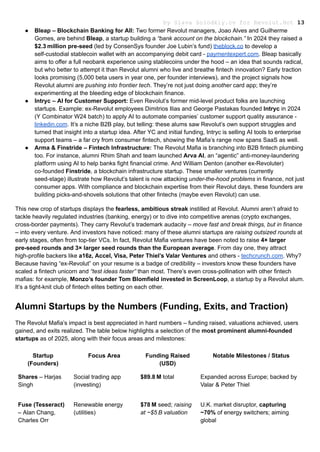
● Bleap – Blockchain Banking for All: Two former Revolut managers, Joao Alves and Guilherme
Gomes, are behind Bleap, a startup building a “bank account on the blockchain.” In 2024 they raised a
$2.3 million pre-seed (led by ConsenSys founder Joe Lubin’s fund) theblock.co to develop a
self-custodial stablecoin wallet with an accompanying debit card - paymentexpert.com. Bleap basically
aims to offer a full neobank experience using stablecoins under the hood – an idea that sounds radical,
but who better to attempt it than Revolut alumni who live and breathe fintech innovation? Early traction
looks promising (5,000 beta users in year one, per founder interviews), and the project signals how
Revolut alumni are pushing into frontier tech. They’re not just doing another card app; they’re
experimenting at the bleeding edge of blockchain finance.
● Intryc – AI for Customer Support: Even Revolut’s former mid-level product folks are launching
startups. Example: ex-Revolut employees Dimitrios Ilias and George Pastakas founded Intryc in 2024
(Y Combinator W24 batch) to apply AI to automate companies’ customer support quality assurance -
linkedin.com. It’s a niche B2B play, but telling: these alums saw Revolut’s own support struggles and
turned that insight into a startup idea. After YC and initial funding, Intryc is selling AI tools to enterprise
support teams – a far cry from consumer fintech, showing the Mafia’s range now spans SaaS as well.
● Arma & Finstride – Fintech Infrastructure: The Revolut Mafia is branching into B2B fintech plumbing
too. For instance, alumni Rhim Shah and team launched Arva AI, an “agentic” anti-money-laundering
platform using AI to help banks fight financial crime. And William Denton (another ex-Revoluter)
co-founded Finstride, a blockchain infrastructure startup. These smaller ventures (currently
seed-stage) illustrate how Revolut’s talent is now attacking under-the-hood problems in finance, not just
consumer apps. With compliance and blockchain expertise from their Revolut days, these founders are
building picks-and-shovels solutions that other fintechs (maybe even Revolut) can use.
This new crop of startups displays the fearless, ambitious streak instilled at Revolut. Alumni aren’t afraid to
tackle heavily regulated industries (banking, energy) or to dive into competitive arenas (crypto exchanges,
cross-border payments). They carry Revolut’s trademark audacity – move fast and break things, but in finance
– into every venture. And investors have noticed: many of these alumni startups are raising outsized rounds at
early stages, often from top-tier VCs. In fact, Revolut Mafia ventures have been noted to raise 4× larger
pre-seed rounds and 3× larger seed rounds than the European average. From day one, they attract
high-profile backers like a16z, Accel, Visa, Peter Thiel’s Valar Ventures and others - techcrunch.com. Why?
Because having “ex-Revolut” on your resume is a badge of credibility – investors know these founders have
scaled a fintech unicorn and “test ideas faster” than most. There’s even cross-pollination with other fintech
mafias: for example, Monzo’s founder Tom Blomfield invested in ScreenLoop, a startup by a Revolut alum.
It’s a tight-knit club of fintech elites betting on each other.
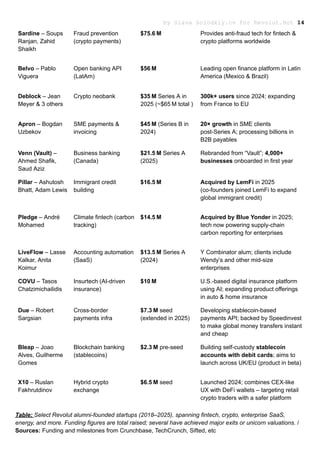
Alumni Startups by the Numbers (Funding, Exits, and Traction)
The Revolut Mafia’s impact is best appreciated in hard numbers – funding raised, valuations achieved, users
gained, and exits realized. The table below highlights a selection of the most prominent alumni-founded
startups as of 2025, along with their focus areas and milestones:
Startup
(Founders)
Focus Area Funding Raised
(USD)
Notable Milestones / Status
Shares – Harjas
Singh
Social trading app
(investing)
$89.8 M total Expanded across Europe; backed by
Valar & Peter Thiel
Fuse (Tesseract)
– Alan Chang,
Charles Orr
Renewable energy
(utilities)
$78 M seed; raising
at ~$5 B valuation
U.K. market disruptor, capturing
~70% of energy switchers; aiming
global
14.
by Slava Solodkiy.cvfor Revolut.Hot 14
Sardine – Soups
Ranjan, Zahid
Shaikh
Fraud prevention
(crypto payments)
$75.6 M Provides anti-fraud tech for fintech &
crypto platforms worldwide
Belvo – Pablo
Viguera
Open banking API
(LatAm)
$56 M Leading open finance platform in Latin
America (Mexico & Brazil)
Deblock – Jean
Meyer & 3 others
Crypto neobank $35 M Series A in
2025 (~$65 M total )
300k+ users since 2024; expanding
from France to EU
Apron – Bogdan
Uzbekov
SME payments &
invoicing
$45 M (Series B in
2024)
20× growth in SME clients
post-Series A; processing billions in
B2B payables
Venn (Vault) –
Ahmed Shafik,
Saud Aziz
Business banking
(Canada)
$21.5 M Series A
(2025)
Rebranded from “Vault”; 4,000+
businesses onboarded in first year
Pillar – Ashutosh
Bhatt, Adam Lewis
Immigrant credit
building
$16.5 M Acquired by LemFi in 2025
(co-founders joined LemFi to expand
global immigrant credit)
Pledge – André
Mohamed
Climate fintech (carbon
tracking)
$14.5 M Acquired by Blue Yonder in 2025;
tech now powering supply-chain
carbon reporting for enterprises
LiveFlow – Lasse
Kalkar, Anita
Koimur
Accounting automation
(SaaS)
$13.5 M Series A
(2024)
Y Combinator alum; clients include
Wendy’s and other mid-size
enterprises
COVU – Tasos
Chatzimichailidis
Insurtech (AI-driven
insurance)
$10 M U.S.-based digital insurance platform
using AI; expanding product offerings
in auto & home insurance
Due – Robert
Sargsian
Cross-border
payments infra
$7.3 M seed
(extended in 2025)
Developing stablecoin-based
payments API; backed by Speedinvest
to make global money transfers instant
and cheap
Bleap – Joao
Alves, Guilherme
Gomes
Blockchain banking
(stablecoins)
$2.3 M pre-seed Building self-custody stablecoin
accounts with debit cards; aims to
launch across UK/EU (product in beta)
X10 – Ruslan
Fakhrutdinov
Hybrid crypto
exchange
$6.5 M seed Launched 2024; combines CEX-like
UX with DeFi wallets – targeting retail
crypto traders with a safer platform
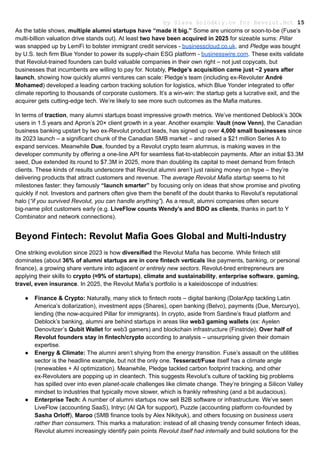
Table: Select Revolut alumni-founded startups (2018–2025), spanning fintech, crypto, enterprise SaaS,
energy, and more. Funding figures are total raised; several have achieved major exits or unicorn valuations. /
Sources: Funding and milestones from Crunchbase, TechCrunch, Sifted, etc
15.
by Slava Solodkiy.cvfor Revolut.Hot 15
As the table shows, multiple alumni startups have “made it big.” Some are unicorns or soon-to-be (Fuse’s
multi-billion valuation drive stands out). At least two have been acquired in 2025 for sizeable sums: Pillar
was snapped up by LemFi to bolster immigrant credit services - businesscloud.co.uk, and Pledge was bought
by U.S. tech firm Blue Yonder to power its supply-chain ESG platform - businesswire.com. These exits validate
that Revolut-trained founders can build valuable companies in their own right – not just copycats, but
businesses that incumbents are willing to pay for. Notably, Pledge’s acquisition came just ~2 years after
launch, showing how quickly alumni ventures can scale: Pledge’s team (including ex-Revoluter André
Mohamed) developed a leading carbon tracking solution for logistics, which Blue Yonder integrated to offer
climate reporting to thousands of corporate customers. It’s a win-win: the startup gets a lucrative exit, and the
acquirer gets cutting-edge tech. We’re likely to see more such outcomes as the Mafia matures.
In terms of traction, many alumni startups boast impressive growth metrics. We’ve mentioned Deblock’s 300k
users in 1.5 years and Apron’s 20× client growth in a year. Another example: Vault (now Venn), the Canadian
business banking upstart by two ex-Revolut product leads, has signed up over 4,000 small businesses since
its 2023 launch – a significant chunk of the Canadian SMB market – and raised a $21 million Series A to
expand services. Meanwhile Due, founded by a Revolut crypto team alumnus, is making waves in the
developer community by offering a one-line API for seamless fiat-to-stablecoin payments. After an initial $3.3M
seed, Due extended its round to $7.3M in 2025, more than doubling its capital to meet demand from fintech
clients. These kinds of results underscore that Revolut alumni aren’t just raising money on hype – they’re
delivering products that attract customers and revenue. The average Revolut Mafia startup seems to hit
milestones faster: they famously “launch smarter” by focusing only on ideas that show promise and pivoting
quickly if not. Investors and partners often give them the benefit of the doubt thanks to Revolut’s reputational
halo (“if you survived Revolut, you can handle anything”). As a result, alumni companies often secure
big-name pilot customers early (e.g. LiveFlow counts Wendy’s and BDO as clients, thanks in part to Y
Combinator and network connections).
Beyond Fintech: Revolut Mafia Goes Global and Multi-Industry
One striking evolution since 2023 is how diversified the Revolut Mafia has become. While fintech still
dominates (about 36% of alumni startups are in core fintech verticals like payments, banking, or personal
finance), a growing share venture into adjacent or entirely new sectors. Revolut-bred entrepreneurs are
applying their skills to crypto (≈9% of startups), climate and sustainability, enterprise software, gaming,
travel, even insurance. In 2025, the Revolut Mafia’s portfolio is a kaleidoscope of industries:
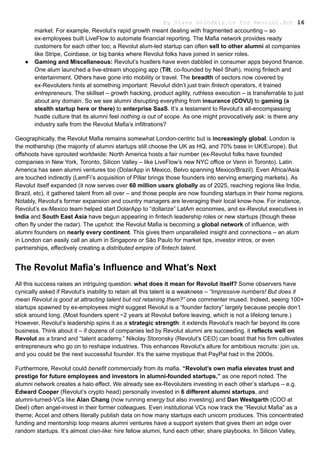
● Finance & Crypto: Naturally, many stick to fintech roots – digital banking (DolarApp tackling Latin
America’s dollarization), investment apps (Shares), open banking (Belvo), payments (Due, Mercuryo),
lending (the now-acquired Pillar for immigrants). In crypto, aside from Sardine’s fraud platform and
Deblock’s banking, alumni are behind startups in areas like web3 gaming wallets (ex: Ayelen
Denovitzer’s Qubit Wallet for web3 gamers) and blockchain infrastructure (Finstride). Over half of
Revolut founders stay in fintech/crypto according to analysis – unsurprising given their domain
expertise.
● Energy & Climate: The alumni aren’t shying from the energy transition. Fuse’s assault on the utilities
sector is the headline example, but not the only one. Tesseract/Fuse itself has a climate angle
(renewables + AI optimization). Meanwhile, Pledge tackled carbon footprint tracking, and other
ex-Revoluters are popping up in cleantech. This suggests Revolut’s culture of tackling big problems
has spilled over into even planet-scale challenges like climate change. They’re bringing a Silicon Valley
mindset to industries that typically move slower, which is frankly refreshing (and a bit audacious).
● Enterprise Tech: A number of alumni startups now sell B2B software or infrastructure. We’ve seen
LiveFlow (accounting SaaS), Intryc (AI QA for support), Puzzle (accounting platform co-founded by
Sasha Orloff), Maroo (SMB finance tools by Alex Nikityuk), and others focusing on business users
rather than consumers. This marks a maturation: instead of all chasing trendy consumer fintech ideas,
Revolut alumni increasingly identify pain points Revolut itself had internally and build solutions for the
16.
by Slava Solodkiy.cvfor Revolut.Hot 16
market. For example, Revolut’s rapid growth meant dealing with fragmented accounting – so
ex-employees built LiveFlow to automate financial reporting. The Mafia network provides ready
customers for each other too; a Revolut alum-led startup can often sell to other alumni at companies
like Stripe, Coinbase, or big banks where Revolut folks have joined in senior roles.
● Gaming and Miscellaneous: Revolut’s hustlers have even dabbled in consumer apps beyond finance.
One alum launched a live-stream shopping app (Tilt, co-founded by Neil Shah), mixing fintech and
entertainment. Others have gone into mobility or travel. The breadth of sectors now covered by
ex-Revoluters hints at something important: Revolut didn’t just train fintech operators, it trained
entrepreneurs. The skillset – growth hacking, product agility, ruthless execution – is transferrable to just
about any domain. So we see alumni disrupting everything from insurance (COVU) to gaming (a
stealth startup here or there) to enterprise SaaS. It’s a testament to Revolut’s all-encompassing
hustle culture that its alumni feel nothing is out of scope. As one might provocatively ask: is there any
industry safe from the Revolut Mafia’s infiltrations?
Geographically, the Revolut Mafia remains somewhat London-centric but is increasingly global. London is
the mothership (the majority of alumni startups still choose the UK as HQ, and 70% base in UK/Europe). But
offshoots have sprouted worldwide: North America hosts a fair number (ex-Revolut folks have founded
companies in New York, Toronto, Silicon Valley – like LiveFlow’s new NYC office or Venn in Toronto). Latin
America has seen alumni ventures too (DolarApp in Mexico, Belvo spanning Mexico/Brazil). Even Africa/Asia
are touched indirectly (LemFi’s acquisition of Pillar brings those founders into serving emerging markets). As
Revolut itself expanded (it now serves over 60 million users globally as of 2025, reaching regions like India,
Brazil, etc), it gathered talent from all over – and those people are now founding startups in their home regions.
Notably, Revolut’s former expansion and country managers are leveraging their local know-how. For instance,
Revolut’s ex-Mexico team helped start DolarApp to “dollarize” LatAm economies, and ex-Revolut executives in
India and South East Asia have begun appearing in fintech leadership roles or new startups (though these
often fly under the radar). The upshot: the Revolut Mafia is becoming a global network of influence, with
alumni founders on nearly every continent. This gives them unparalleled insight and connections – an alum
in London can easily call an alum in Singapore or São Paulo for market tips, investor intros, or even
partnerships, effectively creating a distributed empire of fintech talent.
The Revolut Mafia’s Influence and What’s Next
All this success raises an intriguing question: what does it mean for Revolut itself? Some observers have
cynically asked if Revolut’s inability to retain all this talent is a weakness – “Impressive numbers! But does it
mean Revolut is good at attracting talent but not retaining them?” one commenter mused. Indeed, seeing 100+
startups spawned by ex-employees might suggest Revolut is a “founder factory” largely because people don’t
stick around long. (Most founders spent ~2 years at Revolut before leaving, which is not a lifelong tenure.)
However, Revolut’s leadership spins it as a strategic strength: it extends Revolut’s reach far beyond its core
business. Think about it – if dozens of companies led by Revolut alumni are succeeding, it reflects well on
Revolut as a brand and “talent academy.” Nikolay Storonsky (Revolut’s CEO) can boast that his firm cultivates
entrepreneurs who go on to reshape industries. This enhances Revolut’s allure for ambitious recruits: join us,
and you could be the next successful founder. It’s the same mystique that PayPal had in the 2000s.
Furthermore, Revolut could benefit commercially from its mafia. “Revolut’s own mafia elevates trust and
prestige for future employees and investors in alumni-founded startups,” as one report noted. The
alumni network creates a halo effect. We already see ex-Revoluters investing in each other’s startups – e.g.
Edward Cooper (Revolut’s crypto head) personally invested in 6 different alumni startups, and
alumni-turned-VCs like Alan Chang (now running energy but also investing) and Dan Westgarth (COO at
Deel) often angel-invest in their former colleagues. Even institutional VCs now track the “Revolut Mafia” as a
theme; Accel and others literally publish data on how many startups each unicorn produces. This concentrated
funding and mentorship loop means alumni ventures have a support system that gives them an edge over
random startups. It’s almost clan-like: hire fellow alumni, fund each other, share playbooks. In Silicon Valley,
17.
by Slava Solodkiy.cvfor Revolut.Hot 17
the PayPal Mafia famously helped each other’s companies (LinkedIn, Yelp, Tesla, etc.) – we’re witnessing a
similar dynamic with Revolut’s crew in Europe.
Looking ahead, one visionary (and provocative) idea floated is: What if Revolut formally harnessed its
mafia? In other words, could Revolut create an internal accelerator or VC arm to incubate employee ideas
before they quit? Could it spin up a program for “entrepreneurs in residence” to test new products under the
Revolut umbrella? So far, no fintech has explicitly done this, but the opportunity is glaring. As an internal
Revolut strategy slide mused: “What if the Mafia becomes part of Revolut?”. There is huge acquisition
potential for Revolut to reabsorb some alumni startups and widen its own super-app ecosystem. Revolut
could cherry-pick the best of what its alumni build – much like how Google or Facebook acquire
alumni-founded startups to bring talent back in-house. In Revolut’s case, we might imagine them buying a
successful alumni venture (for example, if Shares or Fuse or Sardine fits a strategic hole, why not?). This
would both expand Revolut’s services and signal to current employees that they don’t necessarily have to
leave to innovate. The slide from 2023 noted Revolut had 2,500+ employees (and growing), representing
“virtually endless potential founders” on staff. Instead of losing them all, Revolut might one day create an
alumni fund or internal incubator to capture that entrepreneurial energy inside the company. It hasn’t happened
yet – Storonsky is notoriously focused on Revolut’s own growth and may not want the distraction – but given
the success of the Revolut Mafia outside, this could be a futuristic approach to corporate innovation in
fintech. Imagine Revolut acting as a holding company of spin-offs, or offering alumni founders resources in
exchange for equity stakes. It would be a bold, edgy move befitting Revolut’s style.
For now, though, the Revolut Mafia operates informally, and that might be just fine. This network has
essentially become an extension of Revolut’s influence across the tech landscape. In 2025, Revolut isn’t
just a fintech unicorn; it’s the progenitor of an entire ecosystem of startups. Collectively, Revolut alumni-led
companies have raised more money than Revolut itself did and employ thousands of people around the world.
One could cheekily argue the Revolut Mafia Inc. is bigger than Revolut – a band of fintech guerrillas now
building an empire of their own.
As the fintech sector marches toward 2026 and Revolut eyes a potential IPO, the alumni founders march on as
well – some collaborating with Revolut, some competing at its edges, all of them pushing the envelope. The
Revolut Mafia story shows no sign of slowing: new startups will continue to emerge each year (even H1 2023
produced as many alumni startups as all of 2020 – indicating the pipeline is only growing as Revolut’s
headcount grows). It’s a virtuous cycle of creative destruction. Revolut’s alumni are redefining fintech and
tech at large, armed with experience, connections, and a fearless mentality forged under Storonsky’s intense
leadership.
In sum, on December 18, 2025, the Revolut Mafia looks like a seasoned, ever-expanding league of
founders: dozens of faces from Revolut’s past now leading companies with serious numbers (over a billion
dollars raised, multiple unicorns, hundreds of millions of users collectively) and notable brands (from Fuse in
energy to Belvo in LatAm to Deel and Sequoia where alumni hold C-level or VC roles). They are provocative
thinkers and doers, unafraid to challenge incumbents – very much children of the Revolut ethos. If you thought
Revolut was just a single fintech app, think again: its real legacy may be the army of entrepreneurs it
unleashed. And as this Mafia grows, one can’t help but wonder – will the next fintech giant to rival Revolut
itself be founded by Revolut alumni? Given the trajectory, it’s not only possible, it’s likely. The Revolut
Mafia’s second generation is coming into its own, and they’re playing for keeps in the global tech arena,
indeed, the Revolut Mafia has graduated from an intriguing concept into a full-blown phenomenon – a
visionary network harnessing startup power in a way that’s edgy, unexpected, and endlessly fascinating to
watch.
Sources:
● Solodkiy, V. (2023). “Revolut mafia is bigger than you think.” - medium.com. (Original research outlining 67 alumni-founded startups with
$451M raised, and broader alumni ventures with $2.2B funding)
18.
by Slava Solodkiy.cvfor Revolut.Hot 18
● Tenity (2025). “UK Fintech in 2024–2025: Guide to Europe’s Fintech Capital.” (Notes Revolut alumni launched 34 companies as of 2024,
among top in Europe)
● Tech.eu (2024). “Revolut executive says the fintech is a ‘training ground’ for future founders.” (Revolut comms head discussing high founder
output and encouragement of alumni entrepreneurship)
● Sifted (2024). “Klarna dethrones Revolut as top fintech founder factory.” (Data: Revolut alumni founded 49 startups by Oct 2024, second only
to Klarna’s 62)
● TechCrunch (2024). “Ex-Revolut employees use AI to automate accounting” (LiveFlow $13.5M Series A); DL News (2025) “Revolut alumni
raise $35M for crypto neobank Deblock.”; FinTech Futures (2024) “Apron secures $30M Series B”; Financial IT (2025) “Vault rebrands to
Venn, raises $21.5M”f; BusinessCloud (2025) “LemFi acquires Pillar (ex-Revolut founders)”; Business Wire (2025) “Blue Yonder acquires
Pledge” (Funding rounds, user metrics, and acquisitions involving alumni startups)
● LinkedIn posts (2023–2025) by industry experts and Revolut alumni themselves, providing names of startups and roles (e.g. Seb Johnson’s
list of Revolut Mafia founders and companies). These corroborate the above data and highlight individual alumni achievements across various
sectors.
● Revolut Mafia: Founders of 50+ companies
● Startup Factories: Revolut
● The Revolut Mafia is real
● Is Fuse's $5bn funding the start of the 'Revolut mafia'?
● Revolut mafia: 35+ companies, 750M+ raised, 13.1% founder rate
● The team at @fuseenergy have built one of, if not THE, fastest growing companies in Europe
● Today, I’m excited to publicly launch @neviswealth
● The @Revolut Mafia is on track to be the greatest ever
● Revolut Completes Fundraising Process Establishing $75 Billion Valuation
● Revolut Mafia: Harnessing the Power of Startup Mafias
● Investors bet big on Revolut alumni: $451m
● Europe’s first $1 Trillion company is loading...
● Revolut has just confirmed its FIFTH employee secondary sale
● Not sure who coined the term #mafia
● Fintech Fact #16: Revolut isn’t just a bank—it’s a startup factory
● Revolut’s crypto growth is accelerating fast
● FUNDING: Nevis raises $35m to build AI for wealth management
● @BleapApp, a blockchain-based banking startup founded by former Revolut executives
● Tilt, the shopping app from ex-Revolut staff, bags £13.7m
● X10, a crypto exchange startup founded by Ex-Revolut alumni
● London-based payments startup Due