Organizational
Culture
Learning Objectives:
● Enumerate and discuss the stages of
socialization;
● Explain the importance of organizational
culture;
● Explore and value the meaning of
workplace spirituality; and
● Distinguish the dimensions of corporate
social responsibility
Organizational Culture Overview
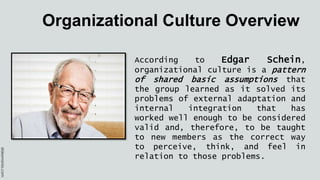
According to Edgar Schein,
organizational culture is a pattern
of shared basic assumptions that
the group learned as it solved its
problems of external adaptation and
internal integration that has
worked well enough to be considered
valid and, therefore, to be taught
to new members as the correct way
to perceive, think, and feel in
relation to those problems.
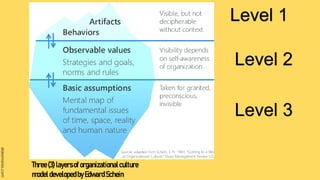
Level 1
Level 2
Level 3
Three(3) layersoforganizationalculture
modeldevelopedbyEdwardSchein
Socialization
and
Culture
Socialization and Culture
Socialization is a process by which an organization
brings new employees to the organization. It is a
continuous process throughout an individual’s
career. It is the transmittal of values, attitudes,
practices, and traditions in the workplace from
older to younger employees.
Stages of
Socialization
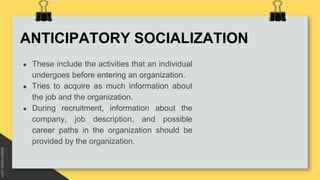
ANTICIPATORY SOCIALIZATION
● These include the activities that an individual
undergoes before entering an organization.
● Tries to acquire as much information about
the job and the organization.
● During recruitment, information about the
company, job description, and possible
career paths in the organization should be
provided by the organization.
ACCOMODATION
● Tries to fit in the organization‘s culture.
● Establishes new relationships with co-workers
and superiors.
● Begins to blend and adapt by clarifying their roles
and learning the organization's assigned tasks
and responsibilities.
● The company should offer orientation and
training programs, challenging tasks, and
performance evaluation processes.
ROLE MANAGEMENT
● Conflicts may arise from time to time.
● New hire tries to deal with conflicts between work
and home or between him/herself and a co-worker or
a superior.
● The org or the company should provide counseling
sessions and should also deal with stress effectively.
● Job satisfaction is also necessary to minimize
conflicts, absenteeism, and turnover.
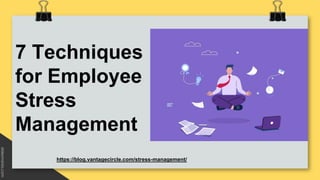
7 Techniques
for Employee
Stress
Management
https://blog.vantagecircle.com/stress-management/
1. A Culture of Rewards and Recognition
Remember, toxic work culture is always the
culprit behind high levels of stress in the
workplace.
In fact,
57% of people report leaving work feeling
exhausted and that a toxic atmosphere often
compounds that stress.
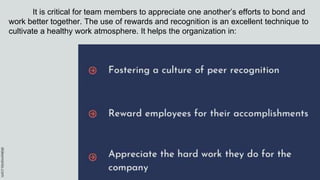
It is critical for team members to appreciate one another’s efforts to bond and
work better together. The use of rewards and recognition is an excellent technique to
cultivate a healthy work atmosphere. It helps the organization in:
2. Make room for regular
surveys
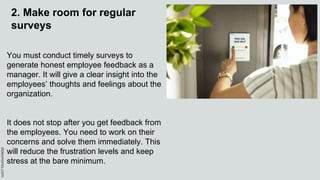
You must conduct timely surveys to
generate honest employee feedback as a
manager. It will give a clear insight into the
employees’ thoughts and feelings about the
organization.
It does not stop after you get feedback from
the employees. You need to work on their
concerns and solve them immediately. This
will reduce the frustration levels and keep
stress at the bare minimum.
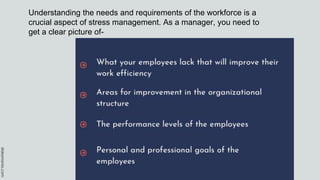
Understanding the needs and requirements of the workforce is a
crucial aspect of stress management. As a manager, you need to
get a clear picture of-
3. Good employee perks and
benefits
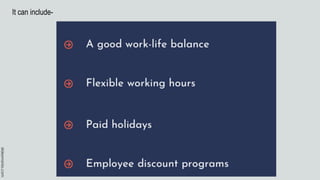
As a manager, you must keep your employees satisfied with
the help of various employee perks and benefits.
It can include-
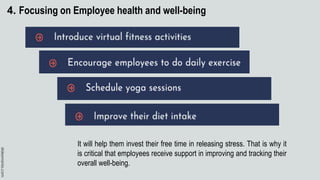
4. Focusing on Employee health and well-being
It will help them invest their free time in releasing stress. That is why it
is critical that employees receive support in improving and tracking their
overall well-being.
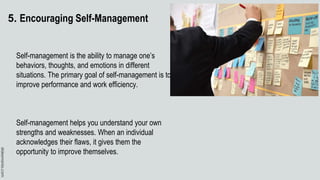
5. Encouraging Self-Management
Self-management is the ability to manage one’s
behaviors, thoughts, and emotions in different
situations. The primary goal of self-management is to
improve performance and work efficiency.
Self-management helps you understand your own
strengths and weaknesses. When an individual
acknowledges their flaws, it gives them the
opportunity to improve themselves.
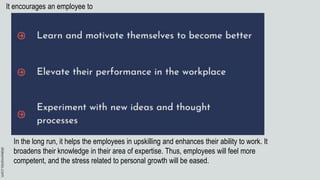
In the long run, it helps the employees in upskilling and enhances their ability to work. It
broadens their knowledge in their area of expertise. Thus, employees will feel more
competent, and the stress related to personal growth will be eased.
It encourages an employee to
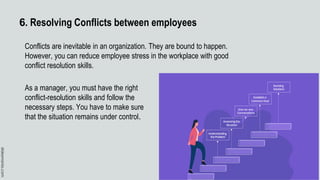
6. Resolving Conflicts between employees
Conflicts are inevitable in an organization. They are bound to happen.
However, you can reduce employee stress in the workplace with good
conflict resolution skills.
As a manager, you must have the right
conflict-resolution skills and follow the
necessary steps. You have to make sure
that the situation remains under control.
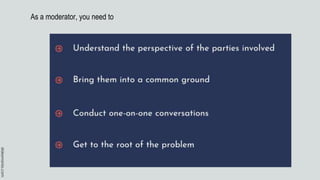
As a moderator, you need to
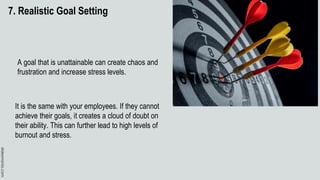
7. Realistic Goal Setting
A goal that is unattainable can create chaos and
frustration and increase stress levels.
It is the same with your employees. If they cannot
achieve their goals, it creates a cloud of doubt on
their ability. This can further lead to high levels of
burnout and stress.
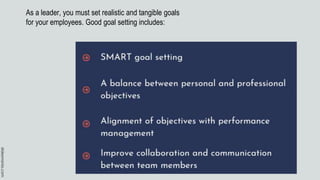
As a leader, you must set realistic and tangible goals
for your employees. Good goal setting includes:
Can Organizational
Culture Be Changed?
• An organizational culture comprises a set of
characteristics that developed over the years.
• It is Deeply rooted in high-held values, customs, traditions,
and norms that are strengthened and maintained through
VMG, administrative practices, and others.
With these characteristics, can organizational culture be
changed? Cultural change can take place in an organization
when some, if not most, of the following conditions exist:
A crisis or state of
emergency
• This situation is characterized by a sudden setback that
challenges and weakens the status quo.
• Examples include heavy financial loss, below-par
industry standing, loss of major customers, or a dramatic
technological breakthrough.
Turnover in
leadership
• When a new leader comes, the organization can have a
new set of values that are more capable of responding to
the present crisis.
Young and small
organizations
• When a new leader comes, the organization can have a
new set of values that are more capable of responding to
the present crisis.
Weak culture
• A weak culture can be easily changed where values are
not deeply entrenched among its members.
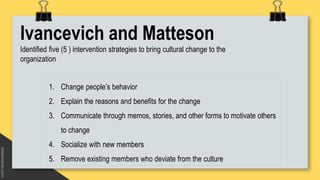
Ivancevich and Matteson
Identified five (5 ) intervention strategies to bring cultural change to the
organization
1. Change people’s behavior
2. Explain the reasons and benefits for the change
3. Communicate through memos, stories, and other forms to motivate others
to change
4. Socialize with new members
5. Remove existing members who deviate from the culture
Elements that an organizational
culture is a source of
competitive advancement
Development of a corporate culture
● Development of a culture that gives importance to the organization’s history and
heritage.
● The sense of accomplishment in the past and the continuous valuing of these
experiences will help develop a sense of appreciation for the company’s past.
● Key people in the past who greatly contributed to the organization become role
models of the present employees.
Development of unity and oneness
● The values can be summarized into phrases that depict the organization’s
fundamental principle that can be assimilated into employees' working lives.
● Employees feel that they are important by how they are trained and rewarded for
their efforts.
● They will feel good inside, and this will create a culture of satisfaction and loyalty
to the company.
Create an empowered mindset
● Employees can participate in certain decisions and are allowed to work on their
own.
● It will create an environment that is conducive to open communication, and they
will be happy to share their talents and skills and work toward the achievement of
the organization's goals.
Credo and Corporate
Responsibility
The four dimensions of corporate responsibility are:
1. Economic
2. Legal
3. Ethical
4. Voluntary and philanthropic
Workplace spirituality
• It is not about God, religious practices, or theology but about recognizing the
importance of an inner life to people.
• Before, spirituality was disregarded as part of an individual's working life.
They propagate rational thinking and eliminate the concept of “feeling” or
emotion.
• Today, the study of emotions has greatly improved our understanding of
organizational behavior, and OB specialists can better understand employee
behavior and attitude in the 21st century.
Cultural Characteristics of
Spiritual Organizations
1. STRONG SENSE OF PURPOSE
• Provide a clear vision and mission which
revolve around a meaningful purpose.
• They are not only after profits but also
the welfare of employees.
• They build strong values which can be a
good foundation for employees to
emulate
2. FOCUS ON INDIVIDUAL
DEVELOPMENT
• SO recognize people’s abilities; they
want employees to learn and grow.
• They build cultures where employees
feel secure and comfortable while
working in the company.
3. TRUST AND OPENNESS
• SO provides a “trusting” environment
• Managers admit their fault and not afraid
to commit mistakes.
• They deal with everyone fairly.
4. EMPLOYEE EMPOWERMENT
• Strong sense of trust empowerment
promotes learning and growth.
• Employees are allowed to make most of
the work-related decisions.
• Managers trust their employees to deliver
results.
5. Toleration of employee expression
• SO do not suppress individual emotions.
• Managers provide counseling to their
subordinates when needed
Thank you!
Catacutan, Ronisa R.
Degamo, Johndy V.