The old way and the new:The principles of conventional software engineering, principles of modern software management, transitioning to an iterative process.
Explore conventional and modern software engineering principles, improving software economics, and transitioning to iterative development for enhanced quality and efficiency.
Similar to The old way and the new:The principles of conventional software engineering, principles of modern software management, transitioning to an iterative process.
The old way and the new:The principles of conventional software engineering, principles of modern software management, transitioning to an iterative process.
1.
SOFTWARE PROJECT MANAGEMENT
Theold way and the new:
The principles of conventional
software engineering, principles of
modern software management,
transitioning to an iterative process.
2.
UNIT II
Improving SoftwareEconomics:
Reducing Software product size, improving software processes, improving team
effectiveness, improving automation, Achieving required quality, peer inspections.
The old way and the new:
The principles of conventional software engineering, principles of modern software
management, transitioning to an iterative process.
3.
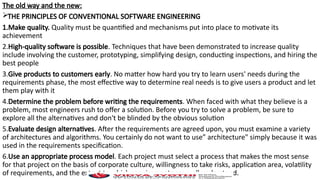
The old wayand the new:
THE PRINCIPLES OF CONVENTIONAL SOFTWARE ENGINEERING
1.Make quality. Quality must be quantified and mechanisms put into place to motivate its
achievement
2.High-quality software is possible. Techniques that have been demonstrated to increase quality
include involving the customer, prototyping, simplifying design, conducting inspections, and hiring the
best people
3.Give products to customers early. No matter how hard you try to learn users' needs during the
requirements phase, the most effective way to determine real needs is to give users a product and let
them play with it
4.Determine the problem before writing the requirements. When faced with what they believe is a
problem, most engineers rush to offer a solution. Before you try to solve a problem, be sure to
explore all the alternatives and don't be blinded by the obvious solution
5.Evaluate design alternatives. After the requirements are agreed upon, you must examine a variety
of architectures and algorithms. You certainly do not want to use” architecture" simply because it was
used in the requirements specification.
6.Use an appropriate process model. Each project must select a process that makes the most sense
for that project on the basis of corporate culture, willingness to take risks, application area, volatility
of requirements, and the extent to which requirements are well understood.
4.
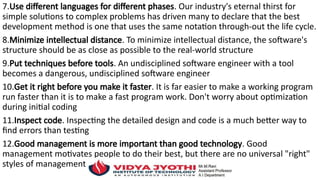
7.Use different languagesfor different phases. Our industry's eternal thirst for
simple solutions to complex problems has driven many to declare that the best
development method is one that uses the same notation through-out the life cycle.
8.Minimize intellectual distance. To minimize intellectual distance, the software's
structure should be as close as possible to the real-world structure
9.Put techniques before tools. An undisciplined software engineer with a tool
becomes a dangerous, undisciplined software engineer
10.Get it right before you make it faster. It is far easier to make a working program
run faster than it is to make a fast program work. Don't worry about optimization
during initial coding
11.Inspect code. Inspecting the detailed design and code is a much better way to
find errors than testing
12.Good management is more important than good technology. Good
management motivates people to do their best, but there are no universal "right"
styles of management.
6.
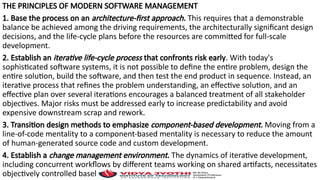
THE PRINCIPLES OFMODERN SOFTWARE MANAGEMENT
1. Base the process on an architecture-first approach. This requires that a demonstrable
balance be achieved among the driving requirements, the architecturally significant design
decisions, and the life-cycle plans before the resources are committed for full-scale
development.
2. Establish an iterative life-cycle process that confronts risk early. With today's
sophisticated software systems, it is not possible to define the entire problem, design the
entire solution, build the software, and then test the end product in sequence. Instead, an
iterative process that refines the problem understanding, an effective solution, and an
effective plan over several iterations encourages a balanced treatment of all stakeholder
objectives. Major risks must be addressed early to increase predictability and avoid
expensive downstream scrap and rework.
3. Transition design methods to emphasize component-based development. Moving from a
line-of-code mentality to a component-based mentality is necessary to reduce the amount
of human-generated source code and custom development.
4. Establish a change management environment. The dynamics of iterative development,
including concurrent workflows by different teams working on shared artifacts, necessitates
objectively controlled baselines.
7.
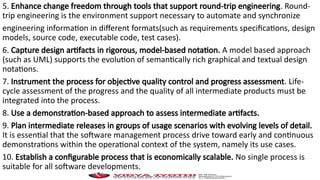
5. Enhance changefreedom through tools that support round-trip engineering. Round-
trip engineering is the environment support necessary to automate and synchronize
engineering information in different formats(such as requirements specifications, design
models, source code, executable code, test cases).
6. Capture design artifacts in rigorous, model-based notation. A model based approach
(such as UML) supports the evolution of semantically rich graphical and textual design
notations.
7. Instrument the process for objective quality control and progress assessment. Life-
cycle assessment of the progress and the quality of all intermediate products must be
integrated into the process.
8. Use a demonstration-based approach to assess intermediate artifacts.
9. Plan intermediate releases in groups of usage scenarios with evolving levels of detail.
It is essential that the software management process drive toward early and continuous
demonstrations within the operational context of the system, namely its use cases.
10. Establish a configurable process that is economically scalable. No single process is
suitable for all software developments.
9.
TRANSITIONING TO ANITERATIVE PROCESS
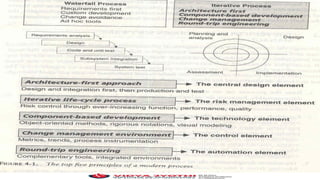
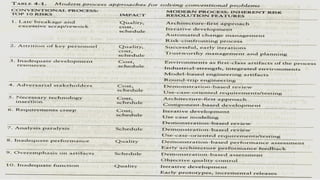
Modern software development processes have moved away from the
conventional waterfall model, in which each stage of the development process is
dependent on completion of the previous stage.
The economic benefits inherent in transitioning from the conventional waterfall
model to an iterative development process are significant but difficult to quantify.
As one benchmark of the expected economic impact of process improvement,
consider the process exponent parameters of the COCOMO II model.