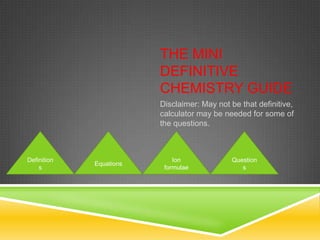
THE MINI
                         DEFINITIVE
                         CHEMISTRY GUIDE
                         Disclaimer: May not be that definitive,
                         calculator may be needed for some of
                         the questions.


Definition                   Ion             Question
             Equations
    s                     formulae              s
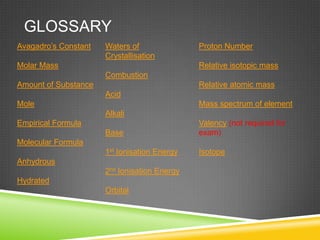
GLOSSARY
Avagadro’s Constant   Waters of               Proton Number
                      Crystallisation
Molar Mass                                    Relative isotopic mass
                      Combustion
Amount of Substance                           Relative atomic mass
                      Acid
Mole                                          Mass spectrum of element
                      Alkali
Empirical Formula                             Valency (not required for
                      Base                    exam)
Molecular Formula
                      1st Ionisation Energy   Isotope
Anhydrous
                      2nd Ionisation Energy
Hydrated
                      Orbital
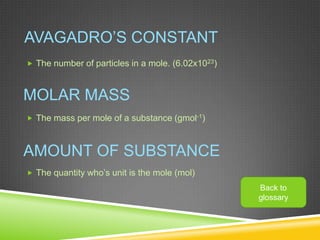
AVAGADRO’S CONSTANT
 The number of particles in a mole. (6.02x10²³)


MOLAR MASS
 The mass per mole of a substance (gmol-1)


AMOUNT OF SUBSTANCE
 The quantity who’s unit is the mole (mol)
                                                   Back to
                                                   glossary
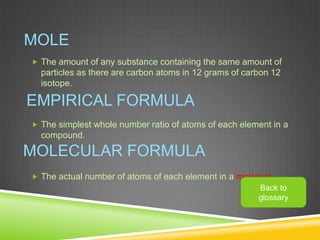
MOLE
 The amount of any substance containing the same amount of
  particles as there are carbon atoms in 12 grams of carbon 12
  isotope.

EMPIRICAL FORMULA
 The simplest whole number ratio of atoms of each element in a
  compound.

MOLECULAR FORMULA
 The actual number of atoms of each element in a molecule.
                                                        Back to
                                                        glossary
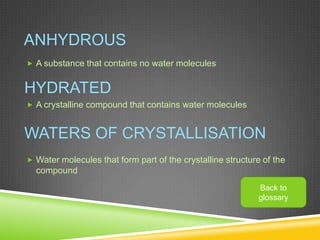
ANHYDROUS
 A substance that contains no water molecules


HYDRATED
 A crystalline compound that contains water molecules


WATERS OF CRYSTALLISATION
 Water molecules that form part of the crystalline structure of the
  compound
                                                             Back to
                                                             glossary
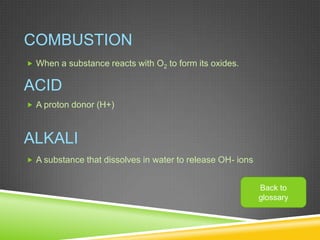
COMBUSTION
 When a substance reacts with O2 to form its oxides.


ACID
 A proton donor (H+)


ALKALI
 A substance that dissolves in water to release OH- ions


                                                            Back to
                                                            glossary
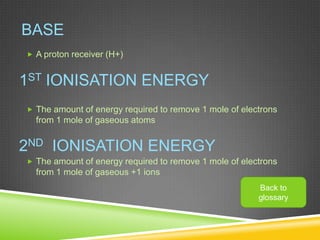
BASE
 A proton receiver (H+)


1ST IONISATION ENERGY
 The amount of energy required to remove 1 mole of electrons
  from 1 mole of gaseous atoms


2ND IONISATION ENERGY
 The amount of energy required to remove 1 mole of electrons
  from 1 mole of gaseous +1 ions
                                                        Back to
                                                        glossary
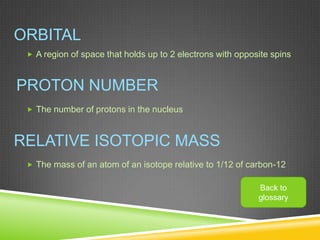
ORBITAL
  A region of space that holds up to 2 electrons with opposite spins


PROTON NUMBER
  The number of protons in the nucleus


RELATIVE ISOTOPIC MASS
  The mass of an atom of an isotope relative to 1/12 of carbon-12


                                                            Back to
                                                            glossary
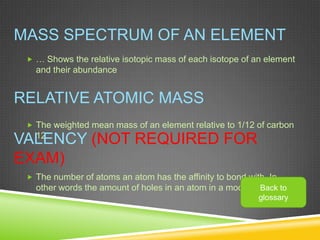
MASS SPECTRUM OF AN ELEMENT
  … Shows the relative isotopic mass of each isotope of an element
   and their abundance


RELATIVE ATOMIC MASS
  The weighted mean mass of an element relative to 1/12 of carbon
  12
VALENCY (NOT REQUIRED FOR
EXAM)
  The number of atoms an atom has the affinity to bond with. In
   other words the amount of holes in an atom in a modelling kit. to
                                                           Back
                                                            glossary
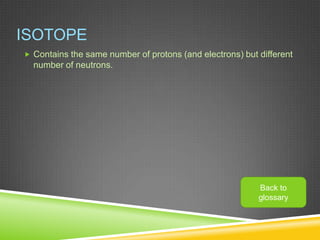
ISOTOPE
 Contains the same number of protons (and electrons) but different
  number of neutrons.


                                                          Back to
                                                          glossary
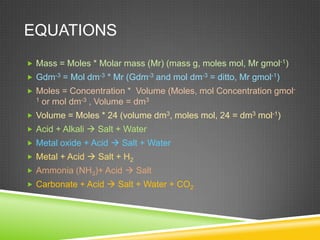
EQUATIONS
 Mass = Moles * Molar mass (Mr) (mass g, moles mol, Mr gmol-1)
 Gdm-3 = Mol dm-3 * Mr (Gdm-3 and mol dm-3 = ditto, Mr gmol-1)
 Moles = Concentration * Volume (Moles, mol Concentration gmol-
  1   or mol dm-3 , Volume = dm3
 Volume = Moles * 24 (volume dm3, moles mol, 24 = dm3 mol-1)
 Acid + Alkali  Salt + Water
 Metal oxide + Acid  Salt + Water
 Metal + Acid  Salt + H2
 Ammonia (NH3)+ Acid  Salt
 Carbonate + Acid  Salt + Water + CO2
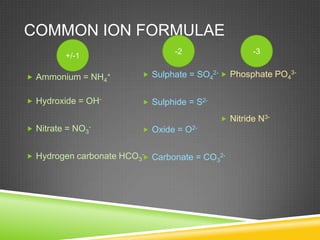
COMMON ION FORMULAE
                                -2                  -3
         +/-1

 Ammonium = NH4+         Sulphate = SO42-  Phosphate PO43-


 Hydroxide = OH-         Sulphide = S2-

                                             Nitride N3-
 Nitrate = NO3-          Oxide = O2-


 Hydrogen carbonate HCO3- Carbonate = CO32-
                         
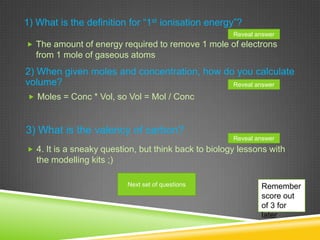
1) What is the definition for “1st ionisation energy”?
                                                      Reveal answer
 The amount of energy required to remove 1 mole of electrons
  from 1 mole of gaseous atoms
2) When given moles and concentration, how do you calculate
volume?                                      Reveal answer

 Moles = Conc * Vol, so Vol = Mol / Conc


3) What is the valency of carbon?
                                                      Reveal answer
 4. It is a sneaky question, but think back to biology lessons with
   the modelling kits ;)

                           Next set of questions              Remember
                                                              score out
                                                              of 3 for
                                                              later
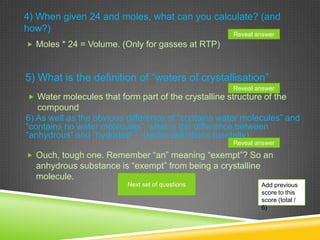
4) When given 24 and moles, what can you calculate? (and
how?)
                                                      Reveal answer
 Moles * 24 = Volume. (Only for gasses at RTP)


5) What is the definition of “waters of crystallisation”
                                                      Reveal answer
 Water molecules that form part of the crystalline structure of the
   compound
6) As well as the obvious difference of “contains water molecules” and
“contains no water molecules”, what is the difference between
“anhydrous” and “hydrated”? (recite definitions mentally)
                                                      Reveal answer

 Ouch, tough one. Remember “an” meaning “exempt”? So an
  anhydrous substance is “exempt” from being a crystalline
  molecule.
                          Next set of questions               Add previous
                                                              score to this
                                                              score (total /
                                                              6)
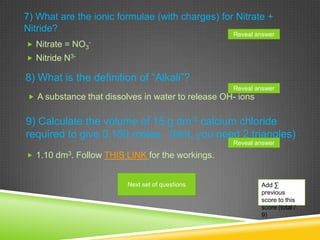
7) What are the ionic formulae (with charges) for Nitrate +
Nitride?
                                                   Reveal answer
 Nitrate = NO3-
 Nitride N3-

8) What is the definition of “Alkali”?
                                                   Reveal answer
 A substance that dissolves in water to release OH- ions


9) Calculate the volume of 15 g dm-3 calcium chloride
required to give 0.150 moles. (hint, you need 2 triangles)
                                                   Reveal answer

 1.10 dm3. Follow THIS LINK for the workings.


                         Next set of questions              Add ∑
                                                            previous
                                                            score to this
                                                            score (total /
                                                            9)
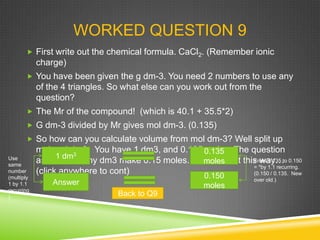
WORKED QUESTION 9
        First write out the chemical formula. CaCl2. (Remember ionic
            charge)
        You have been given the g dm-3. You need 2 numbers to use any
            of the 4 triangles. So what else can you work out from the
            question?
        The Mr of the compound! (which is 40.1 + 35.5*2)
        G dm-3 divided by Mr gives mol dm-3. (0.135)
        So how can you calculate volume from mol dm-3? Well split up
            mol and dm3. You have 1 dm3, and 0.135 0.135 The question
                      3
                                                   moles.
Use
same
            asks 1 dm many dm3 make 0.15 moles. So moles of it this way…to 0.150
                  how                              think          From 0.135
                                                                  = *by 1.1 recurring.
number      (click anywhere to cont)                              (0.150 / 0.135. New
(multiply                                                 0.150         over old.)
1 by 1.1        Answer                                    moles
recurring
)                                 Back to Q9
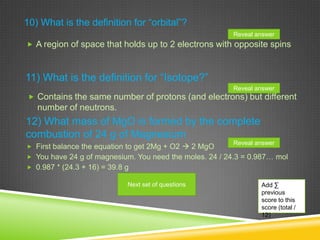
10) What is the definition for “orbital”?
                                                        Reveal answer
 A region of space that holds up to 2 electrons with opposite spins


11) What is the definition for “Isotope?”
                                                        Reveal answer
 Contains the same number of protons (and electrons) but different
   number of neutrons.
12) What mass of MgO is formed by the complete
combustion of 24 g of Magnesium
                                                        Reveal answer
 First balance the equation to get 2Mg + O2  2 MgO
 You have 24 g of magnesium. You need the moles. 24 / 24.3 = 0.987… mol
 0.987 * (24.3 + 16) = 39.8 g

                             Next set of questions              Add ∑
                                                                previous
                                                                score to this
                                                                score (total /
                                                                12)
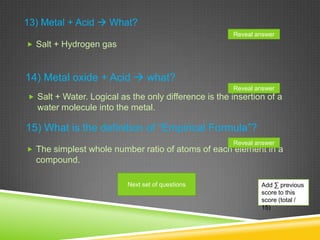
13) Metal + Acid  What?
                                                      Reveal answer
 Salt + Hydrogen gas


14) Metal oxide + Acid  what?
                                                      Reveal answer
 Salt + Water. Logical as the only difference is the insertion of a
  water molecule into the metal.

15) What is the definition of “Empirical Formula”?
                                                      Reveal answer
 The simplest whole number ratio of atoms of each element in a
  compound.

                          Next set of questions               Add ∑ previous
                                                              score to this
                                                              score (total /
                                                              15)
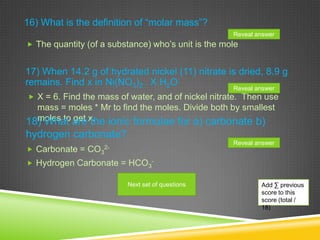
16) What is the definition of “molar mass”?
                                                    Reveal answer
 The quantity (of a substance) who’s unit is the mole


17) When 14.2 g of hydrated nickel (11) nitrate is dried, 8.9 g
remains. Find x in Ni(NO3)2 . X H2O
                                                    Reveal answer
 X = 6. Find the mass of water, and of nickel nitrate. Then use
  mass = moles * Mr to find the moles. Divide both by smallest
18) What are x. ionic formulae for a) carbonate b)
  moles to get the
hydrogen carbonate?
                                                    Reveal answer
 Carbonate = CO3   2-

 Hydrogen Carbonate = HCO3-

                         Next set of questions              Add ∑ previous
                                                            score to this
                                                            score (total /
                                                            18)
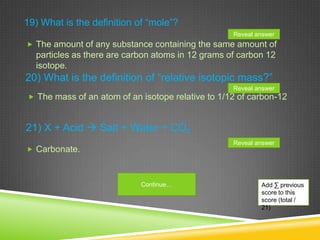
19) What is the definition of “mole”?
                                                   Reveal answer
 The amount of any substance containing the same amount of
  particles as there are carbon atoms in 12 grams of carbon 12
  isotope.
20) What is the definition of “relative isotopic mass?”
                                                   Reveal answer
 The mass of an atom of an isotope relative to 1/12 of carbon-12


21) X + Acid  Salt + Water + CO2
                                                   Reveal answer
 Carbonate.


                         Next Continue…
                              set of questions             Add ∑ previous
                                                           score to this
                                                           score (total /
                                                           21)
THE MOMENT OF TRUTH, YOUR
SCORE…
       90% +
                   Fantastic!
         A*
       80% +
                   Great!
         A
       70% +
                  …
         B
       60% +
                   Never!
         C