The Making of the National Movement in India: 1870s-1947
An overview of India's nationalist movement, key laws, political organizations, leaders like Gandhi, and major events shaping the struggle for independence from 1870s to 1947.
The Making of the National Movement in India: 1870s-1947
1.
THE MAKING OFTHE NATIONAL
MOVEMENT:
1870’S-1947
CHAPTER 11
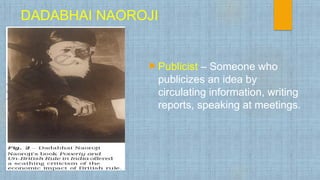
2.
The Emergence ofNationalism
India was the people of India – all the people
irrespective of class, colour, caste, creed,
language, or gender.
And the country, its resources and systems,
were meant for all of them.
This consciousness began to be clearly stated
by the political associations formed after 1850,
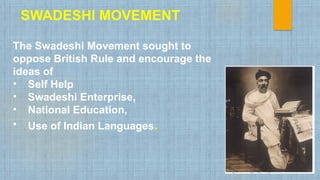
especially those that came into being in the
1870s and 1880s.
3.
Most of thesewere led by English-educated
professionals such as lawyers.
The more important ones were the Poona
Sarvajanik Sabha, the Indian Association, the
Madras Mahajan Sabha, the Bombay Presidency
Association, and of course the Indian National
Congress.
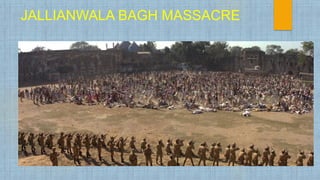
4.
Note the name,“Poona Sarvajanik Sabha”. The literal
meaning of “sarvajanik” is “of or for all the people”
(sarva = all + janik = of the people).
They worked with the idea that the people should be
sovereign – a modern consciousness and a key feature
of nationalism.
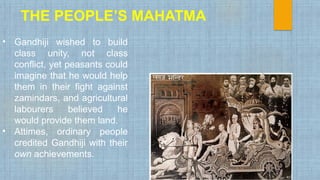
Sovereign – The capacity to act independently
without outside interference
5.
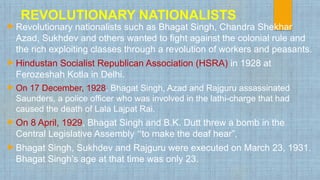
LAWS THAT INCREASEDDISSATISFACTION
The Arms Act (1878) : With intent to disallowing Indians from
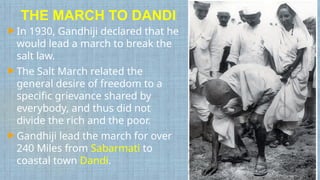
possessing arms.
Vernacular Press Act (1878) : It was enacted in an effort to
silence those who were critical of the government.
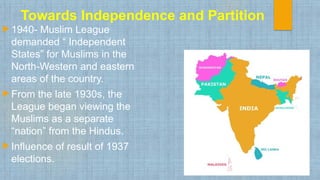
The Act allowed the government to confiscate the
assets of newspapers including their
printing presses if the newspapers published
anything that was found “objectionable”.
6.
Ilbert Bill 1883
Thebill provided for the trial of British or
European persons by Indians, and sought
equality between British and Indian judges in the
country.
But when white opposition forced the government
to withdraw the bill, Indians were enraged. The
event highlighted the racial attitudes of the British
in India.
The need for an all-India organisation of educated
Indians had been felt since 1880, but the Ilbert Bill
controversy deepened this desire.
7.
INDIAN NATIONAL CONGRESS
(INC)
INCwas established in December 1885, when 72
delegates from all over the country met at Bombay.
The early leadership – Dadabhai Naoroji, Pherozeshah
Mehta, Badruddin Tyabji, W.C. Bonnerji, Surendranath
Banerji, Romesh Chandra Dutt, S. Subramania Iyer,
among others – was largely from Bombay and Calcutta.
8.
Naoroji, a businessmanand publicist
settled in London, and for a time member
of the British Parliament, guided the
younger nationalists.
A retired British official, A.O. Hume, also
played a part in bringing Indians from the
various regions together.
9.
DADABHAI NAOROJI
Publicist– Someone who
publicizes an idea by
circulating information, writing
reports, speaking at meetings.
10.
A NATION INTHE MAKING
It has often been said that the Congress in the first twenty
years was “moderate” in its objectives and methods.
During this period it demanded a greater voice for Indians in
the government and in administration.
11.
It wantedthe Legislative Councils to be made
more representative, given more power, and
introduced in provinces where none existed.
It demanded that Indians be placed in high
positions in the government. For this purpose
it called for civil service examinations to be
held in India as well, not just in London.
Other demands included the separation of
the judiciary from the executive, the repeal
(end the validity) of the Arms Act and the
freedom of speech and expression.
12.
ECONOMIC DEMANDS OFCONGRESS
The Congress demanded reduction of
revenue, cut in military expenditure, and
more funds for irrigation.
It passed many resolutions on the salt
tax, treatment of Indian laborers abroad,
and the sufferings of forest dwellers –
caused by an interfering forest
administration.
13.
“Freedom is ourbirthright”
In Bengal, Maharashtra and
Punjab, leaders such as Bepin
Chandra Pal, Bal Gangadhar Tilak
and Lala Lajpat Rai were beginning
to explore more radical objectives
and methods.
They criticised the Moderates for
their “politics of prayers”, and
emphasised the importance of self-
reliance and constructive work.
14.
They arguedthat people must rely on
their own strength, not on the “good”
intentions of the government;
people must fight for swaraj.
Tilak raised the slogan, “Freedom is my
birthright and I shall have it!”
15.
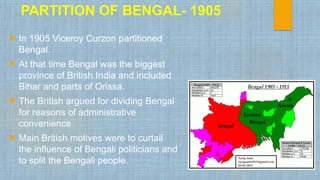
PARTITION OF BENGAL-1905
In 1905 Viceroy Curzon partitioned
Bengal.
At that time Bengal was the biggest
province of British India and included
Bihar and parts of Orissa.
The British argued for dividing Bengal
for reasons of administrative
convenience
Main British motives were to curtail
the influence of Bengali politicians and
to split the Bengali people.
16.
The partitionof Bengal infuriated people all
over India. All sections of the Congress –
the Moderates and the Radicals, opposed it.
The struggle that unfolded came to be
known as the Swadeshi movement,
strongest in Bengal but with echoes
elsewhere too – in deltaic Andhra for
instance, it was known as the
Vandemataram Movement.
17.
SWADESHI MOVEMENT
The SwadeshiMovement sought to
oppose British Rule and encourage the
ideas of
• Self Help
• Swadeshi Enterprise,
• National Education,
• Use of Indian Languages.
18.
MUSLIM LEAGUE
Agroup of Muslim landlords and nawabs formed the All India
Muslim League at Dacca in 1906.
It desired separate electorates for Muslims, a demand
conceded by the government in1909.
Some seats in the councils were now reserved for Muslims
who would be elected by Muslim voters.
19.
This tempted politiciansto gather a
following by distributing favours to their
own religious groups.
In 1907, Congress split in two halves.
The Moderates were opposed to the use
of boycott.
20.
LUCKNOW PACT- 1916
The two groups of Congress
reunited in December 1915. Next
year (1916) the Congress and the
Muslim League signed the historic
Lucknow Pact and decided to work
together for representative
government in the country.
21.
SUMMARY QUESTIONS
Explainthe Terms:
1) Soverign 2) Sarvajanik
How INC existed ?
What is Lucknow Pact?
Whe Bengal’s partition excuted?
What were the features of Swadeshi Movement?
22.
The Growth ofMass Nationalism
The First World War altered the economic and
political situation in India. It led to a huge rise in
the defence expenditure of the Government of
India.
The government in turn increased taxes on
individual incomes and business profits.
Increased military expenditure and the
demands for war supplies led to a sharp rise in
prices which created great difficulties for the
common people.
23.
Indian industriesexpanded during the war, and
Indian business groups began to demand greater
opportunities for development.
Indians who participated in war as soldiers when
returned from the battle became more
knowledgeable about motive of the British rule
and exploitation of Asian and African people.
In 1917 there was a revolution in Russia. News
about peasants’ and workers’ struggles and ideas
of socialism circulated widely, inspiring Indian
nationalists.
24.
THE ADVENT OFMAHATMA
GANDHI
Gandhiji, aged 46, arrived in India in 1915 from
South Africa.
His South African campaigns had brought him in
contact with various types of Indians: Hindus,
Muslims, Parsis and Christians; Gujaratis,
Tamils and north Indians; and upper-class
merchants, lawyers and workers.
25.
Mahatma Gandhispent his first year in India
travelling throughout the country,
understanding the people, their needs and the
overall situation.
His earliest interventions were in Champaran,
Kheda and Ahmedabad where he came into
contact with Rajendra Prasad and Vallabhbhai
Patel.
In Ahmedabad he led a successful
millworkers’ strike in 1918.
26.
The Rowlatt Satyagraha
In 1919 Gandhiji gave a call for a
satyagraha against the Rowlatt Act that
the British had just passed.
The Act curbed fundamental rights such
as the freedom of expression and
strengthened police powers.
Mahatma Gandhi and Mohammad Ali
Jinnah criticised the Act as “devilish” and
tyrannical.
27.
6 April1919 – Observed as a day of
“Humiliation and prayer”
13 April 1919- General Dyer caused The
Jallianwala Bagh Massacre.
Tagore renounced his “Knighthood” to
express his pain and anger against British.
KHILAFAT AGITATION ANDTHE NON-
COOPERATION MOVEMENT
In 1920 the British imposed a harsh treaty on
the Turkish Sultan or Khalifa.
The leaders of the Khilafat agitation,
Mohammad Ali and Shaukat Ali, now wished to
initiate a full-fledged Non-Cooperation
Movement.
Gandhiji supported their call and urged the
Congress to campaign against “Punjab wrongs”
(Jallianwala massacre), the Khilafat wrong and
demand swaraj.
30.
SUMMARY QUESTIONS
1. Whatare the advents of Gandhiji? How does
it help him in organizing his movements?
2. How police powers were strengthened by
Rowlatt Act?
3. Explain Khilafat agitation.
31.
PEOPLE’S INITIATIVES
Peopletook Gandhiji’s call for non-
cooperation in their own manner.
In Kheda, Gujarat, Patidar peasants
organised nonviolent campaigns
against the high land revenue
In coastal Andhra and interior Tamil
Nadu, liquor shops were picketed
32.
THE NON-COOPERATION
MOVEMENT
Thismovement gained momentum
through 1921-22.
Many lawyers such as Motilal Nehru,
C.R. Das, C. Rajagop alachari and
Asaf Ali gave up their practices.
British titles were surrendered and
legislatures boycotted.
People lit public bonfires of foreign
cloth.
33.
Guntur DistrictTribals staged “Forest Satyagrahas”.
Sind- Muslim traders entushiastic about Khilafat
call.
Bengal- Khilafat-Non-Cooperation alliance built
communal unity.
Punjab- the Akali agitation of the Sikhs sought to
remove corrupt mahants.
Assam:- tea garden labourers, shouting “Gandhi
Maharaj ki Jai”, demanded a big increase in their
wages.
34.
THE PEOPLE’S MAHATMA
•Gandhiji wished to build
class unity, not class
conflict, yet peasants could
imagine that he would help
them in their fight against
zamindars, and agricultural
labourers believed he
would provide them land.
• Attimes, ordinary people
credited Gandhiji with their
own achievements.
35.
CALL OFF NON-COOPERATION
MOVEMENT
Mahatma Gandhi, as you know, was against
violent movements.
He abruptly called off the Non-Cooperation
Movement when in February 1922 a crowd of
peasants set fire to a police station in Chauri
Chaura.
Twentytwo policemen were killed on that day.
The peasants were provoked because the police
had fired on their peaceful demonstration.
36.
THE HAPPENINGS OF1922-1929
Establishement of Rashtriya Swayamsevak Sangh and Communist
Party of India is important development of mid-1920s.
Chitta Ranjan Das and Motilal Nehru argued that the party
should fight elections to the councils and enter them in order to
influence government policies.
The decade closed with the Congress resolving to fight for
Purna Swaraj (complete independence) in 1929 under the
presidentship of Jawaharlal Nehru at Lahore.
Consequently, “Independence Day” was observed on 26
January 1930 all over the country.
37.
REVOLUTIONARY NATIONALISTS
Revolutionarynationalists such as Bhagat Singh, Chandra Shekhar
Azad, Sukhdev and others wanted to fight against the colonial rule and
the rich exploiting classes through a revolution of workers and peasants.
Hindustan Socialist Republican Association (HSRA) in 1928 at
Ferozeshah Kotla in Delhi.
On 17 December, 1928, Bhagat Singh, Azad and Rajguru assassinated
Saunders, a police officer who was involved in the lathi-charge that had
caused the death of Lala Lajpat Rai.
On 8 April, 1929, Bhagat Singh and B.K. Dutt threw a bomb in the
Central Legislative Assembly “to make the deaf hear”,
Bhagat Singh, Sukhdev and Rajguru were executed on March 23, 1931.
Bhagat Singh’s age at that time was only 23.
38.
SUMMARY QUESTIONS
1. Whatactivities were undertaken by activists
under Non-Cooperation Movement?
2. Why Gandhiji called off the Non-Cooperation
Movement?
3. Why was Bhagt Singh executed? How did
they help in National Movement?
39.
THE MARCH TODANDI
In 1930, Gandhiji declared that he
would lead a march to break the
salt law.
The Salt March related the
general desire of freedom to a
specific grievance shared by
everybody, and thus did not
divide the rich and the poor.
Gandhiji lead the march for over
240 Miles from Sabarmati to
coastal town Dandi.
40.
ACHIEVEMENT of CivilDisobedience
Movement
The combined struggles of the Indian people bore fruit when
the Government of India Act of 1935 prescribed provincial
autonomy and the government announced elections to the
provincial legislatures in 1937.
The Congress formed governments in 7 out of 11 provinces.
1939 Second World War broke out. Congress was ready to
support British in view of Critical of Hitler, but in turn, they
wanted India be granted independence after war.
41.
Quit India andLater
In the middle of Second World War, Mahatma Gandhi told to
British that the must Quit India immediately.
“Do or Die” slogan was given to the people by him.
Communications and symbols of state authority were attacked
all over the country.
By the end of 1943 over 90,000 people were arrested, and
around 1,000 killed in police firing. In many areas orders were
given to machine-gun crowds from airplanes.
42.
1940- MuslimLeague
demanded “ Independent
States” for Muslims in the
North-Western and eastern
areas of the country.
From the late 1930s, the
League began viewing the
Muslims as a separate
“nation” from the Hindus.
Influence of result of 1937
elections.
Towards Independence and Partition
43.
TOWARDS FREEDOM
Atthe end of the war in 1945, the British opened negotiations
between the Congress, the League and themselves for the
independence of India.
League saw itself as the sole spokesperson of India’s Muslims.
The Congress could not accept this claim since a large number
of Muslims still supported it. Thus the talks failed.
44.
CONSTITUENCY ELECTION IN1946
Congress – Fine performance on general Constituencies.
League- Spectacular success on Muslim Reserved Seats.
Now League persisted with demand for “Pakistan”.
Cabinet Mission (Three Cabinet level Ministers of British) in
March 1946 suggested United India with some autonomy for
Muslim-majority areas.
Congress and Leagues disagreed with the Cabinet Mission’s
proposal.
45.
PARTITION
The MuslimLeague decided on mass agitation for winning its
Pakistan demand.
It announced 16 August 1946 as “Direct Action Day”.
On this day riots broke out in Calcutta, lasting several days
and resulting in the death of thousands of people.
By March 1947 violence spread to different parts of northern
India.
46.
Partition alsomeant that India changed, many of its cities
changed, and a new country – Pakistan – was born.
So, the joy of our country’s independence from British rule
came mixed with the pain and violence of Partition.
47.
SUMMARY QUESTIONS
1. WhyGandhiji decided to break Salt Law?
2. What were the achievements of Civil
Disobedience Movement?
3. How ‘Quit India Movement’ affected the British
Government?
4. Why Partition became ineveitable?
5. Which slogan would you have given for any of
the above movements? Why?



![HISTORYProjectOutline class 10 of icse board education]](https://cdn.slidesharecdn.com/ss_thumbnails/historyprojectoutline10-240727055256-780bf30f-thumbnail.jpg?width=640&height=640&fit=bounds)


