The Journey from Rejection to Recognition: Building Resilience and Growth
Explore how to transform rejection into motivation by understanding its impact, learning from setbacks, and developing resilience to achieve personal and professional recognition.
The Journey from Rejection to Recognition: Building Resilience and Growth
2.
Introduction
Rejection is oneof the most difficult experiences we encounter in life. Whether it comes in the
form of a job application that was unsuccessful, a business idea that was turned down, a
scholarship that was denied, a creative work that received little attention, or an opportunity that
went to someone else, rejection can leave us questioning our abilities and wondering whether we
are truly capable of achieving our dreams. In those moments, it is easy to see rejection as a final
verdict rather than what it really can be: a moment in a much larger journey.
But what if rejection is not the opposite of recognition? What if it is part of the road that leads to
it?
The journey from rejection to recognition is rarely straightforward. It requires the courage to face
disappointment, the humility to learn from criticism, and the determination to keep moving
forward when success seems far away. Many people who eventually achieve recognition
experience setbacks long before their efforts are celebrated. What separates them is not the
absence of rejection, but how they respond to it.
In this chapter, we will explore the different forms rejection can take and the emotional impact it
can have on our confidence, motivation, and sense of purpose. We will examine how a painful
setback can become a turning point and how rejection can provide valuable lessons about our
weaknesses, strengths, and direction. We will also look at practical ways to transform rejection
into motivation by developing resilience, improving our skills, setting meaningful goals, and
refusing to allow one disappointment to define our future.
More importantly, we will explore the journey itself—the patience, consistency, discipline, and
perseverance required to turn repeated setbacks into eventual progress. Through examples of
people who faced rejection before achieving recognition, we will see that success is often built
quietly, long before it is publicly acknowledged.
Recognition, however, is not limited to awards, applause, promotions, or public praise.
Sometimes the greatest recognition is recognizing your own growth: realizing that you are
stronger, wiser, more capable, and more prepared than you were when you first faced rejection.
Your rejection may be part of your story, but it does not have to be the end of it. The question is
not whether you will face rejection, but what you will choose to do after it. This is the journey
from rejection to recognition—a journey of resilience, growth, persistence, and ultimately,
transformation.
3.
Understanding Rejection
Rejection isa word most people would rather avoid. It carries an emotional weight that can make
even the strongest person question themselves. To be rejected is to be told, directly or indirectly,
“Not this time,” “You are not the right person,” “Your idea is not what we are looking for,” or
sometimes, “No.” Whether the rejection comes from an employer, an institution, a business
partner, a publisher, a client, or someone we care about, the experience can be painful.
Yet rejection is an unavoidable part of life.
Every person who pursues something meaningful will eventually encounter it. The person who
applies for a dream job may receive a rejection email. The entrepreneur may pitch an idea that
investors do not believe in. The student may apply for a scholarship and not be selected. The
writer may submit a manuscript and receive a refusal. The artist may create something they
believe in only to discover that the audience does not respond as expected.
Even people who eventually become highly successful have experienced moments when
someone said no to them.
The difference is that rejection does not have to be the conclusion of the story. It can be a
chapter.
What Does Rejection Really Mean?
At its simplest, rejection means that an opportunity, request, idea, application, or relationship has
not been accepted. But emotionally, rejection often means much more to the person experiencing
it.
We have a tendency to connect what happens to us with who we are.
If we apply for a job and are rejected, we may think, I am not good enough.
If our business proposal is rejected, we may think, My idea is worthless.
If our creative work is ignored, we may think, I have no talent.
If someone does not choose us, we may think, I am not valuable.
This is where rejection becomes dangerous—not because the rejection itself has the power to
determine our future, but because of the meaning we attach to it.
A rejection is an outcome. It is not necessarily a definition of your ability, character, potential, or
worth.
4.
Sometimes a rejectionsimply means that you were not the right fit for that particular
opportunity at that particular moment. Sometimes it means that there is something you
need to improve. Sometimes the decision was influenced by circumstances you could
never have controlled.
Understanding this distinction is the first step toward responding to rejection in a healthier
and more productive way.
5.
The Many Facesof Rejection
Rejection does not always look the same. It can appear in almost every
area of life.
Career Rejection
One of the most common forms is professional rejection. You may
spend hours preparing a résumé, researching a company, attending
interviews, and imagining yourself in a new position, only to receive an
email informing you that another candidate was selected.
The disappointment can be especially intense when you believed you
were qualified.
But being rejected for one position does not mean you are
unemployable. It may mean another candidate had more relevant
experience, the organization changed its needs, or the position simply
was not the right match.
The important question is not only, “Why did they reject me?” but also,
“What can I learn from this experience?”
Educational Rejection
Students also experience rejection. A university application may be
unsuccessful. A scholarship may go to another applicant. A student may
not be selected for a prestigious program or opportunity.
6.
Why Does RejectionHurt So Much?
If rejection is such a normal part of life, why does it hurt so deeply?
Part of the answer lies in our need for acceptance. We want to belong. We want our efforts to
be valued. We want our abilities to be recognized. We want to know that we matter.
When rejection occurs, it can temporarily threaten that sense of security.
We may begin replaying the experience in our minds.
What did I do wrong?
Why wasn't I good enough?
What does this say about me?
What will other people think?
These questions can become destructive when they are driven by emotion rather than
reflection.
There is a significant difference between asking, “What can I learn from this?” and asking,
“What is wrong with me?”
The first question creates possibilities. The second can create shame.
7.
Rejection Is NotAlways a Judgment of Your Worth
One of the most important lessons in the journey from
rejection to recognition is learning not to confuse a
decision with a personal verdict.
Imagine two equally talented people applying for one
position. Only one can be selected.
The person who is not chosen may walk away
believing they are inadequate. But the rejection does
not prove that. It simply means that, in that particular
competition, another person was selected.
The same principle applies in many areas of life.
A publisher can reject a manuscript without proving
that the writer has no talent.
An investor can reject a business proposal without
proving that the entrepreneur has no potential.
A university can reject an application without
determining the student's ultimate future.
A customer can reject a product without proving that
the entrepreneur's entire business is destined to fail.
This does not mean that every rejection should be
ignored. Sometimes rejection contains valuable
criticism. Sometimes it exposes genuine weaknesses
that need attention.
8.
When Rejection Becomesa Teacher
Rejection becomes useful when we are willing to examine it honestly.
Suppose you apply for ten jobs and receive no offers. You could conclude, “Nobody wants
me.”
Or you could investigate.
Perhaps your résumé needs improvement. Perhaps you need additional skills. Perhaps
your interview technique needs work. Perhaps you are applying for positions that do not
match your current experience.
The second approach does not guarantee immediate success, but it gives you something
rejection alone cannot provide: a direction for improvement.
This is one of the greatest opportunities hidden inside rejection.
It can force us to stop, evaluate, and grow.
Sometimes we need rejection to reveal what success might have allowed
9.
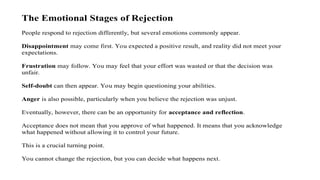
The Emotional Stagesof Rejection
People respond to rejection differently, but several emotions commonly appear.
Disappointment may come first. You expected a positive result, and reality did not meet your
expectations.
Frustration may follow. You may feel that your effort was wasted or that the decision was
unfair.
Self-doubt can then appear. You may begin questioning your abilities.
Anger is also possible, particularly when you believe the rejection was unjust.
Eventually, however, there can be an opportunity for acceptance and reflection.
Acceptance does not mean that you approve of what happened. It means that you acknowledge
what happened without allowing it to control your future.
This is a crucial turning point.
You cannot change the rejection, but you can decide what happens next.
10.
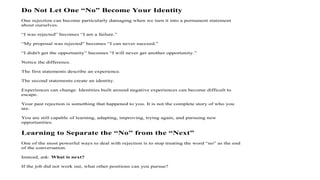
Do Not LetOne “No” Become Your Identity
One rejection can become particularly damaging when we turn it into a permanent statement
about ourselves.
“I was rejected” becomes “I am a failure.”
“My proposal was rejected” becomes “I can never succeed.”
“I didn't get the opportunity” becomes “I will never get another opportunity.”
Notice the difference.
The first statements describe an experience.
The second statements create an identity.
Experiences can change. Identities built around negative experiences can become difficult to
escape.
Your past rejection is something that happened to you. It is not the complete story of who you
are.
You are still capable of learning, adapting, improving, trying again, and pursuing new
opportunities.
Learning to Separate the “No” from the “Next”
One of the most powerful ways to deal with rejection is to stop treating the word “no” as the end
of the conversation.
Instead, ask: What is next?
If the job did not work out, what other positions can you pursue?
11.
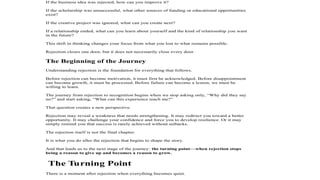
If the businessidea was rejected, how can you improve it?
If the scholarship was unsuccessful, what other sources of funding or educational opportunities
exist?
If the creative project was ignored, what can you create next?
If a relationship ended, what can you learn about yourself and the kind of relationship you want
in the future?
This shift in thinking changes your focus from what you lost to what remains possible.
Rejection closes one door, but it does not necessarily close every door.
The Beginning of the Journey
Understanding rejection is the foundation for everything that follows.
Before rejection can become motivation, it must first be acknowledged. Before disappointment
can become growth, it must be processed. Before failure can become a lesson, we must be
willing to learn.
The journey from rejection to recognition begins when we stop asking only, “Why did they say
no?” and start asking, “What can this experience teach me?”
That question creates a new perspective.
Rejection may reveal a weakness that needs strengthening. It may redirect you toward a better
opportunity. It may challenge your confidence and force you to develop resilience. Or it may
simply remind you that success is rarely achieved without setbacks.
The rejection itself is not the final chapter.
It is what you do after the rejection that begins to shape the story.
And that leads us to the next stage of the journey: the turning point—when rejection stops
being a reason to give up and becomes a reason to grow.
The Turning Point
There is a moment after rejection when everything becomes quiet.
12.
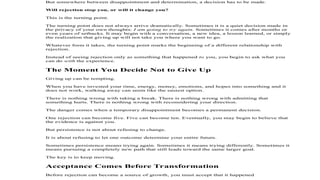
But somewhere betweendisappointment and determination, a decision has to be made.
Will rejection stop you, or will it change you?
This is the turning point.
The turning point does not always arrive dramatically. Sometimes it is a quiet decision made in
the privacy of your own thoughts: I am going to try again. Sometimes it comes after months or
even years of setbacks. It may begin with a conversation, a new idea, a lesson learned, or simply
the realization that giving up will not take you where you want to go.
Whatever form it takes, the turning point marks the beginning of a different relationship with
rejection.
Instead of seeing rejection only as something that happened to you, you begin to ask what you
can do with the experience.
The Moment You Decide Not to Give Up
Giving up can be tempting.
When you have invested your time, energy, money, emotions, and hopes into something and it
does not work, walking away can seem like the easiest option.
There is nothing wrong with taking a break. There is nothing wrong with admitting that
something hurts. There is nothing wrong with reconsidering your direction.
The danger comes when a temporary disappointment becomes a permanent decision.
One rejection can become five. Five can become ten. Eventually, you may begin to believe that
the evidence is against you.
But persistence is not about refusing to change.
It is about refusing to let one outcome determine your entire future.
Sometimes persistence means trying again. Sometimes it means trying differently. Sometimes it
means pursuing a completely new path that still leads toward the same larger goal.
The key is to keep moving.
Acceptance Comes Before Transformation
Before rejection can become a source of growth, you must accept that it happened
13.
It does notmean you are happy about the outcome. It does not mean you believe the rejection
was fair. It simply means that you stop fighting a reality you cannot change.
You were not selected.
The application was unsuccessful.
The proposal was declined.
The opportunity went to someone else.
The relationship ended.
These things may be painful, but they are facts.
Once you accept what happened, you can redirect your energy toward what you can control.
You cannot change yesterday's decision.
You can change what you learn from it.
You can change how you prepare for the next opportunity.
You can change the skills you develop.
You can change your strategy.
You can change your response.
That is where transformation begins.
Ask Better Questions
After rejection, our first questions are often emotional.
Why me?
Why wasn't I good enough?
What do they have that I don't?
Why does this always happen to me?
14.
A more productiveapproach is to ask questions that create action.
What can I learn from this?
Was there something within my control that I could have done better?
What skills do I need to develop?
Was this opportunity actually the right fit for me?
What would I do differently if I had another chance?
What is my next step?
These questions do not erase disappointment. They transform disappointment into reflection.
And reflection can lead to growth.
Not Every Rejection Is Your Fault
There is an important balance to maintain.
Learning from rejection does not mean blaming yourself for every negative outcome.
Sometimes you can do everything right and still be rejected.
A company may have chosen an internal candidate. A scholarship may have received thousands
of qualified applications. An investor may have decided to focus on a different industry. A client
may simply have had a different budget.
There are factors you cannot control.
If you automatically assume every rejection proves that you are inadequate, you may spend your
life trying to fix problems that were never yours to fix.
15.
qualifications.
The entrepreneur whoseproposal is rejected may return with a stronger business plan.
The writer whose manuscript is rejected may improve their craft and write a better book.
The student who misses an opportunity may become more disciplined in preparation for the next one.
The key is to use pain as fuel rather than allowing it to become an anchor.
Pain says, This hurt.
Motivation asks, What will I do about it?
That distinction can change everything.
Develop a Growth Mindset
A major part of the turning point is learning to believe that your abilities are not fixed.
If you believe that talent is permanent, rejection can feel devastating.
You may think:
I wasn't chosen because I'm not talented.
I'm not naturally good at this.
Other people are simply better than me.
But a growth-oriented mindset asks a different question:
What can I improve?
Skills can be developed. Knowledge can be expanded. Experience can be gained. Communication
can be strengthened. Confidence can grow through practice.
You may not be ready for an opportunity today.
16.
Turning Rejection intoMotivation
Rejection can take something from you.
It can take your confidence, your enthusiasm, your sense of direction, and sometimes even your
willingness to try again. But rejection can also give something back—if you learn how to use it.
The same experience that makes one person give up can motivate another person to become
stronger, more prepared, and more determined.
The difference is not always the rejection itself.
It is the response.
Turning rejection into motivation does not mean pretending that rejection does not hurt. It means
refusing to allow the pain to become the final outcome. Instead of allowing disappointment to
weaken you permanently, you can use it as a source of energy for growth.
This chapter explores how to make that shift.
Motivation Can Come from Disappointment
We often imagine motivation as something positive: an inspiring speech, an encouraging mentor,
a dream, or a vision of success.
But motivation can also emerge from disappointment.
There are moments when hearing “no” makes you realize how badly you want to hear “yes.”
A rejected job application may motivate you to improve your qualifications.
A failed business proposal may motivate you to understand your market better.
A disappointing examination result may motivate you to change your study habits.
A rejected creative project may push you to develop your craft.
The rejection becomes a wake-up call.
It forces you to confront the gap between where you are and where you want to be.
17.
After rejection, itis natural to ask, “Why me?”
Why did this happen?
Why was someone else chosen?
Why didn't they recognize my potential?
Why does success seem easier for other people?
These questions may express genuine frustration, but they rarely provide a useful path forward.
A more productive question is:
What next?
What will you do now?
What can you improve?
Who can you learn from?
What opportunity can you pursue?
What skill can you develop?
What strategy can you change?
“What next?” shifts your attention from the past to the future.
You cannot always control what has happened.
But you can influence what happens next.
Identify the Lesson Hidden in the Rejection
Every rejection does not contain a lesson, but many do.
The challenge is learning how to find it.
Suppose you applied for a position and were not selected. Perhaps your experience was not
strong enough. Perhaps your interview answers were unclear. Perhaps your application did not
18.
If you submitteda business proposal and it was rejected, examine the reasons.
Was the problem the product?
The price?
The market?
The presentation?
The timing?
The business model?
If you are a writer and your work is rejected, consider whether there are areas of your writing
that need development.
The objective is not to criticize yourself endlessly.
It is to extract useful information from the experience.
A rejection that teaches you something has not been entirely wasted.
Create Goals After Rejection
Motivation becomes stronger when it has direction.
It is not enough to say, “I will prove them wrong.”
That emotion may provide temporary energy, but it is not always enough to sustain long-term
progress.
Instead, turn your disappointment into measurable goals.
If you were rejected because you lacked a qualification, set a goal to obtain it.
If your presentation was weak, commit to practicing public speaking.
If your portfolio was not competitive, create new work.
If your business proposal was unclear, rebuild it.
19.
Instead of simplywanting to succeed, you begin to define what success requires.
Make Your Next Attempt Better
One of the clearest signs that rejection has become motivation is improvement.
Your next attempt should not simply be a repetition of the previous one.
Ask yourself:
What will I do differently this time?
Perhaps you will prepare more thoroughly.
Perhaps you will seek professional advice.
Perhaps you will research the organization more carefully.
Perhaps you will improve your communication.
Perhaps you will approach a different audience.
Perhaps you will give yourself more time.
Improvement does not guarantee success, but it increases your readiness.
And every improved attempt moves you closer to the person capable of achieving the goal.
Build Discipline, Not Just Motivation
Motivation is powerful, but it is not always reliable.
There will be days when you feel inspired.
There will also be days when you do not.
If your progress depends entirely on feeling motivated, your efforts may stop whenever your
emotions change.
This is why discipline matters.
Discipline means continuing to do what needs to be done even when you do not feel like doing
20.
Use Rejection toStrengthen Your Skills
One of the most practical ways to respond to rejection is to become better at what you do.
Ask yourself what your field requires and identify areas where you can improve.
You may need stronger communication skills.
You may need technical knowledge.
You may need better leadership abilities.
You may need more experience.
You may need to improve your writing, presentation, networking, negotiation, or problem-
solving skills.
Do not wait for another rejection to reveal the same weakness.
Work on it now.
The period between rejection and your next opportunity can become a preparation season.
Use it wisely.
Build a Habit of Learning
People who turn rejection into motivation tend to remain curious.
They ask questions.
They read.
They listen.
They seek mentors.
They study people who are already successful.
They learn from mistakes.
21.
This habit oflearning creates an advantage.
Instead of seeing every setback as evidence that you cannot succeed, you begin to see it as
information that can help you improve.
You become less afraid of mistakes because you understand that mistakes can teach you.
You become less afraid of criticism because you know that useful criticism can strengthen you.
You become less afraid of rejection because you know that rejection does not have to stop your
development.
Be Careful with the Desire to “Prove Them Wrong”
There is nothing wrong with allowing rejection to motivate you.
But there is a danger in making revenge your primary motivation.
You may think:
One day they will regret rejecting me.
That thought can provide energy, but it can also keep you emotionally connected to the people
who rejected you.
Your goal should eventually become bigger than proving someone else wrong.
Do not build your future around revenge.
Build it around purpose.
You do not need to become successful simply so someone who rejected you can see your
success.
Become successful because you believe in the work.
Because you value the goal.
Because you want to grow.
Because you want to make a difference.
22.
When your motivationcomes from purpose, it becomes much more sustainable.
Surround Yourself with Encouragement
There will be moments when your own motivation becomes weak.
This is where the right people matter.
Find people who believe in growth.
Talk to mentors who can offer perspective.
Spend time with friends who encourage healthy ambition.
Learn from people who have experienced setbacks themselves.
Sometimes another person's confidence in you can help you recover your own confidence.
But remember that encouragement should not replace responsibility.
A good mentor does not simply tell you that everything will work out.
They help you understand what you need to do to improve your chances.
Celebrate Small Victories
When you are recovering from rejection, do not wait for a major achievement before recognizing
progress.
Celebrate small victories.
You completed the course.
You improved your résumé.
You made the difficult phone call.
You submitted another application.
You finished the project.
You received positive feedback.
You learned a new skill.
23.
You tried againdespite being afraid.
These moments matter.
Small victories build confidence.
Confidence builds momentum.
Momentum makes it easier to continue.
Eventually, the small steps begin to create significant change.
Develop Resilience
Resilience is not the absence of disappointment.
A resilient person can be disappointed, hurt, frustrated, or afraid and still find a way forward.
That is important because the journey from rejection to recognition may involve more than one
setback.
You may be rejected again.
You may fail again.
You may make mistakes again.
If your definition of success is “I must never experience rejection,” you will always be
vulnerable to disappointment.
A stronger definition is:
Success means I can continue growing despite rejection.
That mindset gives you room to fail without believing that you are finished.
Give Yourself Permission to Start Again
Sometimes the most courageous response to rejection is simply beginning again.
Try again.
Apply again.
Write again.
24.
Build again.
Study again.
Dreamagain.
There may be fear attached to starting again because you remember how the previous attempt
ended.
But courage is not the absence of fear.
Courage is moving forward despite it.
Your next attempt may not succeed either.
But you will learn something.
You will become more experienced.
You will understand the process better.
And eventually, persistence combined with learning can produce a result that the first attempt
could not.
Motivation Must Become Action
At some point, thinking about success is no longer enough.
You have to act.
Make the call.
Send the application.
Write the proposal.
Practice the skill.
Attend the course.
Meet the person.
Build the product.
25.
Take the nextstep.
You do not need to have the entire journey figured out before you begin.
Often, clarity comes through action.
The first step creates information.
The second step creates experience.
The third step creates confidence.
Gradually, the path becomes clearer.
Your Rejection Can Become Part of Your Strength
One day, you may look back at the rejection that once hurt you and see it differently.
You may realize that it forced you to develop a skill you desperately needed.
It may have pushed you toward a better opportunity.
It may have introduced you to people you would never have met otherwise.
It may have made you more disciplined.
It may have strengthened your confidence.
It may have taught you patience.
Most importantly, it may have shown you that you could survive disappointment and continue
moving forward.
That is strength.
The goal is not to erase your rejection from your story.
The goal is to transform its meaning.
From Motivation to Momentum
26.
Continue the Journey
Thejourney from rejection to recognition is not always
easy, and sometimes we need guidance,
encouragement, and real-life lessons from people who
have walked the path before us. If you want to explore
this journey more deeply, the book From Rejection to
Recognition offers further insights into overcoming
setbacks, developing resilience, and turning difficult
experiences into opportunities for growth.