The Impact of Water Temperature on Sugar Dissolving Speed: A Sweet Science Experiment
Explore how water temperature affects sugar dissolving speed through a fun, controlled experiment demonstrating molecular movement and real-life applications in cooking and chemistry.
The Impact of Water Temperature on Sugar Dissolving Speed: A Sweet Science Experiment
1.
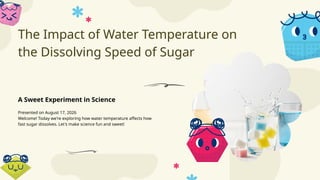
The Impact ofWater Temperature on
the Dissolving Speed of Sugar
Presented on August 17, 2026
Welcome! Today we're exploring how water temperature affects how
fast sugar dissolves. Let's make science fun and sweet!
A Sweet Experiment in Science
2.
What's the Problem?
EverydayScience
The Big Question Temperature Matters?
Why It Matters
Why does sugar dissolve faster in some water than
others? Is temperature the secret ingredient?
Does the temperature of water really change how
fast sugar dissolves? Let's investigate!
Understanding dissolving helps us in cooking,
chemistry, and many everyday situations around
us.
From making sweet drinks to baking, dissolving speed
plays a big role in our daily lives!
3.
Our Hypothesis
Our Prediction
SugarDissolves Faster in Hot
Water
Heat Energizes Water Molecules
Sugar Breaks Apart Quicker
We hypothesize that sugar will dissolve faster in hot
water compared to cold or warm water.
Heat gives water molecules more kinetic energy,
causing them to move faster and interact more with
sugar.
When molecules move faster, they collide with sugar
crystals more often, breaking them apart more
quickly.
Hot water will dissolve sugar fastest, warm water next,
and cold water will take the longest of all.
4.
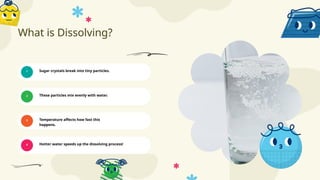
What is Dissolving?
Sugarcrystals break into tiny particles.
1
2
3
4
These particles mix evenly with water.
Temperature affects how fast this
happens.
Hotter water speeds up the dissolving process!
5.
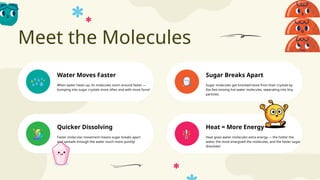
Meet the Molecules
Heat= More Energy
Water Moves Faster Sugar Breaks Apart
Quicker Dissolving
When water heats up, its molecules zoom around faster —
bumping into sugar crystals more often and with more force!
Sugar molecules get knocked loose from their crystals by
the fast-moving hot water molecules, separating into tiny
particles.
Faster molecular movement means sugar breaks apart
and spreads through the water much more quickly!
Heat gives water molecules extra energy — the hotter the
water, the more energized the molecules, and the faster sugar
dissolves!
6.
The Experiment Setup
Threecups of water: cold, warm, and hot.
1
2
3
4
Same amount of sugar added to each cup.
Time measured until sugar fully
dissolves.
Record and compare results for each cup!
7.
Variables to Watch
Watertemperature is what we change! We test cold, warm, and hot water to see how each one affects how quickly the sugar disappears into the
water.
To keep our experiment fair, we keep these the same: the amount of sugar added to each cup, the stirring speed and technique, and the size of
the cup used for each test.
The time it takes for sugar to fully dissolve is what we measure! We use a stopwatch to record how many seconds pass until no sugar crystals are
visible in each cup.
Controlling variables means only water temperature changes between tests. This way, we know for sure that any difference in dissolving time is
caused by temperature — not something else!
Independent
Variable
Controlled
Variables
Dependent Variable
Why Control Variables?
8.
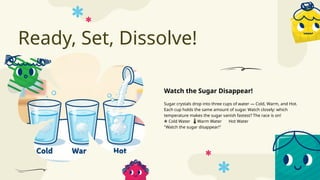
Ready, Set, Dissolve!
Sugarcrystals drop into three cups of water — Cold, Warm, and Hot.
Each cup holds the same amount of sugar. Watch closely: which
temperature makes the sugar vanish fastest? The race is on!
❄️Cold Water Warm Water Hot Water
️
🌡️
"Watch the sugar disappear!"
Watch the Sugar Disappear!
9.
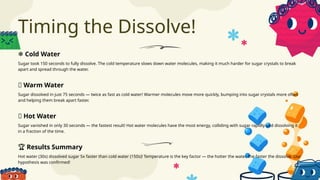
Timing the Dissolve!
Sugartook 150 seconds to fully dissolve. The cold temperature slows down water molecules, making it much harder for sugar crystals to break
apart and spread through the water.
Sugar vanished in only 30 seconds — the fastest result! Hot water molecules have the most energy, colliding with sugar rapidly and dissolving it
in a fraction of the time.
Sugar dissolved in just 75 seconds — twice as fast as cold water! Warmer molecules move more quickly, bumping into sugar crystals more often
and helping them break apart faster.
Hot water (30s) dissolved sugar 5x faster than cold water (150s)! Temperature is the key factor — the hotter the water, the faster the dissolve. Our
hypothesis was confirmed!
❄️Cold Water
🔥 Hot Water
🌊 Warm Water
🏆 Results Summary
10.
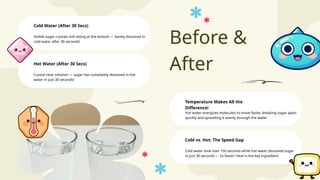
Visible sugar crystalsstill sitting at the bottom — barely dissolved in
cold water after 30 seconds!
Hot water energizes molecules to move faster, breaking sugar apart
quickly and spreading it evenly through the water.
Crystal clear solution — sugar has completely dissolved in hot
water in just 30 seconds!
Cold water took over 150 seconds while hot water dissolved sugar
in just 30 seconds — 5x faster! Heat is the key ingredient.
Cold Water (After 30 Secs)
Temperature Makes All the
Difference!
Hot Water (After 30 Secs)
Cold vs. Hot: The Speed Gap
Before &
After
11.
The Science BehindIt
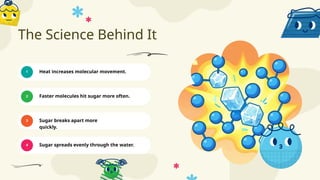
Heat increases molecular movement.
1
2
3
4
Faster molecules hit sugar more often.
Sugar breaks apart more
quickly.
Sugar spreads evenly through the water.
12.
Fun Fact Time!
–Science Fun Daily
When water heats up, its molecules move faster and faster — like a
dance party! The hotter the water, the more energetic the molecules,
and the quicker sugar dissolves. Science is always grooving!
"Heating things up makes molecules dance
faster!"
13.
Real-Life Relevance
Food ScienceFun
Cooking & Baking Perfect Hot Drinks
Everyday Chemistry
Dissolving sugar in recipes works best with warm
water — bakers and chefs use this trick every day!
Making tea or coffee just right means using hot
water so sugar dissolves quickly and evenly in your
cup.
Chemistry happens all around us — from fizzy
drinks to medicine, dissolving is part of everyday
life!
Understanding how temperature affects dissolving
helps us make better food, drinks, and science
discoveries!
14.
What Did WeLearn?
Sugar dissolves faster in hot water.
1
2
3
4
Temperature affects molecular movement.
Controlled experiments help test
hypotheses.
Heat energizes molecules and speeds up dissolving!
15.
Try It Yourself!
TimeYour Results!
Gather Your Supplies Change the Temperature
Stir and Observe
You'll need sugar, water, and three cups. Set up cold, warm,
and hot water to start your experiment at home!
Try water at different temperatures — cold, lukewarm, and
hot. Add the same amount of sugar to each cup and
watch!
Vary your stirring speed too! Does stirring faster make
sugar dissolve quicker? Observe what happens in each
cup.
Use a stopwatch to time how long sugar takes to dissolve in
each cup. Record your results and have fun discovering!
16.
Questions & Curiosity
Whatelse might temperature affect beyond sugar dissolving? Think about ice melting, cooking food, or how gases behave — temperature plays a
role in so many everyday science moments around us!
What experiments would you like to try next? Design your own test — change the stirring speed, try different liquids, or test other solids. Science
is all about asking questions and exploring!
How do other substances dissolve in water? Explore how salt, baking soda, or powdered drink mix behave differently — some dissolve quickly,
others slowly, and some barely dissolve at all!
Every great scientist started with a question just like yours. Keep wondering, keep testing, and keep discovering — the world is full of sweet
science surprises waiting for you to uncover!
Temperature Effects
Your Experiment
Ideas
Other Substances
Keep Being Curious!
 Most read

 Most read
 Most read