The Impact of Chemists: Louis Pasteur and the Foundations of Germ Theory
Explore Louis Pasteur's experiments disproving spontaneous generation, the development of germ theory, and their profound effects on medicine, industry, and public health practices.
The Impact of Chemists: Louis Pasteur and the Foundations of Germ Theory
1.
Chemists and Howthey
Have Made an Impact on
our Lives
SESSION 2 Lesson
General Science - Grade 11
Designed by Teacher/s: Fitz Daril Clyne T. Jaso
2.
The Impact ofChemists: Louis Pasteur
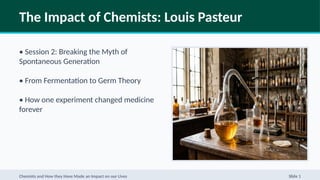
• Session 2: Breaking the Myth of
Spontaneous Generation
• From Fermentation to Germ Theory
• How one experiment changed medicine
forever
Chemists and How they Have Made an Impact on our Lives Slide 1
3.
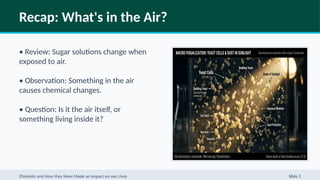
Recap: What's inthe Air?
• Review: Sugar solutions change when
exposed to air.
• Observation: Something in the air
causes chemical changes.
• Question: Is it the air itself, or
something living inside it?
Chemists and How they Have Made an Impact on our Lives Slide 2
4.
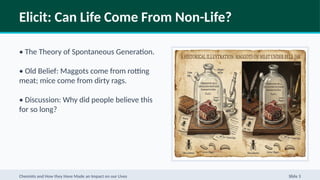
Elicit: Can LifeCome From Non-Life?
• The Theory of Spontaneous Generation.
• Old Belief: Maggots come from rotting
meat; mice come from dirty rags.
• Discussion: Why did people believe this
for so long?
Chemists and How they Have Made an Impact on our Lives Slide 3
5.
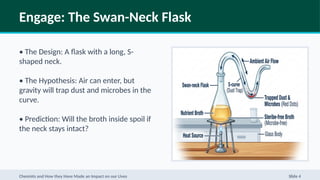
Engage: The Swan-NeckFlask
• The Design: A flask with a long, S-
shaped neck.
• The Hypothesis: Air can enter, but
gravity will trap dust and microbes in the
curve.
• Prediction: Will the broth inside spoil if
the neck stays intact?
Chemists and How they Have Made an Impact on our Lives Slide 4
6.
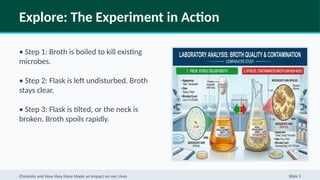
Explore: The Experimentin Action
• Step 1: Broth is boiled to kill existing
microbes.
• Step 2: Flask is left undisturbed. Broth
stays clear.
• Step 3: Flask is tilted, or the neck is
broken. Broth spoils rapidly.
Chemists and How they Have Made an Impact on our Lives Slide 5
7.
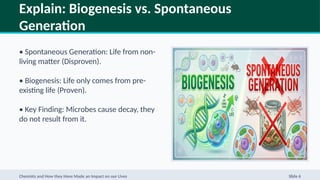
Explain: Biogenesis vs.Spontaneous
Generation
• Spontaneous Generation: Life from non-
living matter (Disproven).
• Biogenesis: Life only comes from pre-
existing life (Proven).
• Key Finding: Microbes cause decay, they
do not result from it.
Chemists and How they Have Made an Impact on our Lives Slide 6
8.
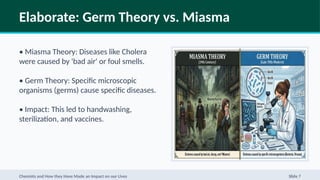
Elaborate: Germ Theoryvs. Miasma
• Miasma Theory: Diseases like Cholera
were caused by 'bad air' or foul smells.
• Germ Theory: Specific microscopic
organisms (germs) cause specific diseases.
• Impact: This led to handwashing,
sterilization, and vaccines.
Chemists and How they Have Made an Impact on our Lives Slide 7
9.
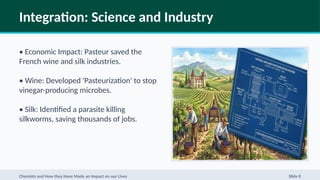
Integration: Science andIndustry
• Economic Impact: Pasteur saved the
French wine and silk industries.
• Wine: Developed 'Pasteurization' to stop
vinegar-producing microbes.
• Silk: Identified a parasite killing
silkworms, saving thousands of jobs.
Chemists and How they Have Made an Impact on our Lives Slide 8
10.
Evaluate: Check YourKnowledge (Part 1)
1. The theory that life arises from non-
living matter is called:
A) Biogenesis
B) Spontaneous Generation
C) Evolution
D) Cell Theory
2. What was the purpose of the 'Swan-
Neck' in Pasteur's flask?
Chemists and How they Have Made an Impact on our Lives Slide 9
11.
Evaluate: Check YourKnowledge (Part 2)
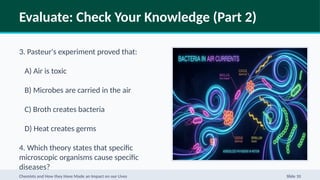
3. Pasteur's experiment proved that:
A) Air is toxic
B) Microbes are carried in the air
C) Broth creates bacteria
D) Heat creates germs
4. Which theory states that specific
microscopic organisms cause specific
diseases?
Chemists and How they Have Made an Impact on our Lives Slide 10
12.
Evaluate: Check YourKnowledge (Part 3)
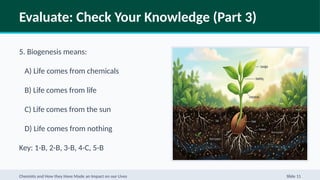
5. Biogenesis means:
A) Life comes from chemicals
B) Life comes from life
C) Life comes from the sun
D) Life comes from nothing
Key: 1-B, 2-B, 3-B, 4-C, 5-B
Chemists and How they Have Made an Impact on our Lives Slide 11
13.
Extend: Reflection
• Task:Write a short reflection (1
paragraph).
• Prompt: How would hospital practices
or our daily hygiene look today if we still
believed in Spontaneous Generation and
Miasma?
• Think about: Surgery, food storage, and
public health.
Chemists and How they Have Made an Impact on our Lives Slide 12
Editor's Notes
#1 Welcome the class. Today's topic is Chemists and How they Have Made an Impact on our Lives.
#2 Welcome back, students. In our last session, we looked at how fermentation turns sugar into alcohol. Today, we dive deeper into the man behind that discovery—Louis Pasteur. We are going to explore how he proved that life doesn't just 'appear' out of nowhere, a discovery that forms the foundation of modern biology and medicine.
#3 Recall our discussion on fermentation. We observed that 'something' in the air caused sugar solutions to spoil or ferment. For centuries, people thought the air itself had a 'vital force' that created life. Today, we examine if that's true or if the air is simply a transport system for microscopic hitchhikers.
#4 Before Pasteur, the world believed in 'Spontaneous Generation.' If you left meat out, maggots appeared. To the naked eye, it looked like the meat *created* the maggots. Class, why do you think this theory was so hard to disprove before the invention of high-powered microscopes?
#5 Pasteur designed this ingenious 'Swan-Neck' flask. The curve allows air—which people thought carried the 'vital force'—to reach the broth, but the 'S' shape acts as a trap for dust and microbes. If life comes from the air itself, the broth should spoil. If life comes from microbes on dust, the broth should stay clear. What is your prediction?
#6 When Pasteur boiled the broth, he killed everything inside. As long as the flask remained upright, the broth stayed clear for years! But as soon as he tilted it so the broth touched the dust trapped in the neck, or if he broke the neck off, the broth became cloudy with life. This was the 'smoking gun' against spontaneous generation.
#7 This established the principle of Biogenesis: 'Omne vivum ex vivo'—all life comes from life. Pasteur proved that the microscopic organisms were already there, carried by dust. They didn't just 'pop' into existence because of the broth. This changed how we viewed decay and rot entirely.
#8 Before this, doctors believed 'Miasma'—the smell of sewage or rotting garbage—made people sick. Pasteur showed that it wasn't the smell, but the invisible germs within the environment. Imagine a world where surgeons didn't wash their hands because they didn't believe germs existed. That was the world before Pasteur.
#9 Science isn't just in the lab. Pasteur’s work was fueled by the French Industrial Revolution. The wine industry was failing because wine kept turning into vinegar. By applying his knowledge of microbes, he saved the economy. This is a perfect example of how chemistry and biology have direct economic and historical impacts.
#10 Let's see what we've learned. Question 1: What do we call the old belief that life comes from non-life? (Pause) The answer is B, Spontaneous Generation. Question 2: Why was that S-curve so important? (Pause) The answer is B, to trap dust and microbes while letting air in.
#11 Moving on. Question 3: What was the main takeaway from the broth? (Pause) It's B, microbes are carried in the air. Question 4: What theory replaced Miasma? (Pause) It is C, Germ Theory. This is the cornerstone of modern medicine.
#12 Final question. What is the definition of Biogenesis? (Pause) The answer is B, life comes from life. Great job everyone. These five concepts are essential for understanding why we use soap, why we pasteurize milk, and how we fight infections today.
#13 To wrap up, I want you to reflect. If we still thought bad smells caused disease and maggots just appeared out of meat, what would a hospital look like today? Would we have refrigerators? Would surgeons wear gloves? Write down your thoughts and we will share a few before the end of the period.