The Future of Work:
How AI Is Reshaping the Global Workforce
BY
RUKUNDO Emmanuel,
28.11.2025
KIGALI - RWANDA
INTRODUCTION
•The advent of Artificial Intelligence (AI) and
extensive automation constitutes a profound
structural discontinuity, signalling the arrival of a
"fourth industrial revolution" that compels a
rigorous reassessment of global labour markets.
•This transformation, driven by automation,
sophisticated Generative AI (GenAI), and the
normalization of remote collaboration,
necessitates immediate strategic engagement by
HR leaders, technology professionals, and
futurists concerning job categories, requisite
human skills, and socio-economic governance.
The Unprecedented
Disruption of
Automation and Job
Displacement
•Unlike previous technological leaps, where
machines primarily replaced manual labour, the
current wave of AI demonstrates the capacity to
perform complex cognitive functions previously
considered exclusive to human intellect. This
shift places a unique demographic under threat:
white-collar, middle-class jobs are now the
most at risk.
•Quantitative forecasts underscore the magnitude of this
impending displacement. A comprehensive analysis
suggests that by 2030, a sweeping total of 400 million to
800 million jobs globally could be displaced by
automation.
•Crucially, this threat permeates all skill levels: while
lower-skilled occupations in retail, transportation, and
manufacturing are highly vulnerable, the risk extends
deeply into high-skill professions like law, medicine, and
finance due to AI’s advanced task capabilities.
•This technological hollowing-out is anticipated to
exacerbate economic divisions, leading to a profound
"polarization of wealth and skills":
High-skilled workers who successfully complement AI
tools are likely to experience increased productivity
and wages.
Low-skilled workers risk being marginalized, leading
to increased income inequality and potential
economic instability.
THE AUGMENTATIVE POWER
OF GENERATIVE ARTIFICAL
INTELLIGENCE
• Generative AI, exemplified by models like ChatGPT, is
rapidly being integrated into professional workflows,
significantly altering the nature of knowledge work. This

segment of the AI revolution, while currently accounting for
a small percentage of overall vacancies (0.2 percent globally
in 2024), demonstrates exponential growth in demand, with
GenAI skills vacancies surging ninefold globally between
2021 and 2024.
Case Study: Augmentation
in Software Development
The impact of GenAI tools on highly skilled
roles is demonstrable, often shifting human
effort toward higher-value activities:
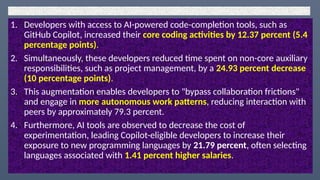
1. Developers with access to AI-powered code-completion tools, such as
GitHub Copilot, increased their core coding activities by 12.37 percent (5.4
percentage points).
2. Simultaneously, these developers reduced time spent on non-core auxiliary
responsibilities, such as project management, by a 24.93 percent decrease
(10 percentage points).
3. This augmentation enables developers to "bypass collaboration frictions"
and engage in more autonomous work patterns, reducing interaction with
peers by approximately 79.3 percent.
4. Furthermore, AI tools are observed to decrease the cost of
experimentation, leading Copilot-eligible developers to increase their
exposure to new programming languages by 21.79 percent, often selecting
languages associated with 1.41 percent higher salaries.
GenAI in Human Resources
and Business Strategy
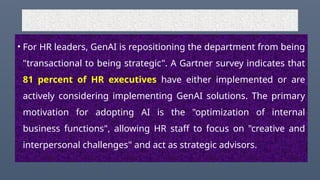
• For HR leaders, GenAI is repositioning the department from being
"transactional to being strategic". A Gartner survey indicates that
81 percent of HR executives have either implemented or are
actively considering implementing GenAI solutions. The primary
motivation for adopting AI is the "optimization of internal
business functions", allowing HR staff to focus on "creative and
interpersonal challenges" and act as strategic advisors.
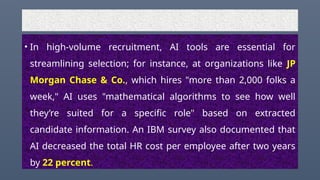
• In high-volume recruitment, AI tools are essential for
streamlining selection; for instance, at organizations like JP
Morgan Chase & Co., which hires "more than 2,000 folks a
week," AI uses "mathematical algorithms to see how well
they’re suited for a specific role" based on extracted
candidate information. An IBM survey also documented that
AI decreased the total HR cost per employee after two years
by 22 percent.
Ethical Imperatives, Transparency,
and Workforce Trust
The deployment of AI in high-stakes
decisions, particularly recruitment, presents
profound ethical and governance
challenges. Ethical scrutiny is vital, given
that "concerns over trust and compliance
hinder 60%" of businesses considering AI
implementation.
Research examining perceptions of AI in hiring reveals a significant paradox:
while HR professionals generally recognize efficiency benefits (87 percent
agreement), trust levels remain remarkably low.
1. Trust Deficit: The combined average trust level in AI-based hiring is only 39
percent.
2. Transparency and Bias: The most critical concerns are the lack of
transparency (81.5 percent combined average concern) and the system’s
failure to reduce bias (only 35 percent combined average belief that AI
reduces bias).
.
3. Algorithmic Bias: AI systems often function as "black boxes,"
operating with opaqueness that restricts accountability and conflicts
with principles of procedural fairness. They risk amplifying existing
systemic discrimination by being trained on "historically skewed
datasets" that perpetuate inequalities.
4. Privacy Concerns: The use of video interview analysis and
psychometric data raises fundamental questions about privacy and
surveillance, a major concern for 76 percent of respondents.
.
These tools are not "neutral technological instruments" but
"sociotechnical systems" requiring "strict ethical oversight,
continuous fairness auditing, inclusive data practices, and
regulatory compliance". Organizations must prioritize
Explainable AI (XAI) approaches to provide clear
justifications for decisions and mitigate the risk of amplifying
discrimination "under the guise of objectivity".
The Global Digital Skills
Bifurcation and Talent Migration
The AI era demands a transformed, tiered skill set. Workers require
basic digital literacy to use tools like ChatGPT, intermediate skills for
integrating AI into business functions, and advanced AI skills for
developing and customizing algorithms.
Demand for advanced digital skills and AI talent is heavily
concentrated, with High-Income Countries (HICs) driving the global
market, accounting for roughly 70 percent of all AI vacancies from
2021 to 2024.
This concentration highlights a severe global imbalance:
• Digital Skills Gap: Less than 5 percent of the population in Low-Income
Countries (LICs) possess basic digital skills, compared with 66 percent in HICs.
Less than 15 percent of the population in Lower-Middle-Income Countries
(LMICs) possess intermediate digital skills.
• Brain Drain: The disparity in opportunity drives significant talent outflow. For
instance, 57 percent of the world’s most-elite AI researchers originating from
China and India eventually relocate to work in the United States. Countries like
Bangladesh, Lebanon, Nigeria, and Ukraine experience high-skilled talent
outflows that are 3–4 times higher than their inflows.
Amidst this technical focus, durable transversal soft skills such as "critical thinking,
intellectual curiosity, communication, and teamwork" remain fundamental, as
specialized technical skills are increasingly vulnerable to obsolescence.
Remote Collaboration and the
Shifting Geography of Work
Coincident with AI advancements, remote collaboration technologies
have fundamentally redefined the geography of work, empowering the
"work from anywhere" model, which grants employees the freedom to
choose their city, town, or country of residence.
This geographic flexibility offers strategic benefits for both employers
and communities:
1. It expands access to skilled workers and reduces employee attrition.
2. For cities, remote work breaks the traditional "chicken and egg
situation" where a lack of jobs discouraged workers and a lack of
workers discouraged companies. Remote workers arrive "with their
jobs" already secured, enabling heartland and mid-sized cities to
"compete for talent in ways that were once out of reach". At least 50
heartland cities now offer incentives to attract these workers.
3. While flexibility is valued, research supports a hybrid model,
emphasizing that in-person time remains essential for strategy,
mentorship, and culture, with teams convening roughly 25% of the
time. Consequently, "Off-sites are becoming the new office".
Policy Responses: Universal
Basic Income (UBI) as a
Mitigating Strategy
Given the predicted scope of technological unemployment
and the polarization of wealth, policy analysis frequently
examines Universal Basic Income (UBI) as a potential safety
net. UBI is defined as a policy proposal where "all citizens
receive a regular, unconditional income", ensuring a basic
standard of living irrespective of employment status.
Proponents argue that UBI can mitigate the "societal impact of job
displacement and skills mismatch," providing individuals with the
financial freedom to adapt to a changing labour market.
Furthermore, UBI is seen as a mechanism to reduce poverty, simplify
complex welfare programs, and foster autonomy and
entrepreneurship by removing the immediate "pressures of
survival".
Insights from international UBI pilot programs offer empirical evidence:
1. Kenya Give Directly Trial: One of the largest trials involves over 20,000
villagers receiving unconditional payments for up to 12 years. Results show
that recipients experienced improved economic security and well-being.
Critically, recipients used the payments to invest in productive assets, such
as livestock and small businesses, demonstrating that UBI can foster
entrepreneurship. Initial findings also show a significant reduction in
poverty levels among recipients compared to control groups
2. Challenges: Despite the advantages, significant challenges remain, primarily
fiscal sustainability. Critics note that implementing UBI in developed countries
could run into the "trillions of dollars annually". Concerns also persist regarding
inflationary pressures and the potential for UBI to create work disincentives.
The recommended approach for UBI implementation is a "cautious, phased
approach" complemented by strategic investments in education, retraining, and
progressive taxation.
CONCLUSIONS
• The reshaping of the global workforce by AI and
automation is best understood as a sophisticated
calculation, balancing technological efficiency with
human equity. If AI is the high-speed rail network
optimizing commerce and logistics, policymakers must
simultaneously build the social security infrastructure—
represented by UBI and skills training—to ensure no
segment of the population is left stranded by the
accelerating pace of technological change. Failure to
address the ethical vacuum surrounding automated
decision-making and the global skills gap risks
amplifying social inequality under the false premise
of technological neutrality.
ABOUT AUTHOR:
DOCUMENT, PROFILE AND OTHER PUBLICATIONS
DOCUMENT AND PROFILE
This PPT presentation was prepared by Rukundo
Emmanuel, a student at the University of Rwanda,
enrolled in the Department of Modern Languages,
specializing in Linguistics and Literature. The purpose
of this document is to provide a foundational
overview of the global development of education.
DOCUMENT AND PROFILE: OTHER PUBLICATIONS
OTHER PUBLICATIONS:
1. STRATUM THEORY: https://
www.slideshare.net/slideshow/stratum-theory-linguistics-of-graziadia-isaia-ascoli-pptx/283270496
2. A SCREENPLAY: FROM ZERO TO HERO: https://
www.slideshare.net/slideshow/example-of-a-screenplay-from-zero-to-hero-pdf/284191108
3. THE MESSAGE AND INFERENTIAL MODELS OF COMMUNICATION: https://
www.slideshare.net/slideshow/pragmatics-the-study-of-language-use-and-communication-the-message-model-inferential-
model-pdf/284196315
4. MEANING OF EMOJIS OF SOCIAL MEDIA: https://
www.slideshare.net/slideshow/meaning-of-emojis-of-social-media-rukundo-e-pptx/284268937
5. UNDERSTANDING OPPOSITES IN ENGLISH: https://
THANK YOU!