Introduction: Why
Study Social
Development
Patterns?
Understandingthe intricate patterns of social development is crucial for
comprehending a nation's past, navigating its present, and shaping its future.
For India, a land of immense diversity and complex history, this study offers
invaluable insights into societal evolution, challenges, and opportunities.
3.
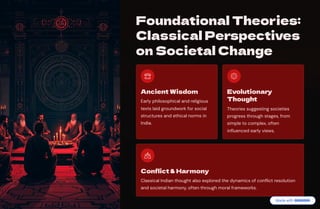
Foundational Theories:
Classical Perspectives
onSocietal Change
Ancient Wisdom
Early philosophical and religious
texts laid groundwork for social
structures and ethical norms in
India.
Evolutionary
Thought
Theories suggesting societies
progress through stages, from
simple to complex, often
influenced early views.
Conflict & Harmony
Classical Indian thought also explored the dynamics of conflict resolution
and societal harmony, often through moral frameworks.
4.
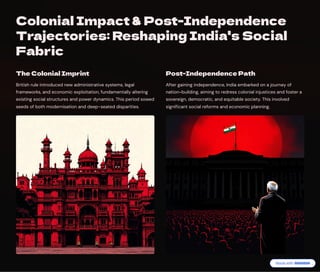
Colonial Impact &Post-Independence
Trajectories: Reshaping India's Social
Fabric
The Colonial Imprint
British rule introduced new administrative systems, legal
frameworks, and economic exploitation, fundamentally altering
existing social structures and power dynamics. This period sowed
seeds of both modernisation and deep-seated disparities.
Post-Independence Path
After gaining independence, India embarked on a journey of
nation-building, aiming to redress colonial injustices and foster a
sovereign, democratic, and equitable society. This involved
significant social reforms and economic planning.
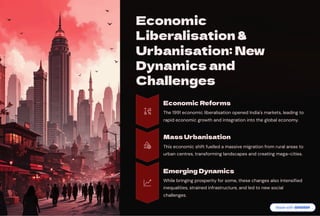
5.
Economic
Liberalisation &
Urbanisation: New
Dynamicsand
Challenges
Economic Reforms
The 1991 economic liberalisation opened India's markets, leading to
rapid economic growth and integration into the global economy.
Mass Urbanisation
This economic shift fuelled a massive migration from rural areas to
urban centres, transforming landscapes and creating mega-cities.
Emerging Dynamics
While bringing prosperity for some, these changes also intensified
inequalities, strained infrastructure, and led to new social
challenges.
6.
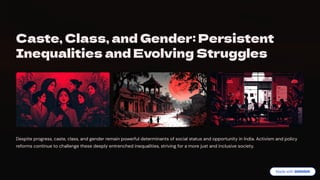
Caste, Class, andGender: Persistent
Inequalities and Evolving Struggles
Despite progress, caste, class, and gender remain powerful determinants of social status and opportunity in India. Activism and policy
reforms continue to challenge these deeply entrenched inequalities, striving for a more just and inclusive society.
7.
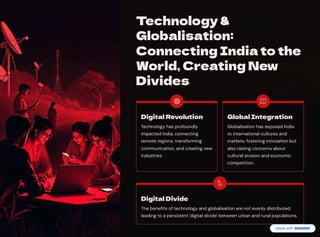
Technology &
Globalisation:
Connecting Indiato the
World, Creating New
Divides
Digital Revolution
Technology has profoundly
impacted India, connecting
remote regions, transforming
communication, and creating new
industries.
Global Integration
Globalisation has exposed India
to international cultures and
markets, fostering innovation but
also raising concerns about
cultural erosion and economic
competition.
Digital Divide
The benefits of technology and globalisation are not evenly distributed,
leading to a persistent 'digital divide' between urban and rural populations.
8.
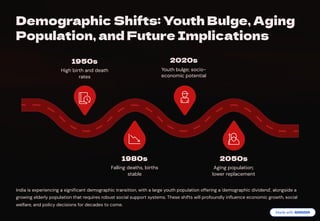
Demographic Shifts: YouthBulge, Aging
Population, and Future Implications
1950s
High birth and death
rates
1980s
Falling deaths, births
stable
2020s
Youth bulge; socio-
economic potential
2050s
Aging population;
lower replacement
India is experiencing a significant demographic transition, with a large youth population offering a 'demographic dividend', alongside a
growing elderly population that requires robust social support systems. These shifts will profoundly influence economic growth, social
welfare, and policy decisions for decades to come.
9.
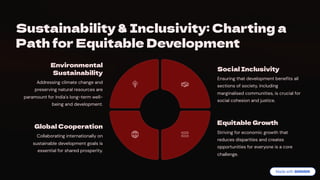
Sustainability & Inclusivity:Charting a
Path for Equitable Development
Environmental
Sustainability
Addressing climate change and
preserving natural resources are
paramount for India's long-term well-
being and development.
Social Inclusivity
Ensuring that development benefits all
sections of society, including
marginalised communities, is crucial for
social cohesion and justice.
Equitable Growth
Striving for economic growth that
reduces disparities and creates
opportunities for everyone is a core
challenge.
Global Cooperation
Collaborating internationally on
sustainable development goals is
essential for shared prosperity.
10.
Conclusion: Key Takeawaysand the
Future of Social Development in India
Complex Legacy
India's social development is a tapestry woven with ancient
traditions, colonial legacies, and modern aspirations.
Dynamic Changes
Rapid economic shifts, urbanisation, and technological
advancements continue to redefine societal norms.
Persistent Challenges
Inequalities related to caste, class, and gender remain
significant hurdles on the path to true equity.
Future-Oriented
Embracing sustainability, inclusivity, and harnessing its
demographic dividend will be key to India's future social
progress.