The Essential Guide to Building Secure, HIPAA-Compliant Healthcare Software ppt M3.pptx
Learn how to build secure, HIPAA-compliant healthcare software that protects patient data, ensures interoperability, and drives operational efficiency.
Executive Summary
In February2024, a major healthcare company suffered a breach that exposed data for 110 million
Americans. The cause? Basic security failures: no encryption, no two-factor authentication. The cost?
$2.45 billion, a $22 million ransom, and irreparable damage to patient trust.
This wasn't a sophisticated attack. It was preventable. And it's exactly why healthcare executives can
no longer treat software security as an IT afterthought.
Healthcare organizations face a critical challenge: you need technology to compete and deliver
modern care, but generic software solutions create dangerous compliance gaps. The average
healthcare data breach now costs $7.42 million with ransomware attacks on healthcare up 6% in 2024
the question isn't whether to invest in secure, compliant software. It's whether you know how to build it
right.
This guide walks you through what HIPAA compliance really means for your software, why generic
solutions consistently fail healthcare organizations, and how custom healthcare software development
solves these challenges while driving business growth.
In this guide, you’ll find:
The Real Cost of Getting Healthcare Software Wrong
Why Generic Software Consistently Fails Healthcare
What HIPAA Compliance Really Means (Beyond the Buzzwords)
The Five Core Requirements Your Healthcare Software Must Meet
The AI Compliance Challenge: New Technology, New Risks
3.
The Real Costof Getting Healthcare Software Wrong
Let's start with what's at stake.
When we talk about HIPAA compliance, most people think about fines. And yes, penalties range from $141 to
over $2 million per violation. [4] But that's not what keeps healthcare executives up at night.
The real costs are:
Patient Trust: Once broken, it's nearly impossible to rebuild. Patients who lose confidence in your ability to
protect their data will seek care elsewhere. In healthcare, trust is your foundation.
Operational Disruption: When a breach occurs, your systems may be locked for days or weeks.
Staff can't access records. Procedures get delayed. Patients are diverted to other facilities. Revenue stops,
but expenses continue.
Legal Liability: Class-action lawsuits from affected patients. Regulatory investigations. Potential criminal
charges if negligence is proven. Legal costs alone can dwarf regulatory fines.
Competitive Disadvantage: While you're managing a crisis, competitors are winning your market share.
Healthcare providers won't refer patients to organizations with security problems. Payers won't partner with
risky entities.
Long-Term Brand Damage: News of healthcare breaches spreads fast. Your organization's name becomes
associated with the breach, not your quality of care. This reputation damage persists for years.
Here's what many healthcare leaders miss: most breaches don't happen because of sophisticated
hackers. They happen because software wasn't built right in the first place.
4.
Why Generic SoftwareConsistently Fails Healthcare
You've probably experienced this: you implement a new software system, and within weeks, your team is
frustrated. It doesn't match your workflows. It can't connect properly with your existing systems. And when
you ask about specific security features HIPAA requires, you get vague answers or expensive customization
quotes.
This happens because generic software is built for the broadest possible market. Healthcare is just one
checkbox on their feature list.
Here's why this approach fails:
Security as an Add-On: Generic software developers build the core product first, then try to add security
features later. But healthcare data security and compliance need to be foundational, built into
every component from the start. You can't retrofit true HIPAA compliance.
One-Size-Fits-None Workflows: How you discharge patients, coordinate care, verify insurance, or schedule
procedures is unique to your organization. Generic software forces you to abandon your optimized processes
and adopt their rigid workflows, creating inefficiency and security gaps where workarounds become
necessary. Automated clinical workflows should enhance your processes, not replace them with inferior
alternatives.
Integration Nightmares: Your organization uses multiple systems - EHRs, billing platforms, lab systems,
imaging archives, and pharmacy networks. Generic software rarely integrates cleanly with all of these. Each
poor integration creates a potential security vulnerability and compliance gap. Healthcare software
interoperability is essential, not optional.
5.
What HIPAA ComplianceReally Means (Beyond the Buzzwords)
Before we discuss solutions, let's clarify what you're actually building toward. HIPAA compliance isn't a single checklist; it's a comprehensive
framework with four key components:
1. The Privacy Rule: Who Sees What
This rule controls access to patient information. In practice, it means your software must:
Limit data access based on job function (doctors see full records, billing staff only see payment information)
Track and justify every access to patient data
Allow patients to see who's accessed their information
Provide mechanisms for patients to request corrections or restrictions
The underlying principle: minimum necessary access. Users should only see the specific patient data they need for their specific task,
nothing more.
2. The Security Rule: How You Protect It
This is where most software fails. The Security Rule requires three layers of protection:
Technical safeguards: PHI data encryption, access controls, audit logs, secure transmission protocols, and automatic session timeouts.
These HIPAA security features must work together seamlessly.
Administrative safeguards: Risk assessments, staff training, incident response procedures, and designated compliance oversight.
Physical safeguards: Controlled facility access, workstation security, and device management protocols.
Notice these aren't just features you can buy; they require organizational processes and software designed to support them through secure
medical data processing.
6.
The Five CoreRequirements Your Healthcare Software Must Meet
Let us walk you through what actually makes software HIPAA-compliant.
These aren't optional features, they're foundational requirements.
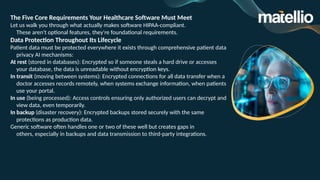
Data Protection Throughout Its Lifecycle
Patient data must be protected everywhere it exists through comprehensive patient data
privacy AI mechanisms:
At rest (stored in databases): Encrypted so if someone steals a hard drive or accesses
your database, the data is unreadable without encryption keys.
In transit (moving between systems): Encrypted connections for all data transfer when a
doctor accesses records remotely, when systems exchange information, when patients
use your portal.
In use (being processed): Access controls ensuring only authorized users can decrypt and
view data, even temporarily.
In backup (disaster recovery): Encrypted backups stored securely with the same
protections as production data.
Generic software often handles one or two of these well but creates gaps in
others, especially in backups and data transmission to third-party integrations.
7.
The AI ComplianceChallenge: New Technology, New Risks
Healthcare organizations are excited about AI, and rightfully so. AI and ML in healthcare software offer tremendous potential for
automating documentation, improving diagnostics, and personalizing care through clinical NLP models and AI-driven healthcare
compliance. The healthcare AI market was valued at USD 26.57 billion in 2024 and is projected to reach USD 505.59 billion by
2033.
But there's a critical compliance issue many organizations discover too late: most popular AI tools can't legally be used with
patient data.
Why ChatGPT and Similar Tools Are HIPAA Violations
Here's what happens: A well-meaning doctor asks ChatGPT to summarize patient notes. A billing specialist uses it to draft a letter to
an insurance company that includes patient details. An administrator uploads appointment data to analyze patterns.
Each of these actions is a HIPAA violation.
Why? Because OpenAI (ChatGPT), Google (standard Gemini), and Anthropic (Claude) don't sign Business Associate Agreements for
their consumer services. Using these tools with any patient data, even a patient name combined with any health information, violates
HIPAA.
The risk isn't just regulatory. AI systems can "hallucinate" and generate plausible but incorrect information. In one documented
case, an AI chatbot provided medical advice that could have been fatal if followed. In healthcare, incorrect AI outputs don't just
create liability; they endanger patients. Healthcare chatbot HIPAA compliance isn't optional, it's essential.
8.
Contact US
For detailedinformation visit https://www.matellio.com/blog/ai-in-payroll/ E-mail - info@matellio.com
Contact Number - +14085601910
Explore more insights at - https://www.matellio.com/blog/