The Developing Person Through the Life Span 12th Edition PDF
3.
Accessibility
Macmillan Learning iscommitted to the goal of providing equal
access to all products regardless of an individual’s age, ability, or
situation and embraces the opportunity to develop services and
information technologies that are accessible and usable by all
individuals. Accessibility at Macmillan Learning is about extending
the power of education to all users. In addition to addressing
product compatibility with assistive technologies such as screen
reader software, alternative keyboard devices, and voice recognition
products, we are working to ensure that the content and platforms
we provide are fully accessible.
Our E-books
Macmillan Learning became the first education solutions company
to become Global Certified Accessible , providing “born
accessible” digital learning (e-book) options for students with
disabilities. Books that are born accessible are developed to ensure
that all students, no matter their ability, have the same access to
information. This is increasingly important for students and
instructors, as more than one out of every ten students who attends
college has a disability.
tm
2
4.
To become GlobalCertified Accessible, Benetech evaluated
Macmillan Learning’s workflow for creating accessible books, as
well as many samples of content across the disciplines they publish
in, and certified conformance to the accessible EPUB creation
guidelines, which are based on WCAG 2.0 AA+ standards put in place
by the international standards organizations and the publishing
community. Using a collaborative process, Benetech evaluated and
provided feedback on more than one hundred accessibility features.
The certification applies to all books created using Macmillan
Learning’s updated process, which includes all e-books with a 2019
copyright and beyond.
Extended Descriptions
In this book, extended descriptions are present for complex images
and graphs that may be helpful to understanding content. These
extended descriptions can be accessed via a link on this icon:
Alternative Text
When an image provides important pedagogical information,
alternative text (which is also known as alt text) is provided for the
image. This text is not visible on the page but can be accessed and
read with screen reader technology and other assistive technologies.
Our alt text is written and reviewed by subject matter experts.
3
5.
Color Contrast
All ofour book designs and illustrations are checked to ensure that
they meet contrast requirements for WCAG 2.0 AA . Meeting these
standards ensures ease of use for users with low vision and color
blindness, and can create a more supportive learning environment
for users with learning disabilities.
Navigation
E-book navigation is designed to make it easy for users, with or
without assistive technology, to discover and learn from content
within the textbook. Text reflows when resized so there is no
horizontal scrolling on the page, and page numbers are embedded
in the book so that students can always find where they are
compared to classmates using the print equivalent. Heading
structures are clearly marked up so it’s easy to see where you are
within the book as you work your way through.
Accessibility Help
If you have any questions about the accessibility of this e-book or
other Macmillan Learning e-books, please reach out to us at
webaccessibility@macmillan.com . For student resources, visit our
knowledge base .
4
6.
New!
for The DevelopingPerson Through the
Life Span, Twelfth Edition
Engaging Every Student. Supporting Every
Instructor. Setting the New Standard for
Teaching and Learning.
Achieve for Psychology sets a whole new standard for integrating
assessments , activities , and analytics into your teaching. It brings
together all of the features that instructors and students loved about
our previous platform, LaunchPad — interactive e-book,
LearningCurve adaptive quizzing and other assessments, interactive
learning activities, extensive instructor resources — in a powerful new
platform that offers:
A cleaner, more intuitive, mobile-friendly interface.
Powerful analytics.
Self-regulated learning and goal-setting surveys.
A fully integrated iClicker classroom response system, with
questions available for each chapter or the option to integrate
5
7.
your own.
A NEWvideo collection for Developmental Psychology!
Our resources were co-designed with instructors and students , on a
foundation of years of learning research , and rigorous testing over
multiple semesters. The result is superior content, organization, and
functionality. Achieve’s pre-built assignments engage students both
inside and outside of class . And Achieve is effective for students of all
levels of motivation and preparedness, whether they are high
achievers or need extra support.
Macmillan Learning offers deep platform integration of Achieve with
all LMS providers, including Blackboard, Brightspace, Canvas, and
Moodle. With integration, students can access course content and
their grades through one sign-in. And you can pair Achieve with
course tools from your LMS, such as discussion boards and chat and
Gradebook functionality. LMS integration is also available with
Inclusive Access. For more information, visit
www.macmillanlearning.com/college/us/solutions/lms-integration or
talk to your local sales representative.
Achieve was built with accessibility in mind. Macmillan Learning
strives to create products that are usable by all learners and meet
universally applied accessibility standards. In addition to addressing
product compatibility with assistive technologies such as screen
reader software, alternative keyboard devices, and voice recognition
products, we are working to ensure that the content and platforms we
6
8.
provide are fullyaccessible. For more information visit
www.macmillanlearning.com/college/us/our-story/accessibility
Mobile: Based on user data, we know that many students use parts of
Achieve on a mobile device. As such, activities such as e-book
readings and videos are easily used across devices with different
screens.
Achieve for The Developing Person Through
the Life Span: Assessments
LearningCurve Adaptive Quizzing
Based on extensive learning and memory research proven effective
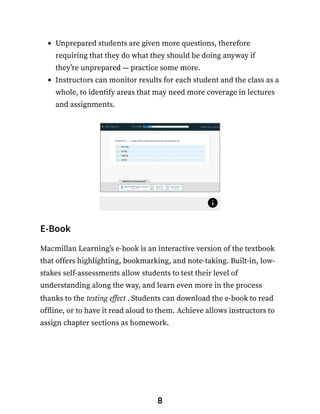
for hundreds of thousands of students, LearningCurve focuses on the
core concepts in every chapter, providing individualized question sets
and feedback for correct and incorrect responses. The system adapts
to each student’s level of understanding, with follow-up quizzes
targeting areas where the student needs improvement. Each question
is tied to a learning objective and linked to the appropriate section of
the e-book to encourage students to discover the right answer for
themselves. LearningCurve has consistently been rated the #1
resource by instructors and students alike.
LearningCurve’s game-like quizzing promotes retrieval practice
through its unique delivery of questions and its point system.
Students with a firm grasp on the material get plenty of practice
but proceed through the activity relatively quickly.
7
9.
Unprepared students aregiven more questions, therefore
requiring that they do what they should be doing anyway if
they’re unprepared — practice some more.
Instructors can monitor results for each student and the class as a
whole, to identify areas that may need more coverage in lectures
and assignments.
E-Book
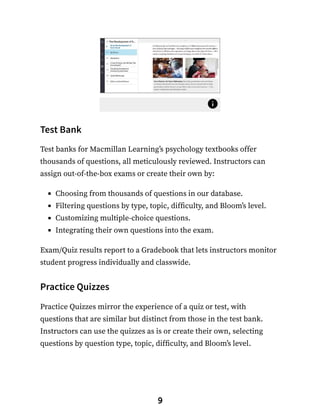
Macmillan Learning’s e-book is an interactive version of the textbook
that offers highlighting, bookmarking, and note-taking. Built-in, low-
stakes self-assessments allow students to test their level of
understanding along the way, and learn even more in the process
thanks to the testing effect . Students can download the e-book to read
offline, or to have it read aloud to them. Achieve allows instructors to
assign chapter sections as homework.
8
10.
Test Bank
Test banksfor Macmillan Learning’s psychology textbooks offer
thousands of questions, all meticulously reviewed. Instructors can
assign out-of-the-box exams or create their own by:
Choosing from thousands of questions in our database.
Filtering questions by type, topic, difficulty, and Bloom’s level.
Customizing multiple-choice questions.
Integrating their own questions into the exam.
Exam/Quiz results report to a Gradebook that lets instructors monitor
student progress individually and classwide.
Practice Quizzes
Practice Quizzes mirror the experience of a quiz or test, with
questions that are similar but distinct from those in the test bank.
Instructors can use the quizzes as is or create their own, selecting
questions by question type, topic, difficulty, and Bloom’s level.
9
11.
Achieve for TheDeveloping Person Through
the Life Span : Activities
Achieve is designed to support and encourage active learning by
connecting familiar activities and practices out of class with some of
the most effective and approachable in-class activities, curated from a
variety of active learning sources.
New and Updated! Video Collection for Developmental
Psychology
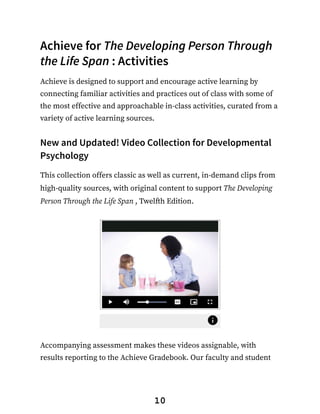
This collection offers classic as well as current, in-demand clips from
high-quality sources, with original content to support The Developing
Person Through the Life Span , Twelfth Edition.
Accompanying assessment makes these videos assignable, with
results reporting to the Achieve Gradebook. Our faculty and student
10
12.
consultants were instrumentalin helping us create this diverse and
engaging set of clips. All videos are closed-captioned and found only
in Achieve .
Immersive Learning Activities
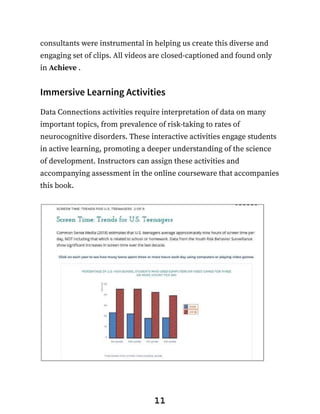
Data Connections activities require interpretation of data on many
important topics, from prevalence of risk-taking to rates of
neurocognitive disorders. These interactive activities engage students
in active learning, promoting a deeper understanding of the science
of development. Instructors can assign these activities and
accompanying assessment in the online courseware that accompanies
this book.
11
13.
Developing Lives 2.0
Thisthoroughly revised program provides a robust interactive
experience in which users “raise” their own child from conception to
adolescence. With greater attention to diversity and culture, this
program deepens students’ understanding of developmental concepts
and research. Enhanced navigation makes it easier for students to
revisit earlier choices and review key information. Developing Lives
has been fully optimized to work seamlessly within Macmillan’s
Achieve platform.
NEW Concept Practice Tutorials
Achieve includes dozens of these dynamic, interactive mini-tutorials
that teach and reinforce the course’s foundational ideas. Each of these
brief activities (only 5 minutes to complete) addresses one or two key
concepts, in a consistent format — review, practice, quiz, and
conclusion.
12
14.
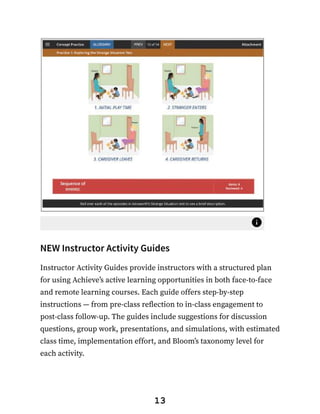
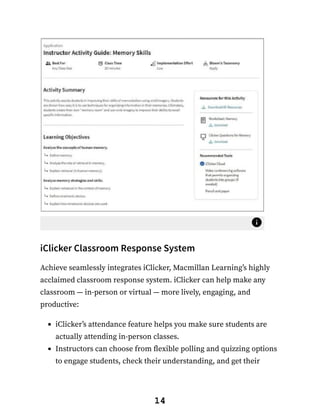
NEW Instructor ActivityGuides
Instructor Activity Guides provide instructors with a structured plan
for using Achieve’s active learning opportunities in both face-to-face
and remote learning courses. Each guide offers step-by-step
instructions — from pre-class reflection to in-class engagement to
post-class follow-up. The guides include suggestions for discussion
questions, group work, presentations, and simulations, with estimated
class time, implementation effort, and Bloom’s taxonomy level for
each activity.
13
15.
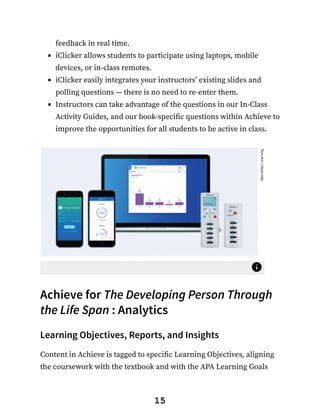
iClicker Classroom ResponseSystem
Achieve seamlessly integrates iClicker, Macmillan Learning’s highly
acclaimed classroom response system. iClicker can help make any
classroom — in-person or virtual — more lively, engaging, and
productive:
iClicker’s attendance feature helps you make sure students are
actually attending in-person classes.
Instructors can choose from flexible polling and quizzing options
to engage students, check their understanding, and get their
14
16.
feedback in realtime.
iClicker allows students to participate using laptops, mobile
devices, or in-class remotes.
iClicker easily integrates your instructors’ existing slides and
polling questions — there is no need to re-enter them.
Instructors can take advantage of the questions in our In-Class
Activity Guides, and our book-specific questions within Achieve to
improve the opportunities for all students to be active in class.
Achieve for The Developing Person Through
the Life Span : Analytics
Learning Objectives, Reports, and Insights
Content in Achieve is tagged to specific Learning Objectives, aligning
the coursework with the textbook and with the APA Learning Goals
15
17.
and Outcomes. Reportingwithin Achieve helps students see how they
are performing against objectives, and it helps instructors determine
if any student, group of students, or the class as a whole needs extra
help in specific areas. This enables more efficient and effective
instructor interventions.
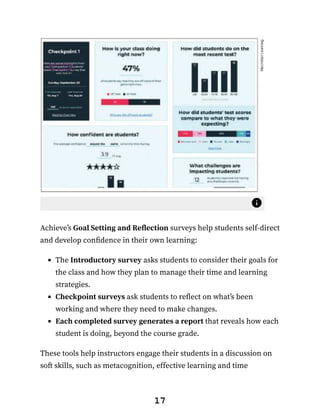
Achieve provides reports on student activities, assignments, and
assessments at the course level, unit level, subunit level, and
individual student level, so instructors can identify trouble spots and
adjust their efforts accordingly. Within Reports, the Insights section
offers snapshots with high-level data on student performance and
behavior, to answer such questions as:
What are the top Learning Objectives to review in this unit?
What are the top assignments to review?
What’s the range of performance on a particular assignment?
How many students aren’t logging in?
16
18.
Achieve’s Goal Settingand Reflection surveys help students self-direct
and develop confidence in their own learning:
The Introductory survey asks students to consider their goals for
the class and how they plan to manage their time and learning
strategies.
Checkpoint surveys ask students to reflect on what’s been
working and where they need to make changes.
Each completed survey generates a report that reveals how each
student is doing, beyond the course grade.
These tools help instructors engage their students in a discussion on
soft skills, such as metacognition, effective learning and time
17
19.
management strategies, andother non-cognitive skills that impact
student success.
Additional Instructor Resources in Achieve:
All Within One Place
Image Slides and Tables
Presentation slides feature chapter photos, illustrations, and tables
and can be used as is or customized to fit an instructor’s needs. Alt text
for images is available upon request via
WebAccessibility@Macmillan.com
Instructor’s Resource Manuals
Downloadable PDF manuals include a range of resources, such as
chapter outlines or summaries, teaching tips, discussion starters,
sample syllabi, assignment suggestions, and classroom activities.
Lecture Slides
Accessible, downloadable presentation slides provide support for key
concepts and themes from the text and can be used as is or
customized to fit an instructor’s needs.
Customer Support
18
20.
Our Achieve ClientSuccess Team — dedicated platform experts —
provides collaboration, software expertise, and consulting to tailor
each course to fit your instructional goals and student needs. Start
with a demo at a time that works for you to learn more about how to
set up your customized course. Talk to your sales representative or
visit www.macmillanlearning.com/college/us/contact-us/training-and-
demos for more information.
Pricing and bundling options are available at the Macmillan student store:
store.macmillanlearning.com
19
21.
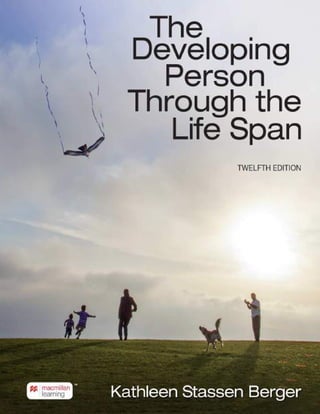
The Developing Person
Throughthe Life Span
TWELFTH EDITION
Kathleen Stassen Berger
Bronx Community College
City University of New York
20
22.
Executive Vice Presidentand General Manager: Charles Linsmeier
Vice President, Social Sciences and High School: Shani Fisher
Senior Executive Program Manager: Christine Cardone
Senior Development Editor: Andrea Musick Page
Editorial Assistant: Olivia Madigan
Executive Marketing Manager: Katherine Nurre
Marketing Assistant: Claudia Cruz
Senior Media Editor: Stefani Wallace
Executive Director, Digital Workflow Strategy: Noel Hohnstine
Assistant Media Editor: Clarah Grossman
Director, Content Management Enhancement: Tracey Kuehn
Senior Managing Editor: Lisa Kinne
Senior Content Project Manager: Peter Jacoby
Senior Project Manager: Arindam Bose, Lumina Datamatics, Inc.
Media Project Manager: Brian Nobile
Senior Workflow Supervisor: Susan Wein
Executive Permissions Editor: Sheena Goldstein
Photo Researcher: Cheryl DuBois
Director of Design, Content Management: Diana Blume
Senior Cover Design Manager: John Callahan
Senior Design Services Manager: Natasha A. S. Wolfe
Interior Design: Studio Montage and Lumina Datamatics, Inc.
Icon credits: Satryo Std/Shutterstock, Pondok Icon/Shutterstock, cve
iv/Shutterstock, Bagel Studio/Shutterstock,
21
About the Author
KathleenStassen Berger received her undergraduate degree at
Stanford University and Radcliffe College, and then she earned an
M.A.T. from Harvard University and an M.S. and Ph.D. from Yeshiva
University. Her broad experience as an educator includes directing a
preschool, serving as chair of philosophy at the United Nations
International School, and teaching child and adolescent
development to graduate students at Fordham University in New
York and undergraduates at Montclair State University in New Jersey
and Quinnipiac University in Connecticut. She also taught social
psychology to inmates at Sing Sing Prison who were earning
paralegal degrees.
Currently, Berger is a professor at Bronx Community College of the
City University of New York, as she has been for most of her
professional career. She began there as an adjunct in the English
23
25.
Department and forthe past decades has been a full professor in the
Social Sciences Department, which includes psychology, sociology,
economics, anthropology, political science, and human services.
She has taught Introduction to Psychology, Child and Adolescent
Development, Adulthood and Aging, Social Psychology, Abnormal
Psychology, and Human Motivation. Her students — from diverse
ethnic, economic, and educational backgrounds, of many ages,
ambitions, and interests — honor her with the highest teaching
evaluations.
Berger is also the author of The Developing Person Through Childhood
and Adolescence , Invitation to the Life Span , and A Topical Approach to
the Developing Person Through the Life Span , as well as
Grandmothering: Building Strong Ties with Every Generation (2019).
Berger’s developmental texts are currently used at more than 700
colleges and universities worldwide and are published in Spanish,
French, Italian, and Portuguese as well as English. Her research
interests include adolescent identity, immigration, bullying, and
grandparents, and she has published articles on developmental
topics in the Wiley Encyclopedia of Psychology , Developmental Review ,
and in publications of the American Association for Higher
Education and the National Education Association for Higher
Education. She continues teaching and learning from her students
as well as from her four daughters and three grandsons.
24
26.
Brief Contents
PART 1The Beginnings
1 The Science of Human Development
2 Theories of Development
3 The New Genetics
4 Prenatal Development and Birth
PART 2 The First Two Years
5 The First Two Years: Biosocial Development
6 The First Two Years: Cognitive Development
7 The First Two Years: Psychosocial Development
25
27.
PART 3 EarlyChildhood
8 Early Childhood: Biosocial Development
9 Early Childhood: Cognitive Development
10 Early Childhood: Psychosocial Development
PART 4 Middle Childhood
11 Middle Childhood: Biosocial Development
12 Middle Childhood: Cognitive Development
13 Middle Childhood: Psychosocial Development
PART 5 Adolescence
14 Adolescence: Biosocial Development
15 Adolescence: Cognitive Development
26
28.
16 Adolescence: PsychosocialDevelopment
PART 6 Emerging Adulthood
17 Emerging Adulthood: Biosocial Development
18 Emerging Adulthood: Cognitive Development
19 Emerging Adulthood: Psychosocial Development
PART 7 Adulthood
20 Adulthood: Biosocial Development
21 Adulthood: Cognitive Development
22 Adulthood: Psychosocial Development
27
29.
PART 8 LateAdulthood
23 Late Adulthood: Biosocial Development
24 Late Adulthood: Cognitive Development
25 Late Adulthood: Psychosocial Development
26 Death, Bereavement, and Affirmation of Life
Appendix: More About Research Methods
Glossary
References
Name Index
Subject Index
28
30.
Contents
Preface
PART 1 TheBeginnings
1 The Science of Human Development
Understanding How and Why
The Scientific Method
A VIEW FROM SCIENCE: Do You Need Friends?
The Nature–Nurture Controversy
The Life-Span Perspective
Development Is Multidirectional
Development Is Multicontextual
Development Is Multicultural
A CASE TO STUDY: A Very Rude Child?
Development Is Multidisciplinary
29
31.
Development Is Plastic
DoingScience
Three Methods of Science
The Designs of Developmental Science
Cautions and Challenges from Science
CONTRASTING PERSPECTIVES: Science and Truth
Correlation and Causation
Quantity and Quality
Ethics
2 Theories of Development
Theories of Development
Theory and Practice
Theories and Facts
Grand Theories
Psychodynamic Theory: Freud and Erikson
Behaviorism: Conditioning and Learning
Cognitive Theory: Piaget and Neuroscience
INSIDE THE BRAIN: Measuring Mental Activity
A VIEW FROM SCIENCE: Thinking and Perspective
Newer Theories
Sociocultural Theory
Evolutionary Theory
VISUALIZING DEVELOPMENT: Historical
Highlights of Developmental Science
What Theories Contribute
30
32.
CONTRASTING PERSPECTIVES: ToiletTraining —
How and When?
3 The New Genetics
The Genetic Code
2 to 1 to 46 to 21,000 to 3 Billion
Same and Different
Matching Genes and Chromosomes
Sex Chromosomes
CONTRASTING PERSPECTIVES: Too Many Boys?
New Cells, New People
Cells and Identity
A VIEW FROM SCIENCE: Golden Rice
In Vitro Fertilization
Twins and More
VISUALIZING DEVELOPMENT: One Baby or More?
From Genotype to Phenotype
Many Factors
A CASE TO STUDY: Women Engineers
Gene–Gene Interactions
Nature and Nurture
Practical Applications
Chromosomal and Genetic Differences
Not Exactly 46
Gene Disorders
Genetic Counseling
CAREER ALERT: The Genetic Counselor
31
33.
4 Prenatal Developmentand Birth
Prenatal Development
Germinal: The First 14 Days
Embryo: From Weeks Three to Eight
Fetus: From the Ninth Week Until Birth
INSIDE THE BRAIN: Essential Connections
Birth
Variations in How and Where
The Newborn’s First Minutes
VISUALIZING DEVELOPMENT: The Apgar
Medical Assistance at Birth
CONTRASTING PERSPECTIVES: Drugs in the Birth
Process
Problems and Solutions
Risk Analysis
Teratogens
A CASE TO STUDY: He Cannot Get the Right Words
Out
Limiting Harm
A VIEW FROM SCIENCE: Psychological Disorders
Low Birthweight: Causes and Consequences
The New Family
The Newborn
Birth Parents
Partners
Family Bonding
32
34.
PART 2 TheFirst Two Years
5 The First Two Years: Biosocial Development
Body Changes
Body Size
Sleep
Brain Development
INSIDE THE BRAIN: Neuroscience Vocabulary
Harming the Infant Body and Brain
Perceiving and Moving
The Senses
Motor Skills
A VIEW FROM SCIENCE: Sticky Mittens
Cultural Variations
Surviving in Good Health
Nutrition
Considering Culture
A CASE TO STUDY: Scientist at Work
Immunization
VISUALIZING DEVELOPMENT: Immunization
6 The First Two Years: Cognitive Development
33
35.
The Eager Mind
Listeningto Learn
Looking to Learn
How to Learn
Infant Memory
Piaget’s Sensorimotor Intelligence
Stages One and Two: Primary Circular Reactions
Stages Three and Four: Secondary Circular
Reactions
CONTRASTING PERSPECTIVES: How to Measure
Object Permanence
Stages Five and Six: Tertiary Circular Reactions
Language in the First Two Years
The Universal Sequence
A CASE TO STUDY: Early Speech
Theories of Language Learning
VISUALIZING DEVELOPMENT: Early
Communication and Language
All True?
7 The First Two Years: Psychosocial Development
Emotional Development
Early Emotions
Toddlers’ Emotions
Temperament and Personality
A VIEW FROM SCIENCE: Temperament over the
Years
34
36.
The Development ofSocial Bonds
Synchrony
Attachment
CONTRASTING PERSPECTIVES: Attachment
Parenting
A CASE TO STUDY: Can We Bear This
Commitment?
VISUALIZING DEVELOPMENT: Developing
Attachment
Social Referencing
All Partners
Theories of Infant Psychosocial Development
Psychoanalytic Theory
Behaviorism
Cognitive Theory
Evolutionary Theory
Who Should Care for Babies?
Baby Care
International Baby Care
Baby Care by Fathers, Grandmothers, and Sisters
Conclusions from the Science
35
37.
PART 3 EarlyChildhood
8 Early Childhood: Biosocial Development
Body Changes
Growth Patterns
Nutrition
Brain Growth
Myelination
INSIDE THE BRAIN: Connected Hemispheres
Maturation of the Prefrontal Cortex
Stress and the Brain
Advancing Motor Skills
VISUALIZING DEVELOPMENT: Developing Motor
Skills
Avoidable Injury
Describing Prevention
A CASE TO STUDY: “My Baby Swallowed Poison”
A VIEW FROM SCIENCE: Getting Research to the
Authorities
Child Maltreatment
Discovering the “Battered Child”
36
38.
Definitions and Statistics
Consequencesof Maltreatment
Preventing Harm
9 Early Childhood: Cognitive Development
Thinking During Early Childhood
Executive Function
Children’s Theories
INSIDE THE BRAIN: The Role of Experience
Two Theories of Cognition
Piaget: Preoperational Thought
A CASE TO STUDY: Stones in the Belly
Vygotsky: Social Learning
Language as a Tool
Language Learning
The Sensitive Time for Language Learning
Acquiring Grammar
Learning Two Languages
Early-Childhood Schooling
Homes and Schools
Child-Centered Programs
Teacher-Directed Programs
CONTRASTING PERSPECTIVES: Comparing Child-
Centered and Teacher-Directed Preschools
Intervention Programs
CAREER ALERT: The Preschool Teacher
37
39.
VISUALIZING DEVELOPMENT: Early-Childhood
Schooling
10Early Childhood: Psychosocial Development
Emotional Development
Emotion Regulation
A VIEW FROM SCIENCE: Waiting for the
Marshmallow
Motivation
Play
Other Children
Social Play
VISUALIZING DEVELOPMENT: More Play Time,
Less Screen Time
Challenges for Caregivers
Styles of Caregiving
Discipline
CONTRASTING PERSPECTIVES: Spare the Rod?
Teaching Right and Wrong
Becoming Boys and Girls: Sex and Gender
Gender in Early Childhood
Theories of Sex and Gender
A CASE TO STUDY: The Berger Daughters
38
40.
PART 4 MiddleChildhood
11 Middle Childhood: Biosocial Development
A Healthy Time
Habits and Health
Physical Activity
Motor Skills and Education
A VIEW FROM SCIENCE: Making Music
Health Challenges in Middle Childhood
VISUALIZING DEVELOPMENT: Childhood Obesity
Around the World
CAREER ALERT: Health Care Professionals
Brain Development
Brains and Motion
Measuring the Mind
A VIEW FROM SCIENCE: The Flynn Effect
Children with Distinct Educational Needs
Many Causes, Many Symptoms
CONTRASTING PERSPECTIVES: Drugs for
Children
39
41.
Specific Learning Disorders
ACASE TO STUDY: The Gifted and Talented
Special Education
12 Middle Childhood: Cognitive Development
Thinking
Piaget on Middle Childhood
CONTRASTING PERSPECTIVES: Two or Twenty
Pills a Day?
Vygotsky and Culture
Neuroscience
INSIDE THE BRAIN: Coordination and Capacity
Language
Vocabulary
CAREER ALERT: The Speech Therapist
Teaching and Learning
The Curriculum
Schooling in the United States
VISUALIZING DEVELOPMENT: Education in
Middle Childhood
13 Middle Childhood: Psychosocial Development
The Nature of the Child
Industry and Inferiority
Resilience and Stress
Families During Middle Childhood
Shared and Nonshared Environments
Function and Structure
40
42.
Family Structures
VISUALIZING DEVELOPMENT:Family Structures
Around the World
Family Trouble
Other Children
The Culture of Children
Friendships
Bullying
Children’s Morality
A CASE TO STUDY: Stop and Think
PART 5 Adolescence
14 Adolescence: Biosocial Development
Puberty Begins
Sequence
Unseen Beginnings
Body Rhythms
Brain Growth
41
43.
INSIDE THE BRAIN:Lopsided Growth
When Will Puberty Begin?
A VIEW FROM SCIENCE: Stress and Puberty
Growth and Nutrition
Growing Bigger and Stronger
Diet Deficiencies
VISUALIZING DEVELOPMENT: Satisfied with Your
Body?
Sexual Maturation
Sexual Characteristics
Sexual Activity
Sexual Problems in Adolescence
15 Adolescence: Cognitive Development
Self and Logic
Egocentrism
Formal Operational Thought
Modes of Thinking
Dual Processing
Intuition Versus Analysis
A CASE TO STUDY: Biting the Policeman
CONTRASTING PERSPECTIVES: Longevity Versus
Immediate Approval
Secondary Education
Definitions and Facts
Measuring Education
42
44.
VISUALIZING DEVELOPMENT: HowMany
Adolescents Are in School?
A VIEW FROM SCIENCE: Creating a Valid Test
Engaged Students
CAREER ALERT: The Teacher
Attitudes About Learning
INSIDE THE BRAIN: Save for a Rainy Day?
16 Adolescence: Psychosocial Development
Identity
Not Yet Achieved
Arenas of Identity Formation
CONTRASTING PERSPECTIVES: Where Are You
From?
Close Relationships
Family
A CASE TO STUDY: The Naiveté of Your Author
Peer Power
Learning About Sex
Technology and Human Relationships
VISUALIZING DEVELOPMENT: Adolescent
Bullying
Sadness and Anger
Depression and Anxiety
Delinquency and Defiance
INSIDE THE BRAIN: Impulses, Rewards, and
Reflection
43
45.
Drug Abuse
A VIEWFROM SCIENCE: Morals, Values, and Drug
Use
Specific Drugs
PART 6 Emerging Adulthood
17 Emerging Adulthood: Biosocial Development
Biological Universals
A New Stage
A VIEW FROM SCIENCE: WEIRD People
VISUALIZING DEVELOPMENT: Highlights in the
Journey to Adulthood
Appearance
Body Systems
Health and Sickness
Examples of Load and Balancing
44
46.
A CASE TOSTUDY: Anita, the Exercise-Deficient
Basketball Star
Long-Term Effects on the Body
Sexual Activity
Clashing Sex Drives
CONTRASTING PERSPECTIVES: Premarital Sex
Unexpected Pregnancy
Taking Risks
Who Are the Risk-Takers?
Benefits and Dangers
CONTRASTING PERSPECTIVES: An Adrenaline
Junkie
18 Emerging Adulthood: Cognitive Development
A New Level of Thinking
Postformal Thought
INSIDE THE BRAIN: Really a Stage?
Dialectical Thought
A CASE TO STUDY: Fire and Alcohol
Ethics and Religion
Measuring Morality
CONTRASTING PERSPECTIVES: COVID-19
Vaccination
Looking at Religion
Doing the Right Thing
Cognitive Growth and Higher Education
Health and Wealth
45
47.
A VIEW FROMSCIENCE: Women and College
College and Cognition
VISUALIZING DEVELOPMENT: Why Study?
19 Emerging Adulthood: Psychosocial Development
Who Am I Now?
Moratorium
Identity Continued
Vocational Identity
CAREER ALERT: The Career Counselor
Social Connections: Family and Friends
COVID-19 and Isolation
The Family
Friendship
CONTRASTING PERSPECTIVES: Hookups
Romantic Partners
Finding a Partner
VISUALIZING DEVELOPMENT: Marital Status in
the United States
Living Together
A CASE TO STUDY: My Students, My Daughters,
and Me
Intimate Partner Violence
Concluding Hopes
46
48.
PART 7 Adulthood
20Adulthood: Biosocial Development
Growing Older
Appearance
The Inner Organs
The Sexual-Reproductive System
A VIEW FROM SCIENCE: Hormone Replacement
Other Health Hazards
Drug Use
Psychoactive Drugs
47
49.
Obesity
VISUALIZING DEVELOPMENT: AdultOverweight
Around the World
Measuring Health
Mortality
Morbidity
Disability
Vitality
Cost-Benefit Analysis
21 Adulthood: Cognitive Development
Adult Intelligence
Inborn IQ
INSIDE THE BRAIN: Connections and Concepts
Cross-Sectional Versus Longitudinal Research
CONTRASTING PERSPECTIVES: Cohort Changes
Dimensions of Intelligence
Fluid and Crystalized Intelligence
Three Forms of Intelligence
Cognitive Hazards
Genes and the Brain
Trauma
Selective Cognition
Multitasking
VISUALIZING DEVELOPMENT: Media Use Among
U.S. Adults
Expert Cognition
48
50.
A CASE TOSTUDY: Playing the Piano
A VIEW FROM SCIENCE: Parenting Expertise
22 Adulthood: Psychosocial Development
Personality Development in Adulthood
Erikson’s Theory
Maslow’s Theory of Personality
The Big Five
Common Themes
Intimacy: Connecting with Others
Romantic Partners
Beyond Partnerships
VISUALIZING DEVELOPMENT: Family
Connections
Generativity: The Work of Adulthood
Parenthood
Caregiving
Employment
A CASE TO STUDY: A Shocking Win
Finding the Balance
49
51.
PART 8 LateAdulthood
23 Late Adulthood: Biosocial Development
Prejudice and Predictions
Demography and Ageism
The Special Harm
A VIEW FROM SCIENCE: I’m Not Like Those Other
Old People
Truth and Stereotype
What Kind of “Old”?
Adjusting to Changes
Microsystem Compensation: Sex
A CASE TO STUDY: Sex Among Older Adults
Macrosystem Compensation: Driving
VISUALIZING DEVELOPMENT: Elders Behind the
Wheel
Exosystem Compensation: The Senses
Primary and Secondary Aging
Compression of Morbidity
50