The Complete Guide to AI Product Development | Data.in
1.
The Complete Guideto AI
Product Development
AI is no longer a side experiment it's the engine behind faster operations,
smarter experiences, and new revenue models. This guide covers
everything from discovery and architecture to deployment, scaling, and
enterprise adoption.
DATA.IN · MAY 2026
2.
Why AI Product
DevelopmentMatters Today
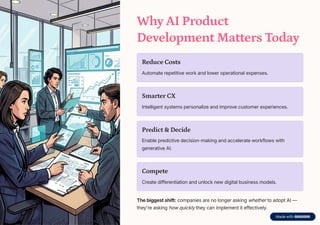
Reduce Costs
Automate repetitive work and lower operational expenses.
Smarter CX
Intelligent systems personalize and improve customer experiences.
Predict & Decide
Enable predictive decision-making and accelerate workflows with
generative AI.
Compete
Create differentiation and unlock new digital business models.
The biggest shift: companies are no longer asking whether to adopt AI —
they're asking how quickly they can implement it effectively.
3.
AI in Action:Real-World Impact
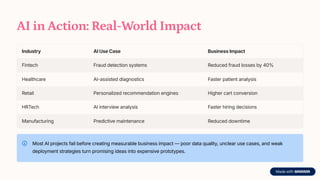
Industry AI Use Case Business Impact
Fintech Fraud detection systems Reduced fraud losses by 40%
Healthcare AI-assisted diagnostics Faster patient analysis
Retail Personalized recommendation engines Higher cart conversion
HRTech AI interview analysis Faster hiring decisions
Manufacturing Predictive maintenance Reduced downtime
Most AI projects fail before creating measurable business impact — poor data quality, unclear use cases, and weak
deployment strategies turn promising ideas into expensive prototypes.
4.
Core AI DevelopmentProcess
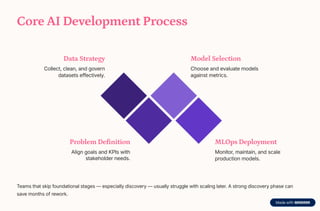
Problem Definition
Align goals and KPIs with
stakeholder needs.
Data Strategy
Collect, clean, and govern
datasets effectively.
Model Selection
Choose and evaluate models
against metrics.
MLOps Deployment
Monitor, maintain, and scale
production models.
Teams that skip foundational stages — especially discovery — usually struggle with scaling later. A strong discovery phase can
save months of rework.
5.
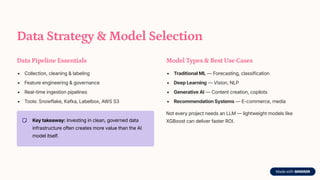
Data Strategy &Model Selection
Data Pipeline Essentials
Collection, cleaning & labeling
Feature engineering & governance
Real-time ingestion pipelines
Tools: Snowflake, Kafka, Labelbox, AWS S3
Key takeaway: Investing in clean, governed data
infrastructure often creates more value than the AI
model itself.
Model Types & Best Use Cases
Traditional ML — Forecasting, classification
Deep Learning — Vision, NLP
Generative AI — Content creation, copilots
Recommendation Systems — E-commerce, media
Not every project needs an LLM — lightweight models like
XGBoost can deliver faster ROI.
6.
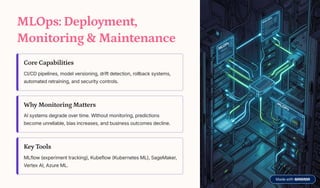
MLOps: Deployment,
Monitoring &Maintenance
Core Capabilities
CI/CD pipelines, model versioning, drift detection, rollback systems,
automated retraining, and security controls.
Why Monitoring Matters
AI systems degrade over time. Without monitoring, predictions
become unreliable, bias increases, and business outcomes decline.
Key Tools
MLflow (experiment tracking), Kubeflow (Kubernetes ML), SageMaker,
Vertex AI, Azure ML.
7.
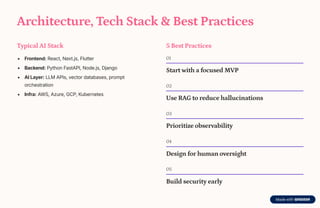
Architecture, Tech Stack& Best Practices
Typical AI Stack
Frontend: React, Next.js, Flutter
Backend: Python FastAPI, Node.js, Django
AI Layer: LLM APIs, vector databases, prompt
orchestration
Infra: AWS, Azure, GCP, Kubernetes
5 Best Practices
01
Start with a focused MVP
02
Use RAG to reduce hallucinations
03
Prioritize observability
04
Design for human oversight
05
Build security early
8.
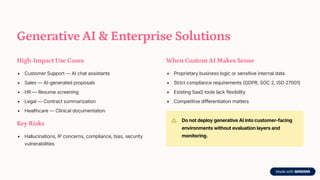
Generative AI &Enterprise Solutions
High-Impact Use Cases
Customer Support — AI chat assistants
Sales — AI-generated proposals
HR — Resume screening
Legal — Contract summarization
Healthcare — Clinical documentation
Key Risks
Hallucinations, IP concerns, compliance, bias, security
vulnerabilities
When Custom AI Makes Sense
Proprietary business logic or sensitive internal data
Strict compliance requirements (GDPR, SOC 2, ISO 27001)
Existing SaaS tools lack flexibility
Competitive differentiation matters
Do not deploy generative AI into customer-facing
environments without evaluation layers and
monitoring.
9.
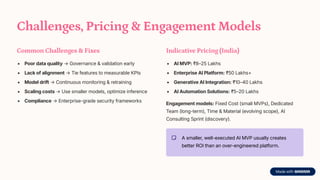
Challenges, Pricing &Engagement Models
Common Challenges & Fixes
Poor data quality → Governance & validation early
Lack of alignment → Tie features to measurable KPIs
Model drift → Continuous monitoring & retraining
Scaling costs → Use smaller models, optimize inference
Compliance → Enterprise-grade security frameworks
Indicative Pricing (India)
AI MVP: ₹8–25 Lakhs
Enterprise AI Platform: ₹50 Lakhs+
Generative AI Integration: ₹10–40 Lakhs
AI Automation Solutions: ₹5–20 Lakhs
Engagement models: Fixed Cost (small MVPs), Dedicated
Team (long-term), Time & Material (evolving scope), AI
Consulting Sprint (discovery).
A smaller, well-executed AI MVP usually creates
better ROI than an over-engineered platform.
10.
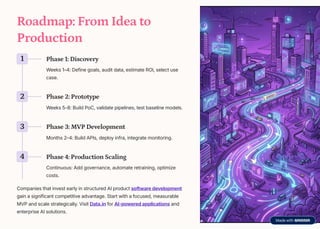
Roadmap: From Ideato
Production
1 Phase 1: Discovery
Weeks 1–4: Define goals, audit data, estimate ROI, select use
case.
2 Phase 2: Prototype
Weeks 5–8: Build PoC, validate pipelines, test baseline models.
3 Phase 3: MVP Development
Months 2–4: Build APIs, deploy infra, integrate monitoring.
4 Phase 4: Production Scaling
Continuous: Add governance, automate retraining, optimize
costs.
Companies that invest early in structured AI product software development
gain a significant competitive advantage. Start with a focused, measurable
MVP and scale strategically. Visit Data.in for AI-powered applications and
enterprise AI solutions.