The Chemistry of Immunity: Louis Pasteur's Impact on Vaccines and Modern Medicine
Explore Louis Pasteur's discovery of attenuation, the first rabies vaccine trial, and his lasting legacy in immunology and medicine, highlighting the chemistry behind immunity and vaccine development.
The Chemistry of Immunity: Louis Pasteur's Impact on Vaccines and Modern Medicine
1.
Chemists and Howthey
Have Made an Impact on
our Lives
SESSION 4 Lesson
General Science - Grade 11
Designed by Teacher/s: Fitz Daril Clyne T. Jaso
2.
Louis Pasteur: TheChemistry of Immunity
• Session 4: Chemists and Their Global
Impact
• Focus: The discovery of attenuation and
the first vaccines
• Key Concepts: Pathogens, immunity, and
chemical signatures
Chemists and How they Have Made an Impact on our Lives Slide 1
3.
Learning Objectives
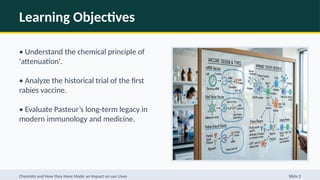
• Understandthe chemical principle of
'attenuation'.
• Analyze the historical trial of the first
rabies vaccine.
• Evaluate Pasteur’s long-term legacy in
modern immunology and medicine.
Chemists and How they Have Made an Impact on our Lives Slide 2
4.
Pre-Lesson: The GermTheory Review
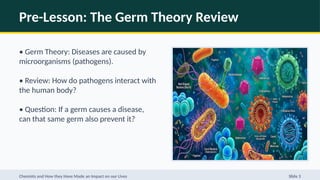
• Germ Theory: Diseases are caused by
microorganisms (pathogens).
• Review: How do pathogens interact with
the human body?
• Question: If a germ causes a disease,
can that same germ also prevent it?
Chemists and How they Have Made an Impact on our Lives Slide 3
5.
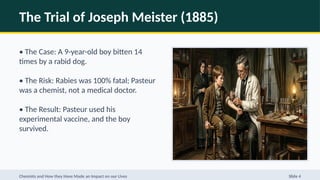
The Trial ofJoseph Meister (1885)
• The Case: A 9-year-old boy bitten 14
times by a rabid dog.
• The Risk: Rabies was 100% fatal; Pasteur
was a chemist, not a medical doctor.
• The Result: Pasteur used his
experimental vaccine, and the boy
survived.
Chemists and How they Have Made an Impact on our Lives Slide 4
6.
The Discovery ofAttenuation
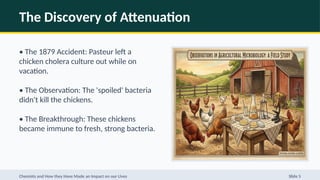
• The 1879 Accident: Pasteur left a
chicken cholera culture out while on
vacation.
• The Observation: The 'spoiled' bacteria
didn't kill the chickens.
• The Breakthrough: These chickens
became immune to fresh, strong bacteria.
Chemists and How they Have Made an Impact on our Lives Slide 5
7.
Explaining Attenuation
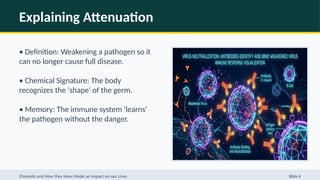
• Definition:Weakening a pathogen so it
can no longer cause full disease.
• Chemical Signature: The body
recognizes the 'shape' of the germ.
• Memory: The immune system 'learns'
the pathogen without the danger.
Chemists and How they Have Made an Impact on our Lives Slide 6
8.
Elaborate: From Anthraxto Rabies
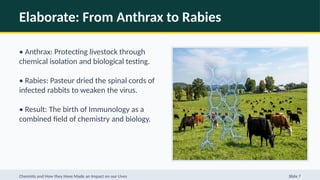
• Anthrax: Protecting livestock through
chemical isolation and biological testing.
• Rabies: Pasteur dried the spinal cords of
infected rabbits to weaken the virus.
• Result: The birth of Immunology as a
combined field of chemistry and biology.
Chemists and How they Have Made an Impact on our Lives Slide 7
9.
Ethical Integration: TheMeister Debate
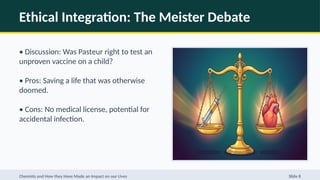
• Discussion: Was Pasteur right to test an
unproven vaccine on a child?
• Pros: Saving a life that was otherwise
doomed.
• Cons: No medical license, potential for
accidental infection.
Chemists and How they Have Made an Impact on our Lives Slide 8
10.
Evaluate: Formative Assessment(Part 1)
1. 'Attenuation' in vaccine development
refers to:
A) Strengthening a germ
B) Weakening a pathogen
C) Creating a new germ
D) Removing all chemicals
2. Pasteur’s first successful human vaccine
was for:
Chemists and How they Have Made an Impact on our Lives Slide 9
11.
Evaluate: Formative Assessment(Part 2)
3. How did Pasteur discover attenuation?
A) By accident with chicken cholera
B) By reading ancient texts
C) By using a telescope
D) By boiling germs until they died
4. Pasteur’s combination of chemistry and
biology led to:
A) Astrology B) Immunology C)
Chemists and How they Have Made an Impact on our Lives Slide 10
12.
Extend: Pasteur’s GlobalLegacy
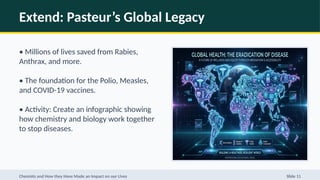
• Millions of lives saved from Rabies,
Anthrax, and more.
• The foundation for the Polio, Measles,
and COVID-19 vaccines.
• Activity: Create an infographic showing
how chemistry and biology work together
to stop diseases.
Chemists and How they Have Made an Impact on our Lives Slide 11
Editor's Notes
#1 Welcome the class. Today's topic is Chemists and How they Have Made an Impact on our Lives.
#2 Welcome students to Session 4. Today we are looking at one of the most influential figures in scientific history: Louis Pasteur. While many know him for pasteurization, his work as a chemist revolutionized how we fight disease. We will explore how he used chemical principles to 'tweak' pathogens, turning them from killers into cures.
#3 By the end of today's lesson, you should be able to explain what attenuation is, recount the high-stakes story of Joseph Meister, and describe how Pasteur’s chemical approach to biology laid the foundation for modern vaccines that save millions of lives annually.
#4 Before we dive in, let’s recall the Germ Theory. We know that tiny organisms called pathogens are responsible for illness. But today's central question is a bit of a paradox: If a germ is the source of the problem, could it also be the key to the solution? How can we use the enemy to build our defenses?
#5 Imagine the scene in 1885. A young boy named Joseph Meister is brought to Pasteur after a brutal attack by a rabid dog. Rabies was a death sentence. Pasteur had a vaccine he’d only tested on dogs. Despite the ethical risks, he began a series of injections. This was a turning point in medical history—the first successful human trial of a laboratory-made vaccine.
#6 Great discoveries often involve luck. In 1879, Pasteur accidentally left a cholera culture exposed to the air while he went on vacation. When he returned and injected his chickens, they didn't die—they just got a little sick. More importantly, when he later exposed them to fresh cholera, they were completely immune. He realized he had 'weakened' the germ chemically through exposure to oxygen.
#7 This is the principle of attenuation. By weakening the pathogen—through heat, chemicals, or drying—Pasteur kept the 'chemical signature' of the germ intact. Think of it like a training dummy for the immune system. The body learns to recognize the threat without having to fight a full-strength invasion.
#8 Pasteur applied this to Anthrax first, saving the livelihoods of farmers. For Rabies, which is a virus (much smaller than bacteria), he used a different chemical process involving drying the spinal cords of infected animals to attenuate the pathogen. This was the moment biology and chemistry fused to create the science of immunology.
#9 Let's pause for an ethical discussion. Pasteur was a chemist, not a doctor. He took a massive risk by injecting Joseph Meister. If the boy had died, Pasteur might have been imprisoned and his work stopped. Do the ends justify the means in scientific discovery? Was it brave or reckless?
#10 Let's check our understanding. Question 1: What is attenuation? (Pause for answers). Correct, it's B, weakening the pathogen. Question 2: Which disease did Pasteur treat in his first human trial? (Pause). That's right, B, Rabies.
#11 Moving on. Question 3: How did he discover it? It was A, the accident with the chickens! Question 4: This created the field of B, Immunology. And finally, Question 5: His legacy is B, helping us understand the cause and prevention of disease.
#12 Pasteur’s legacy is everywhere. Every time someone gets a vaccine today, they are benefiting from the chemistry of attenuation discovered in that 19th-century lab. For your extension activity, I want you to create an infographic or a short report. Connect the dots: how does a chemist's look at a pathogen result in a global health victory?