Helpful Checklists
Checklist forCritical Reading
Checklist for Analyzing a Written Work
Checklist for Examining an Images
Checklist for Peer Review and Revision
Checklist for Editing
Checklist for Reviewing and Revising a Narrative
Checklist for Reviewing and Revising a Description
Checklist for Reviewing and Revising an Example Essay
Checklist for Reviewing and Revising a Comparison-and-
Contrast Essay
Checklist for Reviewing and Revising a Process Analysis
Checklist for Reviewing and Revising a Division or Analysis
Essay
Checklist for Reviewing and Revising a Classification
Checklist for Reviewing and Revising a Cause-and-Effect Essay
Checklist for Reviewing and Revising a Definition
Checklist for Reviewing and Revising an Argument
Checklist for Reviewing and Revising a Mixed-Methods Essay
Checklist for Evaluating Sources
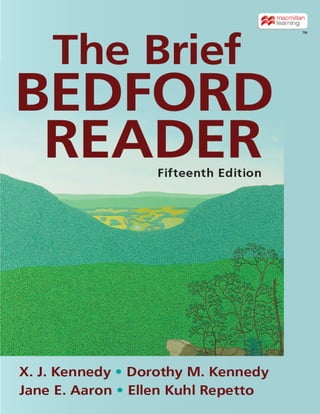
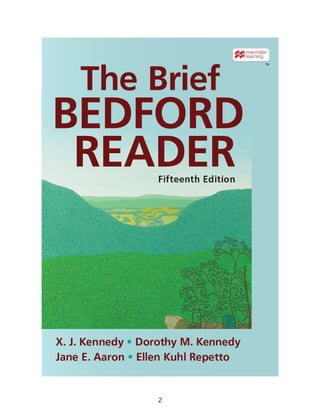
A note about the cover
The Brief Bedford Reader has long featured a cover displaying
nature and in keeping with that theme we’ve chosen Ridge View,
4
Accessibility
Macmillan Learning iscommitted to the goal of providing equal
access to all products regardless of an individual’s age, ability, or
situation and embraces the opportunity to develop services and
information technologies that are accessible and usable by all
individuals. Accessibility at Macmillan Learning is about extending
the power of education to all users. In addition to addressing
product compatibility with assistive technologies such as screen
reader software, alternative keyboard devices, and voice recognition
products, we are working to ensure that the content and platforms
we provide are fully accessible.
Our E-books
Macmillan Learning became the first education solutions company
to become Global Certified Accessible , providing “born
accessible” digital learning (e-book) options for students with
disabilities. Books that are born accessible are developed to ensure
that all students, no matter their ability, have the same access to
information. This is increasingly important for students and
instructors, as more than one out of every ten students who attends
college has a disability.
tm
6
9.
To become GlobalCertified Accessible, Benetech evaluated
Macmillan Learning’s workflow for creating accessible books, as
well as many samples of content across the disciplines they publish
in, and certified conformance to the accessible EPUB creation
guidelines, which are based on WCAG 2.0 AA+ standards put in place
by the international standards organizations and the publishing
community. Using a collaborative process, Benetech evaluated and
provided feedback on more than one hundred accessibility features.
The certification applies to all books created using Macmillan
Learning’s updated process, which includes all e-books with a 2019
copyright and beyond.
Extended Descriptions
In this book, extended descriptions are present for complex images
and graphs that may be helpful to understanding content. These
extended descriptions can be accessed via a link on this icon:
Alternative Text
When an image provides important pedagogical information,
alternative text (which is also known as alt text) is provided for the
image. This text is not visible on the page but can be accessed and
read with screen reader technology and other assistive technologies.
Our alt text is written and reviewed by subject matter experts.
7
10.
Color Contrast
All ofour book designs and illustrations are checked to ensure that
they meet contrast requirements for WCAG 2.0 AA. Meeting these
standards ensures ease of use for users with low vision and color
blindness, and can create a more supportive learning environment
for users with learning disabilities.
Navigation
E-book navigation is designed to make it easy for users, with or
without assistive technology, to discover and learn from content
within the textbook. Text reflows when resized so there is no
horizontal scrolling on the page, and page numbers are embedded
in the book so that students can always find where they are
compared to classmates using the print equivalent. Heading
structures are clearly marked up so it’s easy to see where you are
within the book as you work your way through.
Accessibility Help
If you have any questions about the accessibility of this e-book or
other Macmillan Learning e-books, please reach out to us at
webaccessibility@macmillan.com. For student resources, visit our
knowledge base.
8
11.
Methods for AchievingYour Purpose in
Writing
The Brief Bedford Reader centers on common ways of thinking and
writing about all kinds of subjects. Whatever your purpose in
writing, one or more of these ways of thinking — or methods of
development — can help you discover and shape your ideas.
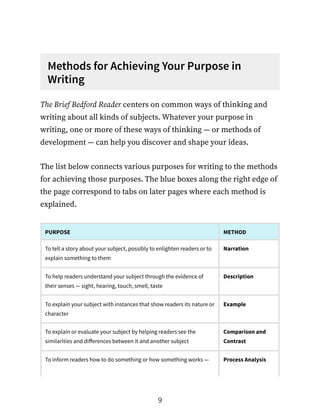
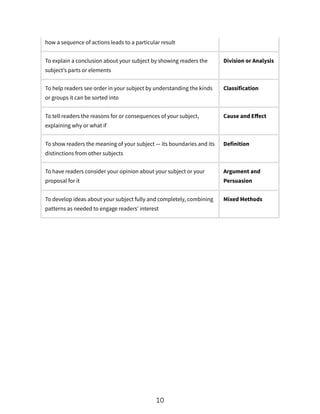
The list below connects various purposes for writing to the methods
for achieving those purposes. The blue boxes along the right edge of
the page correspond to tabs on later pages where each method is
explained.
PURPOSE METHOD
To tell a story about your subject, possibly to enlighten readers or to
explain something to them
Narration
To help readers understand your subject through the evidence of
their senses — sight, hearing, touch, smell, taste
Description
To explain your subject with instances that show readers its nature or
character
Example
To explain or evaluate your subject by helping readers see the
similarities and differences between it and another subject
Comparison and
Contrast
To inform readers how to do something or how something works — Process Analysis
9
12.
how a sequenceof actions leads to a particular result
To explain a conclusion about your subject by showing readers the
subject’s parts or elements
Division or Analysis
To help readers see order in your subject by understanding the kinds
or groups it can be sorted into
Classification
To tell readers the reasons for or consequences of your subject,
explaining why or what if
Cause and Effect
To show readers the meaning of your subject — its boundaries and its
distinctions from other subjects
Definition
To have readers consider your opinion about your subject or your
proposal for it
Argument and
Persuasion
To develop ideas about your subject fully and completely, combining
patterns as needed to engage readers’ interest
Mixed Methods
10
13.
the brief bedfordreader
Fifteenth Edition
X. J. Kennedy
Dorothy M. Kennedy
Jane E. Aaron
Ellen Kuhl Repetto
11
14.
Vice President: LeasaBurton
Program Director: Laura Arcari
Sr Program Mgr Development/Composition: Nancy Tran
Director of Content Development: Jane Knetzger
Senior Development Editor: Leah R. Strauss
Editorial Assistant: Heather Haase
Director of Media Editorial: Adam Whitehurst
Media Editor: Daniel Johnson
Marketing Manager: Joy Fisher Williams
Senior Director, Content Management Enhancement: Tracey Kuehn
Senior Managing Editor: Michael Granger
Senior Manager of Publishing Services: Andrea Cava
Senior Content Project Manager: Lidia MacDonald-Carr
Senior Workflow Project Manager: Jennifer Wetzel
Production Coordinator: Brianna Lester
Director of Design, Content Management: Diana Blume
Cover Design: William Boardman
Permissions Associate: Maisie Howell
Text Permissions Researcher: Elaine Kosta, Lumina Datamatics, Inc.
Permissions Editor: Allison Ziebka-Viering
Photo Researcher: Cheryl DuBois, Lumina Datamatics, Inc.
Director of Digital Production: Keri deManigold
Associate Media Project Manager: Sophie Good
12
preface for instructors
“Awriter,” says Saul Bellow, “is a reader moved to emulate.” From
the beginning, the aim of The Brief Bedford Reader has been to move
students to be writers, through reading and emulating the good
writing of others.
Like its popular predecessors, this fifteenth edition pursues that aim
both rhetorically and thematically. We present the rhetorical
methods realistically, as we ourselves use them — as instinctive
forms that assist invention and fruition and as flexible forms that
mix easily for any purpose a writer may have. Further, we make
numerous thematic connections among selections, both to spark
students’ interest in reading and to show how different writers
tackle similar subjects with unique results.
Filling in this outline is a wealth of features, new and enduring.
new features
engaging new readings by remarkable writers
As always, we have been enthralled with freshening the book’s
selections. In searching for works academic yet lively, we discovered
exceptional rhetorical models that will, we trust, also capture
15
18.
students’ interest. Theseventeen new selections balance pieces by
established favorites such as N. Scott Momaday and Mary Roach
with rising stars such as Grace Talusan and John Green. Five new
essays by exemplary college writers are part of the mix, assuring
students that beginners, too, can produce writing worth reading.
a tighter focus on academic writing
More than ever, The Brief Bedford Reader puts students on solid
footing as they learn and practice the interrelated processes of
critical reading and academic writing. With the encouragement of
instructors who use the book, we have restructured its final sections,
breaking the material on mixed methods and research and
documentation into four distinct chapters, allowing for ease of
comprehension and access in Achieve — an exciting new digital
platform designed to bring engagement, assessment, and
interactivity for students working online (see p. xi for more
information).
New comments on an updated student essay-in-progress. As
before, sample notes and multiple drafts follow student writer
Rosie Anaya from rough idea to finished essay as she models
the stages of writing in response to reading through Part One.
The early drafts in Chapters 2 and 3 are now followed by
commentary anticipating Anaya’s “Next Steps” to help students
understand her process, and the essay itself incorporates recent
16
19.
examples to keep“Mental Illness on Television” current and
relevant to their experiences.
More help with editing. Chapter 4 features additional
examples, new coverage of punctuating parenthetical and
nonrestrictive elements, and updated advice on maintaining
pronoun-antecedent agreement with indefinite pronouns. And
a new “Focus on Source Materials” box in Chapter 10 on
Division or Analysis shows students how to avoid plagiarism
when summarizing, paraphrasing, and quoting from texts.
A new Chapter 15 on Mixed Methods features a full
introduction with all of the support offered for the individual
methods addressed earlier in Part Two, including a chapter-
opening visual with analytic comments, thorough discussions
of reading and writing essays that combine multiple methods, a
graphic organizer, a Focus box, and a revision checklist. And for
the first time, a student essay is presented among the reading
selections.
Three new distinct Chapters (16–18) on researching and
documenting sources in MLA and APA style offer a brief
overview of the research process and include dozens of up-to-
date models for documenting sources in the most recent
versions of MLA and APA style. Both styles continue to be
illustrated by annotated student research papers, and fifteen
additional examples of documented writing, ten of them new,
are spread throughout the book.
17
20.
enhanced visual appeal
Thefifteenth edition of The Brief Bedford Reader also provides more
support for media-saturated students, helping them to understand
the methods by visualizing them at work.
A new discussion of reading visuals critically. Cheerful and
inspiring, a new photograph in Chapter 1 anchors a revised
sample analysis of an image — one that helps to inform the
student essay-in-progress that follows over the next three
chapters.
Refreshed images. Emphasizing the visual as well as the verbal,
each rhetorical chapter opens with a striking image, half of
them new — a photograph, a cartoon, an ad — with updated text
and questions to invite students’ critical reading. Several of the
book’s selections, three of them new to this edition, either take
images as their starting points or include illustrations to explain
or highlight key ideas.
Improved design. The boxed questions and checklists
throughout the book are newly formatted as actual checklists,
encouraging student engagement with their content.
a fresh take on the writers’ comments on writing
After their essays, more than half of the book’s writers offer
comments on everything from reading to grammar to how they
developed the particular piece we reprint. Besides providing rock-
solid advice, these comments — eight of them new — prove that for
18
21.
the pros, too,writing is usually a challenge. Metacognitive new
“Questions for Reflection” following each commentary highlight the
writer’s key points and provide a base for guided interactive writing
assignments in the Achieve digital platform, suggesting how
students might apply the insights to their own work.
For easy access, the “Writers on Writing” are listed in a Directory
under the topics they address. Look up Purpose, for instance, and
find that Chitra Divakaruni, Roxane Gay, and Brent Staples, among
others, have something to say about this crucial aspect of the writing
process.
trademark features
varied selections by quality authors
All of them models of exceptional writing, the essays and literary
works in The Brief Bedford Reader vary in authorship, topic, even
length and format. We offer clear and interesting applications of the
methods of development by noted writers such as Amy Tan, Barry
Lopez, Zadie Smith, and David Sedaris. Half the selections are by
women, and half touch on diversity and inclusion. They range in
subject from family to science, from language to psychology, from
food to politics.
19
22.
focus on studentwork
Featuring more student writing than any other textbook of its kind,
The Brief Bedford Reader presents fourteen models of exemplary
college work (five of them new to this edition): multiple drafts of a
student’s critical reading and response to an essay; eleven essays in
the rhetorical methods given the same treatment as the professional
writing; and two annotated research papers.
realistic treatment of the rhetorical methods
The Brief Bedford Reader treats the methods of development not as
empty forms but as tools for inventing, for shaping, and, ultimately,
for accomplishing a purpose.
A practical guide. The chapters on reading and writing in Part
One and the introductions to the rhetorical methods in Part Two
are simple and clear, with many explanations and suggestions
distilled into bulleted lists and boxed guidelines so that students
can easily follow and use the book’s advice on their own. Each
chapter introduction links the method to the range of purposes
it can serve and gives step-by-step guidance for writing and
revising. (For quick reference, the purpose/method links also
appear inside the front cover, where they are keyed to the
marginal page tabs that appear in each chapter introduction.)
A “Focus” box in every rhetorical chapter highlights an
element of writing that is especially relevant to that method —
for example, verbs in narration, concrete words in description,
20
23.
parallelism in comparisonand contrast, and tone in argument
and persuasion. To show these elements in context, most
selections include a question about them.
An emphasis on mixing the methods takes the realistic
approach even further. We show how writers freely combine
methods to achieve their purposes: Each rhetorical introduction
discusses how that method might work with others, and at least
one “Other Methods” question after every selection helps
students analyze how methods work together. Most
significantly, the new Chapter 15 provides a collection of works
by celebrated writers that specifically illustrate mixed methods.
The headnotes for these selections point to where each method
comes into play.
extensive thematic connections
The Brief Bedford Reader provides substantial opportunities for
topical class discussion and writing. A pair of essays in each chapter
addresses the same subject, from the ordinary (miscommunication)
to the controversial (privilege). Five of those pairings are new, and
the thoroughly refreshed chapter on argument also includes a new
casebook on current issues. A “Connections” writing topic after
every selection suggests links to other selections in the book. And an
alternate table of contents arranges the book’s selections under
more than three dozen topics and academic disciplines.
21
24.
abundant editorial apparatus
Asalways, we’ve surrounded the selections with a wealth of material
designed to get students reading, thinking, and writing. To help
structure students’ critical approach to the selections, each one is
preceded by a headnote on the author and a headnote on the
selection itself, outlining its cultural and historical contexts. Each
selection is followed by sets of questions on meaning, writing
strategy, and language and at least five writing suggestions. One
writing suggestion encourages students to explore their responses in
their journals; another suggests how to develop the journal writing
into an essay; and others emphasize critical writing, research, and
connections among selections.
Besides the aids provided with every selection, the book also
includes additional writing topics at the end of every rhetorical
chapter, a Glossary of Useful Terms that defines key terms used in
the book (all those printed in small capital letters), and a
comprehensive index that alphabetizes not only authors and titles
but also all important topics (including the elements of
composition).
comprehensive instructor’s manual
Available as a PDF that can be downloaded from the book’s catalog
page at macmillanlearning.com, Notes and Resources for Teaching
The Brief Bedford Reader suggests ways to integrate journaling and
22
25.
collaboration into writingclasses; discusses uses for the book’s
chapters on critical reading, academic writing, and research and
documentation; provides tips on using visuals and multimedia
selections in a writing course; offers sample syllabi for courses
taking either a rhetorical or a thematic approach, and correlates the
book’s contents and features to the Council of Writing Program
Administrators (WPA) Outcomes Statement for First-Year
Composition with a detailed chart. In addition, Notes and Resources
discusses every method, every selection (with multimedia resource
suggestions and with possible answers provided for all questions),
and every “Writers on Writing” commentary.
two versions
The Brief Bedford Reader has a sibling. The full edition, The Bedford
Reader, features seventy-nine readings instead of forty-eight,
including student case studies and literary works and including
more essays in each of the rhetorical chapters.
acknowledgments
Hundreds of teachers and students over the years have helped us
shape The Brief Bedford Reader. For this edition, the following
teachers offered insights from their experiences that encouraged
worthy changes: Joe Davis III, North Iowa Community College;
Betsy M. Goetz, Riverland Community College; Andrew M. Howard,
University of the District of Columbia; David McCracken, Coker
23
26.
College; Agnetta Mendoza,Nashville State Community College;
Gregg Nelson, Chippewa Valley Technical College; Michelle Marie
O’Connell, Chippewa Valley Technical College; Joy Patterson, Florida
Institute of Technology; Krista J. Quinn, SUNY Rockland Community
College; Paul W. Reid, Chippewa Valley Technical College; Jennifer
Schaefer, Lord Fairfax Community College; Deborah K. Smalley,
University of Cincinnati; Marian Smith, Chippewa Valley Technical
College; Jenni VanCuren, Lord Fairfax Community College; Sabrina
Walters, Miami Dade College; Brittany Warman, Lord Fairfax
Community College; and Kelli L. White-Mellish, Skagit Valley
College.
We owe, as ever, countless debts to the creative people at and around
Bedford/St. Martin’s. Leasa Burton, Nancy Tran, Joy Fisher Williams,
Adam Whitehurst, and Dan Johnson contributed insight and
support. Leah Strauss, developing the book from an improvised
home office, was a dream: She cheerfully helped to plan and
implement the revisions and new selections and was consistently
reliable for a good laugh in rough moments. Heather Haase assisted,
running the review program and coordinating the many details that
went into this project. William Boardman created the refreshing
new cover. Hilary Newman and Elaine Kosta fought the permissions
battle with grace and aplomb. Lidia MacDonald-Carr expertly
planned and oversaw the production cycle. And Aravinda Kulasekar
Doss, oceans away, transformed the raw manuscript into the
finished book you hold. Our gratitude endures.
24
27.
bedford/st. martin’s putsyou first
From day one, our goal has been simple: to provide inspiring resources that
are grounded in best practices for teaching reading and writing. For nearly
forty years, Bedford/St. Martin’s has partnered with those in the field, listening
to teachers, scholars, and students about the support writers need. We are
committed to helping every writing instructor make the most of our resources.
how can we help you?
✓ Our editors can align our resources to your outcomes through
correlation and transition guides for your syllabus. Just ask us.
✓ Our sales representatives specialize in helping you find the right
materials to support your course goals.
✓ Our learning solutions and product specialists help you make the
most of the digital resources you choose for your course.
✓ Our Bits blog on the Bedford/St. Martin’s English Community
(community.macmillan.com) publishes fresh teaching ideas
regularly. You’ll also find easily downloadable professional resources
and links to author webinars on our community site.
Contact your Bedford/St. Martin’s sales representative or visit
macmillanlearning.com to learn more.
digital and print options for the brief bedford reader
Choose the format that works best for your course, and ask about our
packaging options that offer savings for students.
Digital
✓ Achieve with The Bedford Reader. Achieve offers a dedicated
composition space for writing instructors and students of all comfort
levels with course technology. It provides trusted content with a
robust e-book, as well as diagnostics with personalized study plans.
Achieve’s writing tools break down the writing process for students,
make revision choices more visible to instructors, and guide students
25
28.
through drafting, peerreview, plagiarism avoidance, reflection, and
revision. Fully editable pre-built assignments support the book’s
approach. To order Achieve with The Bedford Reader, use ISBN 978-1-
319-33180-1. For details, visit
macmillanlearning.com/achieve/english.
✓ Popular e-book formats. For details about our e-book partners, visit
macmillanlearning.com/ebooks.
✓ Inclusive Access. Enable every student to receive their course
materials through your LMS on the first day of class. Macmillan
Learning’s Inclusive Access program is the easiest, most affordable
way to ensure all students have access to quality educational
resources. Find out more at macmillanlearning.com/inclusiveaccess.
Print
✓ Paperback editions. Choose between the full version of The Bedford
Reader or a more concise option, The Brief Bedford Reader. To order
the complete edition, use ISBN 978-1-319-33179-5; for the brief
edition, use ISBN 978-1-319-33286-0. To order the print text version of
The Bedford Reader packaged with Achieve for additional savings, use
ISBN 978-1-319-50347-5. To order the print text version of The Brief
Bedford Reader packaged with Achieve for additional savings, use
ISBN 978-1-319-50350-5.
✓ A Student’s Companion for The Bedford Reader. Available for
students who could use a little extra support in the composition
classroom, this guide offers additional support for students in ALP or
co-requisite courses and helps beginning college writers develop on-
level skills.
your course, your way
No two writing programs or classrooms are exactly alike. Our Curriculum
Solutions team works with you to design custom digital (e-book and Achieve)
and print options that provide the resources your students need. (Note that
the options below require enrollment minimums.)
✓ ForeWords for English. Customize any print resource to fit the focus of
your course or program by choosing from a range of prepared topics,
such as Sentence Guides for Academic Writers.
26
29.
✓ Macmillan AuthorProgram (MAP). Add excerpts or package acclaimed
works from Macmillan’s trade imprints to connect students with
prominent authors and public conversations. A list of popular
examples or academic themes is available upon request.
✓ Mix and Match. With our simplest solution, you can add up to 50 pages
of curated content to your Bedford/St. Martin’s text. Contact your sales
representative for additional details.
instructor resources
You have a lot to do in your course. We want to make it easy for you to find the
support you need — and to get it quickly.
Notes and Resources for Teaching The Brief Bedford Reader is available as a PDF
that can be downloaded from macmillanlearning.com; it is also available in
Achieve with The Bedford Reader. In addition to chapter overviews and
teaching tips, the instructor’s manual includes sample syllabi for courses
taking either a rhetorical or thematic approach, suggested multimedia
resources, and possible answers to the reading questions for each selection.
27
30.
contents
PREFACE FOR INSTRUCTORS
CONTENTSBY THEME AND DISCIPLINE
HOW (AND WHY) TO USE THIS BOOK
THE SELECTIONS
Readings
Student examples
Visuals
THE METHODS OF DEVELOPMENT
THE PRACTICAL GUIDANCE
Overviews of reading, writing, and research
Reading questions and writing prompts
Glossary and index
THE WRITERS ON WRITING
PART ONE ACADEMIC READING AND WRITING
1 CRITICAL READING: Learning from Other Writers
READING ACTIVELY
Previewing
Annotating
NANCY MAIRS Disability (annotated essay)
A writer with multiple sclerosis thinks she knows
why the media carry so few images of people like
28
31.
herself with disabilities:Viewers might conclude,
correctly, that “there is something ordinary about
disability itself.”
DEVELOPING AN UNDERSTANDING
Summarizing
Thinking critically
Checklist for critical reading
ANALYZING WRITTEN WORKS
Meaning
Writing strategy
Language
Checklist for analyzing a written work
EXAMINING VISUAL IMAGES
Checklist for examining an image
Visual Image: from A Marathon Survivor Starts
Over, photo essay by Josh Haner
Seeing the big picture
Taking a critical look
2 THE WRITING PROCESS: Discovery and Drafting
ASSESSING THE WRITING SITUATION
Subject
Audience
Purpose
Genre
DISCOVERING IDEAS
29
32.
Keeping a journal
Freewriting
Exploringthe methods of development
Responding to a text
DRAFTING
Focusing on a thesis
Developing ideas
Organizing the evidence
Shaping the introduction and conclusion
A STUDENT ESSAY-IN-PROGRESS
Journal notes on reading
First draft
Next steps
3 THE WRITING PROCESS: Reviewing and Revising
REVIEWING A DRAFT
REVISING IN STAGES
Checklist for peer review and revision
Purpose and genre
Thesis
Unity
Development
Coherence
INTEGRATING EVIDENCE
Exercising caution
Summarizing, paraphrasing, and quoting
30
33.
Synthesizing ideas
A STUDENTESSAY-IN-PROGRESS
Peer responses to first draft
Journal notes on peer review
Revised draft
Next steps
4 THE WRITING PROCESS: Editing
USING EFFECTIVE LANGUAGE
Checklist for editing
CRAFTING CLEAR AND ENGAGING SENTENCES
Emphasis
Parallelism
Sentence variety
FIXING COMMON ERRORS
Sentence fragments
Run-on sentences and comma splices
Subject-verb agreement
Pronouns
Misplaced and dangling modifiers
Shifts
A STUDENT ESSAY-IN-PROGRESS
Edited paragraph
Final draft
ROSIE ANAYA Mental Illness on Television (annotated
student essay)
31
34.
Inspired by readingNancy Mairs’s “Disability”
(Chap. 1), a student writer argues that television
should “portray psychological disability as a part of
everyday life, not a crime.”
PART TWO THE METHODS
5 NARRATION: Telling a Story
Visual Image: Proposal, drawing by Demetri Martin
THE METHOD
THE PROCESS
Purpose and shape
The thesis
The narrator in the story
What to emphasize
Organization
Focus on verbs
How to organize a narrative
Checklist for reviewing and revising a narrative
PAIRED SELECTIONS
HEALTHCARE
OLIVER SACKS Cold Storage
A team of doctors encountered a patient with a
strange metabolic disorder. Their treatment
regimen succeeded — and cost him his life.
Oliver Sacks on Writing
32
35.
JONATHAN BETHARDS CodeThree (student
essay)
An emergency medical technician responds to
a 911 call, and a stand-off ensues.
AMY TAN Fish Cheeks
The writer recalls her teenage angst when the
minister and his cute blond son attended her
family’s Christmas Eve dinner, an elaborate
Chinese feast.
MAYA ANGELOU Champion of the World
She didn’t dare ring up a sale while that epic battle
was on. A noted Black writer remembers from her
childhood the night a people’s fate hung on a pair
of boxing gloves.
Maya Angelou on Writing
ADDITIONAL WRITING TOPICS
6 DESCRIPTION: Writing with Your Senses
Visual Image: Busy Day, photograph by Serena Pallaro
THE METHOD
THE PROCESS
Purpose and audience
Dominant impression and thesis
Organization
Details
How to organize a description
33
36.
Focus on specificand concrete language
Checklist for reviewing and revising a description
SHONDA RHIMES My Summer of Scooping Ice Cream
A minimum-wage job at Baskin-Robbins taught this
television producer and writer perseverance,
responsibility, and a distaste for ice cream.
BARRY LOPEZ The Cape Crozier Penguins
Mixing science and wonder, a naturalist describes
the highlight of an Antarctic research expedition.
Barry Lopez on Writing
PAIRED SELECTIONS
FATHERS
BRAD MANNING Arm Wrestling with My
Father (student essay)
In the time it takes for a strong arm to fall, a
college student learns that becoming an adult
has changed the way he feels about his father
and their physical competition.
Brad Manning on Writing
E. B. WHITE Once More to the Lake
A father takes his young son on a pilgrimage to
a favorite summertime scene from his own
childhood, a lake in Maine. There he arrives at
a chilling revelation.
ADDITIONAL WRITING TOPICS
34
37.
7 EXAMPLE: Pointingto Instances
Visual Image: Costumes to Scare Millennials, cartoon by
Sarah Andersen
THE METHOD
THE PROCESS
The generalization and the thesis
The examples
Organization
Focus on sentence variety
How to organize examples
Checklist for reviewing and revising an example essay
PAIRED SELECTIONS
RACISM
BRENT STAPLES Black Men and Public Space
In near-deserted streets at night, an African
American writer finds that women flee from
him. Relating case histories, he tells what he
has discovered about his “ability to alter public
space.”
Brent Staples on Writing
GRACE TALUSAN Yellow Children
A Filipina immigrant recounts some unsettling
experiences with microaggressions and
explains their lasting impact.
Visual Image: Grace’s Senior High School
Portrait, photograph of the author
35
38.
ANNA QUINDLEN Homeless
Ajournalist who confesses an aversion for “looking
at the big picture, taking the global view,” insists on
seeing homelessness as an individual crisis.
Anna Quindlen on Writing
ZANE RASSLER Looking Back (student essay)
Cataloging hints throughout childhood that pointed
to his “not fitting into the role of a Typical Female,”
a transgender student shows how social norms can
obscure truths that seem obvious in hindsight.
Zane Rassler on Writing
ADDITIONAL WRITING TOPICS
8 COMPARISON AND CONTRAST: Setting Things Side by
Side
Visual Image: Excerpt from Fun Home, graphic memoir
by Alison Bechdel
THE METHOD
Uses of comparison and contrast
Purposes
THE PROCESS
Subjects for comparison
Basis for comparison and thesis
Organization
Balance and flexibility
How to organize a comparison-and-contrast essay
36
39.
Checklist for reviewingand revising a comparison-and-
contrast essay
Focus on parallelism
PAIRED SELECTIONS
ENDANGERED SPECIES
JOURDAN IMANI KEITH At Risk
Drawing striking parallels between spawning
salmon and underserved youth, a naturalist
ponders the mismatched reactions to a label
applied to both animals and people.
Jourdan Imani Keith on Writing
TED CHIANG The Great Silence (short story)
Instead of searching for nonhuman
intelligence in the depths of space, why not
look in the rainforests of Puerto Rico? Taking
on the voice of a parrot, an acclaimed science
fiction writer asks probing questions about the
nature of language and communication.
Visual Images: from The Great Silence, video
installation by Allora & Calzadilla
DAVID SEDARIS Remembering My Childhood on the
Continent of Africa
This beloved essayist complains about his
“unspeakably dull” childhood, when he might have
grown up like his partner, Hugh, amid monkeys
and machete-wielding guards.
37
40.
David Sedaris onWriting
J. OWEN MURPHY Climate Change: Pole Pole
(documented student essay)
Drawing on personal experience and library
research, a seasoned climber likens dismissive
attitudes toward environmental issues to hikers’
faulty assessments of risk.
J. Owen Murphy on Writing
ADDITIONAL WRITING TOPICS
9 PROCESS ANALYSIS: Explaining Step by Step
Visual Image: Fabulous Monggo!, illustration by Malaka
Gharib
THE METHOD
THE PROCESS
How to organize a process analysis
Checklist for reviewing and revising a process analysis
Focus on consistency
PAIRED SELECTIONS
WRITING
ANNE LAMOTT Shitty First Drafts
For those who struggle with writer’s block, this
writer recommends quieting their inner voices
and just getting some words down, no matter
how terrible the effort.
38
41.
KOJI FRAHM Howto Write an A Paper (student
essay)
“Be nebulous. Scratch that, be amphibological.”
With tongue firmly in cheek, a college student
offers writing tips for his peers.
Koji Frahm on Writing
MARY ROACH When Animals Attack
A humorist asks experts in wilderness forensics
what a person should do when faced with a bear, a
cougar, or some other deadly predator.
Mary Roach on Writing
JESSICA MITFORD Behind the Formaldehyde Curtain
With sardonic wit the writer, dubbed “Queen of the
Muckrakers” by Time, details the stages through
which a sallow corpse becomes a masterwork of
mortuary art.
ADDITIONAL WRITING TOPICS
10 DIVISION OR ANALYSIS: Slicing into Parts
Visual Image: Deconstructing Lunch, cartoon by Roz
Chast
THE METHOD
Kinds of division or analysis
Analysis and critical thinking
THE PROCESS
Subject and purpose
39
42.
Principle of analysisand thesis
Evidence
How to organize a division or analysis essay
Focus on source material
Checklist for reviewing and revising a division or
analysis essay
JESSE WARD What PTSD Looks Like (documented student
essay)
A prize-winning photograph prompts a student
writer to connect its subject with his own
experiences as an army veteran.
Visual Image: Brian Scott Ostrom, photograph by
Craig F. Walker
PAIRED SELECTIONS
CONSUMER CULTURE
JOHN GREEN Piggly Wiggly
In an essay modeled after online consumer
reviews, an influential podcaster dissects the
business model of a revolutionary grocery
chain to understand its successes and failures
over time.
John Green on Writing
ZADIE SMITH Find Your Beach
A writer picks apart an insipid phrase from an
ad taking up an entire wall across from her
40
43.
apartment to explorehow its sentiment is
“pure Manhattan.”
Visual Image: Find Your Beach, advertisement
by Corona
Zadie Smith on Writing
ADDITIONAL WRITING TOPICS
11 CLASSIFICATION: Sorting into Kinds
Visual Image: from They Called Us Enemy, graphic
memoir by George Takei
THE METHOD
Subjects and reasons for classification
Kinds of classification
THE PROCESS
Purposes and theses
Categories
Focus on paragraph development
How to organize a classification
Checklist for reviewing and revising a classification
JULIET CORWIN The Lonely World between the
Hearing and the Deaf (student essay)
A student with profound hearing loss feels
excluded from the “Deaf — capital-D —community”
because of her cochlear implants.
PAIRED SELECTIONS
FAILURES TO COMMUNICATE
41
44.
DEBORAH TANNEN ButWhat Do You Mean?
Sometimes an apology is not an apology,
observes an expert on communication. Men
and women would get along better, she says, if
they understood each other’s codes of speech.
Deborah Tannen on Writing
WILLIAM LUTZ The World of Doublespeak
“Pavement deficiencies” (potholes) and “a
career alternative placement program” (a layoff
of workers) are but two expressions that
conceal unpleasant truths. An expert in such
doublespeak explains the types and their
effects.
William Lutz on Writing
ADDITIONAL WRITING TOPICS
12 CAUSE AND EFFECT: Asking Why
Visual Image: Bright Nights, infographic by Lucy
Conklin
THE METHOD
THE PROCESS
Subject and purpose
Thesis
Causal relations
Discovery of causes
Educated guesses
42
45.
How to organizea cause-and-effect analysis
Focus on clarity and conciseness
Checklist for reviewing and revising a cause-and-effect
essay
MARY KILLEEN McCANS Signing Their Lives Away
(documented student essay)
Prescribing opioids does more harm than good,
argues an ambulance volunteer in this thoughtfully
researched essay. Doctors must seek better ways to
manage pain without risking addiction and
overdoses.
Mary Killeen McCans on Writing
DEREK THOMPSON What Makes Things Cool
A specialist in economics and culture examines the
delicate balance between familiarity and novelty
that influences consumers to “like what they like.”
Visual Image: Raymond Loewy, illustration by Mark
Weaver, with photographs by Bernard Hoffman,
Jack Garofalo, and Sherman Oaks Antique Mall
PAIRED SELECTIONS
GLOBALIZATION
CHITRA DIVAKARUNI Live Free and Starve
Forcing developing countries to stop child
labor might not be the cure-all it seems. The
children themselves, asserts this writer, could
suffer fates worse than working.
43
46.
Chitra Divakaruni onWriting
JARED DIAMOND The Global Peril of
Inequality
A famed geographer and evolutionary biologist
warns that impoverished nations cannot
improve their standards of living without
reducing standards enjoyed elsewhere. Do we
have the courage to cut back on our own?
ADDITIONAL WRITING TOPICS
13 DEFINITION: Tracing Boundaries
Visual Image: Friend, artwork by Jonny Sun
THE METHOD
THE PROCESS
Discovery of meanings
Methods of development
Thesis
Evidence
How to organize a definition
Focus on unity
Checklist for reviewing and revising a definition
PAIRED SELECTIONS
PRIVILEGE
TAL FORTGANG Checking My Privilege (student
essay)
44
47.
Despite pressure fromclassmates to consider
his advantages, an Ivy League freshman refuses
“to feel personally apologetic because white
males seem to pull most of the strings in the
world.”
Tal Fortgang on Writing
ROXANE GAY Peculiar Benefits
A cultural critic — who also happens to be “a
woman, a person of color, and the child of
immigrants” — takes note of her own privileges
and admonishes readers to do the same.
Roxane Gay on Writing
RICHARD RODRIGUEZ X: The Neutering of the Spanish
Tongue
A memoirist turned activist objects to recent uses
of Latinx, “a term that is supposed to name people
like me without naming people like me.”
N. SCOTT MOMADAY The Sacred Spell of Words
With affecting sensitivity, a Kiowa writer finds
power in the oral tradition he has studied over a
lifetime.
Visual Images: Emily Spear; Carnegie, Oklahoma;
photographs by Maddie McGarvey
N. Scott Momaday on Writing
ADDITIONAL WRITING TOPICS
45
48.
14 ARGUMENT ANDPERSUASION: Stating Opinions and
Proposals
Visual Image: Corporate America Flag, image from
Adbusters Media Foundation
THE METHOD
Audience and common ground
Elements of argument
Reasoning
Focus on tone
THE PROCESS
Finding a subject
Organizing
How to organize an argument
Checklist for reviewing and revising an argument
ELLY VINTIADIS Mass Shooting and the Myth of the
Violent Mentally Ill (annotated essay)
Citing multiple academic studies, a philosopher
and epidemiologist with a background in
psychology contends that school shootings and
similar violent incidents should not be blamed on
mental illness but on access to guns.
Elly Vintiadis on Writing
PAIRED SELECTIONS
HOW CAN FAMILY IMMIGRATION POLICY BE
REFORMED?
46
49.
LINDA CHAVEZ SupportingFamily Values
A political activist argues that immigrants with
children have a positive influence on the
United States — whether they’re in the country
“legally” or not — and should be granted
amnesty to stay.
Linda Chavez on Writing
MARIE MYUNG-OK LEE I Was an Anchor Baby
An American-born daughter of immigrants
threatened with deportation throughout her
childhood suggests that amnesty is not enough:
Families like hers deserve a chance at full
citizenship instead.
GROUPED SELECTIONS
SHOULD FREEDOM OF SPEECH BE LIMITED?
SARAH HEMPHILL What Happened to Free
Speech on College Campuses? (documented
student essay)
A college student laments the increase of “anti-
speech policies” on campus, arguing that such
“coddling” creates poorly educated citizens
who are ill-prepared for the real world.
Sarah Hemphill on Writing
AZIZ HUQ The Conservative Case against
Banning Critical Race Theory
47
50.
A legal scholarand university professor asserts
that recent efforts to ban the teaching of
“critical race theory” in public schools violate
the very principles of free speech that
politicians claim to support.
JULIA SERANO Free Speech and the Paradox of
Tolerance
In response to “free speech absolutists”
expressing concerns over media censorship, an
activist counters that tolerating hate speech
and the like threatens to silence the voices of
those vulnerable to attack.
Julia Serano on Writing
ADDITIONAL WRITING TOPICS
15 MIXED METHODS: Combining the Patterns of
Development
Visual Image: Not Milk, advertisement by Oatly
THE METHODS
THE PROCESS
Subject and Purpose
Thesis
Organization
Focus on coherence
How to organize an essay using multiple methods
48
51.
Checklist for reviewingand revising a mixed-methods
essay
JOAN DIDION Earthquakes (annotated essay)
With a sharp eye and ear, a famous Californian
observes how she and others respond to a series of
seismic events. Could this be “the Big One”?
Joan Didion on Writing
PAIRED SELECTIONS
TRANSCENDENTALISM
HENRY DAVID THOREAU What I Lived For
“Simplify, simplify!” In this excerpt from
Walden, the influential poet-philosopher
explains his rejection of consumer culture and
the new technologies that came with it.
LUIS ALBERTO URREA Barrio Walden
Giddy with anticipation, a Mexican American
writer takes a commuter train to visit Thoreau’s
cabin and is alternately disappointed and
overcome with transcendental bliss.
Luis Alberto Urrea on Writing
ISABELLA LOH The Blue Death (documented student
essay)
Looking through the eyes of an imagined nurse
inspired by her research, a student writer examines
what New York City medical providers went
through during the pandemic flu of 1918.
49