The Body as Mosque: A Sacred Reframing of Erotic Perception through Sufi Mysticism and Theology
Explores symbolic theology and Sufi mysticism to transform erotic perception into reverent, ethical vision using the body–mosque metaphor, emphasizing contemplative attention over objectification.
The Body as Mosque: A Sacred Reframing of Erotic Perception through Sufi Mysticism and Theology
1.
RESEARCH PRESENTATION ·AUGUST 20, 2026
A sacred reframing of
erotic perception
Maksudul Shadat Akash
Bangladesh University of Professionals
Conceptual theology · Sufi mysticism · embodied perception
2.
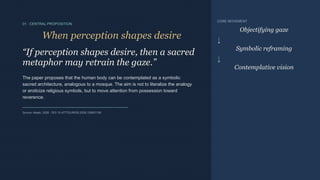
01 · CENTRALPROPOSITION
When perception shapes desire
“If perception shapes desire, then a sacred
metaphor may retrain the gaze.”
The paper proposes that the human body can be contemplated as a symbolic
sacred architecture, analogous to a mosque. The aim is not to literalize the analogy
or eroticize religious symbols, but to move attention from possession toward
reverence.
Source: Akash, 2026 · DOI 10.47772/IJRISS.2026.100601190
CORE MOVEMENT
Objectifying gaze
↓
Symbolic reframing
↓
Contemplative vision
3.
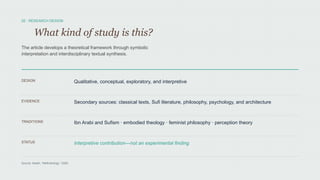
02 · RESEARCHDESIGN
What kind of study is this?
The article develops a theoretical framework through symbolic
interpretation and interdisciplinary textual synthesis.
DESIGN Qualitative, conceptual, exploratory, and interpretive
EVIDENCE Secondary sources: classical texts, Sufi literature, philosophy, psychology, and architecture
TRADITIONS Ibn Arabi and Sufism · embodied theology · feminist philosophy · perception theory
STATUS Interpretive contribution—not an experimental finding
Source: Akash, “Methodology,” 2026.
4.
03 · SACREDARCHITECTURE
The symbolic architecture of the
argument
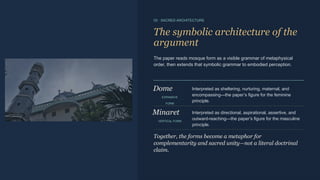
The paper reads mosque form as a visible grammar of metaphysical
order, then extends that symbolic grammar to embodied perception.
Dome
EXPANSIVE
FORM
Interpreted as sheltering, nurturing, maternal, and
encompassing—the paper’s figure for the feminine
principle.
Minaret
VERTICAL FORM
Interpreted as directional, aspirational, assertive, and
outward-reaching—the paper’s figure for the masculine
principle.
Together, the forms become a metaphor for
complementarity and sacred unity—not a literal doctrinal
claim.
5.
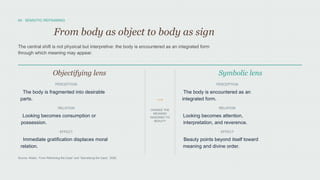
04 · SEMIOTICREFRAMING
From body as object to body as sign
The central shift is not physical but interpretive: the body is encountered as an integrated form
through which meaning may appear.
Objectifying lens
PERCEPTION
The body is fragmented into desirable
parts.
RELATION
Looking becomes consumption or
possession.
EFFECT
Immediate gratification displaces moral
relation.
→
CHANGE THE
MEANING
ASSIGNED TO
BEAUTY
Symbolic lens
PERCEPTION
The body is encountered as an
integrated form.
RELATION
Looking becomes attention,
interpretation, and reverence.
EFFECT
Beauty points beyond itself toward
meaning and divine order.
Source: Akash, “From Reframing the Gaze” and “Sacralizing the Gaze,” 2026.
6.
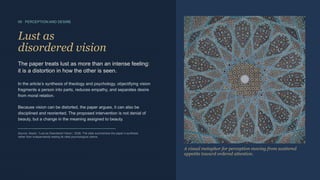
05 · PERCEPTIONAND DESIRE
Lust as
disordered vision
The paper treats lust as more than an intense feeling:
it is a distortion in how the other is seen.
In the article’s synthesis of theology and psychology, objectifying vision
fragments a person into parts, reduces empathy, and separates desire
from moral relation.
Because vision can be distorted, the paper argues, it can also be
disciplined and reoriented. The proposed intervention is not denial of
beauty, but a change in the meaning assigned to beauty.
Source: Akash, “Lust as Disordered Vision,” 2026. The slide summarizes the paper’s synthesis
rather than independently testing its cited psychological claims.
FRAGMENTATION → WHOLENESS
A visual metaphor for perception moving from scattered
appetite toward ordered attention.
7.
06 · SUFIMEDIATION
The barzakh
For Ibn Arabi, barzakh names an imaginal threshold
that holds visible and invisible realities together.
Body
↔ spirit
Form
↔ meaning
Sensuality
↔ sanctity
Beauty
↔ transcendence
In the paper, mosque and body become mediating forms through which the unseen may be
contemplated through the seen.
A THRESHOLD BETWEEN FORM AND MEANING
8.
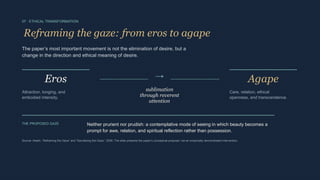
07 · ETHICALTRANSFORMATION
Reframing the gaze: from eros to agape
The paper’s most important movement is not the elimination of desire, but a
change in the direction and ethical meaning of desire.
Eros
Attraction, longing, and
embodied intensity.
→
sublimation
through reverent
attention
Agape
Care, relation, ethical
openness, and transcendence.
THE PROPOSED GAZE Neither prurient nor prudish: a contemplative mode of seeing in which beauty becomes a
prompt for awe, relation, and spiritual reflection rather than possession.
Source: Akash, “Reframing the Gaze” and “Sacralizing the Gaze,” 2026. The slide presents the paper’s conceptual proposal, not an empirically demonstrated intervention.
9.
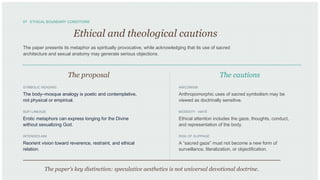
07 · ETHICALBOUNDARY CONDITIONS
Ethical and theological cautions
The paper presents its metaphor as spiritually provocative, while acknowledging that its use of sacred
architecture and sexual anatomy may generate serious objections.
The proposal
SYMBOLIC READING
The body–mosque analogy is poetic and contemplative,
not physical or empirical.
SUFI LINEAGE
Erotic metaphors can express longing for the Divine
without sexualizing God.
INTENDED AIM
Reorient vision toward reverence, restraint, and ethical
relation.
The cautions
ANICONISM
Anthropomorphic uses of sacred symbolism may be
viewed as doctrinally sensitive.
MODESTY · ḤAYĀʾ
Ethical attention includes the gaze, thoughts, conduct,
and representation of the body.
RISK OF SLIPPAGE
A “sacred gaze” must not become a new form of
surveillance, literalization, or objectification.
The paper’s key distinction: speculative aesthetics is not universal devotional doctrine.
10.
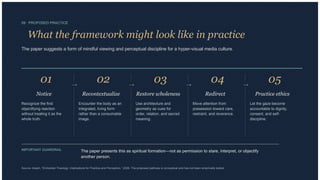
09 · PROPOSEDPRACTICE
What the framework might look like in practice
The paper suggests a form of mindful viewing and perceptual discipline for a hyper-visual media culture.
01
Notice
Recognize the first
objectifying reaction
without treating it as the
whole truth.
→
02
Recontextualize
Encounter the body as an
integrated, living form
rather than a consumable
image.
→
03
Restore wholeness
Use architecture and
geometry as cues for
order, relation, and sacred
meaning.
→
04
Redirect
Move attention from
possession toward care,
restraint, and reverence.
→
05
Practice ethics
Let the gaze become
accountable to dignity,
consent, and self-
discipline.
IMPORTANT GUARDRAIL The paper presents this as spiritual formation—not as permission to stare, interpret, or objectify
another person.
Source: Akash, “Embodied Theology: Implications for Practice and Perception,” 2026. The proposed pathway is conceptual and has not been empirically tested.
11.
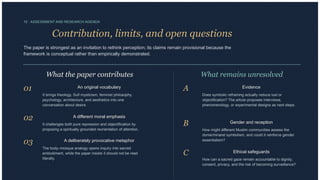
10 · ASSESSMENTAND RESEARCH AGENDA
Contribution, limits, and open questions
The paper is strongest as an invitation to rethink perception; its claims remain provisional because the
framework is conceptual rather than empirically demonstrated.
What the paper contributes
01 An original vocabulary
It brings theology, Sufi mysticism, feminist philosophy,
psychology, architecture, and aesthetics into one
conversation about desire.
02 A different moral emphasis
It challenges both pure repression and objectification by
proposing a spiritually grounded reorientation of attention.
03 A deliberately provocative metaphor
The body–mosque analogy opens inquiry into sacred
embodiment, while the paper insists it should not be read
literally.
What remains unresolved
A Evidence
Does symbolic reframing actually reduce lust or
objectification? The article proposes interviews,
phenomenology, or experimental designs as next steps.
B Gender and reception
How might different Muslim communities assess the
dome/minaret symbolism, and could it reinforce gender
essentialism?
C Ethical safeguards
How can a sacred gaze remain accountable to dignity,
consent, privacy, and the risk of becoming surveillance?
12.
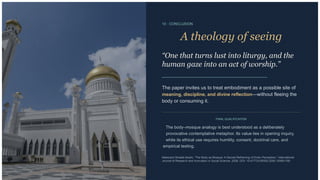
10 · CONCLUSION
Atheology of seeing
“One that turns lust into liturgy, and the
human gaze into an act of worship.”
The paper invites us to treat embodiment as a possible site of
meaning, discipline, and divine reflection—without fleeing the
body or consuming it.
FINAL QUALIFICATION
The body–mosque analogy is best understood as a deliberately
provocative contemplative metaphor. Its value lies in opening inquiry,
while its ethical use requires humility, consent, doctrinal care, and
empirical testing.
Maksudul Shadat Akash, “The Body as Mosque: A Sacred Reframing of Erotic Perception,” International
Journal of Research and Innovation in Social Science, 2026. DOI: 10.47772/IJRISS.2026.100601190