Bonedeish Study Guide 1
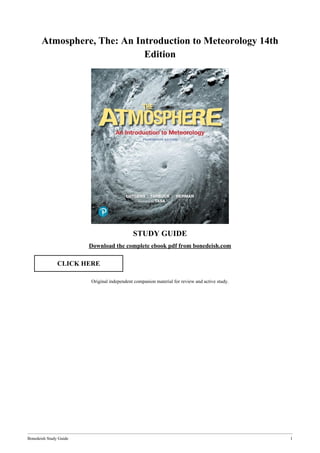
Atmosphere, The: An Introduction to Meteorology 14th
Edition
STUDY GUIDE
Download the complete ebook pdf from bonedeish.com
CLICK HERE
Original independent companion material for review and active study.
Bonedeish Study Guide 2
How to Use This Study Guide
This 25-page guide is designed for active review. Read a topic once for understanding, close the page,
explain the idea from memory, and then reopen the guide to correct what you missed. That
retrieve-check-correct cycle is more useful than repeatedly rereading the same paragraph.
Study map
1. The Atmosphere as a System 12. Local and Regional Winds
2. Composition and Vertical Structure 13. Air Masses
3. Energy from the Sun 14. Fronts
4. Radiation and Heat Balance 15. Midlatitude Cyclones
5. Temperature Patterns 16. Thunderstorms
6. Water in the Atmosphere 17. Tornadoes
7. Humidity and Stability 18. Tropical Cyclones
8. Cloud Formation 19. Weather Observation
9. Precipitation Processes 20. Weather Forecasting
10. Air Pressure 21. Climate Variability
11. Wind and Force Balance 22. Atmosphere-Climate Connections
As you revise, mark each topic as secure, developing, or review. Spend most of your time on the last two
groups and keep testing yourself with fresh examples rather than memorized wording.
Bonedeish Study Guide 3
1. The Atmosphere as a System
Core idea
This page focuses on The Atmosphere as a System. Atmospheric science is built on interacting physical
processes, so each weather pattern is best understood by tracing energy, moisture, pressure, and motion
together. Start by defining the central idea in ordinary language, then identify the observations, variables,
structures, or decisions that make the concept useful.
How to think through it
Ask what drives the pattern: radiation, temperature gradient, moisture, pressure gradient, rotation, or
vertical motion. Then follow how those variables evolve in space and time.
Key checkpoints
• Explain The Atmosphere as a System in your own words without using the guide.
• Identify two terms, structures, variables, or decisions that are central to The Atmosphere as a System.
• Create one concrete example that illustrates The Atmosphere as a System.
• Connect this topic to at least one earlier topic in the guide.
• Write one question you would ask if the evidence or situation were incomplete.
Common error to avoid
Weather maps show outcomes of interacting processes; avoid explaining a pattern with only one variable
when several forces are acting together.
Active recall
1. Why is The Atmosphere as a System important in this subject?
2. What evidence or observation would help you recognize it?
3. How would your reasoning change if one important condition or assumption changed?
Bonedeish Study Guide 4
2. Composition and Vertical Structure
Core idea
This page focuses on Composition and Vertical Structure. Atmospheric science is built on interacting
physical processes, so each weather pattern is best understood by tracing energy, moisture, pressure, and
motion together. Start by defining the central idea in ordinary language, then identify the observations,
variables, structures, or decisions that make the concept useful.
How to think through it
Ask what drives the pattern: radiation, temperature gradient, moisture, pressure gradient, rotation, or
vertical motion. Then follow how those variables evolve in space and time.
Key checkpoints
• Explain Composition and Vertical Structure in your own words without using the guide.
• Identify two terms, structures, variables, or decisions that are central to Composition and Vertical
Structure.
• Create one concrete example that illustrates Composition and Vertical Structure.
• Connect this topic to at least one earlier topic in the guide.
• Write one question you would ask if the evidence or situation were incomplete.
Common error to avoid
Weather maps show outcomes of interacting processes; avoid explaining a pattern with only one variable
when several forces are acting together.
Active recall
1. Why is Composition and Vertical Structure important in this subject?
2. What evidence or observation would help you recognize it?
3. How would your reasoning change if one important condition or assumption changed?
Bonedeish Study Guide 5
3. Energy from the Sun
Core idea
This page focuses on Energy from the Sun. Atmospheric science is built on interacting physical
processes, so each weather pattern is best understood by tracing energy, moisture, pressure, and motion
together. Start by defining the central idea in ordinary language, then identify the observations, variables,
structures, or decisions that make the concept useful.
How to think through it
Ask what drives the pattern: radiation, temperature gradient, moisture, pressure gradient, rotation, or
vertical motion. Then follow how those variables evolve in space and time.
Key checkpoints
• Explain Energy from the Sun in your own words without using the guide.
• Identify two terms, structures, variables, or decisions that are central to Energy from the Sun.
• Create one concrete example that illustrates Energy from the Sun.
• Connect this topic to at least one earlier topic in the guide.
• Write one question you would ask if the evidence or situation were incomplete.
Common error to avoid
Weather maps show outcomes of interacting processes; avoid explaining a pattern with only one variable
when several forces are acting together.
Active recall
1. Why is Energy from the Sun important in this subject?
2. What evidence or observation would help you recognize it?
3. How would your reasoning change if one important condition or assumption changed?
Bonedeish Study Guide 6
4. Radiation and Heat Balance
Core idea
This page focuses on Radiation and Heat Balance. Atmospheric science is built on interacting physical
processes, so each weather pattern is best understood by tracing energy, moisture, pressure, and motion
together. Start by defining the central idea in ordinary language, then identify the observations, variables,
structures, or decisions that make the concept useful.
How to think through it
Ask what drives the pattern: radiation, temperature gradient, moisture, pressure gradient, rotation, or
vertical motion. Then follow how those variables evolve in space and time.
Key checkpoints
• Explain Radiation and Heat Balance in your own words without using the guide.
• Identify two terms, structures, variables, or decisions that are central to Radiation and Heat Balance.
• Create one concrete example that illustrates Radiation and Heat Balance.
• Connect this topic to at least one earlier topic in the guide.
• Write one question you would ask if the evidence or situation were incomplete.
Common error to avoid
Weather maps show outcomes of interacting processes; avoid explaining a pattern with only one variable
when several forces are acting together.
Active recall
1. Why is Radiation and Heat Balance important in this subject?
2. What evidence or observation would help you recognize it?
3. How would your reasoning change if one important condition or assumption changed?
Bonedeish Study Guide 7
5. Temperature Patterns
Core idea
This page focuses on Temperature Patterns. Atmospheric science is built on interacting physical
processes, so each weather pattern is best understood by tracing energy, moisture, pressure, and motion
together. Start by defining the central idea in ordinary language, then identify the observations, variables,
structures, or decisions that make the concept useful.
How to think through it
Ask what drives the pattern: radiation, temperature gradient, moisture, pressure gradient, rotation, or
vertical motion. Then follow how those variables evolve in space and time.
Key checkpoints
• Explain Temperature Patterns in your own words without using the guide.
• Identify two terms, structures, variables, or decisions that are central to Temperature Patterns.
• Create one concrete example that illustrates Temperature Patterns.
• Connect this topic to at least one earlier topic in the guide.
• Write one question you would ask if the evidence or situation were incomplete.
Common error to avoid
Weather maps show outcomes of interacting processes; avoid explaining a pattern with only one variable
when several forces are acting together.
Active recall
1. Why is Temperature Patterns important in this subject?
2. What evidence or observation would help you recognize it?
3. How would your reasoning change if one important condition or assumption changed?
Bonedeish Study Guide 8
6. Water in the Atmosphere
Core idea
This page focuses on Water in the Atmosphere. Atmospheric science is built on interacting physical
processes, so each weather pattern is best understood by tracing energy, moisture, pressure, and motion
together. Start by defining the central idea in ordinary language, then identify the observations, variables,
structures, or decisions that make the concept useful.
How to think through it
Ask what drives the pattern: radiation, temperature gradient, moisture, pressure gradient, rotation, or
vertical motion. Then follow how those variables evolve in space and time.
Key checkpoints
• Explain Water in the Atmosphere in your own words without using the guide.
• Identify two terms, structures, variables, or decisions that are central to Water in the Atmosphere.
• Create one concrete example that illustrates Water in the Atmosphere.
• Connect this topic to at least one earlier topic in the guide.
• Write one question you would ask if the evidence or situation were incomplete.
Common error to avoid
Weather maps show outcomes of interacting processes; avoid explaining a pattern with only one variable
when several forces are acting together.
Active recall
1. Why is Water in the Atmosphere important in this subject?
2. What evidence or observation would help you recognize it?
3. How would your reasoning change if one important condition or assumption changed?
Bonedeish Study Guide 9
7. Humidity and Stability
Core idea
This page focuses on Humidity and Stability. Atmospheric science is built on interacting physical
processes, so each weather pattern is best understood by tracing energy, moisture, pressure, and motion
together. Start by defining the central idea in ordinary language, then identify the observations, variables,
structures, or decisions that make the concept useful.
How to think through it
Ask what drives the pattern: radiation, temperature gradient, moisture, pressure gradient, rotation, or
vertical motion. Then follow how those variables evolve in space and time.
Key checkpoints
• Explain Humidity and Stability in your own words without using the guide.
• Identify two terms, structures, variables, or decisions that are central to Humidity and Stability.
• Create one concrete example that illustrates Humidity and Stability.
• Connect this topic to at least one earlier topic in the guide.
• Write one question you would ask if the evidence or situation were incomplete.
Common error to avoid
Weather maps show outcomes of interacting processes; avoid explaining a pattern with only one variable
when several forces are acting together.
Active recall
1. Why is Humidity and Stability important in this subject?
2. What evidence or observation would help you recognize it?
3. How would your reasoning change if one important condition or assumption changed?
Bonedeish Study Guide 10
8. Cloud Formation
Core idea
This page focuses on Cloud Formation. Atmospheric science is built on interacting physical processes, so
each weather pattern is best understood by tracing energy, moisture, pressure, and motion together. Start by
defining the central idea in ordinary language, then identify the observations, variables, structures, or
decisions that make the concept useful.
How to think through it
Ask what drives the pattern: radiation, temperature gradient, moisture, pressure gradient, rotation, or
vertical motion. Then follow how those variables evolve in space and time.
Key checkpoints
• Explain Cloud Formation in your own words without using the guide.
• Identify two terms, structures, variables, or decisions that are central to Cloud Formation.
• Create one concrete example that illustrates Cloud Formation.
• Connect this topic to at least one earlier topic in the guide.
• Write one question you would ask if the evidence or situation were incomplete.
Common error to avoid
Weather maps show outcomes of interacting processes; avoid explaining a pattern with only one variable
when several forces are acting together.
Active recall
1. Why is Cloud Formation important in this subject?
2. What evidence or observation would help you recognize it?
3. How would your reasoning change if one important condition or assumption changed?
Bonedeish Study Guide 11
9. Precipitation Processes
Core idea
This page focuses on Precipitation Processes. Atmospheric science is built on interacting physical
processes, so each weather pattern is best understood by tracing energy, moisture, pressure, and motion
together. Start by defining the central idea in ordinary language, then identify the observations, variables,
structures, or decisions that make the concept useful.
How to think through it
Ask what drives the pattern: radiation, temperature gradient, moisture, pressure gradient, rotation, or
vertical motion. Then follow how those variables evolve in space and time.
Key checkpoints
• Explain Precipitation Processes in your own words without using the guide.
• Identify two terms, structures, variables, or decisions that are central to Precipitation Processes.
• Create one concrete example that illustrates Precipitation Processes.
• Connect this topic to at least one earlier topic in the guide.
• Write one question you would ask if the evidence or situation were incomplete.
Common error to avoid
Weather maps show outcomes of interacting processes; avoid explaining a pattern with only one variable
when several forces are acting together.
Active recall
1. Why is Precipitation Processes important in this subject?
2. What evidence or observation would help you recognize it?
3. How would your reasoning change if one important condition or assumption changed?
Bonedeish Study Guide 12
10. Air Pressure
Core idea
This page focuses on Air Pressure. Atmospheric science is built on interacting physical processes, so each
weather pattern is best understood by tracing energy, moisture, pressure, and motion together. Start by
defining the central idea in ordinary language, then identify the observations, variables, structures, or
decisions that make the concept useful.
How to think through it
Ask what drives the pattern: radiation, temperature gradient, moisture, pressure gradient, rotation, or
vertical motion. Then follow how those variables evolve in space and time.
Key checkpoints
• Explain Air Pressure in your own words without using the guide.
• Identify two terms, structures, variables, or decisions that are central to Air Pressure.
• Create one concrete example that illustrates Air Pressure.
• Connect this topic to at least one earlier topic in the guide.
• Write one question you would ask if the evidence or situation were incomplete.
Common error to avoid
Weather maps show outcomes of interacting processes; avoid explaining a pattern with only one variable
when several forces are acting together.
Active recall
1. Why is Air Pressure important in this subject?
2. What evidence or observation would help you recognize it?
3. How would your reasoning change if one important condition or assumption changed?
Bonedeish Study Guide 13
11. Wind and Force Balance
Core idea
This page focuses on Wind and Force Balance. Atmospheric science is built on interacting physical
processes, so each weather pattern is best understood by tracing energy, moisture, pressure, and motion
together. Start by defining the central idea in ordinary language, then identify the observations, variables,
structures, or decisions that make the concept useful.
How to think through it
Ask what drives the pattern: radiation, temperature gradient, moisture, pressure gradient, rotation, or
vertical motion. Then follow how those variables evolve in space and time.
Key checkpoints
• Explain Wind and Force Balance in your own words without using the guide.
• Identify two terms, structures, variables, or decisions that are central to Wind and Force Balance.
• Create one concrete example that illustrates Wind and Force Balance.
• Connect this topic to at least one earlier topic in the guide.
• Write one question you would ask if the evidence or situation were incomplete.
Common error to avoid
Weather maps show outcomes of interacting processes; avoid explaining a pattern with only one variable
when several forces are acting together.
Active recall
1. Why is Wind and Force Balance important in this subject?
2. What evidence or observation would help you recognize it?
3. How would your reasoning change if one important condition or assumption changed?
Bonedeish Study Guide 14
12. Local and Regional Winds
Core idea
This page focuses on Local and Regional Winds. Atmospheric science is built on interacting physical
processes, so each weather pattern is best understood by tracing energy, moisture, pressure, and motion
together. Start by defining the central idea in ordinary language, then identify the observations, variables,
structures, or decisions that make the concept useful.
How to think through it
Ask what drives the pattern: radiation, temperature gradient, moisture, pressure gradient, rotation, or
vertical motion. Then follow how those variables evolve in space and time.
Key checkpoints
• Explain Local and Regional Winds in your own words without using the guide.
• Identify two terms, structures, variables, or decisions that are central to Local and Regional Winds.
• Create one concrete example that illustrates Local and Regional Winds.
• Connect this topic to at least one earlier topic in the guide.
• Write one question you would ask if the evidence or situation were incomplete.
Common error to avoid
Weather maps show outcomes of interacting processes; avoid explaining a pattern with only one variable
when several forces are acting together.
Active recall
1. Why is Local and Regional Winds important in this subject?
2. What evidence or observation would help you recognize it?
3. How would your reasoning change if one important condition or assumption changed?
Bonedeish Study Guide 15
13. Air Masses
Core idea
This page focuses on Air Masses. Atmospheric science is built on interacting physical processes, so each
weather pattern is best understood by tracing energy, moisture, pressure, and motion together. Start by
defining the central idea in ordinary language, then identify the observations, variables, structures, or
decisions that make the concept useful.
How to think through it
Ask what drives the pattern: radiation, temperature gradient, moisture, pressure gradient, rotation, or
vertical motion. Then follow how those variables evolve in space and time.
Key checkpoints
• Explain Air Masses in your own words without using the guide.
• Identify two terms, structures, variables, or decisions that are central to Air Masses.
• Create one concrete example that illustrates Air Masses.
• Connect this topic to at least one earlier topic in the guide.
• Write one question you would ask if the evidence or situation were incomplete.
Common error to avoid
Weather maps show outcomes of interacting processes; avoid explaining a pattern with only one variable
when several forces are acting together.
Active recall
1. Why is Air Masses important in this subject?
2. What evidence or observation would help you recognize it?
3. How would your reasoning change if one important condition or assumption changed?
Bonedeish Study Guide 16
14. Fronts
Core idea
This page focuses on Fronts. Atmospheric science is built on interacting physical processes, so each
weather pattern is best understood by tracing energy, moisture, pressure, and motion together. Start by
defining the central idea in ordinary language, then identify the observations, variables, structures, or
decisions that make the concept useful.
How to think through it
Ask what drives the pattern: radiation, temperature gradient, moisture, pressure gradient, rotation, or
vertical motion. Then follow how those variables evolve in space and time.
Key checkpoints
• Explain Fronts in your own words without using the guide.
• Identify two terms, structures, variables, or decisions that are central to Fronts.
• Create one concrete example that illustrates Fronts.
• Connect this topic to at least one earlier topic in the guide.
• Write one question you would ask if the evidence or situation were incomplete.
Common error to avoid
Weather maps show outcomes of interacting processes; avoid explaining a pattern with only one variable
when several forces are acting together.
Active recall
1. Why is Fronts important in this subject?
2. What evidence or observation would help you recognize it?
3. How would your reasoning change if one important condition or assumption changed?
Bonedeish Study Guide 17
15. Midlatitude Cyclones
Core idea
This page focuses on Midlatitude Cyclones. Atmospheric science is built on interacting physical
processes, so each weather pattern is best understood by tracing energy, moisture, pressure, and motion
together. Start by defining the central idea in ordinary language, then identify the observations, variables,
structures, or decisions that make the concept useful.
How to think through it
Ask what drives the pattern: radiation, temperature gradient, moisture, pressure gradient, rotation, or
vertical motion. Then follow how those variables evolve in space and time.
Key checkpoints
• Explain Midlatitude Cyclones in your own words without using the guide.
• Identify two terms, structures, variables, or decisions that are central to Midlatitude Cyclones.
• Create one concrete example that illustrates Midlatitude Cyclones.
• Connect this topic to at least one earlier topic in the guide.
• Write one question you would ask if the evidence or situation were incomplete.
Common error to avoid
Weather maps show outcomes of interacting processes; avoid explaining a pattern with only one variable
when several forces are acting together.
Active recall
1. Why is Midlatitude Cyclones important in this subject?
2. What evidence or observation would help you recognize it?
3. How would your reasoning change if one important condition or assumption changed?
Bonedeish Study Guide 18
16. Thunderstorms
Core idea
This page focuses on Thunderstorms. Atmospheric science is built on interacting physical processes, so
each weather pattern is best understood by tracing energy, moisture, pressure, and motion together. Start by
defining the central idea in ordinary language, then identify the observations, variables, structures, or
decisions that make the concept useful.
How to think through it
Ask what drives the pattern: radiation, temperature gradient, moisture, pressure gradient, rotation, or
vertical motion. Then follow how those variables evolve in space and time.
Key checkpoints
• Explain Thunderstorms in your own words without using the guide.
• Identify two terms, structures, variables, or decisions that are central to Thunderstorms.
• Create one concrete example that illustrates Thunderstorms.
• Connect this topic to at least one earlier topic in the guide.
• Write one question you would ask if the evidence or situation were incomplete.
Common error to avoid
Weather maps show outcomes of interacting processes; avoid explaining a pattern with only one variable
when several forces are acting together.
Active recall
1. Why is Thunderstorms important in this subject?
2. What evidence or observation would help you recognize it?
3. How would your reasoning change if one important condition or assumption changed?
Bonedeish Study Guide 19
17. Tornadoes
Core idea
This page focuses on Tornadoes. Atmospheric science is built on interacting physical processes, so each
weather pattern is best understood by tracing energy, moisture, pressure, and motion together. Start by
defining the central idea in ordinary language, then identify the observations, variables, structures, or
decisions that make the concept useful.
How to think through it
Ask what drives the pattern: radiation, temperature gradient, moisture, pressure gradient, rotation, or
vertical motion. Then follow how those variables evolve in space and time.
Key checkpoints
• Explain Tornadoes in your own words without using the guide.
• Identify two terms, structures, variables, or decisions that are central to Tornadoes.
• Create one concrete example that illustrates Tornadoes.
• Connect this topic to at least one earlier topic in the guide.
• Write one question you would ask if the evidence or situation were incomplete.
Common error to avoid
Weather maps show outcomes of interacting processes; avoid explaining a pattern with only one variable
when several forces are acting together.
Active recall
1. Why is Tornadoes important in this subject?
2. What evidence or observation would help you recognize it?
3. How would your reasoning change if one important condition or assumption changed?
Bonedeish Study Guide 20
18. Tropical Cyclones
Core idea
This page focuses on Tropical Cyclones. Atmospheric science is built on interacting physical processes,
so each weather pattern is best understood by tracing energy, moisture, pressure, and motion together. Start
by defining the central idea in ordinary language, then identify the observations, variables, structures, or
decisions that make the concept useful.
How to think through it
Ask what drives the pattern: radiation, temperature gradient, moisture, pressure gradient, rotation, or
vertical motion. Then follow how those variables evolve in space and time.
Key checkpoints
• Explain Tropical Cyclones in your own words without using the guide.
• Identify two terms, structures, variables, or decisions that are central to Tropical Cyclones.
• Create one concrete example that illustrates Tropical Cyclones.
• Connect this topic to at least one earlier topic in the guide.
• Write one question you would ask if the evidence or situation were incomplete.
Common error to avoid
Weather maps show outcomes of interacting processes; avoid explaining a pattern with only one variable
when several forces are acting together.
Active recall
1. Why is Tropical Cyclones important in this subject?
2. What evidence or observation would help you recognize it?
3. How would your reasoning change if one important condition or assumption changed?
Bonedeish Study Guide 21
19. Weather Observation
Core idea
This page focuses on Weather Observation. Atmospheric science is built on interacting physical
processes, so each weather pattern is best understood by tracing energy, moisture, pressure, and motion
together. Start by defining the central idea in ordinary language, then identify the observations, variables,
structures, or decisions that make the concept useful.
How to think through it
Ask what drives the pattern: radiation, temperature gradient, moisture, pressure gradient, rotation, or
vertical motion. Then follow how those variables evolve in space and time.
Key checkpoints
• Explain Weather Observation in your own words without using the guide.
• Identify two terms, structures, variables, or decisions that are central to Weather Observation.
• Create one concrete example that illustrates Weather Observation.
• Connect this topic to at least one earlier topic in the guide.
• Write one question you would ask if the evidence or situation were incomplete.
Common error to avoid
Weather maps show outcomes of interacting processes; avoid explaining a pattern with only one variable
when several forces are acting together.
Active recall
1. Why is Weather Observation important in this subject?
2. What evidence or observation would help you recognize it?
3. How would your reasoning change if one important condition or assumption changed?
Bonedeish Study Guide 22
20. Weather Forecasting
Core idea
This page focuses on Weather Forecasting. Atmospheric science is built on interacting physical
processes, so each weather pattern is best understood by tracing energy, moisture, pressure, and motion
together. Start by defining the central idea in ordinary language, then identify the observations, variables,
structures, or decisions that make the concept useful.
How to think through it
Ask what drives the pattern: radiation, temperature gradient, moisture, pressure gradient, rotation, or
vertical motion. Then follow how those variables evolve in space and time.
Key checkpoints
• Explain Weather Forecasting in your own words without using the guide.
• Identify two terms, structures, variables, or decisions that are central to Weather Forecasting.
• Create one concrete example that illustrates Weather Forecasting.
• Connect this topic to at least one earlier topic in the guide.
• Write one question you would ask if the evidence or situation were incomplete.
Common error to avoid
Weather maps show outcomes of interacting processes; avoid explaining a pattern with only one variable
when several forces are acting together.
Active recall
1. Why is Weather Forecasting important in this subject?
2. What evidence or observation would help you recognize it?
3. How would your reasoning change if one important condition or assumption changed?
Bonedeish Study Guide 23
21. Climate Variability
Core idea
This page focuses on Climate Variability. Atmospheric science is built on interacting physical processes,
so each weather pattern is best understood by tracing energy, moisture, pressure, and motion together. Start
by defining the central idea in ordinary language, then identify the observations, variables, structures, or
decisions that make the concept useful.
How to think through it
Ask what drives the pattern: radiation, temperature gradient, moisture, pressure gradient, rotation, or
vertical motion. Then follow how those variables evolve in space and time.
Key checkpoints
• Explain Climate Variability in your own words without using the guide.
• Identify two terms, structures, variables, or decisions that are central to Climate Variability.
• Create one concrete example that illustrates Climate Variability.
• Connect this topic to at least one earlier topic in the guide.
• Write one question you would ask if the evidence or situation were incomplete.
Common error to avoid
Weather maps show outcomes of interacting processes; avoid explaining a pattern with only one variable
when several forces are acting together.
Active recall
1. Why is Climate Variability important in this subject?
2. What evidence or observation would help you recognize it?
3. How would your reasoning change if one important condition or assumption changed?
Bonedeish Study Guide 24
22. Atmosphere-Climate Connections
Core idea
This page focuses on Atmosphere-Climate Connections. Atmospheric science is built on interacting
physical processes, so each weather pattern is best understood by tracing energy, moisture, pressure, and
motion together. Start by defining the central idea in ordinary language, then identify the observations,
variables, structures, or decisions that make the concept useful.
How to think through it
Ask what drives the pattern: radiation, temperature gradient, moisture, pressure gradient, rotation, or
vertical motion. Then follow how those variables evolve in space and time.
Key checkpoints
• Explain Atmosphere-Climate Connections in your own words without using the guide.
• Identify two terms, structures, variables, or decisions that are central to Atmosphere-Climate
Connections.
• Create one concrete example that illustrates Atmosphere-Climate Connections.
• Connect this topic to at least one earlier topic in the guide.
• Write one question you would ask if the evidence or situation were incomplete.
Common error to avoid
Weather maps show outcomes of interacting processes; avoid explaining a pattern with only one variable
when several forces are acting together.
Active recall
1. Why is Atmosphere-Climate Connections important in this subject?
2. What evidence or observation would help you recognize it?
3. How would your reasoning change if one important condition or assumption changed?
Bonedeish Study Guide 25
Final Review and Self-Test
Use this page without looking back at the earlier sections. The goal is not to reproduce sentences from the
guide but to prove that you can retrieve, connect, and apply the ideas independently.
• Explain five modules in no more than three sentences each.
• Choose two modules that are strongly related and describe the connection.
• Identify one topic that still feels vague and write the exact question you need answered.
• Create one realistic problem, case, example, or scenario that requires knowledge from at least three
modules.
• List five technical terms you should be able to define accurately.
• Write two common mistakes and the checking strategy you will use to avoid them.
• Identify the three modules you should review first before an exam, assignment, or practical task.
A useful standard for mastery
You should be able to define the main idea, explain the mechanism or reasoning, connect it to related
concepts, and apply it to an unfamiliar example. If one of those steps fails, return to the relevant module
and test yourself again.
Download the complete ebook pdf from bonedeish.com
CLICK HERE