The 2026 AI Inflection - Chapter 10: Transforming Talent and Careers with AI-Augmented Roles and Capability Graphs
Explore how AI reshapes talent strategies, career models, and workforce transformation by emphasizing skills volatility, AI-augmented roles, and capability graphs replacing traditional career ladders in 2026.
The 2026 AI Inflection - Chapter 10: Transforming Talent and Careers with AI-Augmented Roles and Capability Graphs
1.
Chapter 10
The 2026AI Inflection:
AI, Talent, and the End of Linear Careers
Skills volatility. AI-augmented roles. Capability graphs replace ladders.
AI TALENT STRATEGY 2026 SKILLS VOLATILITY WORKFORCE TRANSFORMATION
White Paper
By: Logan Sivanasen - 10th March, 2026
2.
AI Changes WorkFirst. Talent Models
Last.
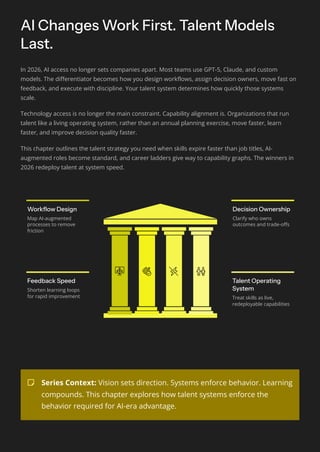
In 2026, AI access no longer sets companies apart. Most teams use GPT-5, Claude, and custom
models. The differentiator becomes how you design workflows, assign decision owners, move fast on
feedback, and execute with discipline. Your talent system determines how quickly those systems
scale.
Technology access is no longer the main constraint. Capability alignment is. Organizations that run
talent like a living operating system, rather than an annual planning exercise, move faster, learn
faster, and improve decision quality faster.
This chapter outlines the talent strategy you need when skills expire faster than job titles, AI-
augmented roles become standard, and career ladders give way to capability graphs. The winners in
2026 redeploy talent at system speed.
Workflow Design
Map AI-augmented
processes to remove
friction
Decision Ownership
Clarify who owns
outcomes and trade-offs
Feedback Speed
Shorten learning loops
for rapid improvement
Talent Operating
System
Treat skills as live,
redeployable capabilities
Series Context: Vision sets direction. Systems enforce behavior. Learning
compounds. This chapter explores how talent systems enforce the
behavior required for AI-era advantage.
3.
The Career LadderWas Built for Stable
Environments. 2026 Is Not Stable.
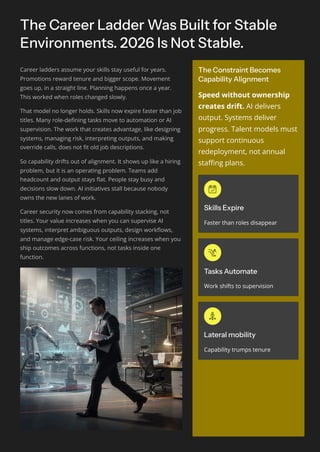
Career ladders assume your skills stay useful for years.
Promotions reward tenure and bigger scope. Movement
goes up, in a straight line. Planning happens once a year.
This worked when roles changed slowly.
That model no longer holds. Skills now expire faster than job
titles. Many role-defining tasks move to automation or AI
supervision. The work that creates advantage, like designing
systems, managing risk, interpreting outputs, and making
override calls, does not fit old job descriptions.
So capability drifts out of alignment. It shows up like a hiring
problem, but it is an operating problem. Teams add
headcount and output stays flat. People stay busy and
decisions slow down. AI initiatives stall because nobody
owns the new lanes of work.
Career security now comes from capability stacking, not
titles. Your value increases when you can supervise AI
systems, interpret ambiguous outputs, design workflows,
and manage edge-case risk. Your ceiling increases when you
ship outcomes across functions, not tasks inside one
function.
The Constraint Becomes
Capability Alignment
Speed without ownership
creates drift. AI delivers
output. Systems deliver
progress. Talent models must
support continuous
redeployment, not annual
staffing plans.
Skills Expire
Faster than roles disappear
Tasks Automate
Work shifts to supervision
Lateral mobility
Capability trumps tenure
4.
Prediction 1: SkillHalf-Life Drops Below
Role Half-Life
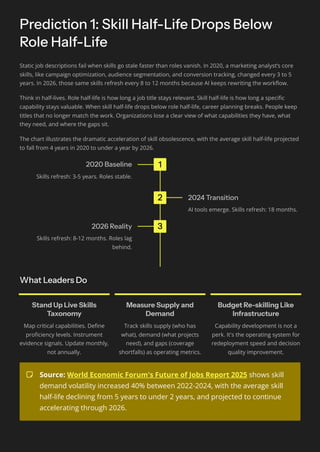
Static job descriptions fail when skills go stale faster than roles vanish. In 2020, a marketing analyst’s core
skills, like campaign optimization, audience segmentation, and conversion tracking, changed every 3 to 5
years. In 2026, those same skills refresh every 8 to 12 months because AI keeps rewriting the workflow.
Think in half-lives. Role half-life is how long a job title stays relevant. Skill half-life is how long a specific
capability stays valuable. When skill half-life drops below role half-life, career planning breaks. People keep
titles that no longer match the work. Organizations lose a clear view of what capabilities they have, what
they need, and where the gaps sit.
The chart illustrates the dramatic acceleration of skill obsolescence, with the average skill half-life projected
to fall from 4 years in 2020 to under a year by 2026.
1
2020 Baseline
Skills refresh: 3-5 years. Roles stable.
2 2024 Transition
AI tools emerge. Skills refresh: 18 months.
3
2026 Reality
Skills refresh: 8-12 months. Roles lag
behind.
What Leaders Do
Stand Up Live Skills
Taxonomy
Map critical capabilities. Define
proficiency levels. Instrument
evidence signals. Update monthly,
not annually.
Measure Supply and
Demand
Track skills supply (who has
what), demand (what projects
need), and gaps (coverage
shortfalls) as operating metrics.
Budget Re-skilling Like
Infrastructure
Capability development is not a
perk. It's the operating system for
redeployment speed and decision
quality improvement.
Source: World Economic Forum's Future of Jobs Report 2025 shows skill
demand volatility increased 40% between 2022-2024, with the average skill
half-life declining from 5 years to under 2 years, and projected to continue
accelerating through 2026.
5.
Prediction 2: CareerLadders Collapse Into
Capability Graphs
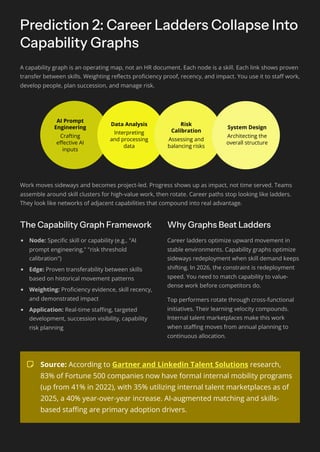
A capability graph is an operating map, not an HR document. Each node is a skill. Each link shows proven
transfer between skills. Weighting reflects proficiency proof, recency, and impact. You use it to staff work,
develop people, plan succession, and manage risk.
AI Prompt
Engineering
Crafting
effective AI
inputs
Data Analysis
Interpreting
and processing
data
Risk
Calibration
Assessing and
balancing risks
System Design
Architecting the
overall structure
Work moves sideways and becomes project-led. Progress shows up as impact, not time served. Teams
assemble around skill clusters for high-value work, then rotate. Career paths stop looking like ladders.
They look like networks of adjacent capabilities that compound into real advantage.
The Capability Graph Framework
Node: Specific skill or capability (e.g., "AI
prompt engineering," "risk threshold
calibration")
Edge: Proven transferability between skills
based on historical movement patterns
Weighting: Proficiency evidence, skill recency,
and demonstrated impact
Application: Real-time staffing, targeted
development, succession visibility, capability
risk planning
Why Graphs Beat Ladders
Career ladders optimize upward movement in
stable environments. Capability graphs optimize
sideways redeployment when skill demand keeps
shifting. In 2026, the constraint is redeployment
speed. You need to match capability to value-
dense work before competitors do.
Top performers rotate through cross-functional
initiatives. Their learning velocity compounds.
Internal talent marketplaces make this work
when staffing moves from annual planning to
continuous allocation.
Source: According to Gartner and Linkedin Talent Solutions research,
83% of Fortune 500 companies now have formal internal mobility programs
(up from 41% in 2022), with 35% utilizing internal talent marketplaces as of
2025, a 40% year-over-year increase. AI-augmented matching and skills-
based staffing are primary adoption drivers.
6.
Prediction 3: AI-AugmentedRoles
Become the Default
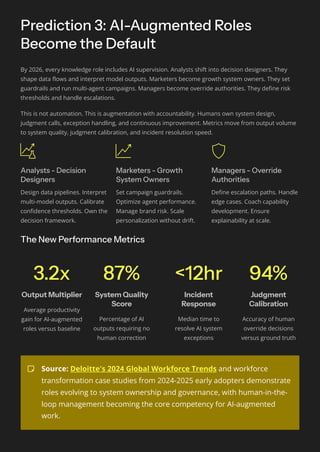
By 2026, every knowledge role includes AI supervision. Analysts shift into decision designers. They
shape data flows and interpret model outputs. Marketers become growth system owners. They set
guardrails and run multi-agent campaigns. Managers become override authorities. They define risk
thresholds and handle escalations.
This is not automation. This is augmentation with accountability. Humans own system design,
judgment calls, exception handling, and continuous improvement. Metrics move from output volume
to system quality, judgment calibration, and incident resolution speed.
Analysts - Decision
Designers
Design data pipelines. Interpret
multi-model outputs. Calibrate
confidence thresholds. Own the
decision framework.
Marketers - Growth
System Owners
Set campaign guardrails.
Optimize agent performance.
Manage brand risk. Scale
personalization without drift.
Managers - Override
Authorities
Define escalation paths. Handle
edge cases. Coach capability
development. Ensure
explainability at scale.
The New Performance Metrics
3.2x
Output Multiplier
Average productivity
gain for AI-augmented
roles versus baseline
87%
System Quality
Score
Percentage of AI
outputs requiring no
human correction
<12hr
Incident
Response
Median time to
resolve AI system
exceptions
94%
Judgment
Calibration
Accuracy of human
override decisions
versus ground truth
Source: Deloitte's 2024 Global Workforce Trends and workforce
transformation case studies from 2024-2025 early adopters demonstrate
roles evolving to system ownership and governance, with human-in-the-
loop management becoming the core competency for AI-augmented
work.
7.
Predictions 4: TheTalent Operating
Model Transforms
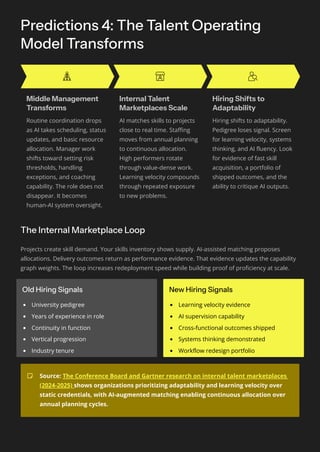
Middle Management
Transforms
Routine coordination drops
as AI takes scheduling, status
updates, and basic resource
allocation. Manager work
shifts toward setting risk
thresholds, handling
exceptions, and coaching
capability. The role does not
disappear. It becomes
human-AI system oversight.
Internal Talent
Marketplaces Scale
AI matches skills to projects
close to real time. Staffing
moves from annual planning
to continuous allocation.
High performers rotate
through value-dense work.
Learning velocity compounds
through repeated exposure
to new problems.
Hiring Shifts to
Adaptability
Hiring shifts to adaptability.
Pedigree loses signal. Screen
for learning velocity, systems
thinking, and AI fluency. Look
for evidence of fast skill
acquisition, a portfolio of
shipped outcomes, and the
ability to critique AI outputs.
The Internal Marketplace Loop
Projects create skill demand. Your skills inventory shows supply. AI-assisted matching proposes
allocations. Delivery outcomes return as performance evidence. That evidence updates the capability
graph weights. The loop increases redeployment speed while building proof of proficiency at scale.
Old Hiring Signals
University pedigree
Years of experience in role
Continuity in function
Vertical progression
Industry tenure
New Hiring Signals
Learning velocity evidence
AI supervision capability
Cross-functional outcomes shipped
Systems thinking demonstrated
Workflow redesign portfolio
Source: The Conference Board and Gartner research on internal talent marketplaces
(2024-2025) shows organizations prioritizing adaptability and learning velocity over
static credentials, with AI-augmented matching enabling continuous allocation over
annual planning cycles.
8.
Prediction 5: CompensationModels and
Board Oversight Evolve
Compensation Models Evolve
Pay reflects contribution across systems, not
narrow task output. Base salary anchors to role
complexity. A capability premium rewards breadth
and verified proficiency in high-demand skill
clusters. An impact share ties pay to cross-
functional outcomes and measurable
improvements in decision quality.
Incentives reward capability expansion. People
who build adjacent skills and rotate through high-
value initiatives see faster compensation growth.
Decision quality improvement, proven through
before-and-after workflow results, becomes
something you pay for.
“Tools deliver output. Systems deliver progress.
Compensation should reward system
contribution, not individual throughput.”
Talent Risk Becomes a Board Issue
Skills volatility creates strategic exposure. A sudden
capability gap can delay launches, raise compliance
risk, or hand advantage to a competitor. Boards
want visibility into capability coverage, AI
readiness, and upskilling throughput.
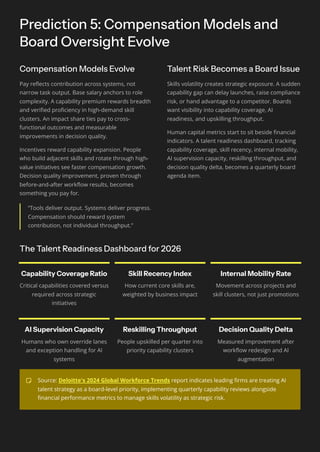
Human capital metrics start to sit beside financial
indicators. A talent readiness dashboard, tracking
capability coverage, skill recency, internal mobility,
AI supervision capacity, reskilling throughput, and
decision quality delta, becomes a quarterly board
agenda item.
The Talent Readiness Dashboard for 2026
Capability Coverage Ratio
Critical capabilities covered versus
required across strategic
initiatives
Skill Recency Index
How current core skills are,
weighted by business impact
Internal Mobility Rate
Movement across projects and
skill clusters, not just promotions
AI Supervision Capacity
Humans who own override lanes
and exception handling for AI
systems
Reskilling Throughput
People upskilled per quarter into
priority capability clusters
Decision Quality Delta
Measured improvement after
workflow redesign and AI
augmentation
Source: Deloitte's 2024 Global Workforce Trends report indicates leading firms are treating AI
talent strategy as a board-level priority, implementing quarterly capability reviews alongside
financial performance metrics to manage skills volatility as strategic risk.
9.
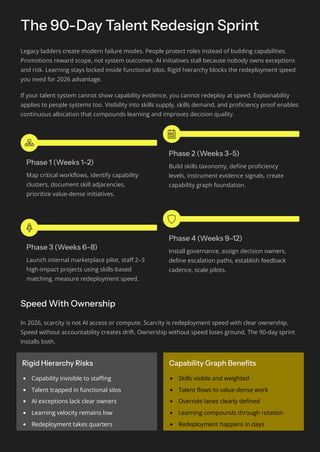
The 90-Day TalentRedesign Sprint
Legacy ladders create modern failure modes. People protect roles instead of building capabilities.
Promotions reward scope, not system outcomes. AI initiatives stall because nobody owns exceptions
and risk. Learning stays locked inside functional silos. Rigid hierarchy blocks the redeployment speed
you need for 2026 advantage.
If your talent system cannot show capability evidence, you cannot redeploy at speed. Explainability
applies to people systems too. Visibility into skills supply, skills demand, and proficiency proof enables
continuous allocation that compounds learning and improves decision quality.
Phase 1 (Weeks 1–2)
Map critical workflows, identify capability
clusters, document skill adjacencies,
prioritize value-dense initiatives.
Phase 2 (Weeks 3–5)
Build skills taxonomy, define proficiency
levels, instrument evidence signals, create
capability graph foundation.
Phase 3 (Weeks 6–8)
Launch internal marketplace pilot, staff 2–3
high-impact projects using skills-based
matching, measure redeployment speed.
Phase 4 (Weeks 9–12)
Install governance, assign decision owners,
define escalation paths, establish feedback
cadence, scale pilots.
Speed With Ownership
In 2026, scarcity is not AI access or compute. Scarcity is redeployment speed with clear ownership.
Speed without accountability creates drift. Ownership without speed loses ground. The 90-day sprint
installs both.
Rigid Hierarchy Risks
Capability invisible to staffing
Talent trapped in functional silos
AI exceptions lack clear owners
Learning velocity remains low
Redeployment takes quarters
Capability Graph Benefits
Skills visible and weighted
Talent flows to value-dense work
Override lanes clearly defined
Learning compounds through rotation
Redeployment happens in days
10.
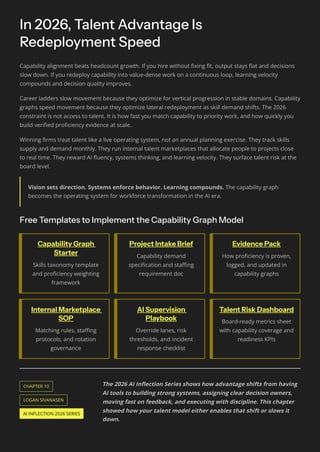
In 2026, TalentAdvantage Is
Redeployment Speed
Capability alignment beats headcount growth. If you hire without fixing fit, output stays flat and decisions
slow down. If you redeploy capability into value-dense work on a continuous loop, learning velocity
compounds and decision quality improves.
Career ladders slow movement because they optimize for vertical progression in stable domains. Capability
graphs speed movement because they optimize lateral redeployment as skill demand shifts. The 2026
constraint is not access to talent. It is how fast you match capability to priority work, and how quickly you
build verified proficiency evidence at scale.
Winning firms treat talent like a live operating system, not an annual planning exercise. They track skills
supply and demand monthly. They run internal talent marketplaces that allocate people to projects close
to real time. They reward AI fluency, systems thinking, and learning velocity. They surface talent risk at the
board level.
Vision sets direction. Systems enforce behavior. Learning compounds. The capability graph
becomes the operating system for workforce transformation in the AI era.
Free Templates to Implement the Capability Graph Model
Capability Graph
Starter
Skills taxonomy template
and proficiency weighting
framework
Project Intake Brief
Capability demand
specification and staffing
requirement doc
Evidence Pack
How proficiency is proven,
logged, and updated in
capability graphs
Internal Marketplace
SOP
Matching rules, staffing
protocols, and rotation
governance
AI Supervision
Playbook
Override lanes, risk
thresholds, and incident
response checklist
Talent Risk Dashboard
Board-ready metrics sheet
with capability coverage and
readiness KPIs
CHAPTER 10
LOGAN SIVANASEN
AI INFLECTION 2026 SERIES
The 2026 AI Inflection Series shows how advantage shifts from having
AI tools to building strong systems, assigning clear decision owners,
moving fast on feedback, and executing with discipline. This chapter
showed how your talent model either enables that shift or slows it
down.