Healthcare technologies refers to the application of digital,electronic and intelligent systems to support the delivery of healthcare services.
These technologies enhance diagnostic accuracy, improve clinical desicion making and facilitate efficient management of health information.
DAR ES SALAAMINSTITUTE OF TECHNOLOGY
DEPARTMENT OF ELECTRICAL ENGINEERING
BACHELOR OF ENGINEERING IN BIOMEDICAL ENGINEERING
TELEMEDICINE TECHNOLOGIES (BEU 08114)
GROUPASSIGNMENT ONE
GROUP MEMBERS
S/N NAMES REG NO.
01. SAMBAI PETRO EDWARD 23034446417
02. IRENE EDWARD RUHUMBIKA 23034475150
03. FREDNAND MAKORE GWENCWHERE 23034494359
04. MARTIN M. RWEGOSHORA 23034403087
05. GRACE ANTHONY MAGANGA 23034415644
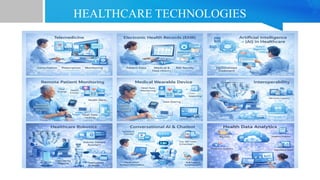
HEALTHCARE TECHNOLOGIES
Healthcare technologyrefers to the application of digital, electronic, and
intelligent systems to support the delivery of healthcare services. These
technologies enhance diagnostic accuracy, improve clinical decision-
making, and facilitate efficient management of health information.
The integration of healthcare technologies also increases access to medical
services and supports patient-centered care. Understanding the major types
of healthcare technologies is essential for appreciating how modern
healthcare systems improve quality, efficiency, and health outcomes.
ARTIFICIAL INTELLIGENCE (AI)
ArtificialIntelligence refers to computer systems that are able to learn
from medical data and assist healthcare professionals in making decisions.
In healthcare, AI is widely used in diagnosis, treatment planning, and
research.
For example: AI algorithms can analyze medical images such as X-rays,
CT scans, or mammograms and identify abnormal patterns that may
indicate diseases like cancer. This helps doctors detect illnesses earlier and
faster. AI is also used in robotic surgery, where surgeons control AI-assisted
robotic arms to perform very precise procedures, reducing human error and
improving patient outcomes.
6.
BLOCKCHAIN TECHNOLOGY
Blockchain isa secure digital system used to store and share health
information in a transparent and tamper-proof way. Each medical record is
stored as a block of data that cannot be changed without permission, which
increases trust and data security. In healthcare, blockchain can be used to
store electronic health records (EHRs) so that patients, doctors, and
pharmacists can access the same accurate information when authorized.
For example: Pharmacists can use blockchain to track the origin of
medicines, helping to prevent counterfeit drugs from entering the
healthcare system.
7.
CLOUD COMPUTING
Cloud computingallows healthcare organizations to store data and run
software on online servers instead of local hospital computers. This makes
health information easily accessible from different locations at any time.
Doctors, nurses, and patients can securely access medical records, test
results, and treatment plans using internet-connected devices.
For example: A doctor in one hospital can review a patient’s lab results
that were uploaded to the cloud by another clinic. Cloud technology also
reduces costs because hospitals do not need to maintain complex computer
systems on their own.
8.
TELEMEDICINE (TELE-HEALTH)
Telemedicine isthe use of communication technologies such as video
calls, mobile apps, and online portals to provide healthcare services from a
distance. It allows patients to consult doctors without physically visiting a
hospital, which saves time and reduces travel costs. Telemedicine is
especially useful for follow-up visits, chronic disease management, and
patients in remote areas.
For example: A patient can discuss test results with a doctor through a
video call and receive medical advice without leaving home.
9.
REMOTE PATIENT MONITORING
Remotepatient monitoring is a healthcare technology that allows doctors
to monitor a patient’s health condition while the patient stays at home. This
is done using medical devices that measure vital signs such as heart rate,
blood pressure, glucose levels, or oxygen saturation. The collected data is
sent electronically to healthcare providers for review.
For example: A heart patient may wear a sensor that continuously
monitors heart activity and alerts the doctor if an abnormal reading occurs.
This improves continuous care and reduces unnecessary hospital visits.
10.
MEDICAL WEARABLE DEVICES
Medicalwearables are electronic devices worn on the body to collect real-
time health data. These devices help track physical activity, vital signs, and
disease-related information over time. Wearables are useful for both
patients and healthcare providers because they provide continuous
monitoring.
For example: A smart watch can measure heart rate and oxygen levels and
notify the user or doctor if there is a potential health risk. Medical
wearables support preventive healthcare and early detection of health
problems.
11.
INTEROPERABILITY IN HEALTHCARE
Interoperabilityrefers to the ability of different healthcare information
systems to communicate, share, and use patient data effectively. This is
important because patients often receive care from multiple healthcare
facilities that may use different software systems. When systems are
interoperable, healthcare providers can access complete and accurate
patient information, improving care coordination.
For example: A patient’s medical history recorded at a clinic can be
accessed by a hospital during an emergency, allowing doctors to make
informed decisions quickly.
12.
HEALTHCARE ROBOTICS
Healthcare roboticsinvolves the use of robotic systems to assist medical
professionals in diagnosis, surgery, and patient care. These robots improve
precision, reduce physical strain on doctors, and enhance patient safety. In
surgery, robots allow minimally invasive procedures by using small
incisions and highly controlled movements.
For example: Robotic-assisted surgery enables surgeons to operate with
greater accuracy while viewing the surgical area in high-definition 3D,
leading to faster recovery times for patients.
13.
CONVERSATIONAL AI ANDCHATBOTS
Conversational AI uses intelligent computer programs called chatbots to
communicate with patients and provide basic healthcare services. These
systems can answer common health questions, schedule appointments, send
medication reminders, and provide post-treatment instructions. Chatbots
improve efficiency in hospitals by reducing the workload of healthcare
staff.
For example: A patient can interact with a hospital chatbot to book an
appointment or request a prescription refill without calling the hospital.
14.
HEALTH DATAANALYTICS
Health dataanalytics involves analyzing large amounts of health data to
identify trends, patterns, and risk factors in populations. This technology
helps healthcare organizations and governments improve disease
prevention and public health planning. By analyzing data from hospitals,
clinics, and wearable devices, health professionals can predict disease
outbreaks and improve treatment strategies.
For example: Data analytics can be used to identify communities at higher
risk of diabetes, allowing early intervention programs to be implemented.
TELEHEALTH & TELEMEDICINESTANDARDS
Telehealth and telemedicine require well-defined standards to ensure the
safe, ethical, and effective delivery of healthcare services through digital
platforms. These standards address key areas such as patient safety, data
privacy, professional accountability, and quality of care.
They are based on internationally accepted principles recommended by the
World Health Organization and implemented by healthcare regulators
worldwide. Understanding these standards is essential for promoting
reliable and high-quality telemedicine practices.
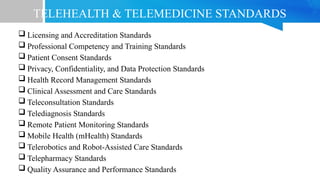
17.
TELEHEALTH & TELEMEDICINESTANDARDS
Licensing and Accreditation Standards
Professional Competency and Training Standards
Patient Consent Standards
Privacy, Confidentiality, and Data Protection Standards
Health Record Management Standards
Clinical Assessment and Care Standards
Teleconsultation Standards
Telediagnosis Standards
Remote Patient Monitoring Standards
Mobile Health (mHealth) Standards
Telerobotics and Robot-Assisted Care Standards
Telepharmacy Standards
Quality Assurance and Performance Standards
18.
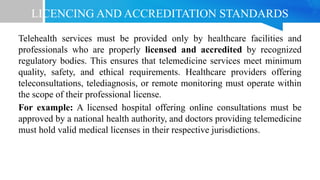
LICENCING AND ACCREDITATIONSTANDARDS
Telehealth services must be provided only by healthcare facilities and
professionals who are properly licensed and accredited by recognized
regulatory bodies. This ensures that telemedicine services meet minimum
quality, safety, and ethical requirements. Healthcare providers offering
teleconsultations, telediagnosis, or remote monitoring must operate within
the scope of their professional license.
For example: A licensed hospital offering online consultations must be
approved by a national health authority, and doctors providing telemedicine
must hold valid medical licenses in their respective jurisdictions.
19.
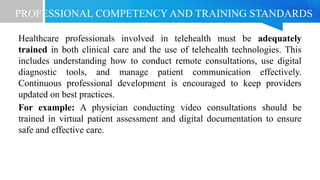
PROFESSIONAL COMPETENCY ANDTRAINING STANDARDS
Healthcare professionals involved in telehealth must be adequately
trained in both clinical care and the use of telehealth technologies. This
includes understanding how to conduct remote consultations, use digital
diagnostic tools, and manage patient communication effectively.
Continuous professional development is encouraged to keep providers
updated on best practices.
For example: A physician conducting video consultations should be
trained in virtual patient assessment and digital documentation to ensure
safe and effective care.
20.
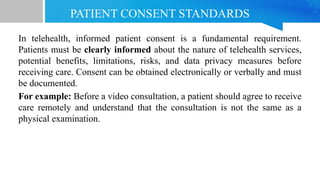
PATIENT CONSENT STANDARDS
Intelehealth, informed patient consent is a fundamental requirement.
Patients must be clearly informed about the nature of telehealth services,
potential benefits, limitations, risks, and data privacy measures before
receiving care. Consent can be obtained electronically or verbally and must
be documented.
For example: Before a video consultation, a patient should agree to receive
care remotely and understand that the consultation is not the same as a
physical examination.
21.
PRIVACY,CONFIDENTIALITY & DATAPROTECTION STANDARDS
Telehealth systems must protect patient information through secure data
transmission, storage, and access control. International standards
emphasize encryption, user authentication, and restricted access to health
records. Patient data must not be shared without authorization.
For example: A telemedicine platform should use encrypted video calls
and secure servers to prevent unauthorized access to medical records.
22.
HEALTH RECORD MANAGEMENTSTANDARDS
All telehealth encounters must be properly documented in the patient’s
health record, just like face-to-face consultations. Records should include
consultation details, diagnosis, treatment, prescriptions, and follow-up
plans. These records must be stored securely and retained according to
national regulations.
For example: A doctor conducting an online consultation should document
the interaction in the electronic health record for future reference and
continuity of care.
23.
CLINICAL ASSESSMENT ANDCARE STANDARDS
Telehealth services must follow established clinical guidelines to ensure
patient safety and quality of care. Healthcare providers must determine
whether a patient’s condition is suitable for telehealth or requires in-person
care. Emergency conditions are generally excluded from telemedicine.
For example: A doctor may manage a stable chronic condition remotely
but refer a patient with severe chest pain to an emergency facility.
24.
TELECONSULTATION STANDARDS
Teleconsultations shouldbe conducted using reliable communication
technologies that allow clear audio and video interaction. Patient identity
must be verified, and consultations should be led by qualified healthcare
professionals. Teleconsultations should maintain the same professional
and ethical standards as in-person visits.
For example: A patient may consult a doctor via a secure video platform to
discuss symptoms and receive medical advice.
25.
TELEDIAGNOSIS STANDARDS
Telediagnosis involvesdiagnosing patients using transmitted medical data
such as images, test results, or vital signs. Standards require the use of
certified medical devices, high-quality data transmission, and qualified
professionals to interpret the information.
For example: A radiologist may analyze X-ray images sent electronically
from a remote clinic to make a diagnosis.
26.
REMOTE PATIENT MONITORINGSTANDARDS
Remote patient monitoring allows healthcare providers to track patient
health data outside traditional clinical settings. Standards require reliable
devices, accurate data collection, patient education, and clear response
protocols for abnormal readings.
For example: A patient with hypertension may use a blood pressure
monitor at home that sends readings to the doctor for ongoing assessment.
27.
MOBILE HEALTH(mHealth)STANDARDS
Mobile healthapplications must comply with medical device regulations,
data security requirements, and clinical guidelines. These applications
should support accurate data collection, patient engagement, and
integration with health systems.
For example: A mobile app that tracks glucose levels should be approved
by relevant authorities and securely transmit data to healthcare providers.
28.
TELEROBOTICS & ROBOT-ASSISTEDCARE STANDARDS
Telerobotic systems used in healthcare must meet strict safety, technical,
and professional standards. These systems should be operated by trained
specialists and supported by reliable communication networks.
For example: A surgeon may use robotic technology to assist in a
procedure while controlling the system remotely, ensuring precision and
patient safety.
29.
TELEPHARMACY STANDARDS
Telepharmacy servicesmust ensure safe prescribing, dispensing, and
counseling of medications. Standards require verification of prescriptions,
patient education, and restrictions on controlled drugs. Secure systems
must be used for medication management and delivery.
For example: A pharmacist may provide medication counseling through a
video call and arrange home delivery of prescribed drugs.
30.
QUALITY, ASSURANCE &PERFORMANCE STANDARDS
Telehealth services must be regularly monitored and evaluated to ensure
quality, safety, and patient satisfaction. This includes tracking performance
indicators, reporting incidents, and continuously improving services.
For example: Healthcare organizations may assess patient feedback and
response times to improve telemedicine services.