Chapter 46
1. Implant fractures
2. Implant complications
3. Abutment and abutment screw complications
4. Residual cement as a technical problem
5. Prosthesis attrition and fracture
6. Prevention of technical complications
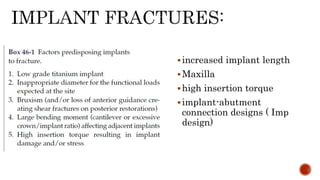
increased implant length
Maxilla
high insertion torque
implant-abutment
connection designs ( Imp
design)
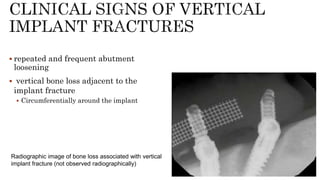
 repeated and frequent abutment
loosening
 vertical bone loss adjacent to the
implant fracture
 Circumferentially around the implant
Radiographic image of bone loss associated with vertical
implant fracture (not observed radiographically)
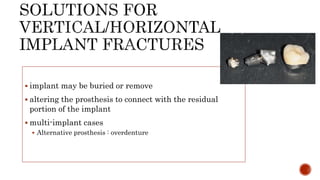
 implant may be buried or remove
 altering the prosthesis to connect with the residual
portion of the implant
 multi-implant cases
 Alternative prosthesis : overdenture
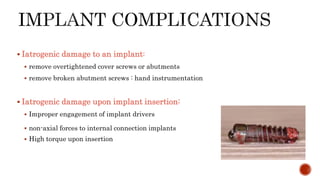
 Iatrogenic damage to an implant:
 remove overtightened cover screws or abutments
 remove broken abutment screws : hand instrumentation
 Iatrogenic damage upon implant insertion:
 Improper engagement of implant drivers
 non-axial forces to internal connection implants
 High torque upon insertion
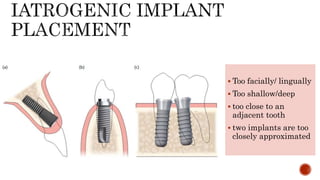
 Too facially/ lingually
 Too shallow/deep
 too close to an
adjacent tooth
 two implants are too
closely approximated
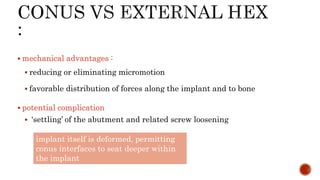
 mechanical advantages :
 reducing or eliminating micromotion
 favorable distribution of forces along the implant and to bone
 potential complication
 ‘settling’ of the abutment and related screw loosening
implant itself is deformed, permitting
conus interfaces to seat deeper within
the implant
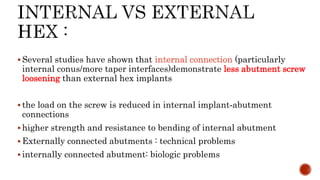
 Several studies have shown that internal connection (particularly
internal conus/more taper interfaces)demonstrate less abutment screw
loosening than external hex implants
 the load on the screw is reduced in internal implant‐abutment
connections
 higher strength and resistance to bending of internal abutment
 Externally connected abutments : technical problems
 internally connected abutment: biologic problems
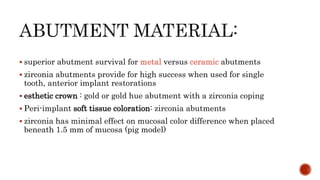
 superior abutment survival for metal versus ceramic abutments
 zirconia abutments provide for high success when used for single
tooth, anterior implant restorations
 esthetic crown : gold or gold hue abutment with a zirconia coping
 Peri-implant soft tissue coloration: zirconia abutments
 zirconia has minimal effect on mucosal color difference when placed
beneath 1.5 mm of mucosa (pig model)
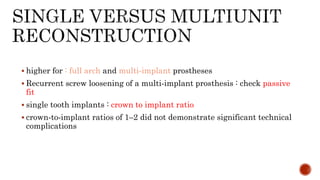
 higher for : full arch and multi‐implant prostheses
 Recurrent screw loosening of a multi‐implant prosthesis : check passive
fit
 single tooth implants : crown to implant ratio
 crown‐to‐implant ratios of 1–2 did not demonstrate significant technical
complications
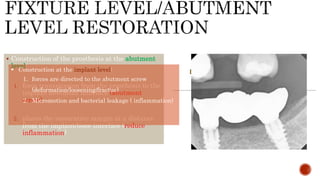
 Construction of the prosthesis at the abutment
level:
1. force transmission from the prosthesis to the
implant abutment interface (abutment
screw)
2. places the restorative margin at a distance
from the implant/bone interface (reduce
inflammation)
 Construction at the implant level:
1. forces are directed to the abutment screw
(deformation/loosening/fractue)
2. Micromotion and bacterial leakage ( inflammation)
 Proper cementation:
1. shallow crown margin locations circumferentially (<1.0 mm)
2. Cementation techniques : venting of crowns, monolayer application with brush
3. Where peri‐implant mucositis is observed : cause must be the presence of residual cement
 Type of cement
 zinc oxide eugenol vs resin cements
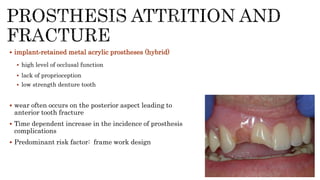
 implant‐retained metal acrylic prostheses (hybrid)
 high level of occlusal function
 lack of proprioception
 low strength denture tooth
 wear often occurs on the posterior aspect leading to
anterior tooth fracture
 Time dependent increase in the incidence of prosthesis
complications
 Predominant risk factor: frame work design
 porcelain-fused-to-metal prosthsesis:
 high porcelain chipping complication
 increased risk of chipping was greater for (× 4.6) for ceramic versus metalacrylic type
prosthesis
 Increased ceramic chipping
 Bruxism
 Absence of nightguard use
 higher rates of mechanical (and biologic) complications were observed for cement-retained
prostheses
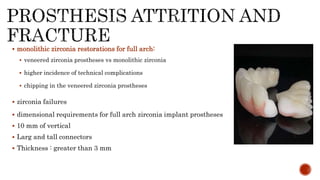
 monolithic zirconia restorations for full arch:
 veneered zirconia prostheses vs monolithic zirconia
 higher incidence of technical complications
 chipping in the veneered zirconia prostheses
 zirconia failures
 dimensional requirements for full arch zirconia implant prostheses
 10 mm of vertical
 Larg and tall connectors
 Thickness : greater than 3 mm
Technical Complications in implant dentistry46.pptx