INTRODUCTION
Teaching-learning are essentialcomponents of
education process. In fact, teaching and learning are
equally important in Nursing education Teaching is the
task of a teacher to impart knowledge, develop attitude
and skills in students whereas learning is the outcome
of effective teaching in terms of developing activities,
progressive change in behaviour because of mental
activities by students.
3.
It is importantfor the teacher
needs to know teaching and
learning aspects of nursing
education.
The communication process
plays a very important role in
teaching-learning process. It is
necessary for a teacher to
understand the concept and
process of communication
4.
DEFINITIONS
TEACHING: Teaching isanactive process in which one person shares
information with others to provide them with the information to
make behavioral changes.
LEARNING: Learningis the process of assimilating information with a
resultant change in behavior.
5.
TEACHING-LEARNING
PROCESS
Teaching and learningprocess can be defined as a
transformation process of knowledge from
teachers to students. Teaching-learning process is
a planned interaction that promotes behavioral
change that is not a result of maturation and
coincidence.
Principles of Teaching
•Principle of Aim: Teaching should always have a clear and well-
planned aim. Before starting any lesson or unit, the teacher must
clearly define why the topic is being taught and what outcomes are
expected. The objectives should help students understand how the
lesson will benefit them in their professional growth as well as
personal development. When learners are aware of the purpose of
learning, they become more motivated, focused, and engaged.
8.
• Principle ofActivity (Learning by Doing)The principle of
activity emphasizes that students learn best through active
participation. Most educational institutions focus on
practical tasks because learning becomes more effective
when students see, perform, and experience the activity
themselves. As the saying goes, “We see, we learn; we do,
we remember.” Practical demonstrations, hands-on training,
and clinical practice are essential to help students gain
competence, confidence, and real-life application of
knowledge.
9.
• Principle ofLinking with Life and Other Subjects:
Learning becomes more meaningful when it relates to real-
life situations and related subjects. When students can
relate new knowledge to their daily life experiences and
previously learned concepts from other subjects,
understanding becomes deeper and retention improves.
This integration helps learners see the practical relevance of
what they are studying, making learning easier and more
long-lasting.
10.
• Principle ofPlanning: Effective teaching requires systematic planning.
Before delivering any lesson or presentation, the teacher should prepare
proper lesson plans, notes, or scripts. Good planning ensures logical
sequencing of content, efficient use of time, and clarity in presentation.
Well-planned teaching always leads to better organization and improved
learning outcomes.
• Principle of Interest or Motivation: The principle of interest or
motivation is considered one of the most important principles of
teaching. Learning largely depends on the learner’s attention, interest,
and willingness to learn. Students can absorb and retain knowledge only
when they are motivated and actively engaged. A motivated learner
remains focused, participates actively, and shows better understanding
and performance.
11.
• Principle ofSympathy and Kindly Atmosphere: Effective teaching cannot
take place in an environment that lacks sympathy, understanding, and
kindness. A supportive and friendly atmosphere helps students feel safe,
respected, and confident to express their doubts and ideas. When teachers
show empathy and concern, students develop trust, which enhances learning
and participation.
• Principle of Creativity: A good teacher presents content in a creative and
interesting manner to make learning enjoyable and meaningful. Creativity in
teaching encourages critical thinking and problem-solving skills. For example,
in nursing education, students can be given signs and symptoms of a patient
and asked to plan treatment according to priority needs.
• Principle of Flexibility and Cooperation: Teaching should not be rigid or
inflexible. While planning a lesson, the teacher must consider both fast
learners and weaker students. The lesson plan should allow scope for
modification and adjustment based on students’ learning needs. Flexibility
and cooperation between the teacher and students ensure inclusive,
effective, and learner-centered teaching.
12.
• Principle ofSelection of Teaching Material: The success
of teaching largely depends on the proper selection of
content. Teaching material should be relevant, accurate,
need-based, and appropriate to the learner’s level. Right
selection of material leads to effective teaching and helps in
achieving desired learning outcomes, benefiting both
teachers and students.
• Principle of Gradation (From Simple to Complex)Teaching
should proceed from easy to difficult, simple to complex,
and known to unknown.
13.
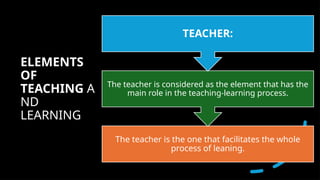
ELEMENTS
OF
TEACHING A
ND
LEARNING
The teacheris the one that facilitates the whole
process of leaning.
The teacher is considered as the element that has the
main role in the teaching-learning process.
TEACHER:
14.
LEARNERS:
The learners areconsidered as the key
participant in the teaching and learning
process. They are considered as the
primary subject or the main reason why
the process is implemented.
15.
MILIEU:
• The LearningEnvironment, Since learning is
triggered off by stimuli in the environment, it
assumes primary importance in teaching
and learning.
• The classroom is the usual although not the
exclusive environment of learning at school.
Teachers need to make the learning
environment as "stimulating" as possible.
Every stimulus in the classroom should
contribute to learning.
16.
Matter:
• The Contentof Learning, This refers
to what is to be learned as specified in
the instructional objective.
• The teacher should make sure that the
minimum standard or level of
proficiency is attained by the class
before moving onto the next lesson or
unit.
• Curriculum makers are advised to be
realistic in projecting subject matter
and avoid giving the students "too
much, too soon.
17.
METHOD:
• The teaching-learningStrategy, This
consist of purposeful, planned
activities and tasks that are
undertaken by the teacher and the
students in the classroom.
18.
MATERIAL:
• The Materialsare resources available to the
teacher and learners which serve as stimuli
in the teaching-learning situation.
MEDIA:
• Communication in Teaching and Learning,
This pertains to the communication system
in the teaching-learning situation.
19.
MASTERY:
• Mastery comesthrough a "fixation" of
what is to be learned, shifting it from
short-term to long- term memory
20.
• PRACTICE: "Practicemakes a man
perfect"- the proverb implies the
importance of repetition in bringing
certain habits up to the point where
they come naturally to him.
21.
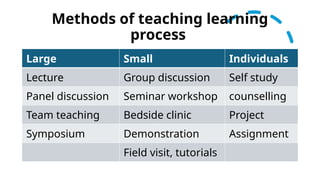
Methods of teachinglearning
process
Large Small Individuals
Lecture Group discussion Self study
Panel discussion Seminar workshop counselling
Team teaching Bedside clinic Project
Symposium Demonstration Assignment
Field visit, tutorials
22.
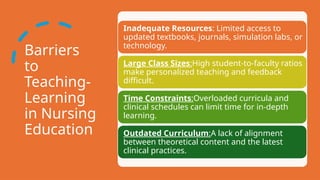
Barriers
to
Teaching-
Learning
in Nursing
Education
Inadequate Resources:Limited access to
updated textbooks, journals, simulation labs, or
technology.
Large Class Sizes:High student-to-faculty ratios
make personalized teaching and feedback
difficult.
Time Constraints:Overloaded curricula and
clinical schedules can limit time for in-depth
learning.
Outdated Curriculum:A lack of alignment
between theoretical content and the latest
clinical practices.
23.
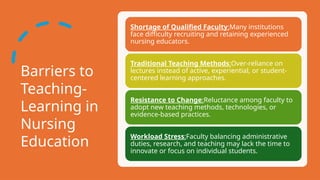
Shortage of QualifiedFaculty:Many institutions
face difficulty recruiting and retaining experienced
nursing educators.
Traditional Teaching Methods:Over-reliance on
lectures instead of active, experiential, or student-
centered learning approaches.
Resistance to Change:Reluctance among faculty to
adopt new teaching methods, technologies, or
evidence-based practices.
Workload Stress:Faculty balancing administrative
duties, research, and teaching may lack the time to
innovate or focus on individual students.
Barriers to
Teaching-
Learning in
Nursing
Education
24.
Barriers
to
Teaching-
Learning
in Nursing
Education
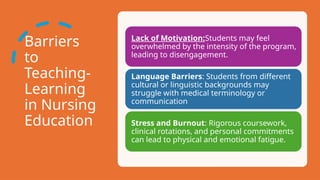
Lack ofMotivation:Students may feel
overwhelmed by the intensity of the program,
leading to disengagement.
Language Barriers: Students from different
cultural or linguistic backgrounds may
struggle with medical terminology or
communication
Stress and Burnout: Rigorous coursework,
clinical rotations, and personal commitments
can lead to physical and emotional fatigue.
Barriers
to
Teaching-
Learning
in Nursing
Education
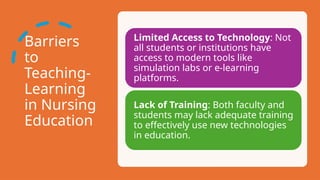
Limited Accessto Technology: Not
all students or institutions have
access to modern tools like
simulation labs or e-learning
platforms.
Lack of Training: Both faculty and
students may lack adequate training
to effectively use new technologies
in education.
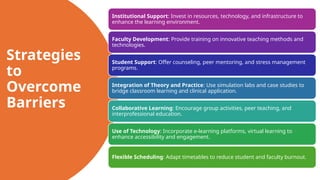
Strategies
to
Overcome
Barriers
Institutional Support: Investin resources, technology, and infrastructure to
enhance the learning environment.
Faculty Development: Provide training on innovative teaching methods and
technologies.
Student Support: Offer counseling, peer mentoring, and stress management
programs.
Integration of Theory and Practice: Use simulation labs and case studies to
bridge classroom learning and clinical application.
Collaborative Learning: Encourage group activities, peer teaching, and
interprofessional education.
Use of Technology: Incorporate e-learning platforms, virtual learning to
enhance accessibility and engagement.
Flexible Scheduling: Adapt timetables to reduce student and faculty burnout.
Nature and
characteristic
s ofTeaching
and learning
• Learning can change life
• Learning is both an emotional and
intellectual experience
• Learning was conceptualization as
• Increasing in one's knowledge
• Memorizing and reproducing
• Applying
• Understanding
• Seeing something in a different way
These categories describe learning as a
reproduction of information and depict
learning as knowledge transforming.
33.
•Professional and Practice-Oriented:
•Teaching focuses on translating theoretical
concepts into practical skills for real-world
healthcare settings.
•Dynamic and Flexible:
• Teaching and learning requires
continuous curriculum updates.
•Learner-Centered:
• Teaching methods prioritize student
engagement, critical thinking, and
problem-solving.
• Educators act as facilitators, mentors, and
role models.
34.
Skills and Competency-Based:
•Teaching emphasizes developing clinical competencies,
including communication, teamwork, and decision-
making skills.
Ethical and Value:
• Educators instill professional values such as compassion,
cultural sensitivity, accountability, and confidentiality.
Simulation-Based:
• High-fidelity simulations, virtual labs, and e-learning
platforms are used to replicate clinical scenarios and
enhance learning outcomes.
Collaborative and Team-Based:
• Nursing education involves group activities, peer
learning, and collaborative projects to mirror team-based
healthcare delivery.