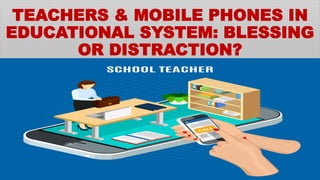
TEACHERS & MOBILE PHONES IN
EDUCATIONAL SYSTEM: BLESSING
OR DISTRACTION?
MEET THE FACILITATOR
RASHEED, OLUWASEGUN KAZEEM (PH.D)
+234 - 8051700164, +234 - 7066867887
kazeemrasheed1440@gmail.com
MNAEAP, EMPM, MNIM, MTRCN, MACSN, CT, Dip. Digital Mkt., CEAF, CLE, CME,
W10FE, CMIE, FMIE, MAPROCON, IECELA, AMIBRN, MCIEMA (USA)
Lead Principal Facilitator at HEED – A - DINK CONSULT
LET’S VIEW THE WORLD
AND THIS . . .
Let’s Reflect on His Word . . .
‫منه‬ ‫جميعا‬ ‫األرض‬ ‫في‬ ‫وما‬ ‫السماوات‬ ‫في‬ ‫ما‬ ‫لكم‬ ‫وسخر‬
‫يتفكرون‬ ‫لقوم‬ ‫آليات‬ ‫ذلك‬ ‫في‬ ‫إن‬
“AND HE HAS SUBJECTED TO YOU WHATEVER IS IN THE HEAVENS AND WHATEVER
IS ON THE EARTH – ALL FROM HIM…” (QUR’AN 45:13)
Key Words . . .
TEACHER: Someone who prepares the learners for a LIFE in a rapidly changing,
technology-driven and interconnected world using all appropriate tools, techniques
and methodologies.
MOBILE PHONES: An electronic device used for voice communication and other forms of
communication (such as text messaging, internet browsing, photography, and social networking).
EDUCATIONAL SYSTEM: A structured arrangement of institutions, policies, processes
and practices through which a society provides organized learning and training to it members.
BLESSING: Something that brings benefit or positive impact. In education, a “blessing” can
mean an advantage, opportunity, or support that helps learning and development.
DISTRACTION: Anything that takes attention away from what is important or being focused.
In an educational context, a distraction is anything that diverts students’ or teachers’ focus from
learning or teaching effectively.
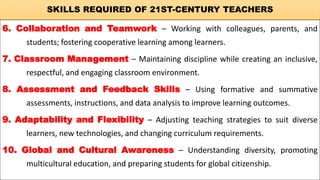
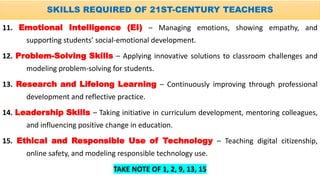
SKILLS REQUIRED OF 21ST-CENTURY TEACHERS
1. Digital Literacy – Ability to use ICT tools (computers, projectors, tablets, AI tools)
effectively in teaching and learning.
2. Technological Pedagogical Knowledge (TPACK) – Skill in integrating
technology with pedagogy and subject content for effective instruction.
3. Critical Thinking Facilitation – Helping students analyze, evaluate, and create
knowledge rather than just recalling facts.
4. Creativity and Innovation – Designing engaging lessons, projects, and real-world
learning experiences that inspire curiosity.
5. Communication Skills – Clear expression, active listening, and the ability to
communicate across digital and face-to-face platforms.
SKILLS REQUIRED OF 21ST-CENTURY TEACHERS
6. Collaboration and Teamwork – Working with colleagues, parents, and
students; fostering cooperative learning among learners.
7. Classroom Management – Maintaining discipline while creating an inclusive,
respectful, and engaging classroom environment.
8. Assessment and Feedback Skills – Using formative and summative
assessments, instructions, and data analysis to improve learning outcomes.
9. Adaptability and Flexibility – Adjusting teaching strategies to suit diverse
learners, new technologies, and changing curriculum requirements.
10. Global and Cultural Awareness – Understanding diversity, promoting
multicultural education, and preparing students for global citizenship.
SKILLS REQUIRED OF 21ST-CENTURY TEACHERS
11. Emotional Intelligence (EI) – Managing emotions, showing empathy, and
supporting students’ social-emotional development.
12. Problem-Solving Skills – Applying innovative solutions to classroom challenges and
modeling problem-solving for students.
13. Research and Lifelong Learning – Continuously improving through professional
development and reflective practice.
14. Leadership Skills – Taking initiative in curriculum development, mentoring colleagues,
and influencing positive change in education.
15. Ethical and Responsible Use of Technology – Teaching digital citizenship,
online safety, and modeling responsible technology use.
TAKE NOTE OF 1, 2, 9, 13, 15
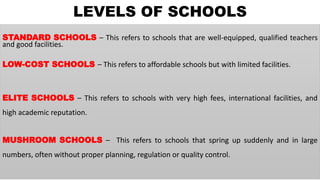
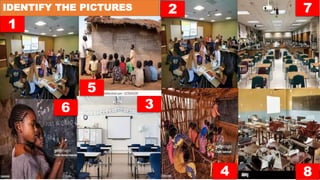
LEVELS OF SCHOOLS
STANDARD SCHOOLS – This refers to schools that are well-equipped, qualified teachers
and good facilities.
LOW-COST SCHOOLS – This refers to affordable schools but with limited facilities.
ELITE SCHOOLS – This refers to schools with very high fees, international facilities, and
high academic reputation.
MUSHROOM SCHOOLS – This refers to schools that spring up suddenly and in large
numbers, often without proper planning, regulation or quality control.
IDENTIFY THE PICTURES
1
2
3
4
5
6
7
8
IMPORTANCE OF PHONES FOR TEACHERS
1. Access to Educational Resources – Teachers can download books, journals, and teaching
guides.
2. Digital Lesson Plan – Phones help in preparing lessons using apps and online tools.
3. Communication with Parents & Students – Easy contact for updates, reminders, and
guidance.
4. Professional Development – Access to online programs, webinars, and training.
5. Quick Research – Teachers can instantly check facts or references during class.
6. Classroom Management Apps – Useful for attendance, grading, and scheduling.
7. Multimedia Teaching – Phones allow teachers to use videos, audio, and animations to explain topics.
8. Emergency Contact – Immediate communication in case of emergencies at school.
9. Access to Religious & Moral Materials – Qur’an, Hadith, or moral stories for character
education.
10. Monitoring Student Progress – Apps help track homework submissions and assessments.
11. Enhancing Creativity – Teachers can create presentations, quizzes, and engaging activities.
12. Documentation – Capturing photos/videos of projects, experiments, or events.
13. Motivating Learners – Using interactive educational apps to keep learners engaged.
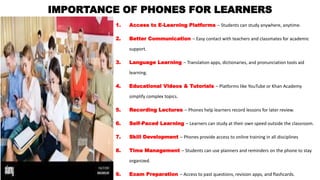
IMPORTANCE OF PHONES FOR LEARNERS
1. Access to E-Learning Platforms – Students can study anywhere, anytime.
2. Better Communication – Easy contact with teachers and classmates for academic
support.
3. Language Learning – Translation apps, dictionaries, and pronunciation tools aid
learning.
4. Educational Videos & Tutorials – Platforms like YouTube or Khan Academy
simplify complex topics.
5. Recording Lectures – Phones help learners record lessons for later review.
6. Self-Paced Learning – Learners can study at their own speed outside the classroom.
7. Skill Development – Phones provide access to online training in all disciplines
8. Time Management – Students can use planners and reminders on the phone to stay
organized.
9. Exam Preparation – Access to past questions, revision apps, and flashcards.
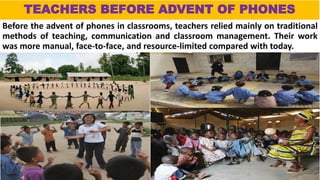
TEACHERS BEFORE ADVENT OF PHONES
Before the advent of phones in classrooms, teachers relied mainly on traditional
methods of teaching, communication and classroom management. Their work
was more manual, face-to-face, and resource-limited compared with today.
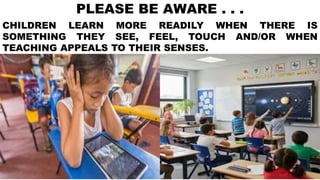
PLEASE BE AWARE . . .
CHILDREN LEARN MORE READILY WHEN THERE IS
SOMETHING THEY SEE, FEEL, TOUCH AND/OR WHEN
TEACHING APPEALS TO THEIR SENSES.
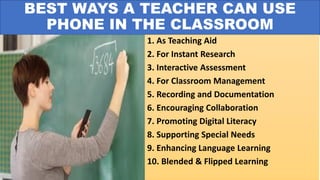
BEST WAYS A TEACHER CAN USE
PHONE IN THE CLASSROOM
1. As Teaching Aid
2. For Instant Research
3. Interactive Assessment
4. For Classroom Management
5. Recording and Documentation
6. Encouraging Collaboration
7. Promoting Digital Literacy
8. Supporting Special Needs
9. Enhancing Language Learning
10. Blended & Flipped Learning
TEACHING ELEMENTARY MATHS
Teaching Yoruba Language
PHYSICS
CHEMISTRY
ISLAMIC STUDIES
HISTORY/ECONOMICS
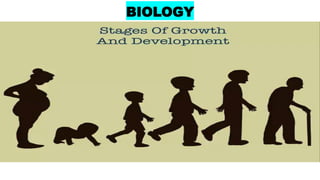
BIOLOGY
GOVERNMENT
PAST QUESTIONS
RULES OF USING PHONES IN THE CLASSROOM
1. Phones should be kept on silent or vibrate mode during class.
2. Use phones only for academic purposes (research, dictionary, calculator, etc.).
3. No answering personal calls or texting during lessons.
4. Avoid social media engagement during instructional time.
5. Respect privacy – no recording teachers or classmates without permission.
6. Always seek authorities' approval before using phones in class. (if allowed)
7. Phones should not be a source of distraction to self or others in class.
8. Use educational apps only when needed.
9. Avoid display of phones during lessons.
10.Students should not be provided with phones during class
or after.
11 keep ringtones or notification sounds muted.
12 Phones must not replace active participation in class discussions.
13 Avoid inappropriate content i.e. phones should not be used for
immoralities
14 Phones must not be shared carelessly
15 Don’t use phone to capture sensitive school materials without consent.
16 Teachers should model proper phone use to set example for students.
17 Do not interrupt class flow by frequently checking your phone.
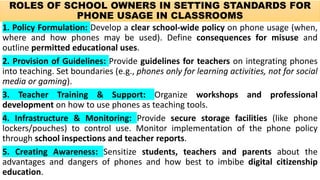
ROLES OF SCHOOL OWNERS IN SETTING STANDARDS FOR
PHONE USAGE IN CLASSROOMS
1. Policy Formulation: Develop a clear school-wide policy on phone usage (when,
where and how phones may be used). Define consequences for misuse and
outline permitted educational uses.
2. Provision of Guidelines: Provide guidelines for teachers on integrating phones
into teaching. Set boundaries (e.g., phones only for learning activities, not for social
media or gaming).
3. Teacher Training & Support: Organize workshops and professional
development on how to use phones as teaching tools.
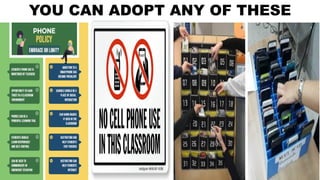
4. Infrastructure & Monitoring: Provide secure storage facilities (like phone
lockers/pouches) to control use. Monitor implementation of the phone policy
through school inspections and teacher reports.
5. Creating Awareness: Sensitize students, teachers and parents about the
advantages and dangers of phones and how best to imbibe digital citizenship
education.
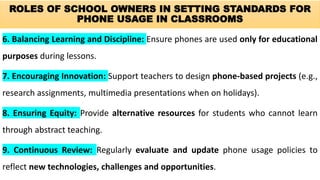
ROLES OF SCHOOL OWNERS IN SETTING STANDARDS FOR
PHONE USAGE IN CLASSROOMS
6. Balancing Learning and Discipline: Ensure phones are used only for educational
purposes during lessons.
7. Encouraging Innovation: Support teachers to design phone-based projects (e.g.,
research assignments, multimedia presentations when on holidays).
8. Ensuring Equity: Provide alternative resources for students who cannot learn
through abstract teaching.
9. Continuous Review: Regularly evaluate and update phone usage policies to
reflect new technologies, challenges and opportunities.
YOU CAN ADOPT ANY OF THESE
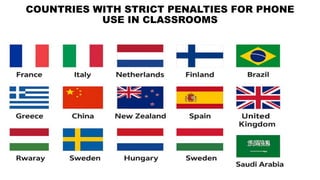
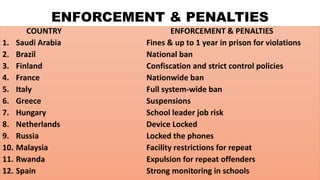
COUNTRIES WITH STRICT PENALTIES FOR PHONE
USE IN CLASSROOMS
ENFORCEMENT & PENALTIES
COUNTRY ENFORCEMENT & PENALTIES
1. Saudi Arabia Fines & up to 1 year in prison for violations
2. Brazil National ban
3. Finland Confiscation and strict control policies
4. France Nationwide ban
5. Italy Full system-wide ban
6. Greece Suspensions
7. Hungary School leader job risk
8. Netherlands Device Locked
9. Russia Locked the phones
10. Malaysia Facility restrictions for repeat
11. Rwanda Expulsion for repeat offenders
12. Spain Strong monitoring in schools
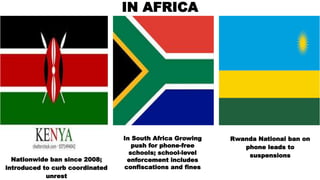
IN AFRICA
Nationwide ban since 2008;
introduced to curb coordinated
unrest
In South Africa Growing
push for phone-free
schools; school-level
enforcement includes
confiscations and fines
Rwanda National ban on
phone leads to
suspensions
THE BIG QUESTION WHERE DO YOU BELONG?
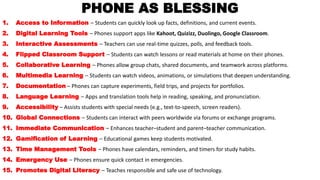
PHONE AS BLESSING
1. Access to Information – Students can quickly look up facts, definitions, and current events.
2. Digital Learning Tools – Phones support apps like Kahoot, Quizizz, Duolingo, Google Classroom.
3. Interactive Assessments – Teachers can use real-time quizzes, polls, and feedback tools.
4. Flipped Classroom Support – Students can watch lessons or read materials at home on their phones.
5. Collaborative Learning – Phones allow group chats, shared documents, and teamwork across platforms.
6. Multimedia Learning – Students can watch videos, animations, or simulations that deepen understanding.
7. Documentation – Phones can capture experiments, field trips, and projects for portfolios.
8. Language Learning – Apps and translation tools help in reading, speaking, and pronunciation.
9. Accessibility – Assists students with special needs (e.g., text-to-speech, screen readers).
10. Global Connections – Students can interact with peers worldwide via forums or exchange programs.
11. Immediate Communication – Enhances teacher–student and parent–teacher communication.
12. Gamification of Learning – Educational games keep students motivated.
13. Time Management Tools – Phones have calendars, reminders, and timers for study habits.
14. Emergency Use – Phones ensure quick contact in emergencies.
15. Promotes Digital Literacy – Teaches responsible and safe use of technology.
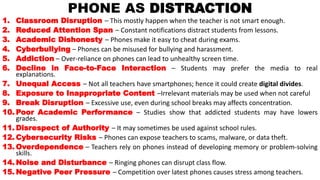
PHONE AS DISTRACTION
1. Classroom Disruption – This mostly happen when the teacher is not smart enough.
2. Reduced Attention Span – Constant notifications distract students from lessons.
3. Academic Dishonesty – Phones make it easy to cheat during exams.
4. Cyberbullying – Phones can be misused for bullying and harassment.
5. Addiction – Over-reliance on phones can lead to unhealthy screen time.
6. Decline in Face-to-Face Interaction – Students may prefer the media to real
explanations.
7. Unequal Access – Not all teachers have smartphones; hence it could create digital divides.
8. Exposure to Inappropriate Content –Irrelevant materials may be used when not careful
9. Break Disruption – Excessive use, even during school breaks may affects concentration.
10. Poor Academic Performance – Studies show that addicted students may have lowers
grades.
11. Disrespect of Authority – It may sometimes be used against school rules.
12. Cybersecurity Risks – Phones can expose teachers to scams, malware, or data theft.
13. Overdependence – Teachers rely on phones instead of developing memory or problem-solving
skills.
14. Noise and Disturbance – Ringing phones can disrupt class flow.
15. Negative Peer Pressure – Competition over latest phones causes stress among teachers.
THANKS FOR YOUR TIME