Taxonomy: The Art of Naming Living Things!
Welcome to the fascinating world where science meets creativity. Discover how biologists organize and name the incredible diversity of
life on Earth.
LEARNING GOAL
Our Objective
By the end of this presentation, you'll understand why scientific nomenclature
is essential for studying and protecting life on Earth. Scientific names create a
universal language that transcends borders, dialects, and cultural differences,
allowing researchers worldwide to communicate clearly about species.
Imagine trying to discuss conservation strategies when every region calls the
same animal by a different name! Scientific naming solves this challenge
beautifully, bringing order to the magnificent chaos of biodiversity.
A Controversial Question
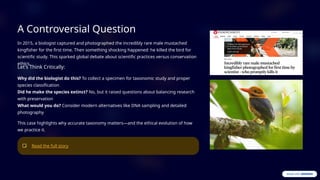
In 2015, a biologist captured and photographed the incredibly rare male mustached
kingfisher for the first time. Then something shocking happened: he killed the bird for
scientific study. This sparked global debate about scientific practices versus conservation
ethics.
Let's Think Critically:
Why did the biologist do this? To collect a specimen for taxonomic study and proper
species classification
Did he make the species extinct? No, but it raised questions about balancing research
with preservation
What would you do? Consider modern alternatives like DNA sampling and detailed
photography
This case highlights why accurate taxonomy matters—and the ethical evolution of how
we practice it.
Read the full story
Would You Call
This Little Kitty?
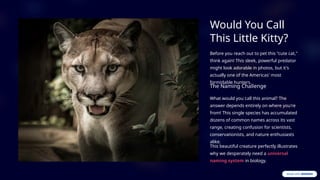
Before you reach out to pet this "cute cat,"
think again! This sleek, powerful predator
might look adorable in photos, but it's
actually one of the Americas' most
formidable hunters.
The Naming Challenge
What would you call this animal? The
answer depends entirely on where you're
from! This single species has accumulated
dozens of common names across its vast
range, creating confusion for scientists,
conservationists, and nature enthusiasts
alike.
This beautiful creature perfectly illustrates
why we desperately need a universal
naming system in biology.
One Species, Many
Countries
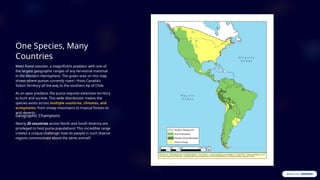
Meet Puma concolor, a magnificent predator with one of
the largest geographic ranges of any terrestrial mammal
in the Western Hemisphere. The green area on this map
shows where pumas currently roam—from Canada's
Yukon Territory all the way to the southern tip of Chile.
As an apex predator, the puma requires extensive territory
to hunt and survive. This wide distribution means the
species exists across multiple countries, climates, and
ecosystems, from snowy mountains to tropical forests to
arid deserts.
Geographic Champions
Nearly 20 countries across North and South America are
privileged to host puma populations! This incredible range
creates a unique challenge: how do people in such diverse
regions communicate about the same animal?
The Synonym Problem
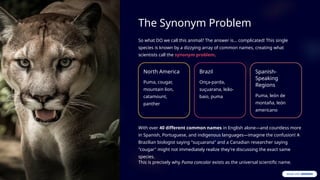
So what DO we call this animal? The answer is... complicated! This single
species is known by a dizzying array of common names, creating what
scientists call the synonym problem.
North America
Puma, cougar,
mountain lion,
catamount,
panther
Brazil
Onça-parda,
suçuarana, leão-
baio, puma
Spanish-
Speaking
Regions
Puma, león de
montaña, león
americano
With over 40 different common names in English alone—and countless more
in Spanish, Portuguese, and indigenous languages—imagine the confusion! A
Brazilian biologist saying "suçuarana" and a Canadian researcher saying
"cougar" might not immediately realize they're discussing the exact same
species.
This is precisely why Puma concolor exists as the universal scientific name.
The Communication Challenge
Now imagine the real-world implications of all those different names. When a conservation biologist in Argentina needs to share
research with colleagues in Mexico, Canada, and Brazil, how do they ensure everyone understands which animal they're discussing?
Language Barriers
Different languages create natural
confusion, but even within the same
language, regional names vary wildly
Research Complications
Literature searches become
nightmares when you need to check
40+ different names to find relevant
studies
Conservation Chaos
Protecting endangered species
requires international cooperation—
impossible without standardized
names
Without a universal naming system, scientific progress would grind to a halt. Every researcher would need to learn dozens of regional
names for each species, cross-reference constantly, and risk confusion at every turn. The solution? Scientific nomenclature provides
one precise name that works everywhere, for everyone.
What Would You
Name This Animal?
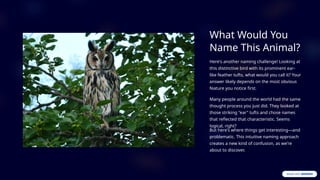
Here's another naming challenge! Looking at
this distinctive bird with its prominent ear-
like feather tufts, what would you call it? Your
answer likely depends on the most obvious
feature you notice first.
Many people around the world had the same
thought process you just did. They looked at
those striking "ear" tufts and chose names
that reflected that characteristic. Seems
logical, right?
But here's where things get interesting—and
problematic. This intuitive naming approach
creates a new kind of confusion, as we're
about to discover.
The Homonym Problem
Eared Owl—But Which One?
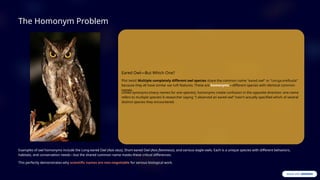
Plot twist! Multiple completely different owl species share the common name "eared owl" or "coruja-orelhuda"
because they all have similar ear-tuft features. These are homonyms—different species with identical common
names.
Unlike synonyms (many names for one species), homonyms create confusion in the opposite direction: one name
refers to multiple species! A researcher saying "I observed an eared owl" hasn't actually specified which of several
distinct species they encountered.
Examples of owl homonyms include the Long-eared Owl (Asio otus), Short-eared Owl (Asio flammeus), and various eagle-owls. Each is a unique species with different behaviors,
habitats, and conservation needs—but the shared common name masks these critical differences.
This perfectly demonstrates why scientific names are non-negotiable for serious biological work.
The Age of Exploration Changed Everything
During the 15th-17th centuries, European ships sailed to every corner of the globe, and naturalists encountered thousands of species completely unknown to Western science. They brought back specimens, sketches, and
descriptions of exotic creatures from Asia, Africa, and the Americas.
Suddenly, the informal, regional naming systems that worked for local flora and fauna became completely inadequate. How could a Portuguese sailor's "sea cat" be matched with a Dutch explorer's description of the same creature?
How could scholars compile knowledge when every expedition used different languages and naming conventions?
01
Chaos Emerges
Explorers documented species using inconsistent, descriptive phrases in
various languages
02
Crisis Point
By the 1700s, the same species might have dozens of conflicting names and
descriptions
03
The Solution
Carl Linnaeus created binomial nomenclature: a standardized, two-part
naming system in Latin
This global explosion of biological discovery created an urgent need for the systematic, universal approach to taxonomy we use today. The solution brought order to chaos and enabled the modern science of biology to flourish.