P.G. Department of Botany
St. Thomas College, Bhilai
BOTANY-PAPER-I : TAXONOMY AND DIVERSITY OF PLANTS
Morphological Evidences
in Taxonomy
AUTHOR - TEJASVAEE KUMAR SHARVA
Student of M.Sc 4th Sem., Submitted to and guided by Dr. Suruchi Parkhey, Asst. Professor, P.G. Department of Botany,
St. Thomas College, Bhilai, Date of submission 04/October/2024
Topic Abridgment
1. Introduction
2. History
3. Types of Morphological Evidences
4. Examples associated with Root
5. Examples associated with Stem
6. Examples associated with Leaf
7. Examples associated with Inflorescence
8. Examples associated with Fruit
9. Significances
10.Conclusions
11.References
I. Introduction :-
• Morphological Evidences in Taxonomy refers
to study of “external appearances” in
plants, and establishing relations based on
similarities and dissimilarities between
them.
• Taxonomic evidences are oldest but most
trusted tool in plant taxonomy as it is based
on directly observable physical evidences.
• It is the foundation upon which classical
classification systems of plants, like those of
Bentham and Hooker system of classifica-
tion (1862-1883) was based upon.
• While modern system of classification give
emphasis on molecular analysis, The mor-
phological evidences still serve as simple but
effective medium for studying taxonomic re-
lations.
II. History :-
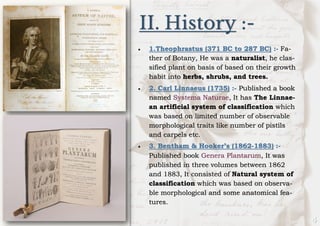
• 1.Theophrastus (371 BC to 287 BC) :- Fa-
ther of Botany, He was a naturalist, he clas-
sified plant on basis of based on their growth
habit into herbs, shrubs, and trees.
• 2. Carl Linnaeus (1735) :- Published a book
named Systema Naturae, It has The Linnae-
an artificial system of classification which
was based on limited number of observable
morphological traits like number of pistils
and carpels etc.
• 3. Bentham & Hooker’s (1862-1883) :-
Published book Genera Plantarum, It was
published in three volumes between 1862
and 1883, It consisted of Natural system of
classification which was based on observa-
ble morphological and some anatomical fea-
tures.
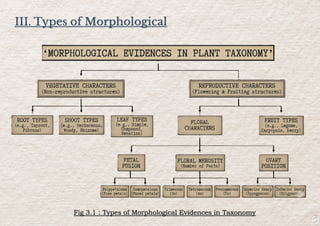
III. Types of Morphological
Fig 3.1 : Types of Morphological Evidences in Taxonomy
IV. Examples associated with
Root :-
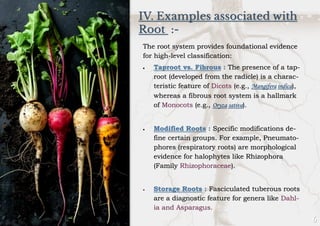
The root system provides foundational evidence
for high-level classification:
• Taproot vs. Fibrous : The presence of a tap-
root (developed from the radicle) is a charac-
teristic feature of Dicots (e.g., Mangifera indica),
whereas a fibrous root system is a hallmark
of Monocots (e.g., Oryza sativa).
• Modified Roots : Specific modifications de-
fine certain groups. For example, Pneumato-
phores (respiratory roots) are morphological
evidence for halophytes like Rhizophora
(Family Rhizophoraceae).
• Storage Roots : Fasciculated tuberous roots
are a diagnostic feature for genera like Dahl-
ia and Asparagus.
V. Examples associated with
Stem :-
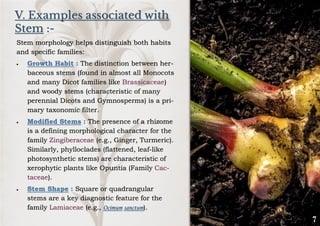
Stem morphology helps distinguish both habits
and specific families:
• Growth Habit : The distinction between her-
baceous stems (found in almost all Monocots
and many Dicot families like Brassicaceae)
and woody stems (characteristic of many
perennial Dicots and Gymnosperms) is a pri-
mary taxonomic filter.
• Modified Stems : The presence of a rhizome
is a defining morphological character for the
family Zingiberaceae (e.g., Ginger, Turmeric).
Similarly, phylloclades (flattened, leaf-like
photosynthetic stems) are characteristic of
xerophytic plants like Opuntia (Family Cac-
taceae).
• Stem Shape : Square or quadrangular
stems are a key diagnostic feature for the
family Lamiaceae (e.g., Ocimum sanctum).
VI. Examples associated with
Leaf :-
Leaves offer a plethora of diagnostic characters:
Venation: Reticulate venation is typical of Di-
cots, while parallel venation is the standard for
Monocots.
• Phyllotaxy : The arrangement of leaves
(alternate, opposite, or whorled) is a stable
character. For instance, opposite decussate
phyllotaxy is a consistent trait in the family
Acanthaceae
• Leaf Type : Simple vs. compound leaves
help identify genera. The palmately com-
pound leaf of Bombax ceiba distinguishes it from
the pinnately compound leaves found in the
family Fabaceae (e.g., Cassia fistula).
• Stipules : The presence of an ochreate stip-
ule (a tubular sheath) is a unique morpho-
logical marker for the family Polygonaceae.
VII. Examples associated with
Inflorescence :-
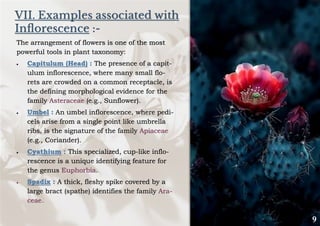
The arrangement of flowers is one of the most
powerful tools in plant taxonomy:
• Capitulum (Head) : The presence of a capit-
ulum inflorescence, where many small flo-
rets are crowded on a common receptacle, is
the defining morphological evidence for the
family Asteraceae (e.g., Sunflower).
• Umbel : An umbel inflorescence, where pedi-
cels arise from a single point like umbrella
ribs, is the signature of the family Apiaceae
(e.g., Coriander).
• Cyathium : This specialized, cup-like inflo-
rescence is a unique identifying feature for
the genus Euphorbia.
• Spadix : A thick, fleshy spike covered by a
large bract (spathe) identifies the family Ara-
ceae.
VIII. Examples associated with
Fruits :-
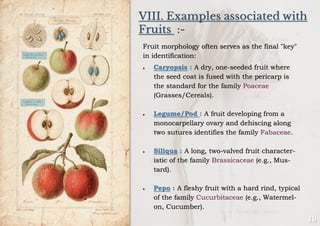
Fruit morphology often serves as the final "key"
in identification:
• Caryopsis : A dry, one-seeded fruit where
the seed coat is fused with the pericarp is
the standard for the family Poaceae
(Grasses/Cereals).
• Legume/Pod : A fruit developing from a
monocarpellary ovary and dehiscing along
two sutures identifies the family Fabaceae.
• Siliqua : A long, two-valved fruit character-
istic of the family Brassicaceae (e.g., Mus-
tard).
• Pepo : A fleshy fruit with a hard rind, typical
of the family Cucurbitaceae (e.g., Watermel-
on, Cucumber).
IX. Significances of studying
morphological evidences :-
Morphological evidence is significant for several
reasons:
 1. Accessibility : It allows for the identifica-
tion of plants in the field without the need
for expensive laboratory equipment.
 2. Stability : Reproductive morphology pro-
vides a stable framework for phylogenetic
studies and understanding evolutionary re-
lationships.
 3. Practical Identification : Most
"Dichotomous Keys" used by botanists are
based almost entirely on morphological
characters.
 4. Nomenclature : Descriptions required for
naming new species (under ICBN/IUCN
rules) are primarily based on morphological
"Type" specimens.
X. Conclusion :-
The Morphological evidences of taxonomy re-
main as fundamental and most reliable means
for taxonomic studies due to :-
• Foundational Framework : Morphology re-
mains indispensable for plant identification.
• Systematic Organization : Diversity is
grounded in measurable features (Roots,
Leaves, Fruits).
• Validation : Morphological classifications
generally align with molecular phylogenetic
analyses.
• Reliability : Characters like the Legume
fruit in Fabaceae or Caryopsis in Poaceae
provide stable classification keys.
• Bentham, G. & Hooker, J.D. (1862–1883).
Genera Plantarum.
• Lawrence, G.H.M. (1951). Taxonomy of Vas-
cular Plants. Oxford & IBH Publishing.
• Singh, G. (2010). Plant Systematics: An
Integrated Approach. Science Publishers.
• Simpson, M.G. (2019). Plant Systematics.
Academic Press
Do you have any
Questions?
References :-