Targeting Homeowners on Facebook Ads:
What Actually Works
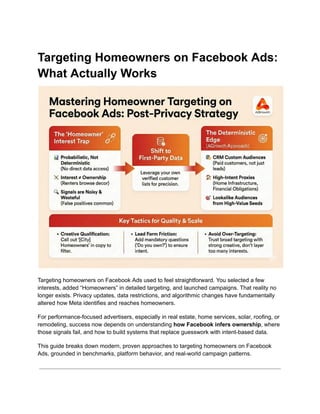
Targeting homeowners on Facebook Ads used to feel straightforward. You selected a few
interests, added “Homeowners” in detailed targeting, and launched campaigns. That reality no
longer exists. Privacy updates, data restrictions, and algorithmic changes have fundamentally
altered how Meta identifies and reaches homeowners.
For performance-focused advertisers, especially in real estate, home services, solar, roofing, or
remodeling, success now depends on understanding how Facebook infers ownership, where
those signals fail, and how to build systems that replace guesswork with intent-based data.
This guide breaks down modern, proven approaches to targeting homeowners on Facebook
Ads, grounded in benchmarks, platform behavior, and real-world campaign patterns.
Why Facebook Can No Longer Reliably Identify
Homeowners
Before building any strategy, it is critical to understand the limits of Facebook’s data.
Ownership Is Not a Direct Data Signal
Facebook does not have real-time access to property deeds, county tax records, or home
ownership registries. When advertisers select “Homeowners” in targeting, they are not
accessing verified ownership data. They are targeting a probabilistic audience built from
behavioral patterns.
Since the rollout of iOS 14.5 and the removal of third-party data partnerships, Facebook’s ability
to identify life events such as buying a home has weakened significantly. The platform now
relies on modeling rather than certainty.
This shift means that ownership is inferred, not confirmed.
Interest Targeting Does Not Equal Ownership
One of the most common mistakes experienced advertisers make is assuming that interest
equals status.
A user interested in home improvement, interior design, or DIY content may be:
●​ A renter upgrading an apartment
●​ A young adult living with family
●​ Someone browsing aspirational content
Content consumption reflects curiosity, not real-world ownership. This gap creates false
positives and wastes budget when interest targeting is used without qualification.
Privacy, iOS, and Data Fragmentation
The loss of deterministic signals means Facebook rarely “knows” that someone has purchased
a home. Instead, it evaluates clusters of behavior. Visiting real estate sites, engaging with
mortgage content, and interacting with local service pages all contribute to probability scoring.
Probability, however, introduces noise. And noise increases CPA.
How Facebook Infers Homeownership Today
While direct ownership data is gone, Facebook still detects patterns. Advanced advertisers
learn to align targeting and creative with those patterns.
Content and Engagement Signals
Facebook observes the ecosystem of content a user interacts with. Frequent engagement with:
●​ Real estate platforms
●​ Mortgage or refinancing content
●​ Home improvement publishers
raises the probability that the user owns property. These are indirect but useful signals when
combined correctly.
Marketplace and Behavioral Clues
Marketplace behavior is one of the strongest indicators. Searches for riding lawn mowers, patio
furniture, or large appliances correlate strongly with homeownership.
Similarly, interactions with local service providers for repairs, HVAC, or roofing indicate both
ownership and active intent.
Why Proxy Signals Are Noisy
The challenge with proxy data is false positives. A renter browsing luxury homes generates
similar signals to a buyer. Stacking too many interests to “filter” these users often backfires by
shrinking audiences and inflating CPMs.
Overly narrow targeting limits Meta’s ability to optimize delivery and frequently results in
unstable performance.
Targeting Strategies That Still Work
The traditional checkbox-based approach is fading. Modern homeowner targeting is about
structure, signals, and creative alignment.
Interest Clusters With Real Intent
Instead of generic home interests, focus on infrastructure-level signals:
●​ HVAC, roofing, solar, insulation
●​ Mortgage refinancing and HELOC-related topics
These interests reflect responsibility and financial engagement, not casual browsing.
Why Single-Interest Targeting Fails
Targeting one large interest, such as a home improvement retailer, introduces algorithmic
dilution. The system optimizes for cheap clicks rather than qualified leads.
Performance improves when interests are used as context, not as the primary filter.
When Interest Targeting Should Be Avoided
In small local markets, complex interest stacks often harm results. With limited population size,
restricting delivery prevents Meta from finding converters.
In these cases, broad targeting combined with highly specific creative consistently outperforms
layered interests.
How to Reach Verified Homeowners Instead of Guessing
The most effective campaigns stop relying solely on Facebook’s inferred data and introduce
first-party signals.
CRM-Based Audiences
Uploading a list of past customers is the strongest deterministic signal available. Focus on:
●​ Closed deals, not raw leads
●​ Customers who completed high-value projects
Facebook uses these profiles to identify similar users based on financial behavior, not clicks.
Offline Conversions and CAPI
Integrating CRM data through Conversions API allows Meta to optimize for actual revenue
events. This shifts learning away from low-quality leads toward true homeowners who purchase
services.
Website and Event-Based Audiences
Not all website traffic is equal. Users who spend time on pricing, warranty, or booking pages
show stronger intent than blog readers.
Optimizing for meaningful actions such as scheduling appointments improves signal quality and
campaign stability.
Scaling Homeowner Reach Without Losing Quality
Scaling introduces a new challenge: maintaining lead quality as spend increases.
Choosing the Right Lookalike Seed
Lookalike performance depends entirely on the seed audience.
●​ Best: customers with significant spend
●​ Acceptable: booked estimates
●​ Poor: ad clickers without conversion
Bad seeds produce high volume and low ROI.
Lookalike Size Strategy
While 1% lookalikes provide precision, broader lookalikes (3–5%) or Advantage+ audiences
often reduce CPA once sufficient data exists. Scale requires flexibility.
Preventing Signal Dilution
Maintain quality by:
●​ Excluding recent leads and customers
●​ Segmenting creative to pre-qualify users
Ads that explicitly call out homeowners filter renters automatically and protect budget.
Common Mistakes in Homeowner Targeting
Even advanced advertisers repeat these errors.
Over-Narrow Targeting
Stacking interests and demographics restricts learning and increases CPMs. Let creative, not
settings, do the filtering.
Lead Forms Without Friction
Instant forms generate volume, not quality. Adding homeowner-specific questions improves lead
value and sales efficiency.
Treating Facebook as Bottom Funnel Only
Homeowners rarely convert on first touch. View-through attribution and assisted conversions
reveal Facebook’s true impact.
FAQs
Can renters be excluded completely?​
Not directly. The most effective filter is creative language combined with qualifying questions.
Does income targeting help?​
It can, but it increases CPMs. Geographic property value targeting often performs better.
Why do renter leads appear?​
Low-friction ads attract curiosity. Increasing qualification solves this.
Landing pages or lead forms?​
Landing pages produce higher-quality leads for high-ticket services. Lead forms suit
volume-focused campaigns.
Is broad targeting effective for local contractors?​
Yes, when paired with strong creative and sufficient pixel history.
Recommended Resources for Targeting Homeowners on
Facebook Ads
Targeting Homeowners on Facebook Ads​
A detailed breakdown of modern homeowner targeting strategies in a post-privacy advertising
landscape.
Rent Meta Agency Ads Account​
An overview of agency-tier Meta ad accounts designed for stability, scalability, and reduced
suspension risk.
https://agrowth.io/blogs/knowledge/targeting-homeowners-on-facebook-ads​
A detailed breakdown of modern homeowner targeting strategies in a post-privacy advertising
landscape.
https://agrowth.io/pages/rent-meta-agency-ads-account​
An overview of agency-tier Meta ad accounts designed for stability, scalability, and reduced
suspension risk.
1) ~3000 characters — In-depth educational version
Targeting Homeowners on Facebook Ads Is About Signals, Not Settings
For years, many advertisers believed that selecting “Homeowners” in Facebook targeting was
enough to reach property owners. That approach no longer works. Since iOS 14.5 and the loss
of third-party data, Meta can no longer verify homeownership directly. What remains is
probabilistic modeling — powerful, but only if you understand how to guide it.
Across high-ticket home service industries, we consistently see that campaigns built on
first-party data outperform pure interest targeting by 25–45% in CPA reduction. Retargeting
users who showed real intent — booked calls, viewed pricing, or submitted qualified forms —
produces far more reliable results than broad interest stacks.
The biggest misconception is equating interests with ownership. A person who likes interior
design or watches DIY videos may be a renter, a student, or simply curious. Interest ≠ status.
This is why “Home Improvement + Luxury + Income Top 10%” stacks often fail: they shrink the
audience while keeping many false positives.
Facebook now infers homeownership from behavior: engagement with mortgage content, visits
to real estate sites, searches for lawn equipment, or interactions with local repair services.
These are useful clues, but still noisy. Smart marketers reduce that noise by bringing their own
data.
The strongest foundation is a CRM-based Custom Audience built from closed deals — not
leads. When paired with Conversions API, Meta learns which users actually purchased, not just
clicked.
Scaling requires the right seed. A 1% Lookalike from high-value customers is precise; a 3–5%
lookalike or Advantage+ audience often performs better once the pixel is seasoned. Always
exclude recent leads and existing customers to protect quality.
Creative does the heavy lifting. Opening lines like “Attention [City] Homeowners” or “If your
home was built before 1990…” filter renters instantly and lower wasted spend.
Finally, attribution matters. Many homeowners see your ad, wait, then search your brand on
Google days later. If you judge Facebook only on last-click, you will underinvest in one of your
best channels.
Homeowner targeting now rewards systems, not shortcuts.
Full framework here:​
https://agrowth.io/blogs/knowledge/targeting-homeowners-on-facebook-ads
#HomeownerAds #MetaMarketing #PaidSocial #LeadGen #HomeServices #DigitalGrowth
2) ~1000 characters — Mid-funnel version
How to Reach Real Homeowners on Facebook
Facebook can no longer “know” who owns a home. Instead, it predicts based on behavior —
and that prediction is often noisy. That is why interest targeting alone rarely delivers consistent
results.
The winning approach combines three layers:
1.​ First-party data — Upload closed customers (not leads) as a Custom Audience and
connect your CRM via Conversions API.
2.​ Smart lookalikes — Start with 1%, then test 3–5% or Advantage+ once you have
enough signal.
3.​ Creative qualification — Call out homeowners directly in your ad copy and add light
friction to lead forms.
Avoid over-stacking interests, especially in small local markets. Broad targeting plus sharp
creative usually beats complex interest layers.
Measure beyond last-click. Many homeowners convert after seeing your ad and later searching
your brand.
If you want predictable results, treat homeowner targeting as a data system, not a checkbox.
Playbook here:​
https://agrowth.io/blogs/knowledge/targeting-homeowners-on-facebook-ads
Tags:​
#HomeownerAds #MetaAds #PerformanceMarketing #LeadGen #HomeServices
3) ~300 characters — Short insight post
Facebook no longer verifies homeowners — it predicts them.​
Stop relying on interests alone. Use closed-customer data, Conversions API, smart lookalikes,
and homeowner-first creative to cut waste and improve lead quality.
Full framework:​
https://agrowth.io/blogs/knowledge/targeting-homeowners-on-facebook-ads
#HomeownerAds #MetaMarketing #GrowthHacking #PaidSocial
4) Short social post (punchy)
Ticking “Homeowners” isn’t a strategy.​
Building signals is.
Use real customer data, smarter lookalikes, and homeowner-first creative — then let Meta
optimize.
Playbook here 👇​
https://agrowth.io/blogs/knowledge/targeting-homeowners-on-facebook-ads
#HomeownerAds #MetaAds #PerformanceMarketing #DigitalGrowth
5) Long social post — storytelling + helpful content
A few years ago, we targeted homeowners like everyone else:​
pick interests, stack layers, launch ads, and hope for the best.
Then reality hit.
Ad costs climbed. Lead quality dropped. And too many renters filled our forms.
What changed the game was shifting from “settings” to “signals.”
Here’s what actually worked:
• Upload closed customers — not leads​
• Connect CRM via Conversions API​
• Build high-quality lookalikes​
• Go broader on targeting​
• Qualify homeowners in the first 3 seconds of your creative​
• Add light friction to lead forms​
• Exclude recent leads and buyers​
• Track assisted conversions, not just last-click
Suddenly, we weren’t guessing anymore — Meta was learning from real homeowners.
If you sell high-ticket home services and want cleaner leads, start here:​
https://agrowth.io/blogs/knowledge/targeting-homeowners-on-facebook-ads
#HomeownerAds #MetaMarketing #HomeServices #PaidSocial #MarketingStory