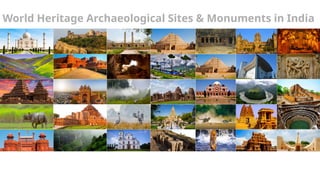
Syllabus_World Heritage Sites and Archaeological Monuments in India
Explore UNESCO's role, World Heritage criteria, Indian heritage laws, conservation, and management of major Indian World Heritage sites including Bhimbetka, Taj Mahal, and more.
Learning Outcomes
After completingthis course, students will be able to
✓ Understand UNESCO
✓ Understand World Heritage
✓ Know the World Heritage Convention
✓ Understand World Heritage Selection Criteria
✓ Learn Indian Heritage Laws
✓ Understand Conservation
✓ Learn Archaeological Site Management
✓ Study major Indian World Heritage Sites
4.
Unit 1: Introductionto UNESCO & World Heritage
Sites
1. World Heritage Convention (Introduction to
the World Heritage Convention (1972)
2. Criteria for selection of World Heritage Sites,
Operational Guidelines for the
Implementation of the World Heritage
Convention)
3. World Heritage Sites List (Tentative List:
Definition and significance, final List: Process
of inclusion, Differences between the Tentative
and Final Lists)
4. Importance of World Heritage Sites (Cultural
and natural heritage, Role in education,
tourism, and international cooperation)
5.
Unit 2: Natureof World Heritage Sites
5. Classification of World Heritage Sites
(Cultural, Natural and Mixed heritage sites)
6. Significance of Heritage Sites
(Historical and cultural importance, Biodiversity
and ecological significance)
7. Management and Conservation
(Policies for preservation and conservation, Role
of government and non-governmental
organizations)
6.
Unit 3:
Important World
Heritage
Monumentsof
India:
An Introduction &
Acts
8. The Ancient Monuments and
Archaeological Sites and Remains Act,
1958
9. The Ancient Monuments and
Archaeological Sites and Remains
Rules, 1959
10. AMASR (Amendment) Act (2010)
7.
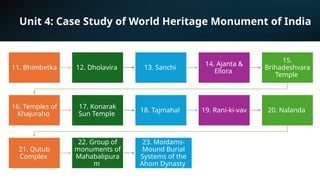
Unit 4: CaseStudy of World Heritage Monument of India
11. Bhimbetka 12. Dholavira 13. Sanchi
14. Ajanta &
Ellora
15.
Brihadeshvara
Temple
16. Temples of
Khajuraho
17. Konarak
Sun Temple
18. Tajmahal 19. Rani-ki-vav 20. Nalanda
21. Qutub
Complex
22. Group of
monuments of
Mahabalipura
m
23. Moidams-
Mound Burial
Systems of the
Ahom Dynasty
8.
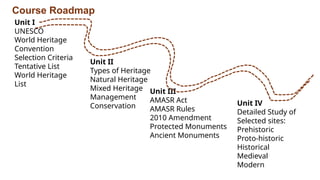
Unit I
UNESCO
World Heritage
Convention
SelectionCriteria
Tentative List
World Heritage
List
Unit III
AMASR Act
AMASR Rules
2010 Amendment
Protected Monuments
Ancient Monuments
Unit IV
Detailed Study of
Selected sites:
Prehistoric
Proto-historic
Historical
Medieval
Modern
Unit II
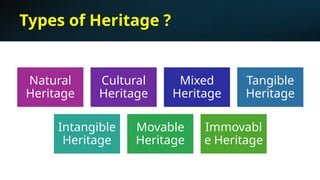
Types of Heritage
Natural Heritage
Mixed Heritage
Management
Conservation
Course Roadmap
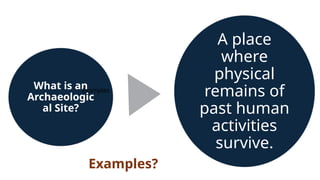
What is an
Archaeologic
alSite?
A place
where
physical
remains of
past human
activities
survive.
Examples
Examples?
14.
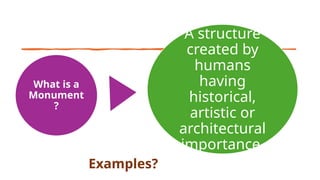
What is a
Monument
?
Astructure
created by
humans
having
historical,
artistic or
architectural
importance.
Examples?
15.
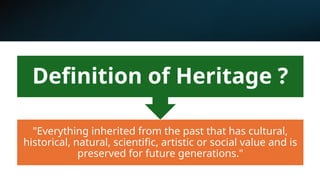
"Everything inherited fromthe past that has cultural,
historical, natural, scientific, artistic or social value and is
preserved for future generations."
Definition of Heritage ?
16.
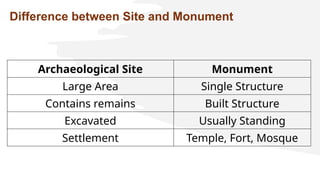
Difference between Siteand Monument
Archaeological Site Monument
Large Area Single Structure
Contains remains Built Structure
Excavated Usually Standing
Settlement Temple, Fort, Mosque
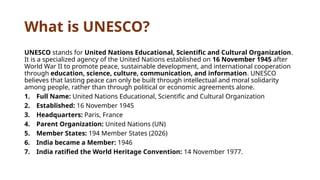
What is UNESCO?
UNESCOstands for United Nations Educational, Scientific and Cultural Organization.
It is a specialized agency of the United Nations established on 16 November 1945 after
World War II to promote peace, sustainable development, and international cooperation
through education, science, culture, communication, and information. UNESCO
believes that lasting peace can only be built through intellectual and moral solidarity
among people, rather than through political or economic agreements alone.
1. Full Name: United Nations Educational, Scientific and Cultural Organization
2. Established: 16 November 1945
3. Headquarters: Paris, France
4. Parent Organization: United Nations (UN)
5. Member States: 194 Member States (2026)
6. India became a Member: 1946
7. India ratified the World Heritage Convention: 14 November 1977.
19.
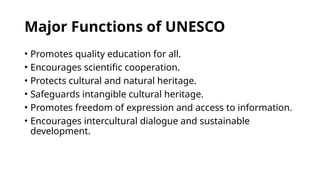
Major Functions ofUNESCO
• Promotes quality education for all.
• Encourages scientific cooperation.
• Protects cultural and natural heritage.
• Safeguards intangible cultural heritage.
• Promotes freedom of expression and access to information.
• Encourages intercultural dialogue and sustainable
development.
20.
UNESCO Logo
• (A)Greek Temple
• Represents knowledge, education, civilization, and culture.
• Symbolizes the preservation of humanity's intellectual heritage.
• Reflects classical architecture and universal learning.
• (B) UNESCO Name
• The word UNESCO appears below the temple in bold capital letters,
emphasizing the organization's global identity.
• Symbolic Meaning
• The logo signifies that education, science, and culture form the
pillars of peace and international cooperation.
21.
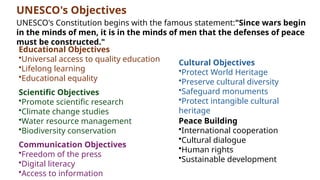
UNESCO's Objectives
UNESCO's Constitutionbegins with the famous statement:"Since wars begin
in the minds of men, it is in the minds of men that the defenses of peace
must be constructed."
Scientific Objectives
•Promote scientific research
•Climate change studies
•Water resource management
•Biodiversity conservation
Educational Objectives
•Universal access to quality education
•Lifelong learning
•Educational equality
Cultural Objectives
•Protect World Heritage
•Preserve cultural diversity
•Safeguard monuments
•Protect intangible cultural
heritage
Peace Building
•International cooperation
•Cultural dialogue
•Human rights
•Sustainable development
Communication Objectives
•Freedom of the press
•Digital literacy
•Access to information
22.
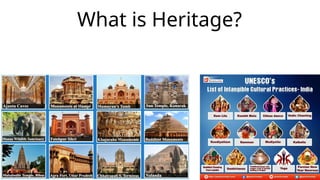
What is WorldHeritage?
World Heritage refers to cultural and natural
properties possessing Outstanding Universal
Value (OUV) whose protection is considered the
responsibility of the entire international
community.
According to the 1972 World Heritage
Convention:
World Heritage includes cultural and natural heritage
considered to be of exceptional importance for present
and future generations of all humanity.
23.
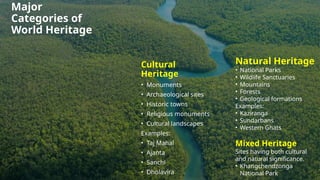
Major
Categories of
World Heritage
Cultural
Heritage
•Monuments
• Archaeological sites
• Historic towns
• Religious monuments
• Cultural landscapes
Examples:
• Taj Mahal
• Ajanta
• Sanchi
• Dholavira
Natural Heritage
• National Parks
• Wildlife Sanctuaries
• Mountains
• Forests
• Geological formations
Examples:
• Kaziranga
• Sundarbans
• Western Ghats
Mixed Heritage
Sites having both cultural
and natural significance.
• Khangchendzonga
National Park
24.
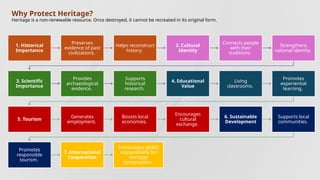
Why Protect Heritage?
Heritageis a non-renewable resource. Once destroyed, it cannot be recreated in its original form.
1. Historical
Importance
Preserves
evidence of past
civilizations.
Helps reconstruct
history.
2. Cultural
Identity
Connects people
with their
traditions.
Strengthens
national identity.
3. Scientific
Importance
Provides
archaeological
evidence.
Supports
historical
research.
4. Educational
Value
Living
classrooms.
Promotes
experiential
learning.
5. Tourism
Generates
employment.
Boosts local
economies.
Encourages
cultural
exchange.
6. Sustainable
Development
Supports local
communities.
Promotes
responsible
tourism.
7. International
Cooperation
Encourages global
responsibility for
heritage
conservation.
25.
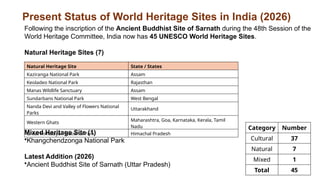
Present Status ofWorld Heritage Sites in India (2026)
Category Number
Cultural 37
Natural 7
Mixed 1
Total 45
Following the inscription of the Ancient Buddhist Site of Sarnath during the 48th Session of the
World Heritage Committee, India now has 45 UNESCO World Heritage Sites.
Natural Heritage Sites (7)
Mixed Heritage Site (1)
•Khangchendzonga National Park
Latest Addition (2026)
•Ancient Buddhist Site of Sarnath (Uttar Pradesh)
Natural Heritage Site State / States
Kaziranga National Park Assam
Keoladeo National Park Rajasthan
Manas Wildlife Sanctuary Assam
Sundarbans National Park West Bengal
Nanda Devi and Valley of Flowers National
Parks
Uttarakhand
Western Ghats
Maharashtra, Goa, Karnataka, Kerala, Tamil
Nadu
Great Himalayan National Park Himachal Pradesh
26.
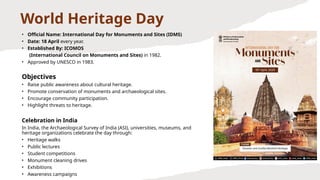
World Heritage Day
•Official Name: International Day for Monuments and Sites (IDMS)
• Date: 18 April every year.
• Established By: ICOMOS
(International Council on Monuments and Sites) in 1982.
• Approved by UNESCO in 1983.
Objectives
• Raise public awareness about cultural heritage.
• Promote conservation of monuments and archaeological sites.
• Encourage community participation.
• Highlight threats to heritage.
Celebration in India
In India, the Archaeological Survey of India (ASI), universities, museums, and
heritage organizations celebrate the day through:
• Heritage walks
• Public lectures
• Student competitions
• Monument cleaning drives
• Exhibitions
• Awareness campaigns
27.
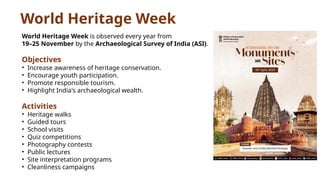
World Heritage Week
WorldHeritage Week is observed every year from
19–25 November by the Archaeological Survey of India (ASI).
Objectives
• Increase awareness of heritage conservation.
• Encourage youth participation.
• Promote responsible tourism.
• Highlight India's archaeological wealth.
Activities
• Heritage walks
• Guided tours
• School visits
• Quiz competitions
• Photography contests
• Public lectures
• Site interpretation programs
• Cleanliness campaigns
28.
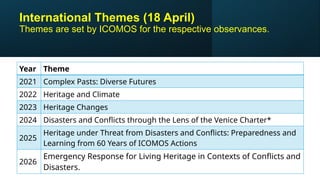
International Themes (18April)
Themes are set by ICOMOS for the respective observances.
Year Theme
2021 Complex Pasts: Diverse Futures
2022 Heritage and Climate
2023 Heritage Changes
2024 Disasters and Conflicts through the Lens of the Venice Charter*
2025
Heritage under Threat from Disasters and Conflicts: Preparedness and
Learning from 60 Years of ICOMOS Actions
2026
Emergency Response for Living Heritage in Contexts of Conflicts and
Disasters.
29.
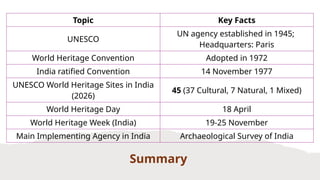
Summary
Topic Key Facts
UNESCO
UNagency established in 1945;
Headquarters: Paris
World Heritage Convention Adopted in 1972
India ratified Convention 14 November 1977
UNESCO World Heritage Sites in India
(2026)
45 (37 Cultural, 7 Natural, 1 Mixed)
World Heritage Day 18 April
World Heritage Week (India) 19-25 November
Main Implementing Agency in India Archaeological Survey of India
30.
Thank
you !
Heritage isnot merely the legacy of the
past-it is a shared responsibility for the
future. Understanding World Heritage
helps us appreciate the cultural
diversity of humanity and the
importance of preserving
archaeological and natural treasures
for generations to come.
Heritage conservation is not only about
protecting old monuments; it is about
preserving the identity, memory,
knowledge, and cultural legacy of
humanity for future generations.