Explore early Indian architecture, covering terminology; proto-historic to Mauryan periods; stūpa architecture in North and South India; and the development of rock-cut caves across Buddhist, Brahmanical, and Jain traditions.
This is for PG students not for API
M.A. Semester I| Art & Architecture | Course I
Historical Account of Early Indian Architecture
Introductory Lecture
Unit I: Terminologies Unit II: Proto-historic to Mauryan Unit III: Stūpa Architecture Unit IV: Stūpa — Deccan & South Unit V: Rock-Cut Architecture
1 Hour
Lecture
Sachin Kr. Tiwary
2.
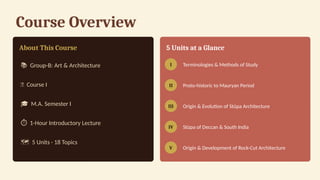
Course Overview
About ThisCourse
📚 Group-B: Art & Architecture
📖 Course I
🎓 M.A. Semester I
️
⏱️ 1-Hour Introductory Lecture
️
🗺️ 5 Units · 18 Topics
5 Units at a Glance
I Terminologies & Methods of Study
II Proto-historic to Mauryan Period
III Origin & Evolution of Stūpa Architecture
IV Stūpa of Deccan & South India
V Origin & Development of Rock-Cut Architecture
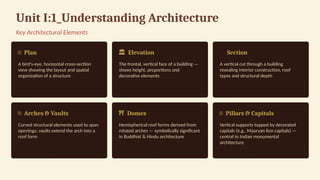
Unit I:1_Understanding Architecture
KeyArchitectural Elements
📐 Plan
A bird's-eye, horizontal cross-section
view showing the layout and spatial
organization of a structure
️
🏛️ Elevation
The frontal, vertical face of a building —
shows height, proportions and
decorative elements
️
️
️
️
️
️
️
️
️
️
️
️
️
️ ️Section
A vertical cut through a building
revealing interior construction, roof
types and structural depth
🌉 Arches & Vaults
Curved structural elements used to span
openings; vaults extend the arch into a
roof form
️
⛩️ Domes
Hemispherical roof forms derived from
rotated arches — symbolically significant
in Buddhist & Hindu architecture
🗿 Pillars & Capitals
Vertical supports topped by decorated
capitals (e.g., Mauryan lion capitals) —
central to Indian monumental
architecture
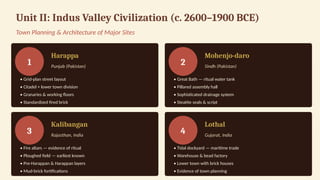
Unit II: IndusValley Civilization (c. 2600–1900 BCE)
Town Planning & Architecture of Major Sites
1
Harappa
Punjab (Pakistan)
• Grid-plan street layout
• Citadel + lower town division
• Granaries & working floors
• Standardized fired brick
2
Mohenjo-daro
Sindh (Pakistan)
• Great Bath — ritual water tank
• Pillared assembly hall
• Sophisticated drainage system
• Steatite seals & script
3
Kalibangan
Rajasthan, India
• Fire altars — evidence of ritual
• Ploughed field — earliest known
• Pre-Harappan & Harappan layers
• Mud-brick fortifications
4
Lothal
Gujarat, India
• Tidal dockyard — maritime trade
• Warehouse & bead factory
• Lower town with brick houses
• Evidence of town planning
8.
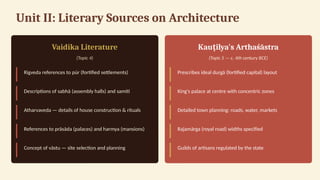
Unit II: LiterarySources on Architecture
Vaidika Literature
(Topic 4)
Rigveda references to púr (fortified settlements)
Descriptions of sabhā (assembly halls) and samiti
Atharvaveda — details of house construction & rituals
References to prāsāda (palaces) and harmya (mansions)
Concept of vāstu — site selection and planning
Kau ilya's Arthaśāstra
ṭ
(Topic 5 — c. 4th century BCE)
Prescribes ideal durgā (fortified capital) layout
King's palace at centre with concentric zones
Detailed town planning: roads, water, markets
Rajamārga (royal road) widths specified
Guilds of artisans regulated by the state
9.
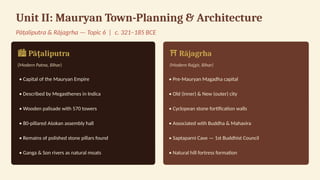
Unit II: MauryanTown-Planning & Architecture
Pāṭaliputra & Rājagrha — Topic 6 | c. 321–185 BCE
️
🏙️Pā aliputra
ṭ
(Modern Patna, Bihar)
• Capital of the Mauryan Empire
• Described by Megasthenes in Indica
• Wooden palisade with 570 towers
• 80-pillared Aśokan assembly hall
• Remains of polished stone pillars found
• Ganga & Son rivers as natural moats
️
⛩️Rājagrha
(Modern Rajgir, Bihar)
• Pre-Mauryan Magadha capital
• Old (inner) & New (outer) city
• Cyclopean stone fortification walls
• Associated with Buddha & Mahavira
• Saptaparni Cave — 1st Buddhist Council
• Natural hill fortress formation
10.
UNIT III
Origin andEvolution of
Stūpa Architecture
North Indian Stūpa Architecture | Topics 7–10
11.
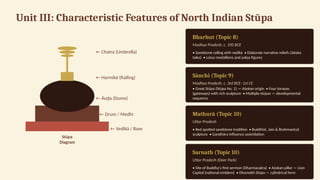
Unit III: CharacteristicFeatures of North Indian Stūpa
Stūpa
Diagram
← Chatra (Umbrella)
← Harmikā (Railing)
← Āṇḍa (Dome)
← Drum / Medhi
← Vedikā / Base
Bharhut (Topic 8)
Madhya Pradesh, c. 100 BCE
• Sandstone railing with vedikā • Elaborate narrative reliefs (Jātaka
tales) • Lotus medallions and yakṣa figures
Sānchi (Topic 9)
Madhya Pradesh, c. 3rd BCE–1st CE
• Great Stūpa (Stūpa No. 1) — Aśokan origin • Four toraṇas
(gateways) with rich sculpture • Multiple stūpas — developmental
sequence
Mathurā (Topic 10)
Uttar Pradesh
• Red spotted sandstone tradition • Buddhist, Jain & Brahmanical
sculpture • Gandhāra influence assimilation
Sarnath (Topic 10)
Uttar Pradesh (Deer Park)
• Site of Buddha's first sermon (Dharmacakra) • Aśokan pillar — Lion
Capital (national emblem) • Dhamekh Stūpa — cylindrical form
12.
UNIT IV
Stūpa ofDeccan
and South India
Amarāvatī · Nāgārjunakoṇḍa · Sannati | Topics 11–13
13.
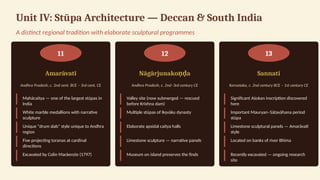
Unit IV: StūpaArchitecture — Deccan & South India
A distinct regional tradition with elaborate sculptural programmes
11
Amarāvatī
Andhra Pradesh, c. 2nd cent. BCE – 3rd cent. CE
Mahācaitya — one of the largest stūpas in
India
White marble medallions with narrative
sculpture
Unique "drum slab" style unique to Andhra
region
Five projecting toranas at cardinal
directions
Excavated by Colin Mackenzie (1797)
12
Nāgārjunako a
ṇḍ
Andhra Pradesh, c. 2nd–3rd century CE
Valley site (now submerged — rescued
before Krishna dam)
Multiple stūpas of Ikṣvāku dynasty
Elaborate apsidal caitya halls
Limestone sculpture — narrative panels
Museum on island preserves the finds
13
Sannati
Karnataka, c. 2nd century BCE – 1st century CE
Significant Aśokan inscription discovered
here
Important Mauryan–Sātavāhana period
stūpa
Limestone sculptural panels — Amarāvatī
style
Located on banks of river Bhīma
Recently excavated — ongoing research
site
14.
UNIT V
Origin andDevelopment
of Rock-Cut Architecture
Topics 14–18 | Barābara to Brahmanical & Jain Caves
15.
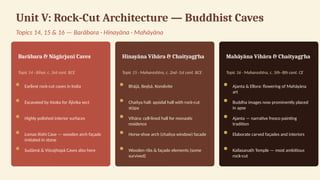
Unit V: Rock-CutArchitecture — Buddhist Caves
Topics 14, 15 & 16 — Barābara · Hīnayāna · Mahāyāna
Barābara & Nāgārjunī Caves
Topic 14 · Bihar, c. 3rd cent. BCE
Earliest rock-cut caves in India
Excavated by Aśoka for Ājīvika sect
Highly polished interior surfaces
Lomas Rishi Cave — wooden arch façade
imitated in stone
Sudāmā & Viśvajhopā Caves also here
Hīnayāna Vihāra & Chaityag ha
ṛ
Topic 15 · Maharashtra, c. 2nd–1st cent. BCE
Bhājā, Beḍsā, Kondivite
Chaitya hall: apsidal hall with rock-cut
stūpa
Vihāra: cell-lined hall for monastic
residence
Horse-shoe arch (chaitya window) facade
Wooden ribs & façade elements (some
survived)
Mahāyāna Vihāra & Chaityag ha
ṛ
Topic 16 · Maharashtra, c. 5th–8th cent. CE
Ajanta & Ellora: flowering of Mahāyāna
art
Buddha images now prominently placed
in apse
Ajanta — narrative fresco painting
tradition
Elaborate carved façades and interiors
Kailasanath Temple — most ambitious
rock-cut
16.
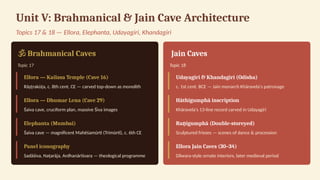
Unit V: Brahmanical& Jain Cave Architecture
Topics 17 & 18 — Ellora, Elephanta, Udayagiri, Khandagiri
️
🕉️Brahmanical Caves
Topic 17
Ellora — Kailasa Temple (Cave 16)
Rāṣṭrakūṭa, c. 8th cent. CE — carved top-down as monolith
Ellora — Dhumar Lena (Cave 29)
Śaiva cave, cruciform plan, massive Śiva images
Elephanta (Mumbai)
Śaiva cave — magnificent Mahēśamūrti (Trimūrti), c. 6th CE
Panel iconography
Sadāśiva, Naṭarāja, Ardhanārīśvara — theological programme
️
️
️
️
️
️
️
️
️
️
️
️
️
️
️Jain Caves
Topic 18
Udayagiri & Khandagiri (Odisha)
c. 1st cent. BCE — Jain monarch Khāravela's patronage
Hāthīgumphā inscription
Khāravela's 13-line record carved in Udayagiri
Ra igumphā (Double-storeyed)
ṇ
Sculptured friezes — scenes of dance & procession
Ellora Jain Caves (30–34)
Dilwara-style ornate interiors, later medieval period
17.
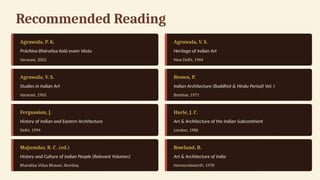
Recommended Reading
Agrawala, P.K.
Prāchīna Bhāratīya Kalā evam Vāstu
Varanasi, 2002
Agrawala, V. S.
Heritage of Indian Art
New Delhi, 1964
Agrawala, V. S.
Studies in Indian Art
Varanasi, 1965
Brown, P.
Indian Architecture (Buddhist & Hindu Period) Vol. I
Bombay, 1971
Fergussion, J.
History of Indian and Eastern Architecture
Delhi, 1994
Harle, J. C.
Art & Architecture of the Indian Subcontinent
London, 1986
Majumdar, R. C. (ed.)
History and Culture of Indian People (Relevant Volumes)
Bharatiya Vidya Bhavan, Bombay
Rowland, B.
Art & Architecture of India
Harmondsworth, 1970
18.
Thank You
Historical Accountof Early Indian Architecture
M.A. Semester I | Art & Architecture | Course I
Unit I: Terminologies Unit II: Proto-historic to Mauryan Unit III: Stūpa North India Unit IV: Stūpa Deccan & South Unit V: Rock-Cut Caves
Editor's Notes
#1 Welcome students to M.A. Semester I. Introduce yourself and outline the scope of this 1-hour introductory lecture covering all 5 units.
#2 Explain the course structure: 5 units, 18 topics. Briefly say what kind of questions the course will help answer — What did ancient Indians build? How? Why?
#3 Unit I opener. Emphasize that before we study monuments, we need a shared vocabulary — like any discipline, architecture has its own language.
#4 Show physical examples if possible — use simple diagrams. A plan is like a blueprint from above. Elevation is what you see when you stand in front. Section reveals interior.
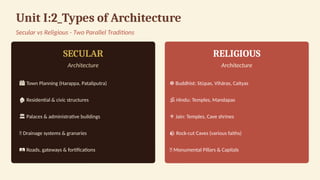
#5 Contrast: secular architecture serves everyday needs; religious serves spiritual and symbolic functions. Both coexist and influence each other in India.
#6 Unit II opener. The story begins 4500 years ago with the Indus Valley cities — already showing sophisticated planning.
#7 Emphasize the astonishing modernity of Harappan planning: grid streets, covered drains, standardized bricks. Ask: "What does this tell us about governance?"
#8 The Arthashastra is crucial — it shows that town planning was a science, governed by royal authority. Connect Vedic literature to cosmic symbolism in planning.
#9 Pataliputra was one of the ancient world's largest cities. Megasthenes' account provides an outside perspective. The polished pillars show Mauryan craft excellence.
#10 Unit III opener. The stupa is the defining monument of early Indian Buddhism. Its form is both architectural and cosmic/symbolic.
#11 Walk through the stupa diagram. Each element has symbolic meaning: the anda = cosmic egg/Mount Meru; the chattra = royalty/protection. Bharhut and Sanchi show evolution.
#12 Unit IV opener. South Indian Buddhist architecture has its own character — white marble at Amaravati vs. Sanchi's sandstone. Emphasize regional diversity.
#13 Amaravati is extraordinary — like a South Indian Sanchi. Note that many sculptures are now in the British Museum. Nagarjunakonda was rescued before the dam submerged it.
#14 Unit V opener. Rock-cut architecture is a uniquely Indian solution — instead of building up, you carve in. Durable, cool, no materials to transport.
#15 Start with Barabara Caves — the earliest. Then show the evolution through Bhaja, Karle, Bedsa to Ajanta and Ellora. The arch facade imitating wood is critical.
#16 Brahmanical and Jain caves show how the rock-cut tradition was adopted across religions. Elephanta's Trimurti is one of the great achievements of Indian sculpture.
#17 Recommend students begin with Brown's Indian Architecture for a clear narrative, and Harle's book for a scholarly treatment with good images. Agrawala books are especially relevant for this university.
#18 Close by reminding students: this course asks them to look carefully, read ancient sources, and understand architecture as both technology and symbol. Look forward to the semester.