Introduction
Components likeball and tapered bearings, gears, rock drill bits, camshafts,
crankpins, axles require outer surface to be hard and wear resistant and inner
core more ductile and tougher
Such properties ensure long service life and sufficient toughness to withstand
shock loads
Ways to achieve such combination of properties:
Thermochemical treatment – Change in surface composition by diffusion of C
and N2 – Carburising and Nitriding
Phase transformation of outer surface by rapid heating and cooling –
(Thermal)
Flame, Induction, electron, and laser beam hardening
6.
Carburising
Also knownas cementation OR case carburising OR case hardening
Carburising – Method of increasing carbon
Applicable: Low carbon steels with % C = 0.1 to 0.25
Process:
Heating to 900 to 930 C
ᵒ in presence of solid, liquid or gas rich in carbon
Holding for definite period till desired case depth is achieved
Cooling
Carbon diffused into steel when heated in austenitic region
Surface layer enriched with 0.7 to 0.9% carbon
Fully austenitic steel is essential because solubility of carbon is
more in austenite than in ferrite
it can be classified as;
Solid OR Pack OR Box carburising
Liquid carburising or salt bath carburising
Gas carburising
7.
Solid carburising
Componentsto be carburised packed with a compound rich in carbon in steel or
CI boxes and sealed with clay
If not sealed properly medium comes in contact with air and burns
without
carburising
Medium: 50 to 55% hardwood charcoal, 30 to 32% coke and
remaining energiser or accelerator like BaCO3
Process:
Heating boxes in a furnace upto 930 C
ᵒ
Holding for definite period till required case depth is achieved
Cooling
High temperature helps in aborption of carbon on surface
Reactions:
O2 (from box) + C (medium)
CO2
BaCO3 BaO + CO2
CO2 + C (from medium)
2CO 2CO + Fe
8.
Solid carburising
Maximumcarbon at the surface and case depth depend upon temperature
of carburising and holding time
Higher the temperature, higher is the case depth but grain coarsening occurs
Higher the holding time, higher is the case depth without change in maximum
concentration at the surface
Carburising time of 6 to 8 hrs for case depth of 1 to 2mm @ 900ᵒ C
Used when extreme uniformity in carbon content is not desired
Case depth: The perpendicular distance from the surface of the steel to the
point at which change in hardness, chemical composition or microstructure of
the case and core cannot be distinguished
9.
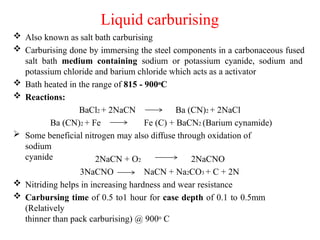
Liquid carburising
Alsoknown as salt bath carburising
Carburising done by immersing the steel components in a carbonaceous fused
salt bath medium containing sodium or potassium cyanide, sodium and
potassium chloride and barium chloride which acts as a activator
Bath heated in the range of 815 - 900 C
ᵒ
Reactions:
BaCl2 + 2NaCN
Ba (CN)2 + Fe
Ba (CN)2 + 2NaCl
Fe (C) + BaCN2 (Barium cynamide)
Some beneficial nitrogen may also diffuse through oxidation of
sodium
cyanide 2NaCN + O2
3NaCNO
2NaCNO
NaCN + Na2CO3 + C + 2N
Nitriding helps in increasing hardness and wear resistance
Carbursing time of 0.5 to1 hour for case depth of 0.1 to 0.5mm
(Relatively
thinner than pack carburising) @ 900ᵒ C
10.
Liquid carburising
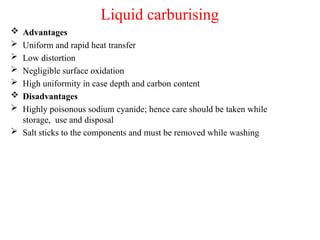
Advantages
Uniform and rapid heat transfer
Low distortion
Negligible surface oxidation
High uniformity in case depth and carbon content
Disadvantages
Highly poisonous sodium cyanide; hence care should be taken while
storage, use and disposal
Salt sticks to the components and must be removed while washing
11.
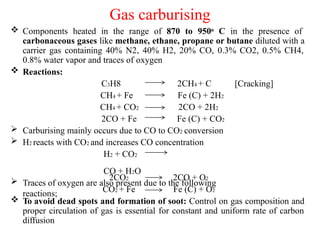
Gas carburising
Componentsheated in the range of 870 to 950ᵒ C in the presence of
carbonaceous gases like methane, ethane, propane or butane diluted with a
carrier gas containing 40% N2, 40% H2, 20% CO, 0.3% CO2, 0.5% CH4,
0.8% water vapor and traces of oxygen
Reactions:
C3H8
CH4 + Fe
CH4 + CO2
2CO + Fe
2CH4 + C
Fe (C) + 2H2
2CO + 2H2
Fe (C) + CO2
[Cracking]
Carburising mainly occurs due to CO to CO2 conversion
H2 reacts with CO2 and increases CO concentration
H2 + CO2
CO + H2O
Traces of oxygen are also present due to the following
reactions;
2CO2
CO2 + Fe
2CO + O2
Fe (C) + O2
To avoid dead spots and formation of soot: Control on gas composition and
proper circulation of gas is essential for constant and uniform rate of carbon
diffusion
12.
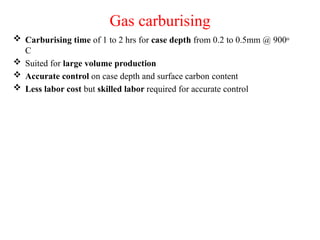
Gas carburising
Carburisingtime of 1 to 2 hrs for case depth from 0.2 to 0.5mm @ 900ᵒ
C
Suited for large volume production
Accurate control on case depth and surface carbon content
Less labor cost but skilled labor required for accurate control
13.
Nitriding
Applicable toalloy steels containing nitride forming elements like Al, Cr,
Mo, V and W
Process carried out @ 550 C
ᵒ ; hence no phase transformation
Proper heat treatment necessary before nitriding
All machining and grinding operations to be completed before nitriding
Area not to be nitrided to be covered by depositing tin by electrolysis
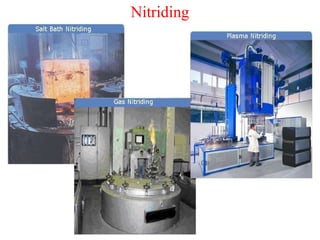
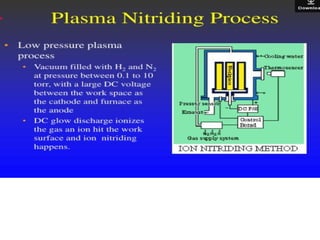
Two types:
Liquid nitriding: Same reactions as that of liquid carburising except only
N diffusion because of low temperatures
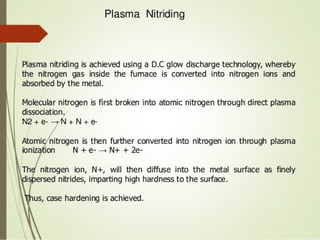
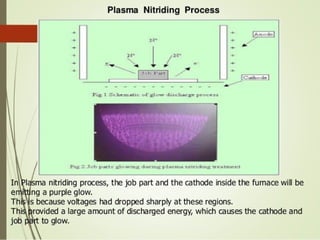
Gas nitriding: Anhydrous ammonia gas is passed which dissociates into
nascent nitrogen and hydrogen
2NH3 2 N + 3H2
Nitriding of alloy steels: Fe4N (White layer) + alloy nitrides (dark). Hence
YES
Nitriding of plain carbon steels: Only white layer. Hence NO
Treatment time depends upon case depth and size; usually 21hrs to 100hrs
Nitriding time of 100hrs for case depth of 0.5mm @ 550ᵒ C
Case hardness: 900-1100VHN
Achieved properties: Good wear resistance, hot hardness, corossion
14.
Nitriding
Applications: Precisiongears, boring bars, forming rolls for paper and
rubber, forming dies, camshafts, crankshafts, cylinder liners
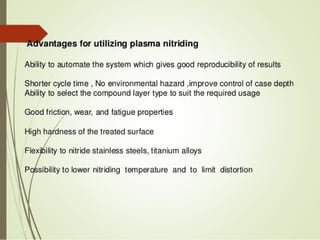
Advantages:
No post heat treatment; hence minimum distortions
High fatigue life
Better corrosion resistance than carburised and hardened components
Excellent bearing properties (Non metallic nature of nitrides, less coefficient
of
friction)
High hardeness than carburised and hardened components
High hot hardness
Disadvantages:
Applicable only to alloy steels containing nitriding elements
Thin case depth
White layer
No heat treatment can be done after nitriding
Carbonitriding
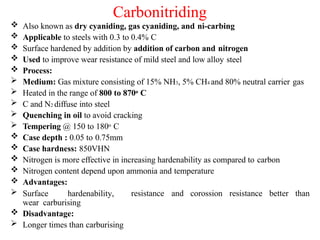
Also knownas dry cyaniding, gas cyaniding, and ni-carbing
Applicable to steels with 0.3 to 0.4% C
Surface hardened by addition by addition of carbon and nitrogen
Used to improve wear resistance of mild steel and low alloy steel
Process:
Medium: Gas mixture consisting of 15% NH3, 5% CH4 and 80% neutral carrier gas
Heated in the range of 800 to 870ᵒ C
C and N2 diffuse into steel
Quenching in oil to avoid cracking
Tempering @ 150 to 180ᵒ C
Case depth : 0.05 to 0.75mm
Case hardness: 850VHN
Nitrogen is more effective in increasing hardenability as compared to carbon
Nitrogen content depend upon ammonia and temperature
Advantages:
Surface hardenability,
wear carburising
Disadvantage:
Longer times than carburising
resistance and corossion resistance better than
21.
Carbonitriding
During carbonitriding,parts are heated in a sealed chamber well into the
austenitic range—around 1600 degrees Fahrenheit—before nitrogen and
carbon are added.
Because the part is heated into the austenitic range, a phase change occurs
and carbon and nitrogen atoms can diffuse into the part.
Nitrogen is commonly added to low carbon, low alloy steels that otherwise
wouldn’t harden well as intended. The nitrogen comes in the form of
ammonia, which cracks on the surface of the part to provide nitrogen that
diffuses into the steel.
Carbonitriding typically achieves greater case depths compared to
nitrocarburizing.
The carbonitriding process usually takes a few hours achieve the desired
results: a part with high surface hardness but with a relatively ductile core.
The process concludes with a quench.
Carbonitriding is used to harden surfaces of parts made of relatively cheaper
and easily-machined steels, like stamped automotive parts or wood screws.
The process makes parts more resistant to wear and increases fatigue
strength.
22.
Nitrocarburizing
Nitrocarburizing alsoentails the dissolution of carbon and nitrogen into a workpiece,
but compared to carbonitriding, more nitrogen is used in nitrocarburizing.
There are two forms of nitrocarburizing: austenitic and ferritic.
Austenitic nitrocarburizing refers to the temperature of the nitrogen-enriched zone at
the surface of a part.
A phase change occurs in that zone, allowing the nitrogen to diffuse.
Ferritic nitrocarburizing is conducted at a lower temperature where no phase change
occurs.
Case depths as a result of nitrocarburizing are typically more shallow compared to
carbonitriding.
Ferritic nitrocarburizing is unique in that it offers case hardening without the need to
heat metal parts into a phase change (it’s done at between 975 and 1,125 degrees
Fahrenheit).
Within that temperature range, nitrogen atoms can diffuse into the steel, but the risk of
distortion is decreased.
Due to their shape and size, carbon atoms cannot diffuse into the part in this low-
temperature process.
Workpieces improved by nitrocarburizing include drive train components in
automobiles and heavy equipment, firearm components like barrels and slides and
dies for manufacturing processes.
23.
Boronizing
Applied tocarbon and tool steels
Medium: Pack or gas
Pack process:
Components packed in heat resistant boxes with mixture of granules or paste of
boron carbide or other boron compounds with addition of activators and
dilutents
Heated in the range of 900-1000ᵒ C
Boron diffuses and layers of FeB @ outer suface and Fe2B @ interior are
formed
FeB phase is hard and brittle; hence not desirable. High temperature, long
treatment time and high alloys favor formation of FeB
Case hardness: 1500-2100 VHN
Case depth: 0.012-0.15 mm
Boronizing time of 6hours for case depth of 0.15mm @900ᵒ C
To optimize the performance hardening and tempering can be carried out after
boronising
24.
Boronizing
Advantages:
Increasesresistance of low alloy steels to sulphuric, phosphoric, and hydrochloric acid
Increases resistance of austenitic stainless steel to hydrochloric acid
Selective hardening is possible
Can be polished to high finish
Can be applied to irregular shapes
Increases tool and mold life by improving resistance to abrasive, sliding and adhesive
wear
Low coefficient of friction
Disadvantages:
Distortions due to high temperature
Poor fatigue and corossion resistance
Applications:
Due to high hot hardness and wear resistance: Hot forging dies, wire drawing dies,
extrusion dies, straightening rolls, ingot molds etc
Nozzles, plungers, gears, shafts and rollers
Oil and gas components like valve components, valve fittings, metal seals, coal/oil
burner nozzles
Turbine components, pump impellors, ball valves and seats, shaft protection sleeve, and
25.
The Aluminizing Process
Aluminizingand thermo-chemical diffusion process is carried out at high
temperatures, typically in the range of 800–1000°C with a prolonged soaking
time to aid the diffusion potential.
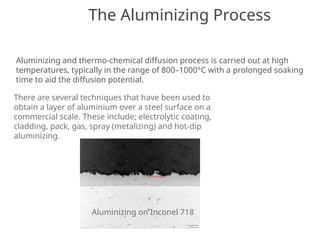
There are several techniques that have been used to
obtain a layer of aluminium over a steel surface on a
commercial scale. These include; electrolytic coating,
cladding, pack, gas, spray (metalizing) and hot-dip
aluminizing.
Aluminizing on Inconel 718
26.
Aluminizing is athermo-chemical diffusion treatment where in the surface
layer of the material is impregnated with aluminum. It is primarily used on
steels, but also on nickel and cobalt based alloys to obtain greater creep
resistance, hardness and corrosion resistance.
• The aluminizing process is usually operating at a relatively high
temperature of 800–1000°C with prolonged soaking time taking into
account the diffusion concept.
• To decrease the grain growth, carbide precipitation and distortion, there
are many investigations relating a low-temperature aluminizing process,
which is operating at a temperature below 700°C.
• However, the diffusion rate of aluminum atoms decreases with
decreasing temperature, although many concerns are relieved by a low-
temperature aluminizing process.
• Consequently, it cannot be refuted that the aluminizing time will be
extended for the low-temperature aluminizing process.
• Bulk plastic deformation is a way to enhance the diffusion rate as
reported in.
• However, the aluminizing process emphasizes only at the surface and in
near-surface regions.
• Thus, plastic deformation only at the surface and in near-surface regions
should be considered to improve the diffusion rate for the
thermochemical surface treatments.
27.
Types of coatingprocesses
Coating Processes
Pack Coating:
Coatings can be applied by pack coating processes, where the compounds
containing Al or Cr are placed inside a powder mixture of aluminum oxide
and an activator to produce a metal halide vapor. These vapors will deposit
on the surface of the work piece.
Vapor Phase Coating:
A more advanced method is to process parts in a vapor phase coating
system, where the workpiece is placed above the donor materials, so the
surface of the parts will not be contaminated by contact with the powder.
Vapor Phase Aluminizing (VPA) and Vapor Phase Chromizing (VPC) are typical
coating processes.
Chemical Vapor deposition (CVD):
The most advanced method of coating is to produce the elements to be
applied either outside or inside the coating chamber by reacting donor
material with halide forming gasses, controlling the rate of deposition by
adjusting the temperature and gas flow rates over or through the work
piece.