Study in Canada from Nepal 2026
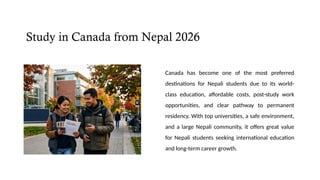
Canada has become one of the most preferred
destinations for Nepali students due to its world-
class education, affordable costs, post-study work
opportunities, and clear pathway to permanent
residency. With top universities, a safe environment,
and a large Nepali community, it offers great value
for Nepali students seeking international education
and long-term career growth.
Why Nepali Students Choose Canada
Canada stands out for its high investment in education, multicultural society, and strong post-graduation
opportunities. Nepali students benefit from affordable tuition compared to the USA, UK, and Australia,
along with the ability to work 24 hours per week during studies. The Post-Graduation Work Permit (PGWP)
up to 3 years and pathways to permanent residency make Canada highly attractive for long-term goals.
Academic Eligibility Requirements
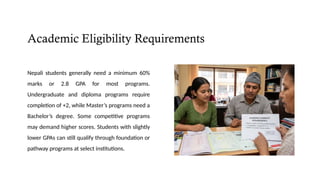
Nepali students generally need a minimum 60%
marks or 2.8 GPA for most programs.
Undergraduate and diploma programs require
completion of +2, while Master’s programs need a
Bachelor’s degree. Some competitive programs
may demand higher scores. Students with slightly
lower GPAs can still qualify through foundation or
pathway programs at select institutions.
English Language Requirements
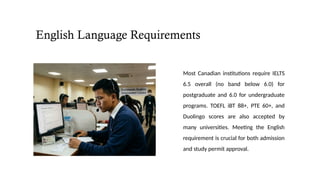
Most Canadian institutions require IELTS
6.5 overall (no band below 6.0) for
postgraduate and 6.0 for undergraduate
programs. TOEFL iBT 88+, PTE 60+, and
Duolingo scores are also accepted by
many universities. Meeting the English
requirement is crucial for both admission
and study permit approval.
Cost to Study in Canada
Tuition fees for Nepali students typically range from CAD 20,000 to 45,000 per year depending on
the program and institution. Students must show minimum proof of funds of CAD 22,895 for living
expenses excluding tuition. Total annual cost including living expenses usually falls between CAD
40,000 to 55,000. Education loans from Nepali banks are widely accepted as proof of funds.
Popular Intakes for Nepali Students
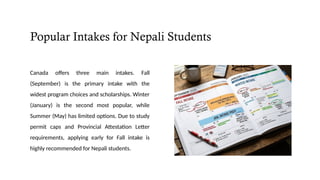
Canada offers three main intakes. Fall
(September) is the primary intake with the
widest program choices and scholarships. Winter
(January) is the second most popular, while
Summer (May) has limited options. Due to study
permit caps and Provincial Attestation Letter
requirements, applying early for Fall intake is
highly recommended for Nepali students.
Post-Graduation Work Permit (PGWP)
The PGWP allows eligible graduates to work in
Canada after completing their studies. Master’s
and Bachelor’s degree holders can get up to 3
years of work permit. This valuable opportunity
helps Nepali students gain international work
experience and strengthens their profile for
permanent residency through Express Entry or
Provincial Nominee Programs.
Study Permit and Visa Process
After receiving a Letter of Acceptance from a Designated Learning Institution (DLI), students
apply for a study permit through the IRCC portal. Most undergraduate and diploma students
require a Provincial Attestation Letter (PAL). The process includes biometrics, medical exam, and
financial proof. Approval rate for Nepali students reached 57% in 2025.
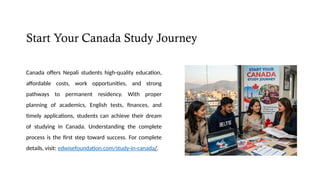
Start Your Canada Study Journey
Canada offers Nepali students high-quality education,
affordable costs, work opportunities, and strong
pathways to permanent residency. With proper
planning of academics, English tests, finances, and
timely applications, students can achieve their dream
of studying in Canada. Understanding the complete
process is the first step toward success. For complete
details, visit: edwisefoundation.com/study-in-canada/.