GOALS OF THEDISCUSSION
• To understand what is stress
• Discuss about the various causes of stress
• Reactions in response to stress
• Healthy and unhealthy ways of dealing with it
• Sleep disturbances and sleep hygiene
• How to deal with a person presenting to you in stress
• When to refer to mental health experts ?
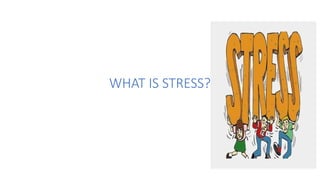
WHAT IS STRESS?
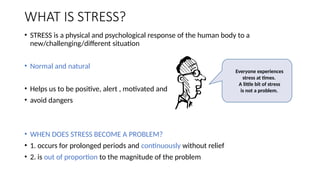
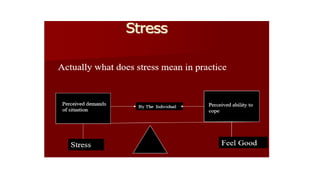
•STRESS is a physical and psychological response of the human body to a
new/challenging/different situation
• Normal and natural
• Helps us to be positive, alert , motivated and
• avoid dangers
• WHEN DOES STRESS BECOME A PROBLEM?
• 1. occurs for prolonged periods and continuously without relief
• 2. is out of proportion to the magnitude of the problem
Everyone experiences
stress at times.
A little bit of stress
is not a problem.
5.
DEFINITION
• Psychological stressis a particular relationship between the person
and the environment that is appraised by the person as taxing or
exceeding his or her resources and endangering his or her well-being.
• STRESS IS A PERSON’S PHYSICAL AND EMOTIONAL RESPONSE TO
CHANGE
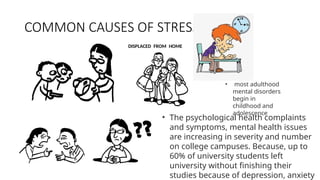
COMMON CAUSES OFSTRESS
DISPLACED FROM HOME
• most adulthood
mental disorders
begin in
childhood and
adolescence
• The psychological health complaints
and symptoms, mental health issues
are increasing in severity and number
on college campuses. Because, up to
60% of university students left
university without finishing their
studies because of depression, anxiety
8.
• Some degreeof stress is beneficial.
• However, stress that prolonged or intense can overtax our ability to
cope and turn into emotional distress and physical complaints
10.
Introduction
• Life withoutstress can not be imagined.
• Psychological stress form an inseparable part of life and, up to a
degree, may be essential for normal personality development.
• If these stresses become too severe or too numerous they may affect
the psychiatric equilibrium, producing maladaptive patterns of
behavior and possibly mental disorders.
11.
Historical Aspect
• WilliamHarvey in the 17th
century and William Osler in the 19th
century frequently alluded to the relationship between adverse life
events and illness onset.
• Hans Selye (1936) is considered to be the father of stress research
12.
• Hans Selyedeveloped a model of stress that he called general
adaptation syndrome. It consists of 3 phases-
• 1.Alarm reaction
• 2.The stage of resistance, in which adaptation is ideally achieved.
• 3 The stage of exhaustion, in which acquired adaptation or resistance
may be lost.
COMMON RESPONSES TOSTRESS
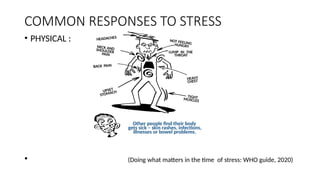
• PHYSICAL :
• (Doing what matters in the time of stress: WHO guide, 2020)
Other people find their body
gets sick – skin rashes, infections,
illnesses or bowel problems.
HEADACHES
NECK AND
SHOULDER
PAIN
BACK PAIN
UPSET
STOMACH
NOT FEELING
HUNGRY
LUMP IN THE
THROAT
HEAVY
CHEST
TIGHT
MUSCLES
16.
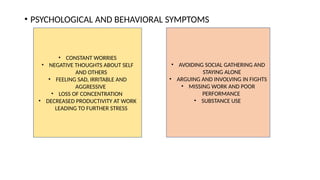
• PSYCHOLOGICAL ANDBEHAVIORAL SYMPTOMS
• CONSTANT WORRIES
• NEGATIVE THOUGHTS ABOUT SELF
AND OTHERS
• FEELING SAD, IRRITABLE AND
AGGRESSIVE
• LOSS OF CONCENTRATION
• DECREASED PRODUCTIVITY AT WORK
LEADING TO FURTHER STRESS
• AVOIDING SOCIAL GATHERING AND
STAYING ALONE
• ARGUING AND INVOLVING IN FIGHTS
• MISSING WORK AND POOR
PERFORMANCE
• SUBSTANCE USE
17.
Stress Response
• Thephysiological component of stress response-
up regulation of functions needed for survival like
• Availability of energy by gluconeogenesis,
• Protein catabolism and lipolysis,
• Oxygen supply stepped up by increased respiratory rate,
• Increased heart rate,
• blood pressure
18.
Down regulation offunctions not of immediate survival value
.Digestive functions
.Appetite
.Growth
.Reproductive behavior
.Immune functions
On behavioral level- alertness, vigilance, focused attention and
cognitive surge
19.
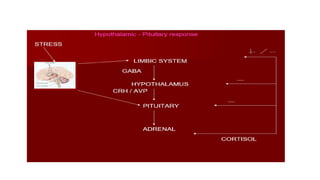
Stress and HPAsystem
• The key CNS system generating the stress response have two modes
of operation-
1.Fast, CRH-driven, neuroendocrine / sympathetic ‘fight – flight’
response mediated by CRH-1 receptors
2.Slower system promoting recovery and adaptation which is activated
by recently discovered urocortins acting via CRh-1 receptors (Hsu &
Hsueh, 2001; Reul & holsboer, 2002)
21.
Stress and Neurotransmitter
•Activate noradrenergic systems in the brain (most notably in the locus
coeruleus) and cause the release of catecholamines from the
autonomic nervous system. Prior exposure to chronic stress results in
enhanced synthesis of brain norepinephrine, apparently through the
induction of tyrosine hydroxylase, the rate-limiting step in
catecholamine synthesis
• Activate serotonergic systems in the brain as evidenced by increased
serotonin (5-HT) turnover
22.
HPA axis andDopamine
• Stress has a major impact on the DA system
• Stress has the effect of increasing Dopaminergic neurotransmission in the
mesofrontal pathway.
• Duration of stressor exposure is also an important determinant of the
resultant changes in the DA system
• Short exposure leads to increased DA release, prolonged exposure to
decrease below control level.
• Another important factor controlling the DA response to stress, is the (un)
controllability of the stressor.
• If coping is possible, increase in DA release continues as long as the
stressful situation lasts
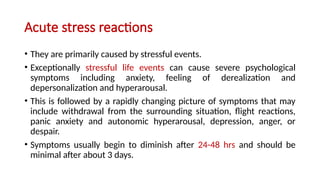
Acute stress reactions
•They are primarily caused by stressful events.
• Exceptionally stressful life events can cause severe psychological
symptoms including anxiety, feeling of derealization and
depersonalization and hyperarousal.
• This is followed by a rapidly changing picture of symptoms that may
include withdrawal from the surrounding situation, flight reactions,
panic anxiety and autonomic hyperarousal, depression, anger, or
despair.
• Symptoms usually begin to diminish after 24-48 hrs and should be
minimal after about 3 days.
Adjustment Disorders
• Stresshas been described as the aetiological agent for adjustment
disorders. Vulnerability to stress is another risk factor.
* Adjustment Disorders is a stress-related phenomenon in which the
stressor precipitates maladaptation and symptoms that are time
limited until the stressor is attenuated or a new state of adaptation
occurs.
* Diverse variables and modifiers are involved regarding who will
experience adjustment disorder s following a stress.
31.
• Most patientsreturn to their previous level of functioning with in 3
months.
• Some persons who receive a diagnosis of an adjustment disorder later
have mood disorders or substance related disorders.
• Treatment: psychotherapy remains the treatment of choice, little role
of pharmacoherapy
32.
Role of stressin psychiatric disease
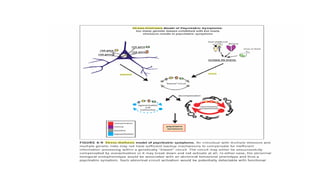
• Stress Diathesis Model
development of psychiatric symptoms is often the function of both
genetic and environmental influence.
Individuals with Multiple genetic risk when exposed to multiple stressor
is unable to compensate for the genetically biased circuit and
manifest psychiatric symptoms
34.
Psychotic disorder
• Adverselife events and stressful social or familial milieu play an
important role in determining the course of illness in general and
episodes of relapse in particular.
• Studies of “expressed emotion,” have demonstrated that persons with
schizophrenia who reside in homes with high-expressed emotion tend
to relapse at twice the rate of those who live with families who have
low-expressed emotion.
• Other stressors that plague the lives of many patients with
schizophrenia (e.G., Poverty, homelessness, and criminal
victimization) also powerfully affect the clinical course of their illness
35.
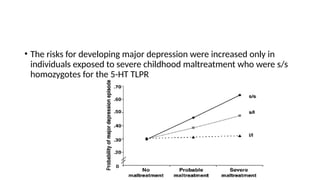
• The risksfor developing major depression were increased only in
individuals exposed to severe childhood maltreatment who were s/s
homozygotes for the 5-HT TLPR
36.
Anxiety Disorders
• Eitherinterpersonal conflict or serious illness (in a significant other)
may trigger the onset of panic disorder in susceptible individuals.
• There is growing evidence that certain adverse early life events such
as childhood emotional, physical, or sexual abuse are risk factors for
the later development of panic disorder, particularly in women.
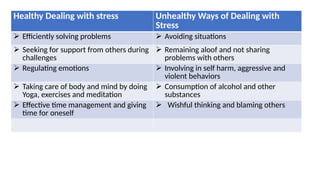
Healthy Dealing withstress Unhealthy Ways of Dealing with
Stress
Efficiently solving problems Avoiding situations
Seeking for support from others during
challenges
Remaining aloof and not sharing
problems with others
Regulating emotions Involving in self harm, aggressive and
violent behaviors
Taking care of body and mind by doing
Yoga, exercises and meditation
Consumption of alcohol and other
substances
Effective time management and giving
time for oneself
Wishful thinking and blaming others
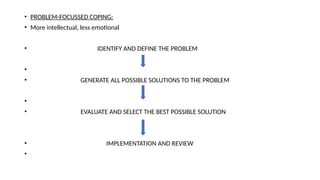
• PROBLEM-FOCUSSED COPING:
•More intellectual, less emotional
• IDENTIFY AND DEFINE THE PROBLEM
•
• GENERATE ALL POSSIBLE SOLUTIONS TO THE PROBLEM
•
• EVALUATE AND SELECT THE BEST POSSIBLE SOLUTION
• IMPLEMENTATION AND REVIEW
•
43.
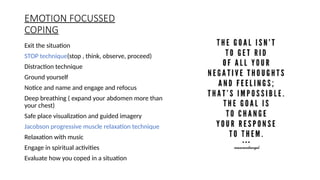
EMOTION FOCUSSED
COPING
Exit thesituation
STOP technique(stop , think, observe, proceed)
Distraction technique
Ground yourself
Notice and name and engage and refocus
Deep breathing ( expand your abdomen more than
your chest)
Safe place visualization and guided imagery
Jacobson progressive muscle relaxation technique
Relaxation with music
Engage in spiritual activities
Evaluate how you coped in a situation
44.
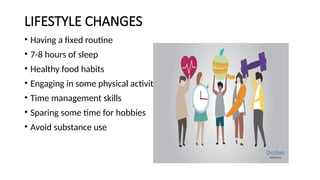
LIFESTYLE CHANGES
• Havinga fixed routine
• 7-8 hours of sleep
• Healthy food habits
• Engaging in some physical activity
• Time management skills
• Sparing some time for hobbies
• Avoid substance use
45.
LIFE SKILLS
• Agroup of psychosocial competencies and interpersonal skills that helps in:
• making informed decisions
• solve problems
• think critically and creatively
• Communicate effectively
• Build healthy relationships
• Empathize with others
• emotional, social and intellectual tools needed to achieve success in life
• Personal, interpersonal and community level
46.
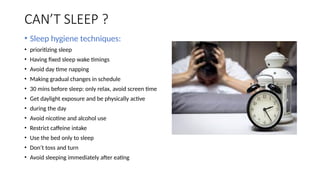
CAN’T SLEEP ?
•Sleep hygiene techniques:
• prioritizing sleep
• Having fixed sleep wake timings
• Avoid day time napping
• Making gradual changes in schedule
• 30 mins before sleep: only relax, avoid screen time
• Get daylight exposure and be physically active
• during the day
• Avoid nicotine and alcohol use
• Restrict caffeine intake
• Use the bed only to sleep
• Don’t toss and turn
• Avoid sleeping immediately after eating
47.
HOW CAN YOUHELP OTHERS IN STRESS?
• MR. A , 15 y/o student was a topper in the class. He was very sincere , obedient and hard working
and friendly. After his parent’s divorce, the class teacher noticed that he wasn’t able to
concentrate, would be found staring in space, had become aloof. His grades started falling and his
concentration and interest in class worsened due to the criticism and taunts of classmates and
relatives. He started skipping classes, was seen smoking and would sometimes skip classes being
under intoxication.
• Finally MR . A decides that enough is enough and approaches his math teacher that he was
always very comfortable with
• How would you help MR. A?
48.
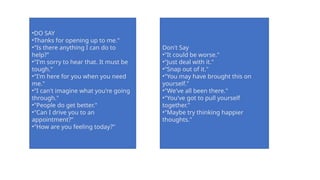
•DO SAY
•Thanks foropening up to me."
•"Is there anything I can do to
help?"
•"I'm sorry to hear that. It must be
tough."
•"I'm here for you when you need
me."
•"I can't imagine what you're going
through."
•"People do get better."
•"Can I drive you to an
appointment?"
•"How are you feeling today?"
Don't Say
•"It could be worse."
•"Just deal with it."
•"Snap out of it."
•"You may have brought this on
yourself."
•"We've all been there."
•"You've got to pull yourself
together."
•"Maybe try thinking happier
thoughts."
49.
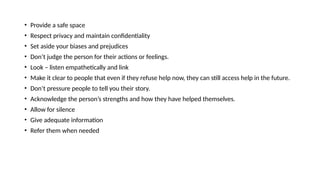
• Provide asafe space
• Respect privacy and maintain confidentiality
• Set aside your biases and prejudices
• Don’t judge the person for their actions or feelings.
• Look – listen empathetically and link
• Make it clear to people that even if they refuse help now, they can still access help in the future.
• Don’t pressure people to tell you their story.
• Acknowledge the person’s strengths and how they have helped themselves.
• Allow for silence
• Give adequate information
• Refer them when needed
50.
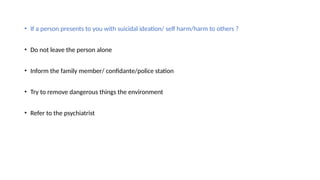
• If aperson presents to you with suicidal ideation/ self harm/harm to others ?
• Do not leave the person alone
• Inform the family member/ confidante/police station
• Try to remove dangerous things the environment
• Refer to the psychiatrist
51.
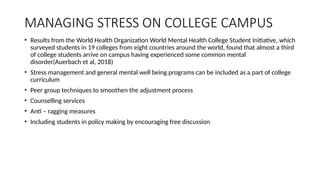
MANAGING STRESS ONCOLLEGE CAMPUS
• Results from the World Health Organization World Mental Health College Student Initiative, which
surveyed students in 19 colleges from eight countries around the world, found that almost a third
of college students arrive on campus having experienced some common mental
disorder(Auerbach et al, 2018)
• Stress management and general mental well being programs can be included as a part of college
curriculum
• Peer group techniques to smoothen the adjustment process
• Counselling services
• Anti – ragging measures
• Including students in policy making by encouraging free discussion
52.
WHEN TO REFER?
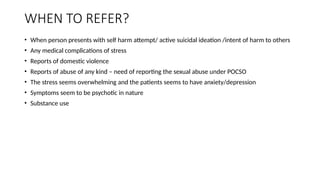
•When person presents with self harm attempt/ active suicidal ideation /intent of harm to others
• Any medical complications of stress
• Reports of domestic violence
• Reports of abuse of any kind – need of reporting the sexual abuse under POCSO
• The stress seems overwhelming and the patients seems to have anxiety/depression
• Symptoms seem to be psychotic in nature
• Substance use
#7 University students are a special group of people that are enduring a critical transitory period in which they are going from adolescence to adulthood and can be one of the most stressful times in a person’s life.