Strengthened Senior High School Curriculum Training for Science Teachers: Key Features and Instructional Design
Comprehensive training on the strengthened SHS curriculum focusing on General Science, instructional design framework, teaching strategies, and assessment to develop scientifically literate learners.
NAME OF RP
*******
Session1
Key Features of the
Strengthened Senior High
School Curriculum and the
Instructional Design
Framework
3.
Session Objectives
At theend of the session, the participants shall
be able to:
a. Explain the rationale, key features, and
structure of the strengthened SHS curriculum.
4.
Session Objectives
At theend of the session, the participants shall
be able to:
b. Clarify shared interpretations of the SHS
Instructional Design Framework.
c. Identify implications of SHS features and the
IDF for instructional planning and quality learning
delivery.
5.
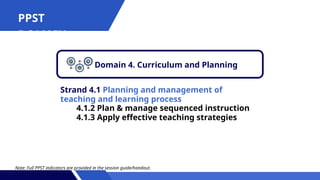
PPST
DOMAIN
Domain 4. Curriculumand Planning
Strand 4.1 Planning and management of
teaching and learning process
4.1.2 Plan & manage sequenced instruction
4.1.3 Apply effective teaching strategies
Note: Full PPST indicators are provided in the session guide/handout.
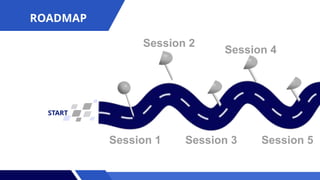
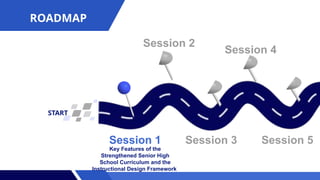
START
Key Features ofthe
Strengthened Senior High
School Curriculum and the
Instructional Design Framework
Session 1
Session 2
Session 3
Session 4
Session 5
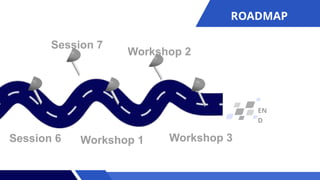
ROADMAP
16.
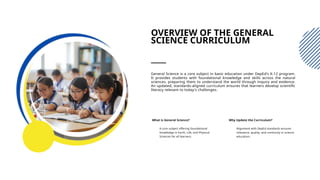
OVERVIEW OF THEGENERAL
SCIENCE CURRICULUM
General Science is a core subject in basic education under DepEd's K-12 program.
It provides students with foundational knowledge and skills across the natural
sciences, preparing them to understand the world through inquiry and evidence.
An updated, standards-aligned curriculum ensures that learners develop scientific
literacy relevant to today's challenges.
What is General Science?
A core subject offering foundational
knowledge in Earth, Life, and Physical
Sciences for all learners.
Why Update the Curriculum?
Alignment with DepEd standards ensures
relevance, quality, and continuity in science
education.
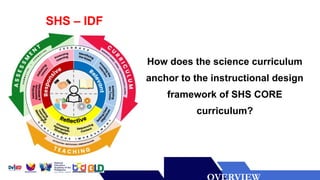
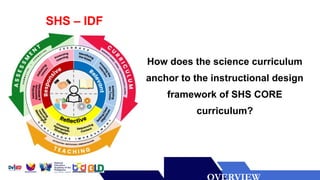
How does thescience curriculum
anchor to the instructional design
framework of SHS CORE
curriculum?
SHS – IDF
23.
How does thescience curriculum
anchor to the instructional design
framework of SHS CORE
curriculum?
SHS – IDF
24.
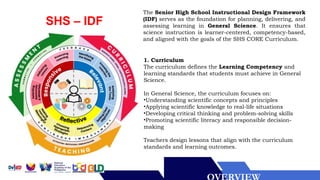
The Senior HighSchool Instructional Design Framework
(IDF) serves as the foundation for planning, delivering, and
assessing learning in General Science. It ensures that
science instruction is learner-centered, competency-based,
and aligned with the goals of the SHS CORE Curriculum.
SHS – IDF
1. Curriculum
The curriculum defines the Learning Competency and
learning standards that students must achieve in General
Science.
In General Science, the curriculum focuses on:
•Understanding scientific concepts and principles
•Applying scientific knowledge to real-life situations
•Developing critical thinking and problem-solving skills
•Promoting scientific literacy and responsible decision-
making
Teachers design lessons that align with the curriculum
standards and learning outcomes.
25.
SHS – IDF
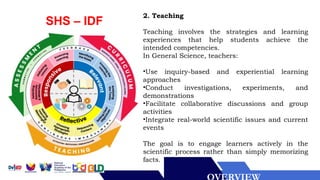
2.Teaching
Teaching involves the strategies and learning
experiences that help students achieve the
intended competencies.
In General Science, teachers:
•Use inquiry-based and experiential learning
approaches
•Conduct investigations, experiments, and
demonstrations
•Facilitate collaborative discussions and group
activities
•Integrate real-world scientific issues and current
events
The goal is to engage learners actively in the
scientific process rather than simply memorizing
facts.
26.
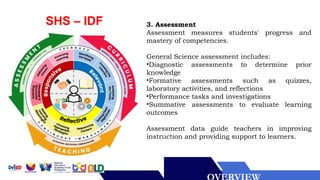
SHS – IDF3. Assessment
Assessment measures students' progress and
mastery of competencies.
General Science assessment includes:
•Diagnostic assessments to determine prior
knowledge
•Formative assessments such as quizzes,
laboratory activities, and reflections
•Performance tasks and investigations
•Summative assessments to evaluate learning
outcomes
Assessment data guide teachers in improving
instruction and providing support to learners.
27.
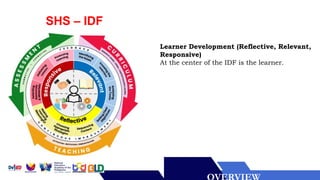
SHS – IDF
LearnerDevelopment (Reflective, Relevant,
Responsive)
At the center of the IDF is the learner.
28.
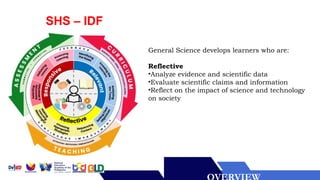
SHS – IDF
GeneralScience develops learners who are:
Reflective
•Analyze evidence and scientific data
•Evaluate scientific claims and information
•Reflect on the impact of science and technology
on society
29.
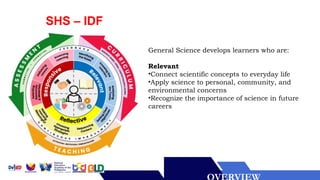
SHS – IDF
GeneralScience develops learners who are:
Relevant
•Connect scientific concepts to everyday life
•Apply science to personal, community, and
environmental concerns
•Recognize the importance of science in future
careers
30.
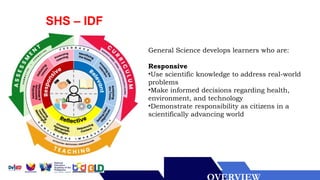
SHS – IDF
GeneralScience develops learners who are:
Responsive
•Use scientific knowledge to address real-world
problems
•Make informed decisions regarding health,
environment, and technology
•Demonstrate responsibility as citizens in a
scientifically advancing world
31.
Lorem ipsum dolorsit amet,
consectetur adipiscing elit.
Praesent tincidunt, nulla lacinia
ultrices vestibulum, turpis ex
gravida purus, non vehicula
sapien mi non nisi.
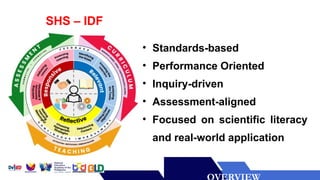
• Standards-based
• Performance Oriented
• Inquiry-driven
• Assessment-aligned
• Focused on scientific literacy
and real-world application
SHS – IDF
32.
Lorem ipsum dolorsit amet,
consectetur adipiscing elit.
Praesent tincidunt, nulla lacinia
ultrices vestibulum, turpis ex
gravida purus, non vehicula
sapien mi non nisi.
What is the primary aim
of the SHS Core Science curriculum
in the Philippines?
33.
Lorem ipsum dolorsit amet,
consectetur adipiscing elit.
Praesent tincidunt, nulla lacinia
ultrices vestibulum, turpis ex
gravida purus, non vehicula
sapien mi non nisi.
Senior High School (SHS) core science aims
to develop scientifically literate citizens
who can apply scientific knowledge, inquiry skills, and
attitudes to solve problems, make informed decisions,
and understand natural phenomena.
Editor's Notes
#21 Say: “Now, let’s take a look at the overview of the Strengthened Senior High School Science Curriculum. This slide gives us a general picture of how the strengthened curriculum is structured. It helps us see how the science curriculum is connected to the instructional design framework and how it aims to develop scientifically literate learners. As we go through this part, think of it as our roadmap for the session. It will guide us as we explore the key components of the curriculum.”
Ask: When you hear the phrase strengthened science curriculum, what comes to mind? Is it about clearer standards, more practical applications, or stronger alignment with real-world skills? Share your thoughts with the person next to you.”
Transition Statement: Thank you for sharing your ideas. Now that we have an initial picture of what a strengthened curriculum might look like, let’s take a closer look at the instructional design framework that shapes the Senior High School Core Science curriculum.
#22 Say: Before we proceed to Session 2A, let’s first activate what you already know. Take a moment to look at the diagram on the screen and think about this question: “How does the science curriculum anchor to the instructional design framework of the SHS CORE curriculum?” I’ll give you two (2) minutes to write your thoughts individually. As you write, think about how the elements of the curriculum—assessment, teaching, and content sequencing—connect with the framework’s components: Responsive, Relevant, and Reflective. After writing, I’d like to invite/ask 2–3 participants to share their insights with the group.
Transition Statement: “Now that we’ve seen how the curriculum anchors to this framework, let’s take a closer look at its main goal —developing scientifically literate citizens who can apply knowledge and skills to real-world challenges.”
#31 Say: This slide shows us the answer. The SHS IDF is standards-based, performance-oriented, inquiry-driven, and assessment-aligned. It ensures that teaching develops scientific literacy and links learning to real-world applications, rather than just going through topics.
Ask: Which of these principles, standards-based, performance-oriented, inquiry-driven, or assessment-aligned do you already practice strongly in your teaching? Which one do you think you need to strengthen further? Share your thoughts with a partner.
Transition Statement: Now that we’ve seen the framework, let’s connect it directly to the standards of the SHS Core Science curriculum on the next slide. This will show us how the framework aligns with specific expectations for learners.
#32 Do: Allow participants a few seconds to read the question.
Say: “What is the primary aim of SHS Core Science?” (Allow responses)
Transition: This means helping learners understand science concepts, think critically, and apply their knowledge responsibly in real-world situations.
#33 Say: “Scientific literacy is more than memorizing content — it’s about understanding science, applying it responsibly, and using it to solve real-world problems”.
Processing Emphasis:
Scientific knowledge, inquiry skills, and attitudes to solve problems – focused of the Science Education Framework
To solve problems, make informed decisions, and understand natural phenomena – Skills
Literacy requires application and reflection.
Transition: “To operationalize this aim, the curriculum is standards-based.”