Strategizing the New Change: Navigating High-Velocity and High-Quantum Transformations
Explore the evolving nature of organizational change, contrasting old and new paradigms, and learn frameworks for managing rapid, complex transformations driven by technology and external shocks.
Strategizing the New Change: Navigating High-Velocity and High-Quantum Transformations
1.
Strategizing
“The New
Change”
Dr. TathagatVarma
Executive Fellow in Management, Indian School of Business
“Theory of Cognitive Chasms: A Grounded Theory of GenAI Adoption”
A COGNITIVE CHASM THOUGHT LEADERSHIP SERIES
2.
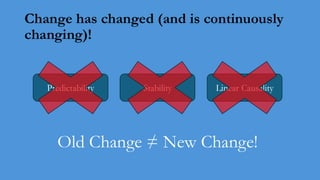
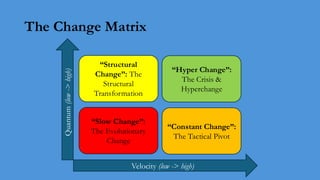
Change has changed(and is continuously
changing)!
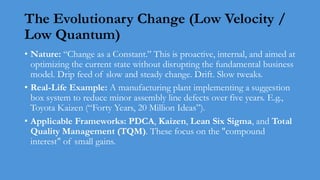
Old Change ≠ New Change!
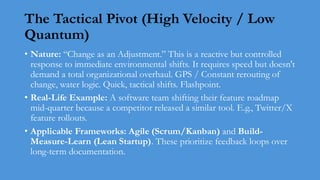
Predictability Linear Causality
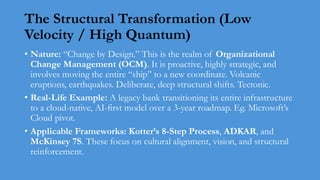
Stability
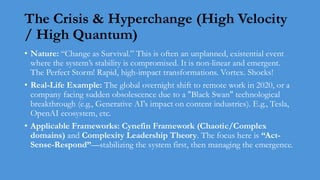
3.
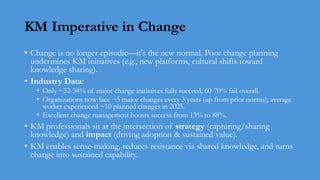
KM Imperative inChange
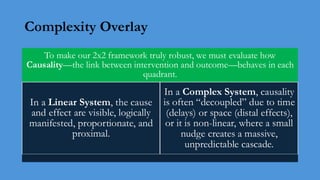
• Change is no longer episodic—it's the new normal. Poor change planning
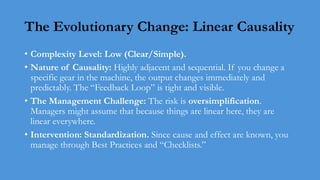
undermines KM initiatives (e.g., new platforms, cultural shifts toward
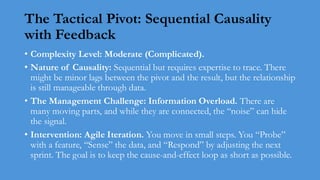
knowledge sharing).
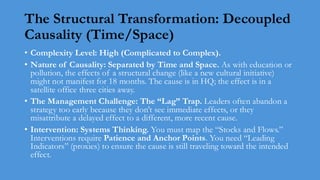
• Industry Data:
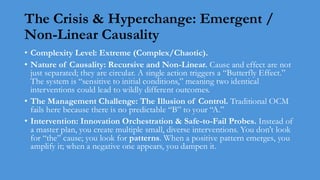
• Only ~32-34% of major change initiatives fully succeed; 60-70% fail overall.
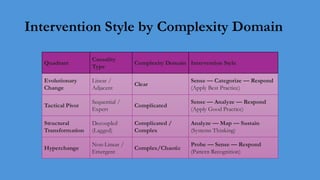
• Organizations now face ~5 major changes every 3 years (up from prior norms); average
worker experienced ~10 planned changes in 2025.
• Excellent change management boosts success from 13% to 88%.
• KM professionals sit at the intersection of strategy (capturing/sharing
knowledge) and impact (driving adoption & sustained value).
• KM enables sense-making, reduces resistance via shared knowledge, and turns
change into sustained capability.
4.
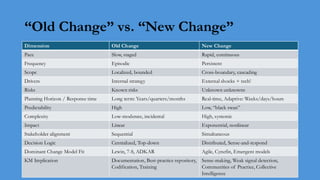
“Old Change” vs.“New Change”
Dimension Old Change New Change
Pace Slow, staged Rapid, continuous
Frequency Episodic Persistent
Scope Localized, bounded Cross-boundary, cascading
Drivers Internal strategy External shocks + tech!
Risks Known risks Unknown unknowns
Planning Horizon / Response time Long term: Years/quarters/months Real-time, Adaptive: Weeks/days/hours
Predictability High Low, “black swan”
Complexity Low-moderate, incidental High, systemic
Impact Linear Exponential, nonlinear
Stakeholder alignment Sequential Simultaneous
Decision Logic Centralized, Top-down Distributed, Sense-and-respond
Dominant Change Model Fit Lewin, 7-S, ADKAR Agile, Cynefin, Emergent models
KM Implication Documentation, Best-practice repository,
Codification, Training
Sense-making, Weak signal detection,
Communities of Practice, Collective
Intelligence
5.
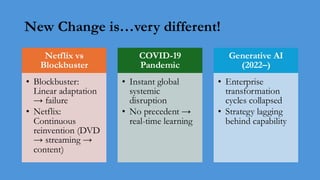
New Change is…verydifferent!
Netflix vs
Blockbuster
• Blockbuster:
Linear adaptation
→ failure
• Netflix:
Continuous
reinvention (DVD
→ streaming →
content)
COVID-19
Pandemic
• Instant global
systemic
disruption
• No precedent →
real-time learning
Generative AI
(2022–)
• Enterprise
transformation
cycles collapsed
• Strategy lagging
behind capability
6.
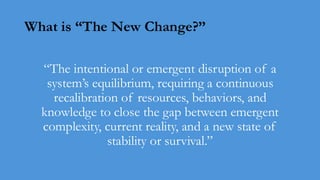
What is “TheNew Change?”
“The intentional or emergent disruption of a
system’s equilibrium, requiring a continuous
recalibration of resources, behaviors, and
knowledge to close the gap between emergent
complexity, current reality, and a new state of
stability or survival.”
7.
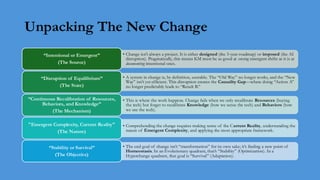
Unpacking The NewChange
• Change isn't always a project. It is either designed (the 3-year roadmap) or imposed (the AI
disruption). Pragmatically, this means KM must be as good at sensing emergent shifts as it is at
documenting intentional ones.
“Intentional or Emergent”
(The Source)
• A system in change is, by definition, unstable. The “Old Way” no longer works, and the “New
Way” isn't yet efficient. This disruption creates the Causality Gap—where doing “Action A”
no longer predictably leads to “Result B.”
“Disruption of Equilibrium”
(The State)
• This is where the work happens. Change fails when we only recalibrate Resources (buying
the tech) but forget to recalibrate Knowledge (how we sense the tech) and Behaviors (how
we use the tech).
“Continuous Recalibration of Resources,
Behaviors, and Knowledge”
(The Mechanism)
• Comprehending the change requires making sense of the Current Reality, understanding the
nature of Emergent Complexity, and applying the most appropriate framework.
"Emergent Complexity, Current Reality"
(The Nature)
• The end goal of change isn’t “transformation” for its own sake; it’s finding a new point of
Homeostasis. In an Evolutionary quadrant, that’s “Stability” (Optimization). In a
Hyperchange quadrant, that goal is “Survival” (Adaptation).
“Stability or Survival”
(The Objective)
8.
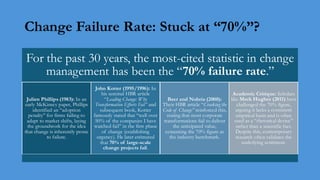
Change Failure Rate:Stuck at “70%”?
For the past 30 years, the most-cited statistic in change
management has been the “70% failure rate.”
Julien Phillips (1983): In an
early McKinsey paper, Phillips
identified an “adoption
penalty” for firms failing to
adapt to market shifts, laying
the groundwork for the idea
that change is inherently prone
to failure.
John Kotter (1995/1996): In
his seminal HBR article
“Leading Change: Why
Transformation Efforts Fail” and
subsequent book, Kotter
famously stated that “well over
50% of the companies I have
watched fail” in the first phase
of change (establishing
urgency). He later estimated
that 70% of large-scale
change projects fail.
Beer and Nohria (2000):
Their HBR article “Cracking the
Code of Change” reinforced this,
stating that most corporate
transformations fail to deliver
the anticipated value,
cementing the 70% figure as
the industry benchmark.
Academic Critique: Scholars
like Mark Hughes (2011) have
challenged the 70% figure,
arguing it lacks a consistent
empirical basis and is often
used as a “rhetorical device”
rather than a scientific fact.
Despite this, contemporary
research often validates the
underlying sentiment.
9.
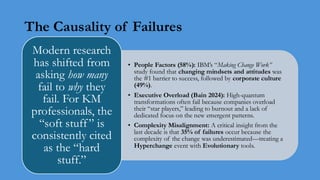
The Causality ofFailures
• People Factors (58%): IBM’s “Making Change Work”
study found that changing mindsets and attitudes was
the #1 barrier to success, followed by corporate culture
(49%).
• Executive Overload (Bain 2024): High-quantum
transformations often fail because companies overload
their “star players,” leading to burnout and a lack of
dedicated focus on the new emergent patterns.
• Complexity Misalignment: A critical insight from the
last decade is that 35% of failures occur because the
complexity of the change was underestimated—treating a
Hyperchange event with Evolutionary tools.
Modern research
has shifted from
asking how many
fail to why they
fail. For KM
professionals, the
“soft stuff” is
consistently cited
as the “hard
stuff.”
10.
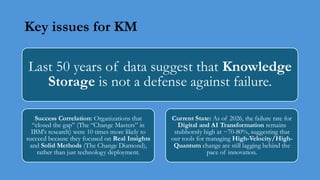
Key issues forKM
Last 50 years of data suggest that Knowledge
Storage is not a defense against failure.
Success Correlation: Organizations that
“closed the gap” (The “Change Masters” in
IBM's research) were 10 times more likely to
succeed because they focused on Real Insights
and Solid Methods (The Change Diamond),
rather than just technology deployment.
Current State: As of 2026, the failure rate for
Digital and AI Transformation remains
stubbornly high at ~70-80%, suggesting that
our tools for managing High-Velocity/High-
Quantum change are still lagging behind the
pace of innovation.
11.
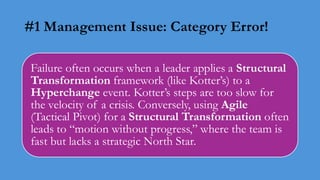
#1 Management Issue:Category Error!
Failure often occurs when a leader applies a Structural
Transformation framework (like Kotter’s) to a
Hyperchange event. Kotter’s steps are too slow for
the velocity of a crisis. Conversely, using Agile
(Tactical Pivot) for a Structural Transformation often
leads to “motion without progress,” where the team is
fast but lacks a strategic North Star.
12.
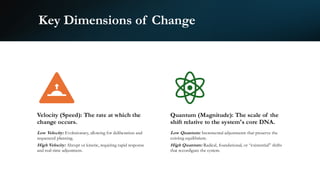
Key Dimensions ofChange
Velocity (Speed): The rate at which the
change occurs.
Low Velocity: Evolutionary, allowing for deliberation and
sequenced planning.
High Velocity: Abrupt or kinetic, requiring rapid response
and real-time adjustment.
Quantum (Magnitude): The scale of the
shift relative to the system's core DNA.
Low Quantum: Incremental adjustments that preserve the
existing equilibrium.
High Quantum: Radical, foundational, or “existential” shifts
that reconfigure the system.
13.
The Change Matrix
Velocity(low -> high)
Quantum
(low
->
high)
“Slow Change”:
The Evolutionary
Change
“Constant Change”:
The Tactical Pivot
“Structural
Change”: The
Structural
Transformation
“Hyper Change”:
The Crisis &
Hyperchange
14.
The Evolutionary Change(Low Velocity /
Low Quantum)
• Nature: “Change as a Constant.” This is proactive, internal, and aimed at
optimizing the current state without disrupting the fundamental business
model. Drip feed of slow and steady change. Drift. Slow tweaks.
• Real-Life Example: A manufacturing plant implementing a suggestion
box system to reduce minor assembly line defects over five years. E.g.,
Toyota Kaizen (“Forty Years, 20 Million Ideas”).
• Applicable Frameworks: PDCA, Kaizen, Lean Six Sigma, and Total
Quality Management (TQM). These focus on the "compound
interest" of small gains.
15.
The Tactical Pivot(High Velocity / Low
Quantum)
• Nature: “Change as an Adjustment.” This is a reactive but controlled
response to immediate environmental shifts. It requires speed but doesn't
demand a total organizational overhaul. GPS / Constant rerouting of
change, water logic. Quick, tactical shifts. Flashpoint.
• Real-Life Example: A software team shifting their feature roadmap
mid-quarter because a competitor released a similar tool. E.g., Twitter/X
feature rollouts.
• Applicable Frameworks: Agile (Scrum/Kanban) and Build-
Measure-Learn (Lean Startup). These prioritize feedback loops over
long-term documentation.
16.
The Structural Transformation(Low
Velocity / High Quantum)
• Nature: “Change by Design.” This is the realm of Organizational
Change Management (OCM). It is proactive, highly strategic, and
involves moving the entire “ship” to a new coordinate. Volcanic
eruptions, earthquakes. Deliberate, deep structural shifts. Tectonic.
• Real-Life Example: A legacy bank transitioning its entire infrastructure
to a cloud-native, AI-first model over a 3-year roadmap. Eg. Microsoft’s
Cloud pivot.
• Applicable Frameworks: Kotter’s 8-Step Process, ADKAR, and
McKinsey 7S. These focus on cultural alignment, vision, and structural
reinforcement.
17.
The Crisis &Hyperchange (High Velocity
/ High Quantum)
• Nature: “Change as Survival.” This is often an unplanned, existential event
where the system’s stability is compromised. It is non-linear and emergent.
The Perfect Storm! Rapid, high-impact transformations. Vortex. Shocks!
• Real-Life Example: The global overnight shift to remote work in 2020, or a
company facing sudden obsolescence due to a "Black Swan" technological
breakthrough (e.g., Generative AI's impact on content industries). E.g., Tesla,
OpenAI ecosystem, etc.
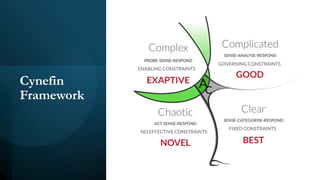
• Applicable Frameworks: Cynefin Framework (Chaotic/Complex
domains) and Complexity Leadership Theory. The focus here is “Act-
Sense-Respond”—stabilizing the system first, then managing the emergence.
18.
#2 Management Issue:Failure to see
complexity
It is comparatively much easier to make sense of a
familiar situation where the causal effects are
reasonably well known or can be fairly well
understood with a simple application of
knowledge or logic. However, most real-world
situations are often “wicked problems” and far
more complex than that!
19.
Complexity Overlay
To makeour 2x2 framework truly robust, we must evaluate how
Causality—the link between intervention and outcome—behaves in each
quadrant.
In a Linear System, the cause
and effect are visible, logically
manifested, proportionate, and
proximal.
In a Complex System, causality
is often “decoupled” due to time
(delays) or space (distal effects),
or it is non-linear, where a small
nudge creates a massive,
unpredictable cascade.
20.
The Evolutionary Change:Linear Causality
• Complexity Level: Low (Clear/Simple).
• Nature of Causality: Highly adjacent and sequential. If you change a
specific gear in the machine, the output changes immediately and
predictably. The “Feedback Loop” is tight and visible.
• The Management Challenge: The risk is oversimplification.
Managers might assume that because things are linear here, they are
linear everywhere.
• Intervention: Standardization. Since cause and effect are known, you
manage through Best Practices and “Checklists.”
21.
The Tactical Pivot:Sequential Causality
with Feedback
• Complexity Level: Moderate (Complicated).
• Nature of Causality: Sequential but requires expertise to trace. There
might be minor lags between the pivot and the result, but the relationship
is still manageable through data.
• The Management Challenge: Information Overload. There are
many moving parts, and while they are connected, the “noise” can hide
the signal.
• Intervention: Agile Iteration. You move in small steps. You “Probe”
with a feature, “Sense” the data, and “Respond” by adjusting the next
sprint. The goal is to keep the cause-and-effect loop as short as possible.
22.
The Structural Transformation:Decoupled
Causality (Time/Space)
• Complexity Level: High (Complicated to Complex).
• Nature of Causality: Separated by Time and Space. As with education or
pollution, the effects of a structural change (like a new cultural initiative)
might not manifest for 18 months. The cause is in HQ; the effect is in a
satellite office three cities away.
• The Management Challenge: The “Lag” Trap. Leaders often abandon a
strategy too early because they don't see immediate effects, or they
misattribute a delayed effect to a different, more recent cause.
• Intervention: Systems Thinking. You must map the “Stocks and Flows.”
Interventions require Patience and Anchor Points. You need “Leading
Indicators” (proxies) to ensure the cause is still traveling toward the intended
effect.
23.
The Crisis &Hyperchange: Emergent /
Non-Linear Causality
• Complexity Level: Extreme (Complex/Chaotic).
• Nature of Causality: Recursive and Non-Linear. Cause and effect are not
just separated; they are circular. A single action triggers a “Butterfly Effect.”
The system is “sensitive to initial conditions,” meaning two identical
interventions could lead to wildly different outcomes.
• The Management Challenge: The Illusion of Control. Traditional OCM
fails here because there is no predictable “B” to your “A.”
• Intervention: Innovation Orchestration & Safe-to-Fail Probes. Instead of
a master plan, you create multiple small, diverse interventions. You don't look
for “the” cause; you look for patterns. When a positive pattern emerges, you
amplify it; when a negative one appears, you dampen it.
24.
Intervention Style byComplexity Domain
Quadrant
Causality
Type
Complexity Domain Intervention Style
Evolutionary
Change
Linear /
Adjacent
Clear
Sense — Categorize — Respond
(Apply Best Practice)
Tactical Pivot
Sequential /
Expert
Complicated
Sense — Analyze — Respond
(Apply Good Practice)
Structural
Transformation
Decoupled
(Lagged)
Complicated /
Complex
Analyze — Map — Sustain
(Systems Thinking)
Hyperchange
Non-Linear /
Emergent
Complex/Chaotic
Probe — Sense — Respond
(Pattern Recognition)
25.
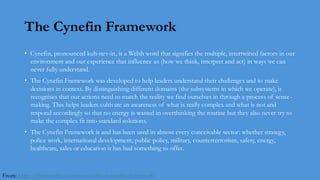
The Cynefin Framework
•Cynefin, pronounced kuh-nev-in, is a Welsh word that signifies the multiple, intertwined factors in our
environment and our experience that influence us (how we think, interpret and act) in ways we can
never fully understand.
• The Cynefin Framework was developed to help leaders understand their challenges and to make
decisions in context. By distinguishing different domains (the subsystems in which we operate), it
recognises that our actions need to match the reality we find ourselves in through a process of sense-
making. This helps leaders cultivate an awareness of what is really complex and what is not and
respond accordingly so that no energy is wasted in overthinking the routine but they also never try to
make the complex fit into standard solutions.
• The Cynefin Framework is and has been used in almost every conceivable sector: whether strategy,
police work, international development, public policy, military, counterterrorism, safety, energy,
healthcare, sales or education it has had something to offer.
From: https://thecynefin.co/about-us/about-cynefin-framework
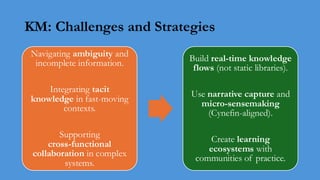
KM: Challenges andStrategies
Navigating ambiguity and
incomplete information.
Integrating tacit
knowledge in fast-moving
contexts.
Supporting
cross-functional
collaboration in complex
systems.
Build real-time knowledge
flows (not static libraries).
Use narrative capture and
micro-sensemaking
(Cynefin-aligned).
Create learning
ecosystems with
communities of practice.
28.
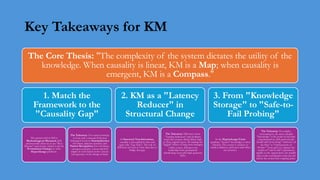
Key Takeaways forKM
The Core Thesis: "The complexity of the system dictates the utility of the
knowledge. When causality is linear, KM is a Map; when causality is
emergent, KM is a Compass."
1. Match the
Framework to the
"Causality Gap"
The greatest risk in KM is
Methodological Mismatch. KM
professionals often try to use "Best
Practice" repositories (which work for
Evolutionary Change) to solve
Hyperchange problems.
The Takeaway: You cannot manage
a Crisis with a manual. KM must
distinguish between Standardization
(for linear, adjacent causality) and
Pattern Recognition (for non-linear,
emergent causality). Successful KM
adapts its tools based on the velocity
and quantum of the change at hand.
2. KM as a "Latency
Reducer" in
Structural Change
In Structural Transformations,
causality is decoupled by time and
space (the "Lag Trap"). The role of
KM here isn't just to store data, but to
bridge that gap.
The Takeaway: KM must create
"Leading Indicators" and feedback
loops that connect distal effects back
to their original causes. By making the
"lagged" effects of long-term strategies
visible sooner, KM prevents
leadership from prematurely
abandoning successful high-quantum
shifts.
3. From "Knowledge
Storage" to "Safe-to-
Fail Probing"
In the Hyperchange/Crisis
quadrant, "known" knowledge is often
obsolete. The system is sensitive to
initial conditions, and cause-and-effect
are recursive.
The Takeaway: In complex
environments, the most valuable
"knowledge" is the result of real-time
experimentation. KM professionals
should shift from being "Archivists of
the Past" to "Orchestrators of
Probes." Your goal is to capture the
results of "safe-to-fail" experiments
rapidly so the organization can amplify
what works and dampen what doesn't
before the system hits a tipping point.
29.
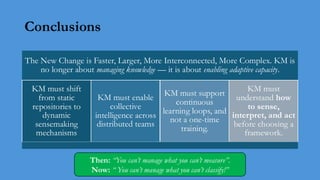
Conclusions
The New Changeis Faster, Larger, More Interconnected, More Complex. KM is
no longer about managing knowledge — it is about enabling adaptive capacity.
KM must shift
from static
repositories to
dynamic
sensemaking
mechanisms
KM must enable
collective
intelligence across
distributed teams
KM must support
continuous
learning loops, and
not a one-time
training.
KM must
understand how
to sense,
interpret, and act
before choosing a
framework.
Then: “You can’t manage what you can’t measure”.
Now: “ You can’t manage what you can’t classify!”