Strategic Roadmap for AI-Driven Software Development Lifecycle Transformation
Explore how AI automates and enhances software development, from intent-driven design to agentic engineering, boosting productivity, security, and quality across the SDLC.
Strategic Roadmap for AI-Driven Software Development Lifecycle Transformation
1.
Engineering Leadership BriefingStrategic Roadmap
AI in Software
Development
Transforming the Software Development Lifecycle (SDLC) through
Automation, Intelligence, and Agentic Engineering
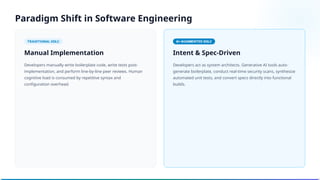
Manual Implementation
Developers manuallywrite boilerplate code, write tests post-
implementation, and perform line-by-line peer reviews. Human
cognitive load is consumed by repetitive syntax and
configuration overhead.
Intent & Spec-Driven
Developers act as system architects. Generative AI tools auto-
generate boilerplate, conduct real-time security scans, synthesize
automated unit tests, and convert specs directly into functional
builds.
Paradigm Shift in Software Engineering
4.
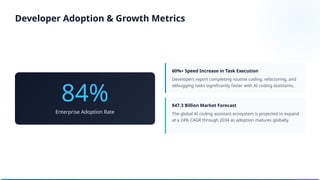
84%
Enterprise Adoption Rate
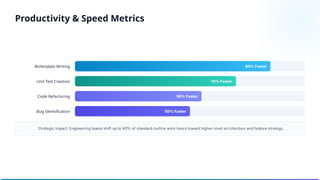
60%+Speed Increase in Task Execution
Developers report completing routine coding, refactoring, and
debugging tasks significantly faster with AI coding assistants.
$47.3 Billion Market Forecast
The global AI coding assistant ecosystem is projected to expand
at a 24% CAGR through 2034 as adoption matures globally.
Developer Adoption & Growth Metrics
5.
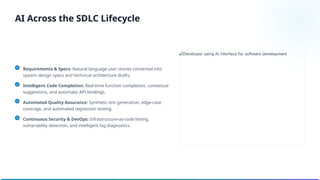
Requirements & Specs:Natural language user stories converted into
system design specs and technical architecture drafts.
Intelligent Code Completion: Real-time function completion, contextual
suggestions, and automatic API bindings.
Automated Quality Assurance: Synthetic test generation, edge-case
coverage, and automated regression testing.
Continuous Security & DevOps: Infrastructure-as-code linting,
vulnerability detection, and intelligent log diagnostics.
AI Across the SDLC Lifecycle
6.
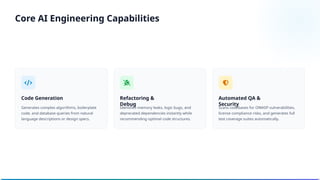
Code Generation
Generates complexalgorithms, boilerplate
code, and database queries from natural
language descriptions or design specs.
Refactoring &
Debug
Identifies memory leaks, logic bugs, and
deprecated dependencies instantly while
recommending optimal code structures.
Automated QA &
Security
Scans codebases for OWASP vulnerabilities,
license compliance risks, and generates full
test coverage suites automatically.
Core AI Engineering Capabilities
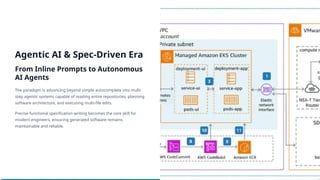
Agentic AI &Spec-Driven Era
From Inline Prompts to Autonomous
AI Agents
The paradigm is advancing beyond simple autocomplete into multi-
step agentic systems capable of reading entire repositories, planning
software architecture, and executing multi-file edits.
Precise functional specification writing becomes the core skill for
modern engineers, ensuring generated software remains
maintainable and reliable.
9.
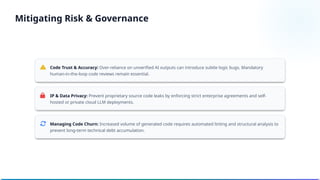
Code Trust &Accuracy: Over-reliance on unverified AI outputs can introduce subtle logic bugs. Mandatory
human-in-the-loop code reviews remain essential.
IP & Data Privacy: Prevent proprietary source code leaks by enforcing strict enterprise agreements and self-
hosted or private cloud LLM deployments.
Managing Code Churn: Increased volume of generated code requires automated linting and structural analysis to
prevent long-term technical debt accumulation.
Mitigating Risk & Governance
10.
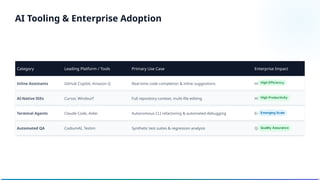
Category Leading Platform/ Tools Primary Use Case Enterprise Impact
Inline Assistants GitHub Copilot, Amazon Q Real-time code completion & inline suggestions High Efficiency
AI-Native IDEs Cursor, Windsurf Full repository context, multi-file editing High Productivity
Terminal Agents Claude Code, Aider Autonomous CLI refactoring & automated debugging Emerging Scale
Automated QA CodiumAI, Testim Synthetic test suites & regression analysis Quality Assurance
AI Tooling & Enterprise Adoption
11.
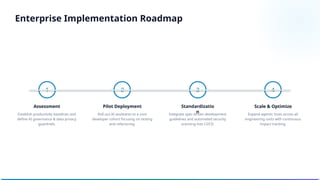
Assessment
Establish productivity baselinesand
define AI governance & data privacy
guardrails.
Pilot Deployment
Roll out AI assistants to a core
developer cohort focusing on testing
and refactoring.
Standardizatio
n
Integrate spec-driven development
guidelines and automated security
scanning into CI/CD.
Scale & Optimize
Expand agentic tools across all
engineering units with continuous
impact tracking.
Enterprise Implementation Roadmap