Storage of Fruits and Vegetables: Techniques and Principles
Explore essential methods and principles for storing fruits and vegetables, including temperature, humidity, ventilation, and advanced storage techniques like cold storage, zero energy storage, and controlled atmosphere storage.
Storage of Fruits and Vegetables: Techniques and Principles
1.
WELCOME
STORAGE OF FRUITSAND
VEGETABLES
Umesh Timilsina
Assistant Professor
Department of Horticulture
AFU
2.
STORAGE OF FRUITSAND VEGETABLES
The action or method of storing something for future
use is known as storage.
The function of storage is to provide an environment
which minimizes the deterioration until the products are
finally consumed.
The proper management of temperature and relative
humidity are the most important factors determining
storage life of horticultural produce.
Reducing the temperature slows down the rate of
respiration and ethylene production.
It also slows down the transpiration loss, thereby
reducing the desiccation of the fruits, vegetables and
also check the growth of micro organisms.
3.
Principles of Storage
•Storage stabilizes the prices of produce by
lengthening the availability.
• Protect the producer and consumer both from the
extremities of prices.
• More uniform distribution is made available.
• Availability of produce in off season for a particular
place is made available.
4.
Objectives of Storage
•To regulate the market in an orderly manner
• To avoid glut (abundant supply of something) and
distress (Poor sale) sale in the market, thus
prolonging the market period
• To make the food available in off season by long
term storage.
5.
Consideration for storage
•While making decision regarding the storage of
various commodities following things should be kept
in mind.
Probable increase in price
Cost of storage
Probable storage loss due to shrinkage, rotting of
produce during storage.
Cost of resorting and packing
Cost of handling and transport to storage and markets
Physical facilities regarding transport and market.
6.
Factors affecting Storageof fruits and vegetables
1. Temperature
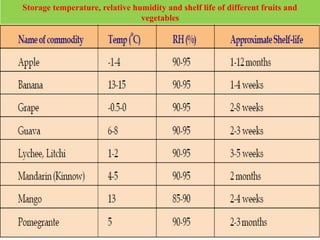
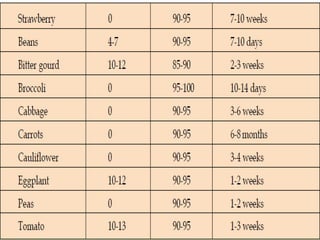
• Proper temperature is to be maintained for better storage.
• Lower the storage temperature lower will be the rate of
respiration rate of fruits and shelf life can be prolonged.
• Therefore appropriate temperature in the storage should be
maintained according to the nature of fruits and vegetables.
2. Relative Humidity
• An effective method for reducing water loss from fruits and
vegetables is to increase the relative humidity of the air.
• This reduces the vapour pressure difference between the
commodity and the air thus the amount of water evaporated
will be reduced.
7.
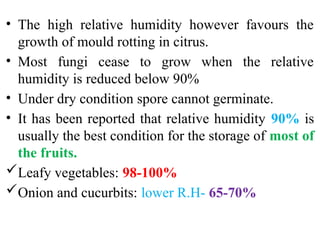
• The highrelative humidity however favours the
growth of mould rotting in citrus.
• Most fungi cease to grow when the relative
humidity is reduced below 90%
• Under dry condition spore cannot germinate.
• It has been reported that relative humidity 90% is
usually the best condition for the storage of most of
the fruits.
Leafy vegetables: 98-100%
Onion and cucurbits: lower R.H- 65-70%
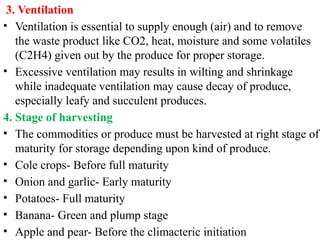
3. Ventilation
• Ventilationis essential to supply enough (air) and to remove
the waste product like CO2, heat, moisture and some volatiles
(C2H4) given out by the produce for proper storage.
• Excessive ventilation may results in wilting and shrinkage
while inadequate ventilation may cause decay of produce,
especially leafy and succulent produces.
4. Stage of harvesting
• The commodities or produce must be harvested at right stage of
maturity for storage depending upon kind of produce.
• Cole crops- Before full maturity
• Onion and garlic- Early maturity
• Potatoes- Full maturity
• Banana- Green and plump stage
• Apple and pear- Before the climacteric initiation
11.
Methods of storage
1.Home or Ordinary storage
Some fruits and vegetables are stored by using conventional
methods.
Fruits and vegetables are kept in ordinary condition or home
condition without having artificial method of temperature
and humidity control.
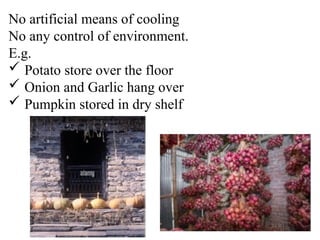
Potatoes and sweet potatoes are stored over the floor of cool
and dry room covered with few inches of sand.
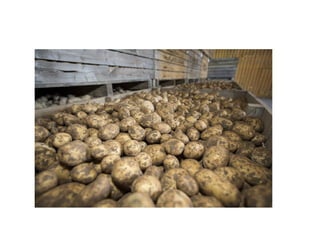
Bunches of garlic are stored by hanging along in the
barandas.
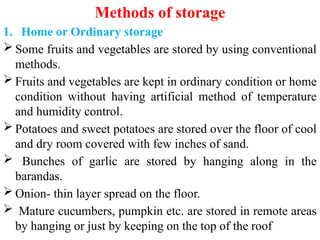
Onion- thin layer spread on the floor.
Mature cucumbers, pumpkin etc. are stored in remote areas
by hanging or just by keeping on the top of the roof
12.
No artificial meansof cooling
No any control of environment.
E.g.
Potato store over the floor
Onion and Garlic hang over
Pumpkin stored in dry shelf
15.
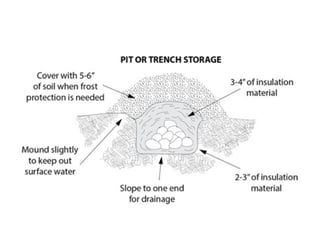
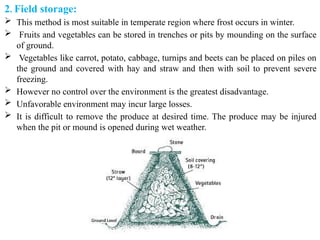
2. Field storage:
This method is most suitable in temperate region where frost occurs in winter.
Fruits and vegetables can be stored in trenches or pits by mounding on the surface
of ground.
Vegetables like carrot, potato, cabbage, turnips and beets can be placed on piles on
the ground and covered with hay and straw and then with soil to prevent severe
freezing.
However no control over the environment is the greatest disadvantage.
Unfavorable environment may incur large losses.
It is difficult to remove the produce at desired time. The produce may be injured
when the pit or mound is opened during wet weather.
17.
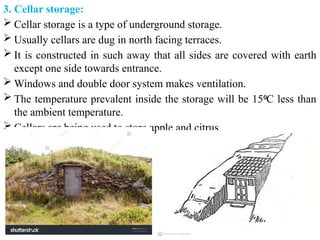
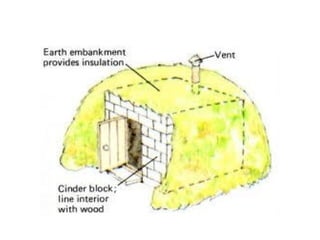
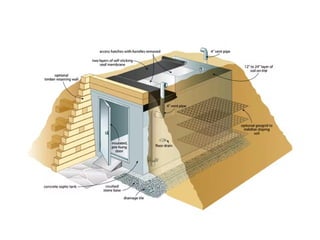
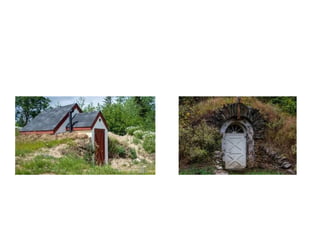
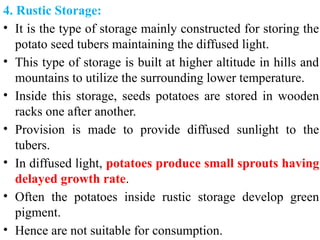
3. Cellar storage:
Cellar storage is a type of underground storage.
Usually cellars are dug in north facing terraces.
It is constructed in such away that all sides are covered with earth
except one side towards entrance.
Windows and double door system makes ventilation.
The temperature prevalent inside the storage will be 15 C less than
⁰
the ambient temperature.
Cellars are being used to store apple and citrus.
21.
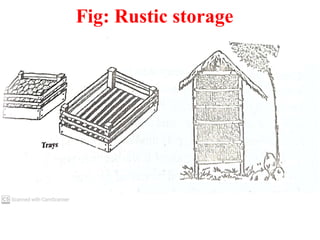
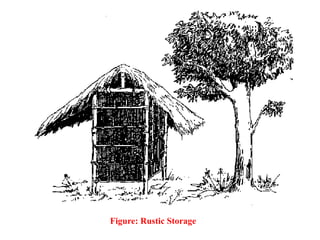
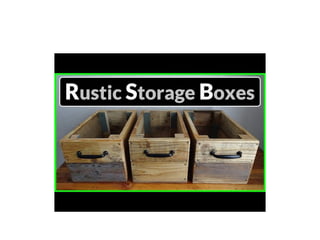
4. Rustic Storage:
•It is the type of storage mainly constructed for storing the
potato seed tubers maintaining the diffused light.
• This type of storage is built at higher altitude in hills and
mountains to utilize the surrounding lower temperature.
• Inside this storage, seeds potatoes are stored in wooden
racks one after another.
• Provision is made to provide diffused sunlight to the
tubers.
• In diffused light, potatoes produce small sprouts having
delayed growth rate.
• Often the potatoes inside rustic storage develop green
pigment.
• Hence are not suitable for consumption.
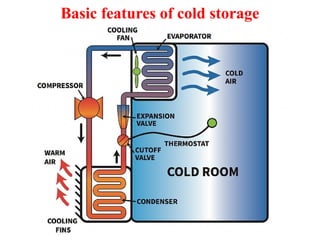
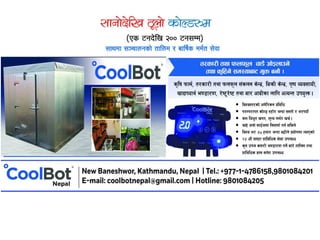
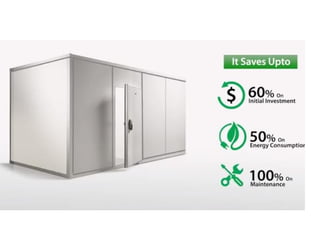
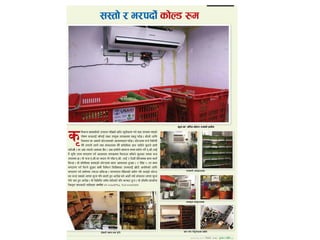
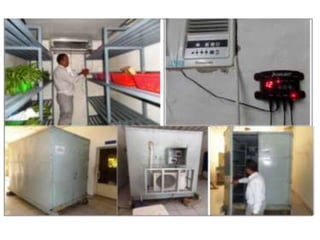
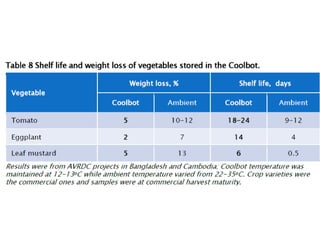
5. Cold storage:
Lowering the temperature to
the lowest safe handling
temperature is of paramount
importance for enhancing the
shelf life, reducing the losses
and maintaining higher quality
during marketing.
As we have discussed earlier that
the respiration rate including all
the metabolic activities are
affected by temperature.
In cold storage, the temperature
is maintained depending upon
the type of commodity.
Refrigerated storage is the
27.
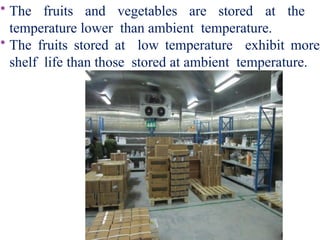
• The fruitsand vegetables are stored at the
temperature lower than ambient temperature.
• The fruits stored at low temperature exhibit more
shelf life than those stored at ambient temperature.
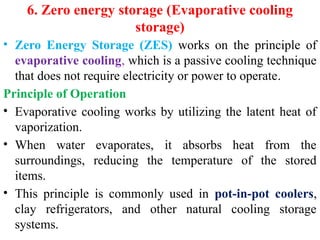
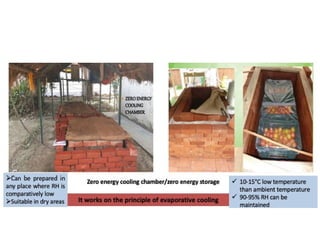
6. Zero energystorage (Evaporative cooling
storage)
• Zero Energy Storage (ZES) works on the principle of
evaporative cooling, which is a passive cooling technique
that does not require electricity or power to operate.
Principle of Operation
• Evaporative cooling works by utilizing the latent heat of
vaporization.
• When water evaporates, it absorbs heat from the
surroundings, reducing the temperature of the stored
items.
• This principle is commonly used in pot-in-pot coolers,
clay refrigerators, and other natural cooling storage
systems.
38.
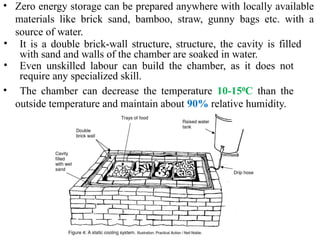
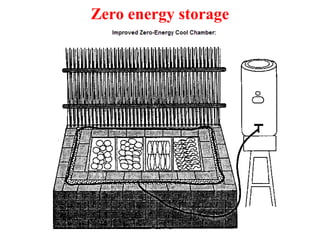
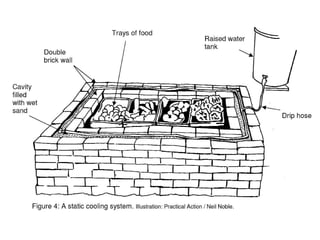
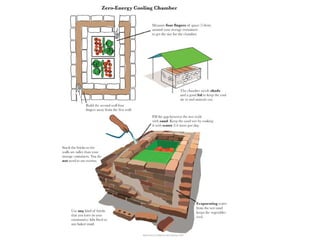
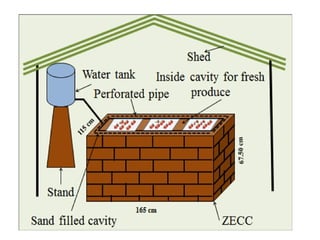
• Zero energystorage can be prepared anywhere with locally available
materials like brick sand, bamboo, straw, gunny bags etc. with a
source of water.
• It is a double brick-wall structure, structure, the cavity is filled
with sand and walls of the chamber are soaked in water.
• Even unskilled labour can build the chamber, as it does not
require any specialized skill.
• The chamber can decrease the temperature 10-15 C
⁰ than the
outside temperature and maintain about 90% relative humidity.
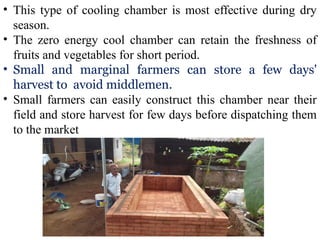
• This typeof cooling chamber is most effective during dry
season.
• The zero energy cool chamber can retain the freshness of
fruits and vegetables for short period.
• Small and marginal farmers can store a few days'
harvest to avoid middlemen.
• Small farmers can easily construct this chamber near their
field and store harvest for few days before dispatching them
to the market
45.
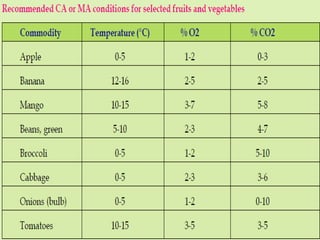
7. Controlled atmosphere(CA) storage
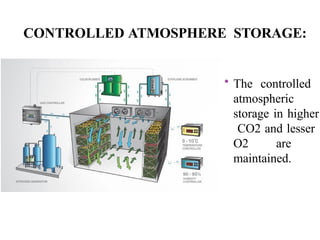
Controlled atmosphere storage generally refers to keeping
produce at decreased oxygen and increased carbon dioxide
concentrations and at suitable range of temperature and RH.
All these these four factors lowers the rate of respirations
and delay ripening and senescence.
Low O2 reduces ethylene production by inhibiting activities
of 1-aminocyclopropane-1-carboxylic acid (ACC) oxidase
and ACC synthase.
Elevated CO2 levels are shown to inhibit the activity of ACC
synthase, while ACC oxidase activity is stimulated at low CO2
levels and inhibited at high CO2 levels.
It was observed that weight losses of bananas during controlled
atmosphere storage decreased with an increase in CO2 or
decrease in O2 concentrations in the storage atmosphere.
Benefits of CAstorage
Slow down respiration and ethylene production
rates, softening and retard senescence of
horticultural produce.
Reduce fruit sensitivity to ethylene action
Alleviate certain physiological disorders such as
chilling injury of various commodities, russet
spotting in lettuce, and some storage disorders
including, scald of apples.
48.
Harmful effects ofCA storage
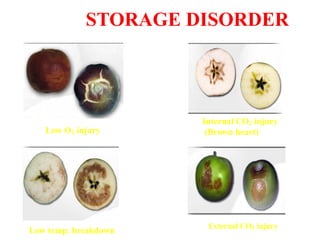
Initiation of certain physiological disorders can
occur, such as blackheart in potatoes, brown stain on
lettuce, and brown heart in apples and pears.
Irregular ripening of fruits, such as banana, mango,
pear and tomato, can result from exposure to O2
levels below 2% or CO2 levels above 5% for more
than 2 to 4 weeks.
Off- flavors and off-odours at very low O2 or very
high CO2 concentration may develop as a result of
anaerobic respiration and fermentative metabolism.
49.
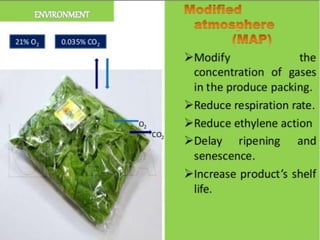
8. Modified atmospherepackage(MAP)Storage
The principle is same as in CA.
In this case, there is no control in the environment.
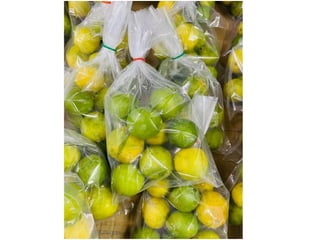
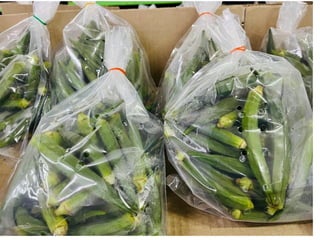
Storage in polyethylene bag is an example of MAP
storage.
Nowadays unsealed with without perforations and
sealed with perforations are commonly used in the
storage of different fruits and vegetables.
MAP is ideally combined with temperature control for
maximum benefit.
Storage where atmospheric control is accurately
controlled are generally called CA storage and where
degree of control "less accurately" monitored are called
MA (modified atmosphere) storage.
53.
CONTROL ATMOSPHERE andMODIFIED
ATMOSPHERE
➢ Control atmosphere (CA):
▪ generally refers to decreased O2 and increased CO2
concentrations, by a precise control of the gas
composition.
➢ Modified atmosphere (MA):
▪ is used when the control of the storage atmosphere is
not closely controlled, such as in plastic film
packaging.
54.
DIFFERENCE
➢MA:
• Gas compositionis modified initially and it changes
dynamically depending on the respiration rate of
produce and permeability of film or storage structure
surrounding the produce
➢CA:
• Gas atmosphere is continuously controlled throughout the
storage period
55.
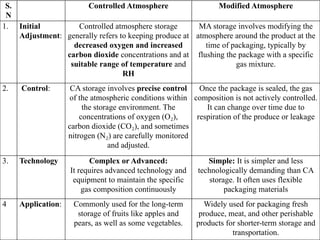
S.
N
Controlled Atmosphere ModifiedAtmosphere
1. Initial
Adjustment:
Controlled atmosphere storage
generally refers to keeping produce at
decreased oxygen and increased
carbon dioxide concentrations and at
suitable range of temperature and
RH
MA storage involves modifying the
atmosphere around the product at the
time of packaging, typically by
flushing the package with a specific
gas mixture.
2. Control: CA storage involves precise control
of the atmospheric conditions within
the storage environment. The
concentrations of oxygen (O ),
₂
carbon dioxide (CO ), and sometimes
₂
nitrogen (N ) are carefully monitored
₂
and adjusted.
Once the package is sealed, the gas
composition is not actively controlled.
It can change over time due to
respiration of the produce or leakage
3. Technology Complex or Advanced:
It requires advanced technology and
equipment to maintain the specific
gas composition continuously
Simple: It is simpler and less
technologically demanding than CA
storage. It often uses flexible
packaging materials
4 Application: Commonly used for the long-term
storage of fruits like apples and
pears, as well as some vegetables.
Widely used for packaging fresh
produce, meat, and other perishable
products for shorter-term storage and
transportation.
56.
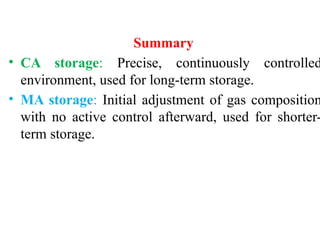
Summary
• CA storage:Precise, continuously controlled
environment, used for long-term storage.
• MA storage: Initial adjustment of gas composition
with no active control afterward, used for shorter-
term storage.
9. Hypobaric storage
•Hypobaric Storage refers to the storage of fruits
and vegetables under reduced atmospheric pressure.
• The storage life of many fruits and vegetables can
be extended by reduced pressure under refrigeration
due to low respiration rate and evacuation of ethylene
• Typical conditions include pressures as low as 80
mm of Hg and 40 mm of Hg and temperatures of 5
°C (40 °F).
• Ripening is retarded by hypobaric storage due to the
reduction in ethylene level.
60.
10. Vaccum Packingor storage
• It reduces the atmospheric oxygen which reduce
the aerobic bacteria and fungi.
• Prevents the evaporation of volatile components
• Reduce oxidative changes.
• Mainly used for storage of dry foods for long time
e.g. Cereals, nuts, spices etc.
• For short term uses, fresh foods such as vegetables
and fruit can also be packed and stored.
61.
Assignment
1. Define storage.Write down the objectives and principle of storage.
2. Briefly explain about the working mechanism of Cold storage.
3. What are the considerations that need to be taken before the storage
of a horticultural commodities?
4. What are the major factors affecting the storage life of horticultural
commodities?
5. Describe the relevance of Zero energy evaporating cooling chambers
in case of Nepalese Context.
6. Write short notes on
a. Rustic storage
b. Cellar storage
c. Zero energy storage
d. Controlled atmospheric storage
e. Modified Atmospheric Package/storage
f. Cold chain management of Horticultural produce
 Most read