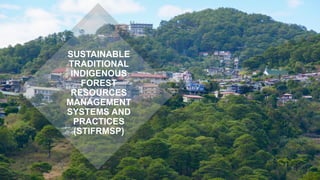
SUSTAINABLE
TRADITIONAL
INDIGENOUS
FOREST
RESOURCES
MANAGEMENT
SYSTEMS AND
PRACTICES
(STIFRMSP)
2
Background
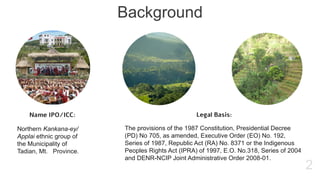
Northern Kankana-ey/
Applai ethnic group of
the Municipality of
Tadian, Mt. Province.
Name IPO/ICC:
The provisions of the 1987 Constitution, Presidential Decree
(PD) No 705, as amended, Executive Order (EO) No. 192,
Series of 1987, Republic Act (RA) No. 8371 or the Indigenous
Peoples Rights Act (IPRA) of 1997, E.O. No.318, Series of 2004
and DENR-NCIP Joint Administrative Order 2008-01.
Legal Basis:
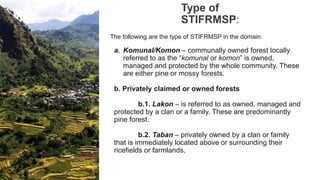
a. Komunal/Komon – communally owned forest locally
referred to as the “komunal or komon” is owned,
managed and protected by the whole community. These
are either pine or mossy forests.
b. Privately claimed or owned forests
b.1. Lakon – is referred to as owned, managed and
protected by a clan or a family. These are predominantly
pine forest.
b.2. Taban – privately owned by a clan or family
that is immediately located above or surrounding their
ricefields or farmlands.
The following are the type of STIFRMSP in the domain:
Type of
STIFRMSP:
Traditional
“Batangan” land use
management
practice
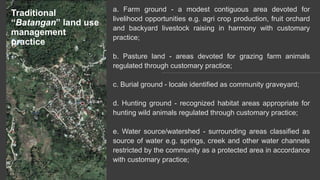
a. Farm ground - a modest contiguous area devoted for
livelihood opportunities e.g. agri crop production, fruit orchard
and backyard livestock raising in harmony with customary
practice;
b. Pasture land - areas devoted for grazing farm animals
regulated through customary practice;
c. Burial ground - locale identified as community graveyard;
d. Hunting ground - recognized habitat areas appropriate for
hunting wild animals regulated through customary practice;
e. Water source/watershed - surrounding areas classified as
source of water e.g. springs, creek and other water channels
restricted by the community as a protected area in accordance
with customary practice;
Traditional
“Batangan” land use
management
practice
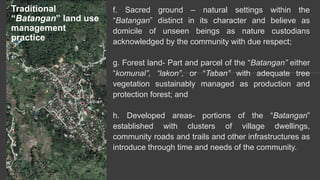
f. Sacred ground – natural settings within the
“Batangan” distinct in its character and believe as
domicile of unseen beings as nature custodians
acknowledged by the community with due respect;
g. Forest land- Part and parcel of the “Batangan” either
“komunal”, “lakon”, or “Taban” with adequate tree
vegetation sustainably managed as production and
protection forest; and
h. Developed areas- portions of the “Batangan”
established with clusters of village dwellings,
community roads and trails and other infrastructures as
introduce through time and needs of the community.
The Indigenous socio political
management overseers
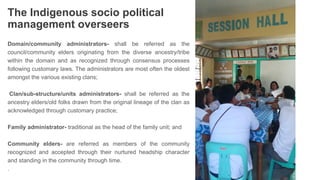
Domain/community administrators- shall be referred as the
council/community elders originating from the diverse ancestry/tribe
within the domain and as recognized through consensus processes
following customary laws. The administrators are most often the oldest
amongst the various existing clans;
Clan/sub-structure/units administrators- shall be referred as the
ancestry elders/old folks drawn from the original lineage of the clan as
acknowledged through customary practice;
Family administrator- traditional as the head of the family unit; and
Community elders- are referred as members of the community
recognized and accepted through their nurtured headship character
and standing in the community through time.
.
Adoption/
Implementation
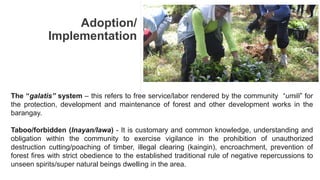
The “galatis” system – this refers to free service/labor rendered by the community “umili” for
the protection, development and maintenance of forest and other development works in the
barangay.
Taboo/forbidden (Inayan/lawa) - It is customary and common knowledge, understanding and
obligation within the community to exercise vigilance in the prohibition of unauthorized
destruction cutting/poaching of timber, illegal clearing (kaingin), encroachment, prevention of
forest fires with strict obedience to the established traditional rule of negative repercussions to
unseen spirits/super natural beings dwelling in the area.
Enabling
traditional
forest
manageme
nt and
regulatory
principles
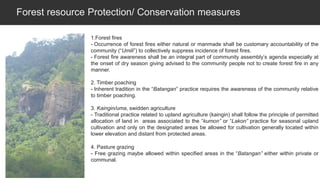
1.Forest fires
- Occurrence of forest fires either natural or manmade shall be customary accountability of the
community (“Umili”) to collectively suppress incidence of forest fires.
- Forest fire awareness shall be an integral part of community assembly’s agenda especially at
the onset of dry season giving advised to the community people not to create forest fire in any
manner.
2. Timber poaching
- Inherent tradition in the “Batangan” practice requires the awareness of the community relative
to timber poaching.
3. Kaingin/uma, swidden agriculture
- Traditional practice related to upland agriculture (kaingin) shall follow the principle of permitted
allocation of land in areas associated to the “kumon” or “Lakon” practice for seasonal upland
cultivation and only on the designated areas be allowed for cultivation generally located within
lower elevation and distant from protected areas.
4. Pasture grazing
- Free grazing maybe allowed within specified areas in the “Batangan” either within private or
communal.
Forest resource Protection/ Conservation measures
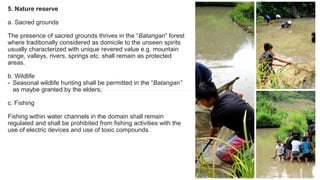
5. Nature reserve
a. Sacred grounds
The presence of sacred grounds thrives in the “Batangan” forest
where traditionally considered as domicile to the unseen spirits
usually characterized with unique revered value e.g. mountain
range, valleys, rivers, springs etc. shall remain as protected
areas.
b. Wildlife
- Seasonal wildlife hunting shall be permitted in the “Batangan”
as maybe granted by the elders;
c. Fishing
Fishing within water channels in the domain shall remain
regulated and shall be prohibited from fishing activities with the
use of electric devices and use of toxic compounds.
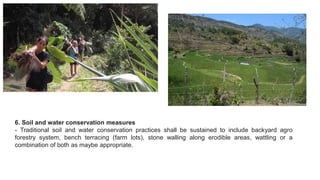
6. Soil and water conservation measures
- Traditional soil and water conservation practices shall be sustained to include backyard agro
forestry system, bench terracing (farm lots), stone walling along erodible areas, wattling or a
combination of both as maybe appropriate.
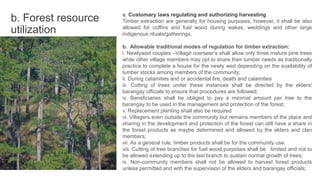
b. Forest resource
utilization
a. Customary laws regulating and authorizing harvesting
Timber extraction are generally for housing purposes, however, it shall be also
allowed for coffins and fuel wood during wakes, weddings and other large
indigenous rituals/gatherings.
b. Allowable traditional modes of regulation for timber extraction:
i. Newlywed couples –Village overseer’s shall allow only three mature pine trees
while other village members may opt to share their lumber needs as traditionally
practice to complete a house for the newly wed depending on the availability of
lumber stocks among members of the community;
ii. During calamities and or accidental fire, death and calamities
iii. Cutting of trees under these instances shall be directed by the elders/
barangay officials to ensure that procedures are followed;
iv. Beneficiaries shall be obliged to pay a minimal amount per tree to the
barangay to be used in the management and protection of the forest;
v. Replacement planting shall also be required
vi. Villagers even outside the community but remains members of the place and
sharing in the development and protection of the forest can still have a share in
the forest products as maybe determined and allowed by the elders and clan
members;
vii. As a general rule, timber products shall be for the community use.
viii. Cutting of tree branches for fuel wood purposes shall be limited and not to
be allowed extending up to the last branch to sustain normal growth of trees;
ix. Non-community members shall not be allowed to harvest forest products
unless permitted and with the supervision of the elders and barangay officials;
c. Allowable traditional
modes of regulation for
non timber extraction
- Harvest/extraction of minor
forest products shall be in the
strict sense for the community
members use
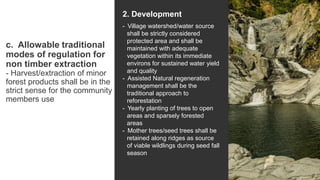
- Village watershed/water source
shall be strictly considered
protected area and shall be
maintained with adequate
vegetation within its immediate
environs for sustained water yield
and quality
- Assisted Natural regeneration
management shall be the
traditional approach to
reforestation
- Yearly planting of trees to open
areas and sparsely forested
areas
- Mother trees/seed trees shall be
retained along ridges as source
of viable wildlings during seed fall
season
2. Development
3. Other customary prohibited acts
i. Disturbing, destroying, dumping or
otherwise disposing of any waste
products detrimental to the water source;
ii. Cutting of timber within designated
watershed, sensitive spots and or critical
areas shall not be allowed;
iii. Upland vegetable cultivation within or
near the watershed area is prohibited
even if the area is privately owned;
iv. Traditional “Ngilin” or holy days shall
be respected deferring within the
“Batangan” forest;
vi. Timber extraction within the “Batangan”
shall be for community use only, harvesting
outside the community impose or standardized
number of trees that each member is allowed
to extract at one time is strictly prohibited;
vii. Marketing of extracted timber for the clan
and family owned forest shall only be confined
within the “ili”;
Strictly prohibited the cutting of young trees
within identified traditional grazing lands; and
viii. Within identified watershed areas (Mossy
forest), communities shall strictly prohibit
cutting of trees, swidden agriculture (kaingin,
uma) and outside leisure activities and shall
remain as protection forest.
4. Conflict Resolution
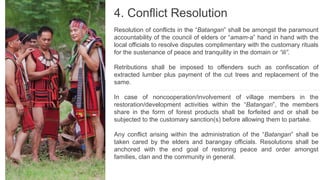
Resolution of conflicts in the “Batangan” shall be amongst the paramount
accountability of the council of elders or “amam-a” hand in hand with the
local officials to resolve disputes complimentary with the customary rituals
for the sustenance of peace and tranquility in the domain or “ili”.
Retributions shall be imposed to offenders such as confiscation of
extracted lumber plus payment of the cut trees and replacement of the
same.
In case of noncooperation/involvement of village members in the
restoration/development activities within the “Batangan”, the members
share in the form of forest products shall be forfeited and or shall be
subjected to the customary sanction(s) before allowing them to partake.
Any conflict arising within the administration of the “Batangan” shall be
taken cared by the elders and barangay officials. Resolutions shall be
anchored with the end goal of restoring peace and order amongst
families, clan and the community in general.
Traditional
resource use
sharing
Benefit sharing as applied in this guideline
shall adhere to the sustainable indigenous
traditional practice in terms of wood, water,
land use and wildlife resource utilization in
the community as govern by customary
laws.
Generally, all community members shall be
ensured of their fair share from forest
products as synonymous to their obligation
to preserve and protect the forest.
Thank You
Jun Akizaki
The Power of PowerPoint – thepopp.com