Sepsis: Comes fromGreek for decay or
putrid. Indicates bacterial contamination.
Asepsis: Absence of significant
contamination.
•Aseptic techniques are used to prevent
contamination of surgical instruments,
medical personnel, and the patient during
surgery.
•Aseptic techniques are also used to
prevent bacterial contamination in food
industry.
Bactericide:
An agent thatkills bacteria. Most do not kill Endospores.
Sporicide:
An agent that kills spores.
7.
Disinfectant
Products usedto kill microorganisms on
inanimate objects or surfaces. Disinfectants
are not necessarily sporicidal, but may be
sporostatic, inhibiting germination or
outgrowth
Antiseptic
A product that destroys or inhibits the growth
of microorganisms in or on living tissue.
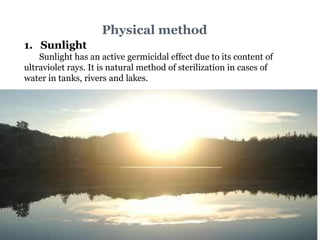
Physical method
1. Sunlight
Sunlighthas an active germicidal effect due to its content of
ultraviolet rays. It is natural method of sterilization in cases of
water in tanks, rivers and lakes.
13.
METHODS OF
STERILIZATION
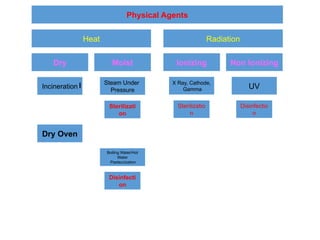
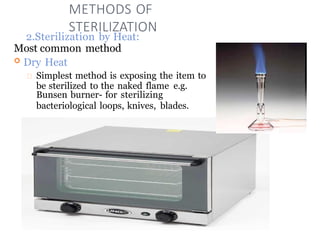
2.Sterilization byHeat:
Most common method
Dry Heat
Simplest method is exposing the item to
be sterilized to the naked flame e.g.
Bunsen burner- for sterilizing
bacteriological loops, knives, blades.
14.
Principles of dryheat
1. Dry heat kills the organisms by denaturation of
bacterial protein, oxidative damage and by the
toxic effect of elevated levels of electrolytes
.
2. Moist heat kills the microorganisms by
denaturation and coagulation of proteins
Dry heat sterilization
a) Red heat
b) Flaming
c) Hot air oven
d) incineration
15.
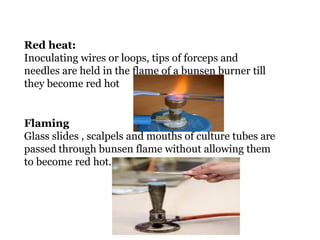
Red heat:
Inoculating wiresor loops, tips of forceps and
needles are held in the flame of a bunsen burner till
they become red hot
Flaming
Glass slides , scalpels and mouths of culture tubes are
passed through bunsen flame without allowing them
to become red hot.
16.
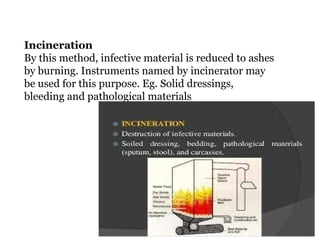
Incineration
By this method,infective material is reduced to ashes
by burning. Instruments named by incinerator may
be used for this purpose. Eg. Solid dressings,
bleeding and pathological materials
17.
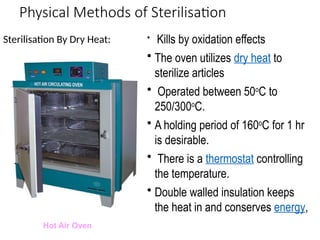
Physical Methods ofSterilisation
Sterilisation By Dry Heat:
Hot Air Oven
• Kills by oxidation effects
• The oven utilizes dry heat to
sterilize articles
• Operated between 50o
C to
250/300o
C.
• A holding period of 160o
C for 1 hr
is desirable.
• There is a thermostat controlling
the temperature.
• Double walled insulation keeps
the heat in and conserves energy,
18.
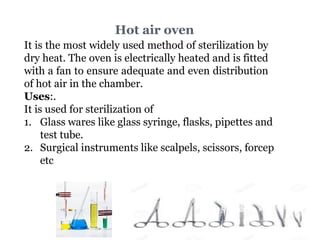
Hot air oven
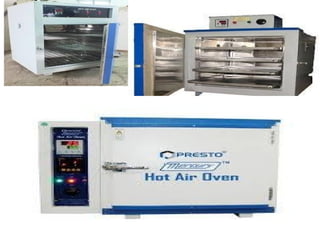
Itis the most widely used method of sterilization by
dry heat. The oven is electrically heated and is fitted
with a fan to ensure adequate and even distribution
of hot air in the chamber.
Uses:.
It is used for sterilization of
1. Glass wares like glass syringe, flasks, pipettes and
test tube.
2. Surgical instruments like scalpels, scissors, forcep
etc
19.
Precaution
i) It shouldnot be overloaded
ii) The material should be arranged in a manner
which allows free circulation of air.
iii) Material to be sterilized should be perfectly dry.
iv) Test tube, flask etc. should be fitted with cotton
plugs.
v) Petridishes and pipettes should be wrapped in
papers.
vi) Rubber materials or any inflammable material
should not be kept inside the oven.
vii) The oven must be allowed to cool for two hours
before opening the doors, since the
glassware may crack by sudden cooling
21.
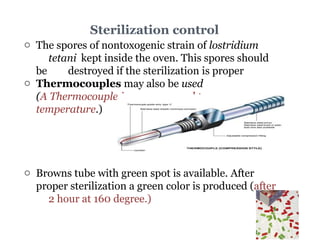
Sterilization control
o Thespores of nontoxogenic strain of lostridium
tetani kept inside the oven. This spores should
be destroyed if the sterilization is proper
o Thermocouples may also be used
(A Thermocouple is a sensor used to measure
temperature.)
o Browns tube with green spot is available. After
proper sterilization a green color is produced (after
2 hour at 160 degree.)
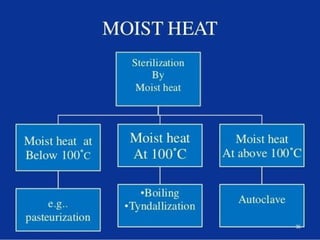
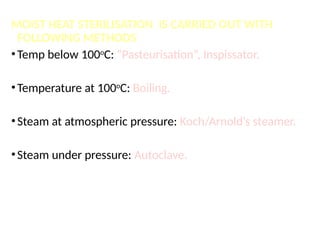
MOIST HEAT STERILISATIONIS CARRIED OUT WITH
FOLLOWING METHODS
•Temp below 100o
C: “Pasteurisation”, Inspissator.
•Temperature at 100o
C: Boiling.
•Steam at atmospheric pressure: Koch/Arnold’s steamer.
•Steam under pressure: Autoclave.
25.
Pasteurisation
•Process of killingof pathogens in the milk but does
not sterilize it .
•Milk is heated at 63o
C for 30 mins.
(HOLDER METHOD)
•At 72o
C for 15-20 Sec. Rapid cooling to 13o
C
(FLASH PROCESS)
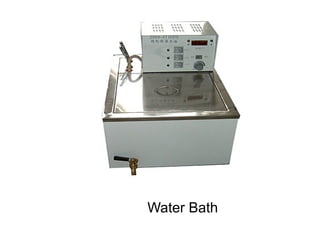
HOT WATER BATH
•To inactivate non sporing bacteria for the preparation of vaccines -
Special vaccine bath at 60o
Cfor one hour is used
• Serum or body fluids containing coagulable proteins can be sterilized
by heating for 1 hr at 56o
C in a water bath for several successive
days.
INSPISSATOR
• Sterilizes byheating at 80-85o
C for half an hour for 3 successive days
• Used to sterilize media such as Lowenstein-Jensen & Loefller’s serum
30.
TEMPERATURE AT 100O
C
Boiling:
Killsvegetative forms of bacterial pathogens.
• Hepatitis virus: Can survive up to 30 minutes of boiling.
Endospores: Can survive up to 20 hours or more of boiling
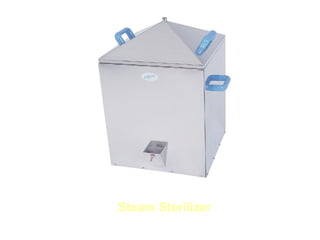
STEAM AT ATMOSPHERICPRESSURE
• Steam is generated using a steamer (Koch/ Arnold)
• Consists of a Tin cabinet
• Has a conical lid to enable the drainage of condensed steam
• Perforated tray above ensures materials are surrounded by steam.
• For routine sterilization exposure of 90 mins is used
33.
• For mediacontaining sugar and gelatin exposure of 100o
C for 20 min for
3 successive days is used
• The process is termed as
Tyndallisation /Intermittent Sterilization
34.
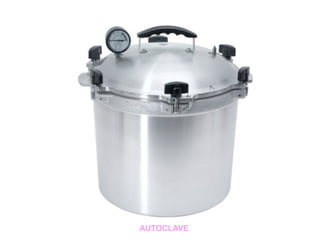
STEAM UNDER PRESSURE-AUTOCLAVE
• Works on the principle of Steam under pressure
•Invented by Charles Chamberland in 1879.
METHODS OF STERILIZATION
Moistheat:
Autoclaving –Standard sterilization method
in hospitals.
The Autoclave works under the same principle
as the pressure cooker where water boils at
increased atmospheric pressure i.e. because of
increased pressure the boiling point of water is
>100°C.
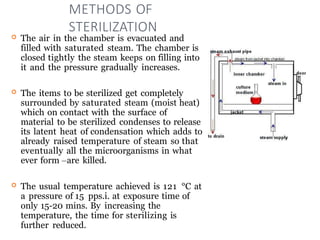
The autoclave is a tough double walled chamber
in which air is replaced by pure saturated
steam under pressure.
37.
METHODS OF
STERILIZATION
Theair in the chamber is evacuated and
filled with saturated steam. The chamber is
closed tightly the steam keeps on filling into
it and the pressure gradually increases.
The items to be sterilized get completely
surrounded by saturated steam (moist heat)
which on contact with the surface of
material to be sterilized condenses to release
its latent heat of condensation which adds to
already raised temperature of steam so that
eventually all the microorganisms in what
ever form –are killed.
The usual temperature achieved is 121 °C at
a pressure of 15 pps.i. at exposure time of
only 15-20 mins. By increasing the
temperature, the time for sterilizing is
further reduced.
38.
METHODS OF STERILIZATION
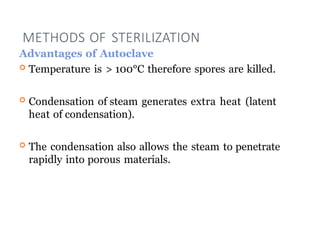
Advantagesof Autoclave
Temperature is > 100°C therefore spores are killed.
Condensation of steam generates extra heat (latent
heat of condensation).
The condensation also allows the steam to penetrate
rapidly into porous materials.
39.
METHODS OF STERILIZATION
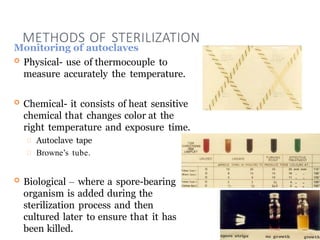
Monitoringof autoclaves
Physical- use of thermocouple to
measure accurately the temperature.
Chemical- it consists of heat sensitive
chemical that changes color at the
right temperature and exposure time.
Autoclave tape
Browne’s tube.
Biological – where a spore-bearing
organism is added during the
sterilization process and then
cultured later to ensure that it has
been killed.
40.
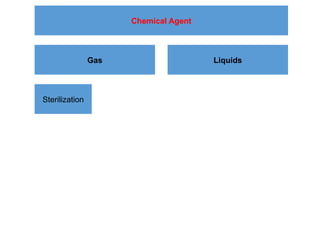
CHEMICAL AGENTS
Chemical agentsact by
• Protein coagulation
• Disruption of the cell membrane
• Removal of Sulphydryl groups
• Substrate competition
41.
ALCOHOLS
• Ethanol /Isopropylalcohol are frequently used
• No action on spores
• Concentration recommended 60-90% in water
Uses
• Disinfection of clinical thermometer.
• Disinfection of the skin – Venupuncture
42.
ALDEHYDES
• Formaldehyde &Glutaraldehyde are frequently used
• Formaldehyde is bactericidal, sporicidal & has a lethal effect on
viruses.
• Glutaraldehyde is effective against Tubercle bacilli, fungi and viruses
43.
USES
FORMALDEHYDE
• To preserveanatomical specimens
• Destroying Anthrax spores in hair and wool
• 10% Formalin+0.5% Sodium tetra borate is used to sterilise metal
instruments
44.
USES
GLUTARALDEHYDE
• Used totreat corrugated rubber anesthetic tubes, Face masks,
Plastic endotracheal tubes, Metal instruments and polythene tubing
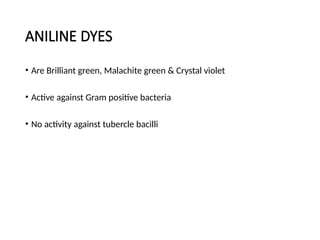
ANILINE DYES
• AreBrilliant green, Malachite green & Crystal violet
• Active against Gram positive bacteria
• No activity against tubercle bacilli
47.
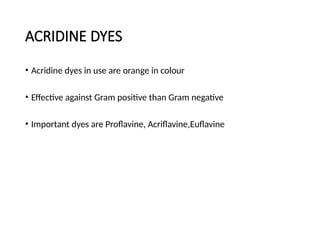
ACRIDINE DYES
• Acridinedyes in use are orange in colour
• Effective against Gram positive than Gram negative
• Important dyes are Proflavine, Acriflavine,Euflavine
48.
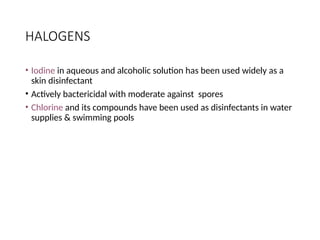
HALOGENS
• Iodine inaqueous and alcoholic solution has been used widely as a
skin disinfectant
• Actively bactericidal with moderate against spores
• Chlorine and its compounds have been used as disinfectants in water
supplies & swimming pools
49.
PHENOLS
• Obtained bydistillation of coal tar
• Phenols are powerful microbicidal substances
• Phenolic derivatives have been widely used as disinfectants for
various purposes in hospitals
• Eg: Lysol, cresol
50.
USES
• Various combinationsare used in the control of pyogenic cocci in
surgical & neonatal units in hospitals.
• Aqueous solutions are used in treatment of wounds
51.
GASES
Ethylene Oxide
•Colourless ,Highlypenetrating gas
with a sweet ethereal smell.
•Effective against all types of
microorganisms including viruses and
spores
52.
USES
• Specially usedfor sterilising heart-lung
machines,respirators,sutures,dental equipments, books and clothing.
• Also used to sterilise Glass, metal and paper surfaces ,plastics,
oil,some foods and tobacco.
BETA PROPIOLACTONE
• Usedin fumigation
• For sterilisation 0.2% BPL is used
• Has a rapid biocidal activity
• Very effective against viruses
55.
SURFACE ACTIVE AGENTSAND METALLIC
SALTS
Substances which reduce the surface tension
–
Surface active agents
56.
• Cations arewidely used in the form of quaternary ammonium
compounds.
• Markedly bactericidal, active against Gram positive organisms.
• No action on spores, tubercle bacilli, viruses
57.
METALLIC SALTS
• Thesalts of silver, copper and mercury are used as disinfectants.
• Act by coagulating proteins
• Marked bacteriostatic, weak bactericidal and limited fungicidal activity
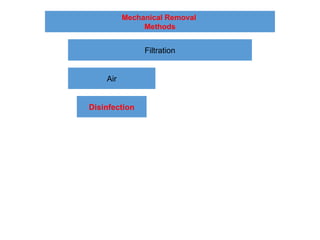
Sterilisation by filtration
Filtrationhelps to remove bacteria from heat labile liquids such as sera and
solutions of sugar, Antibiotics.
The following filters are used
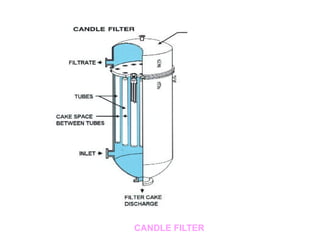
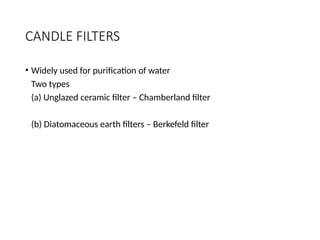
Candle filters
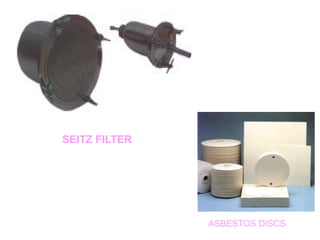
Asbestos filters
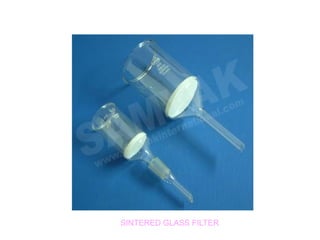
Sintered glass filter
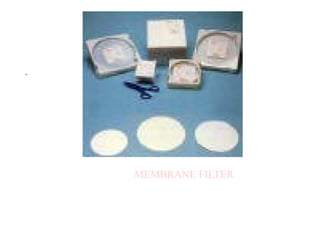
Membrane filters
MEMBRANE FILTERS
• Madeof cellulose esters or other polymers
Uses
• Water purification & analysis
• Sterilization & sterility testing
• Preparation of solutions for parenteral use
Non- Ionising radiation:
•Electromagnetic rays with longer wavelength
• Absorbed as heat
• Can be considered as hot air sterilisation
• Used in rapid mass sterilisation of prepacked Syringes and catheters
Eg: UV rays
70.
IONISING RADIATIONS
• X-rays, gamma rays & cosmic rays.
• High penetrative power
• No appreciable increase in the temperature – COLD STERILISATION
• Sterilise plastics Syringes, catheters, grease fabrics metal foils
71.
ULTRASONIC AND SONICVIBRATION
• Bactericidal
• Microorganisms vary in their sensitivity, hence no practical value in
sterilisation and disinfection
72.
METHODS OF STERILIZATION
Sterilizationby Chemical Methods
Useful for heat sensitive materials e.g. plastics and
lensed instruments endoscopes).
Ethylene Oxide Chamber:
Ethylene oxide alkylates DNA molecules and thereby
inactivates microorganisms.
Ethylene oxide may cause explosion if used pure so it is
mixed with an inert gas e.g. Neon, Freon at a ratio of
10:90
It requires high humidity and is used at relative
humidity 50-60% Temperature : 55-60°C and exposure
period 4-6 hours.
Activated alkaline Glutaraldehyde 2%:
Immerse item in solution for about 20 minutes if
organism is TB. In case of spores, the immersion period
is extended to 2-3 hours.
73.
DISINFECTANTS
Factors influencingactivity of Disinfectants
Directly proportional to temperature.
Directly proportional to concentration up to a point –
optimum concentration. After this level no advantage in
further increases in concentration.
Time: Disinfectants need time to work.
Range of Action : Disinfectants are not equally effective
against the whole spectrum of microbes. e.g.
Chlorhexidine is less active against GNB than Gram Positive
Cocci.
May be inactivated by
Dirt, organic matter
Proteins, Pus, Blood, Mucus, Faeces
Cork and some plastics.
Hypochlorites and Glutaraldehyde are more active
against hepatitis viruses than most other disinfectants.
74.
DISINFECTANTS
Types of Disinfectants
Phenola n d phenolics
Phenol (carbolic acid) is seldom used today. Derivatives of the
phenol molecule, however, are widely used.
Phenolics injure plasma membrane, inactivate
enzymes, or denature proteins. They are stable,
persistent, and are not sensitive to organic matter.
O- Phenylphenol
It is the main ingredient in most formulations of Lysol.
Hexachlorophene
It is main ingredient of a prescription lotion, pHisoHex, used
in nurseries and for surgical and hospital microbial control
procedures to control gram positive skin bacteria such as
Staphylococci and Streptococci.
Excessive use can cause neurological damage.
Triclosan
It is a widely used found in many household products. It has
broad spectrum of activity, especially against gram positive
bacteria. It is also effective against gram negative bacteria and
fungi.
75.
•Biguanides
Chlorhexidine, amember of the biguanide group, is not a
phenol, but its structure and applications resemble
hexachlorophene. It is frequently used for surgical skin
preparation and surgical hand scrubs.
•Halogens
Iodine is effective against all kinds of bacteria, many
endospores, fungi, and some viruses. Its mechanism of activity
may be its combination with the amino acid tyrosine in
enzyme and cellular proteins.
An iodophore is a combination of iodine and an organic
molecule. Iodophores do not stain and are less irritating than
iodine. Examples are Isodine and Betadine.
Chlorine is used as a gas or in combination with other
chemicals. Chlorine gas is used for disinfecting municipal
water supplies, swimming pools, and sewage. Sodium
hypochlorite – ordinary household bleach- is good disinfectant.
Chloramines consist of chlorine and ammonia. They are
more stable than most chlorine. The U.S. military uses tablets
for field disinfection of water.
Chlorine dioxide in gaseous form is used for area
disinfection, most notably to kill endospores of anthrax
bacteria.
76.
DISINFECTANTS
Alcohols
Both ethanoland isopropanol (rubbing alcohol) are
widely used, normally at a concentration of about
70%.
Concentrations of 60% to 95% are effective.
They are bactericidal and fungicidal but are not
effective against endospores or non-enveloped
viruses.
Alcohols enhance the effectiveness of other
chemical agents.
77.
DISINFECTANTS
Heavy metals andtheir compounds
1% silver nitrate solution has been used to prevent gonorrheal
ophthalmia neonatorum, which the infants might have contracted as
they passed through the birth canal (recently been replaced by
antibiotics).
Silver-sulfadiazine is used in wound dressings. Available as topical
cream for use on burns.
Mercuric chloride is highly bactericidal, but is toxic and corrosive and is
inactivated by organic matter. Organic mercury compounds such as
Mercurochrome are less irritating and less toxic than inorganic mercury.
Copper sulfate is often used to destroy green algae in reservoirs or other
water.
Zinc chloride is used in mouthwashes, and zinc oxide is used in paints as
antifungal.