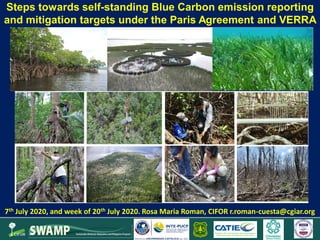
Steps towards self-standing Blue Carbon emission reporting
and mitigation targets under the Paris Agreement and VERRA
7th July 2020, and week of 20th July 2020. Rosa Maria Roman, CIFOR r.roman-cuesta@cgiar.org
SWAMP: Sustainable Wetland Adaptation and
Mitigation Program
http://cifor.org/swamp
Daniel Murdiyarso, Rosa Maria Roman-Cuesta, et al. CIFOR, USFS
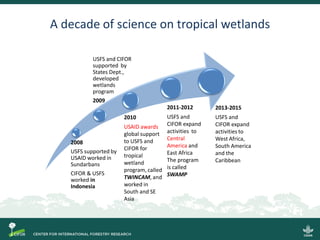
2008
USFS supported by
USAID worked in
Sundarbans
CIFOR & USFS
worked in
Indonesia
USFS and CIFOR
supported by
States Dept.,
developed
wetlands
program
2009
2010
USAID awards
global support
to USFS and
CIFOR for
tropical
wetland
program, called
TWINCAM, and
worked in
South and SE
Asia
2011-2012
USFS and
CIFOR expand
activities to
Central
America and
East Africa
The program
is called
SWAMP
2013-2015
USFS and
CIFOR expand
activities to
West Africa,
South America
and the
Caribbean
A decade of science on tropical wetlands
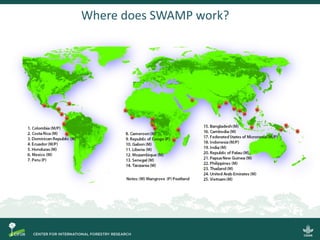
Where does SWAMP work?
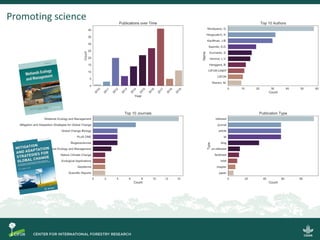
Promoting science
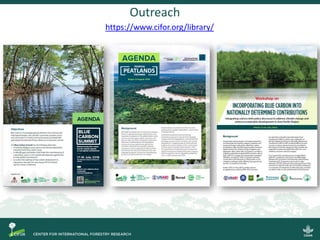
Outreach
https://www.cifor.org/library/
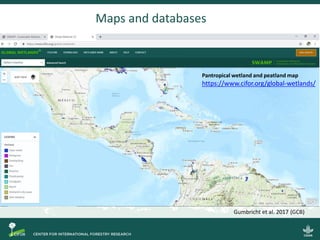
Pantropical wetland and peatland map
https://www.cifor.org/global-wetlands/
Maps and databases
Gumbricht et al. 2017 (GCB)
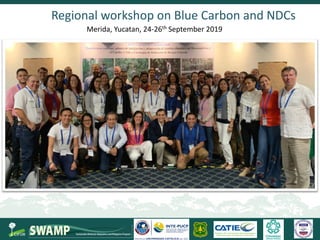
Regional workshop on Blue Carbon and NDCs
Merida, Yucatan, 24-26th September 2019
• Follow up of last year’s SWAMP regional
workshop on Blue Carbon and NDCs in
Merida, Yucatan1
• 20 countries in Latin America and the
Caribbean (LAC) have reported BC under NDCs
• 20 for ADAPTATION2
• 7 countries for MITIGATION2
• Leveraging on:
• NDCs re-submission in 2020
• NDC Global Stocktaking in 2023
• FREL/FRL re-submission in 2021
• Iniciativa 20x20---Bonn Challenge (SLR)
Blue Carbon Webinar: Context
1https://www2.cifor.org/taller-regional-de-carbono-azul/
2Martin et al. (2016) BLUE CARBON - NATIONALLY DETERMINED CONTRIBUTIONS INVENTORY
Appendix to: Coastal blue carbon ecosystems Opportunities for Nationally Determined Contributions.
https://bluecsolutions.org/dev/wp-content/uploads/Blue-Carbon-NDC-Appendix.pdf
• Barriers and Opportunities:
➢ BC-Mangroves---REDD+/FREL/FRL
➢ BC-Mangroves----IPCC guidance
(AFOLU/Wetland Supplement)
➢ BC-Mangroves----Emission Factors with
one measurement of carbon stocks only
➢ BC-Mangroves----Soil carbon and nonCO2
emissions
➢ BC-Mangroves----UNFCCC national scale
vs VERRA project-jurisdictional scale
Blue Carbon Webinar: Focus
• Blue Carbon: Mangroves + coastal wetlands +
Sea grasses.
• Only Mangroves will be discussed today
(most advanced with data)
• Mangroves offer a diversity of Ecosystem
Services, we focus today on mitigation against
climate change only.
• The goal is to clarify specific doubts from LAC
Governments, to support their interest in
developing Blue Carbon initiatives.
• No part of this webinar (UNFCCC, VERRA,
CINVESTAV) is prescriptive. Speakers will share
their experiences and navigate with potential
options, among many other possible.
Blue Carbon Webinar: Considerations
Blue Carbon Webinar Speakers
Peter Aarup Iversen: Team leader on Land Use, Land Use Change
and Forestry (LULUCF) at the United Nations Framework Convention
on Climate Change (UNFCCC) Secretariat. Peter is a Danish national that
counts on more than 20 years of working experience in the nexus between natural
resource management and climate change. This includes long-term assignments with
the Danish government, FAO, UNDP and UNFCCC as well as short-term consultancy
work for UN-organizations, development banks, NGOs and the private sector. He has
participated (co-shared) in UNFCCC negotiations for REDD+, Agriculture and LULUCF
under the Kyoto Protocol and agriculture under SBSTA. He has supported Cambodia
in their readiness phase of REDD+, supervises the Danish reporting on land use
emissions and removals of GHGs to the UNFCCC. He is an expert reviewer of the
IPCC Good Practice Guidance, conducts technical analysis of REDD+ results and
presents at numerous workshops on REDD+, agriculture and LULUCF.
Amy Schmid: Head of the Blue Carbon program at Verra. As the
Program Development Manager, Amy coordinates all program development initiatives
for Verra’s programs, including the VCS, CCB and SD VISta Programs. In this
capacity, she identifies, develops and implements improvements to program
requirements and processes. She also explores opportunities for the scaling up of
biosequestration activities, specifically focusing on blue carbon. Amy holds a Master’s
degree in Biology from Virginia Commonwealth University on the ecology of the forest
carbon cycle. She also holds a Bachelor’s degree in Biology with a specialization in
Environmental and Biological Conservation from the University of Virginia
Blue Carbon Webinar Speakers
Jorge Herrera
Professor at CINVESTAV-Merida. Ocean Resources Department.
Responsible for the mangrove monitoring program in the Yucatan
Peninsula, Mexico. With more than 100 publications, Jorge has spent three
decades of his scientific career researching the highly specialized ecology of
mangroves in their amphibian lifestyle between the land and the water. Besides his
multiple participation as keynote speaker in national and international congresses,
Jorge co-chairs the Coastal-Marine section of the Mexican carbon program, leads the
mangrove monitoring program in the Yucatan Peninsula (CONABIO), and acts as an
international consultant for organizations and networks such as UNESCO, RAMSAR,
CIFOR, or the Mexican-Canadian-US Commission for Environmental Cooperation.
He is a Mexican biologist with a MSc on Marine Biology by the Autonomous
University of Guadalajara, Mexico, and a PhD on Biology by the University of
Barcelona, Spain.
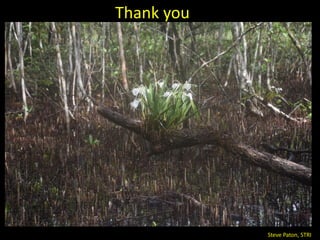
Thank you
Steve Paton, STRI