Steps to the Scientific Method Science Presentation in Blue Beige Illustrative Style.pptx
1.
STEPS TO THESCIENTIFIC
METHOD
GUIDE & CHECKLIST PRESENTATION
GRADE 7
2.
OBJECTIVES
In this presentationwe will:
1.Understand the purpose of the scientific
method.
2.Understand the six steps to the scientific
method.
3.Create a checklist to help remember the
steps.
4.Design an experiment using the steps to
the scientific method.
3.
WHAT IS THEPURPOSE?
The purpose is to excite scientists with
new ideas. It helps them to solve
problems, answer questions, and
understand how things work by
following a logical and organized
approach.
It also helps scientists connect new
ideas to existing ones.
4.
STEP #1: MAKEOBSERVATIONS
Step 1 starts with making
observations. Observations help
scientists explore how they can
change or add to what they see.
Observations can help scientists to ask
questions and improve their critical
thinking and problem solving skills.
5.
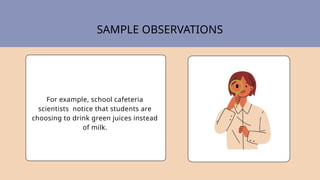
SAMPLE OBSERVATIONS
For example,school cafeteria
scientists notice that students are
choosing to drink green juices instead
of milk.
6.
STEP #2: ASKRELEVANT QUESTIONS
Step 2 starts by asking a question
about something scientists want to
explore or better understand. By
asking questions it begins to allow
for more possibilities to help guide
the hypothesis.
7.
SAMPLE QUESTIONS
Scientists usuallyask questions that
start with: Who? What? When?
Where? Why? and How?
For example; Why do students
prefer drinking green juices over
milk?
8.
STEP #3: MAKEYOUR HYPOTHESIS
Step 3 requires scientists to make a
hypothesis. This will give purpose for
the experiment.
In making a hypothesis, scientists may
be asking a question to find an answer,
or making a statement to see if it is
true or false.
9.
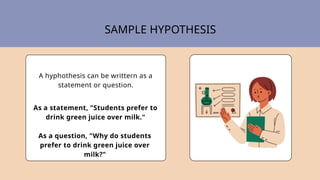
SAMPLE HYPOTHESIS
A hyphothesiscan be writtern as a
statement or question.
As a statement, "Students prefer to
drink green juice over milk."
As a question, "Why do students
prefer to drink green juice over
milk?"
10.
PREPARE FOR YOUREXPERIMENT
Before starting an experiment,
scientists need to gather the proper
material and information to do the
experiment. An experiment is
designed test the hypothesis.
11.
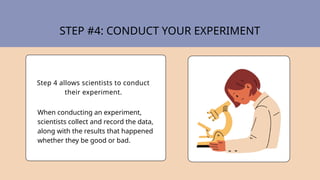
STEP #4: CONDUCTYOUR EXPERIMENT
Step 4 allows scientists to conduct
their experiment.
When conducting an experiment,
scientists collect and record the data,
along with the results that happened
whether they be good or bad.
12.
STEP #5: ANALYZEYOUR RESEARCH
Step 5 shows that all the data is
collected. Scientists then decide
whether or not the results proves
what was mentioned in the
hypothesis.
If it proves the hypothesis, scientists
will then go on to present a
conclusion.
If not, scientists will make some
changes and try the experiment
again.
13.
ANALYSIS & FURTHERQUESTIONS
Further analysis should connect
back to the hypothesis. Scientists
may ask:
• Was the statement true or
false?
• Did my results answer the
question I asked in my
hypothesis?
14.
SAMPLE RESEARCH OUTCOMES
Sampleoutcomes for statements
would be true or false.
For example: it is true that
students prefer drinking green
juices over milk.
Sample outcomes for questions
would reasons.
For example: students prefer the
taste of green juices over milk.
15.
STEP #6: COMMUNICATEYOUR RESULTS
Step 6 in the scientific method is to
communicate and publish the
conclusions.
Scientists will communicate the
results by displaying the data in a way
that others may benefit from their
research.
16.
NOW IT’S YOURTURN
Follow the steps and checklist guide
to make your own report using the
scientific method!
TASK: Explore the effects of 5
different liquids (milk, juice, oil,
vinegar, soda) on eggs!
17.
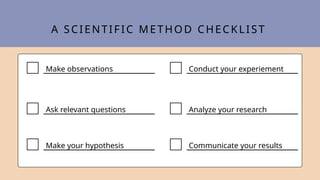
A SCIENTIFIC METHODCHECKLIST
Make observations
Ask relevant questions
Make your hypothesis
Conduct your experiement
Analyze your research
Communicate your results